Hunter vs SMARTe (2026): Which Email Finder Actually Wins?
Hunter is an email finder. SMARTe is a B2B contact database with mobile numbers. They overlap less than the comparison pages suggest - here's which one fits your outbound motion, and what each really costs.
TL;DR
- Hunter is a self-serve email finder built around domain search and verification. You sign up, paste a domain, get emails in seconds. No sales call.
- SMARTe is a B2B contact and account database with a heavy emphasis on mobile numbers and CRM enrichment. Pricing is quote-based and starts with a demo.
- They are not really the same product. Hunter competes on speed and per-lookup accuracy; SMARTe competes on database breadth, phone coverage, and workflow integration.
- If you send cold email at volume and want predictable per-credit costs, an email-finder-first tool (Hunter, Tomba) is the cheaper path. If your reps live on the phone and inside Salesforce, SMARTe's angle makes more sense.
- Tomba sits between them: email finder, verifier, catch-all handling, phone finder, and enrichment on one API, with public pricing from a free 25-search tier up to $249/mo.
What are Hunter and SMARTe, exactly?#
Hunter started as a domain-to-email tool and never drifted far from that. You give it stripe.com, it returns the public and inferred email addresses tied to that domain, each with a confidence score and the sources it crawled. Around that core sit a verifier, a bulk uploader, a Chrome extension, a small campaign sender, and an API. The whole thing is self-serve: card in, credits out.
SMARTe is positioned differently. It sells itself as a GTM data platform - a contact and account database you search by persona, technology, industry, or headcount, then push into your CRM or sequencer. Its loudest differentiator is mobile phone coverage, with compliance framing (GDPR, CCPA, and regional opt-out handling) as a second pillar. You typically enter through a demo request rather than a pricing page.
That difference in shape matters more than any accuracy percentage. One is a lookup utility. The other is a data subscription.
How do Hunter and SMARTe compare head-to-head?#
Here is the practical comparison, feature by feature.
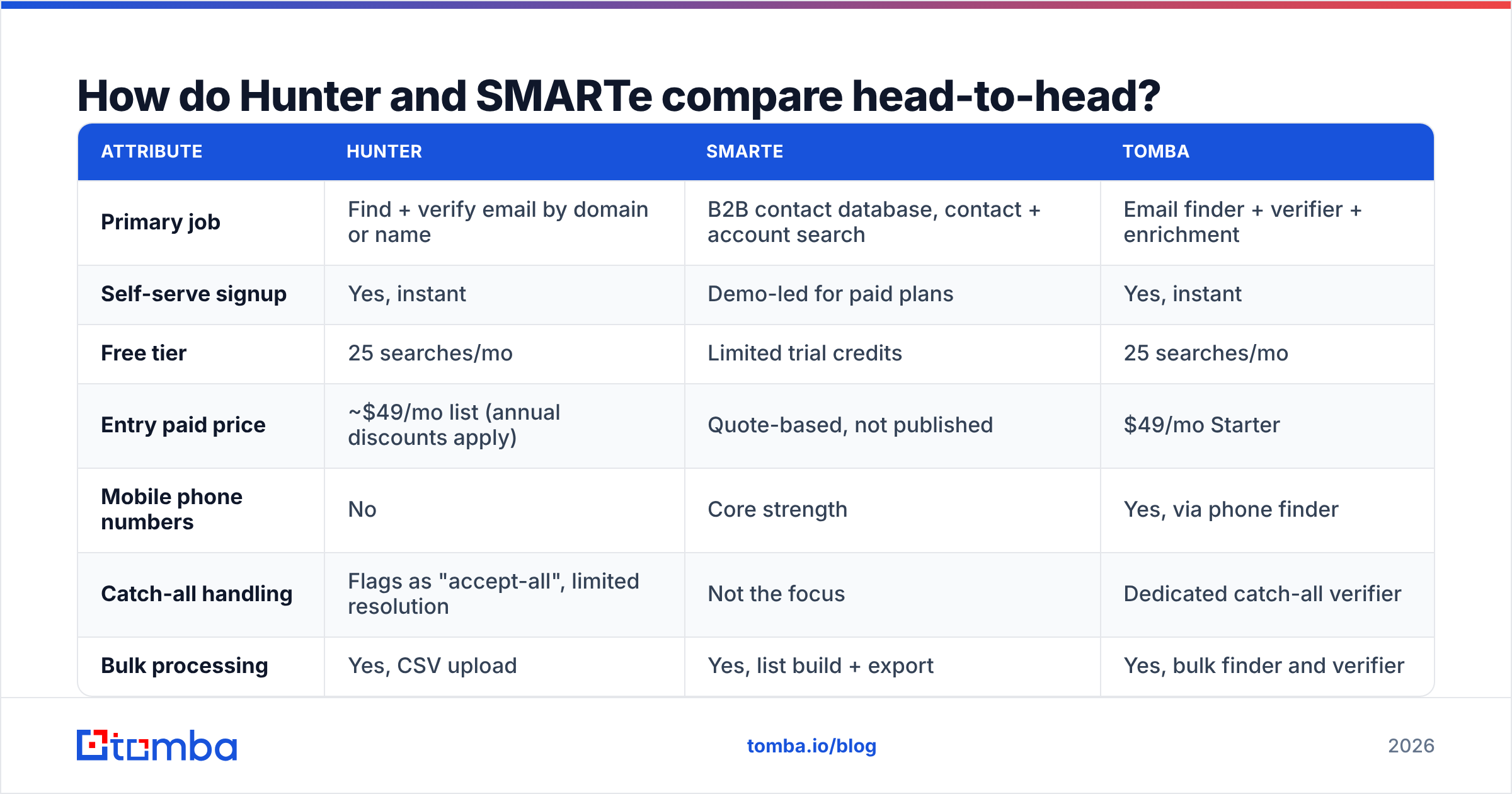
| Attribute | Hunter | SMARTe | Tomba |
|---|---|---|---|
| Primary job | Find + verify email by domain or name | B2B contact database, contact + account search | Email finder + verifier + enrichment |
| Self-serve signup | Yes, instant | Demo-led for paid plans | Yes, instant |
| Free tier | 25 searches/mo | Limited trial credits | 25 searches/mo |
| Entry paid price | ~$49/mo list (annual discounts apply) | Quote-based, not published | $49/mo Starter |
| Mobile phone numbers | No | Core strength | Yes, via phone finder |
| Catch-all handling | Flags as "accept-all", limited resolution | Not the focus | Dedicated catch-all verifier |
| Bulk processing | Yes, CSV upload | Yes, list build + export | Yes, bulk finder and verifier |
| API | Yes, documented | Yes, enrichment-focused | Yes, plus CLI and MCP server |
| Chrome extension | Yes | Yes | Yes |
| Built-in sending | Basic campaigns | No, integrates with sequencers | No, integrates with sequencers |
| Buying friction | Low | Medium to high | Low |
Pricing checked September 2026. Both vendors reshuffle tiers regularly, and SMARTe's numbers depend entirely on your negotiated seat and credit mix, so confirm before you commit.

What are the five things that actually decide this choice?#
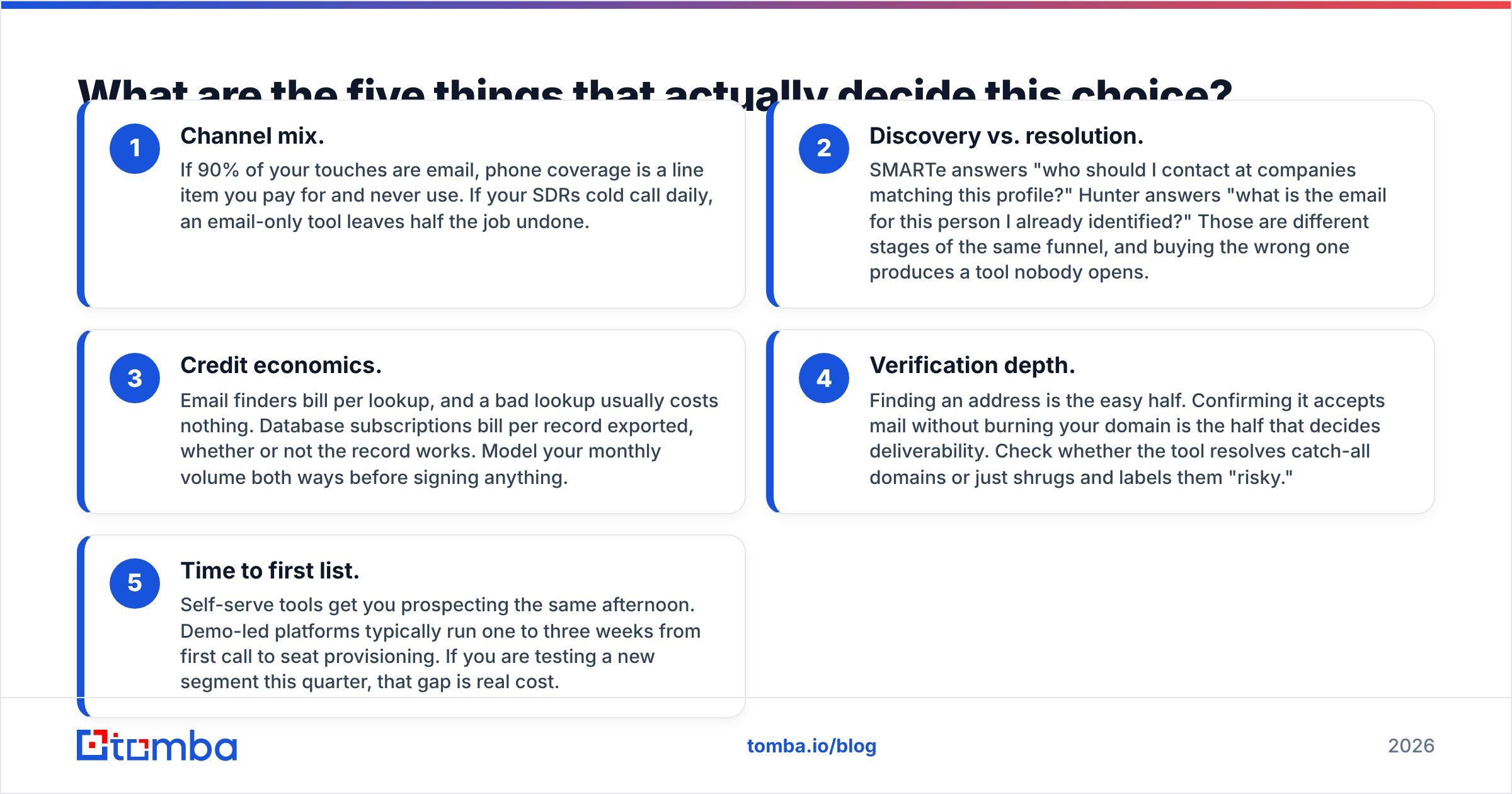
Ignore feature-count marketing. Five variables drive whether Hunter or SMARTe returns better ROI for your team:
- Channel mix. If 90% of your touches are email, phone coverage is a line item you pay for and never use. If your SDRs cold call daily, an email-only tool leaves half the job undone.
- Discovery vs. resolution. SMARTe answers "who should I contact at companies matching this profile?" Hunter answers "what is the email for this person I already identified?" Those are different stages of the same funnel, and buying the wrong one produces a tool nobody opens.
- Credit economics. Email finders bill per lookup, and a bad lookup usually costs nothing. Database subscriptions bill per record exported, whether or not the record works. Model your monthly volume both ways before signing anything.
- Verification depth. Finding an address is the easy half. Confirming it accepts mail without burning your domain is the half that decides deliverability. Check whether the tool resolves catch-all domains or just shrugs and labels them "risky."
- Time to first list. Self-serve tools get you prospecting the same afternoon. Demo-led platforms typically run one to three weeks from first call to seat provisioning. If you are testing a new segment this quarter, that gap is real cost.
Which one finds more valid emails?#
Nobody publishes an honest head-to-head, so treat every "98% accuracy" claim - Hunter's, SMARTe's, or anyone else's - as a marketing number until you run your own list.
What is reliably true from testing patterns across email data providers:
- Coverage skews by region and company size. Most providers are strongest on US-based tech and SaaS companies with 50-5,000 employees. Coverage falls off a cliff on sub-20-person European firms, non-Latin-script domains, and heavily gated industries like healthcare and defense.
- Confidence scores are not verification. Hunter's confidence percentage reflects how many sources corroborate a pattern. That is a useful signal, but it is not an SMTP-level check. Always run found addresses through an email verifier before loading a sequence.
- Catch-all domains break the comparison. Roughly one in five B2B domains accepts all mail at the gateway, which means a naive verifier returns "unknown" and you either guess or skip the lead. Tools that resolve catch-alls with pattern confidence plus secondary signals convert far more of that bucket than tools that don't.
- Bounce rate is the only metric that pays. Run the same 200 companies through both tools, dedupe, send a low-volume test, and compare hard bounces. That takes a week and beats any vendor benchmark.

The honest summary: on straightforward corporate email discovery, Hunter and a good email finder alternative land in the same band, and the gap between them is smaller than the gap between "verified" and "unverified" on either. SMARTe's advantage isn't primarily email hit rate - it's that a record often arrives with a direct dial attached.
What does each actually cost?#
Hunter publishes its tiers. SMARTe does not, which is a meaningful difference in itself: published pricing lets you model unit economics before you talk to anyone, and quote-based pricing means your cost depends partly on how well you negotiate.
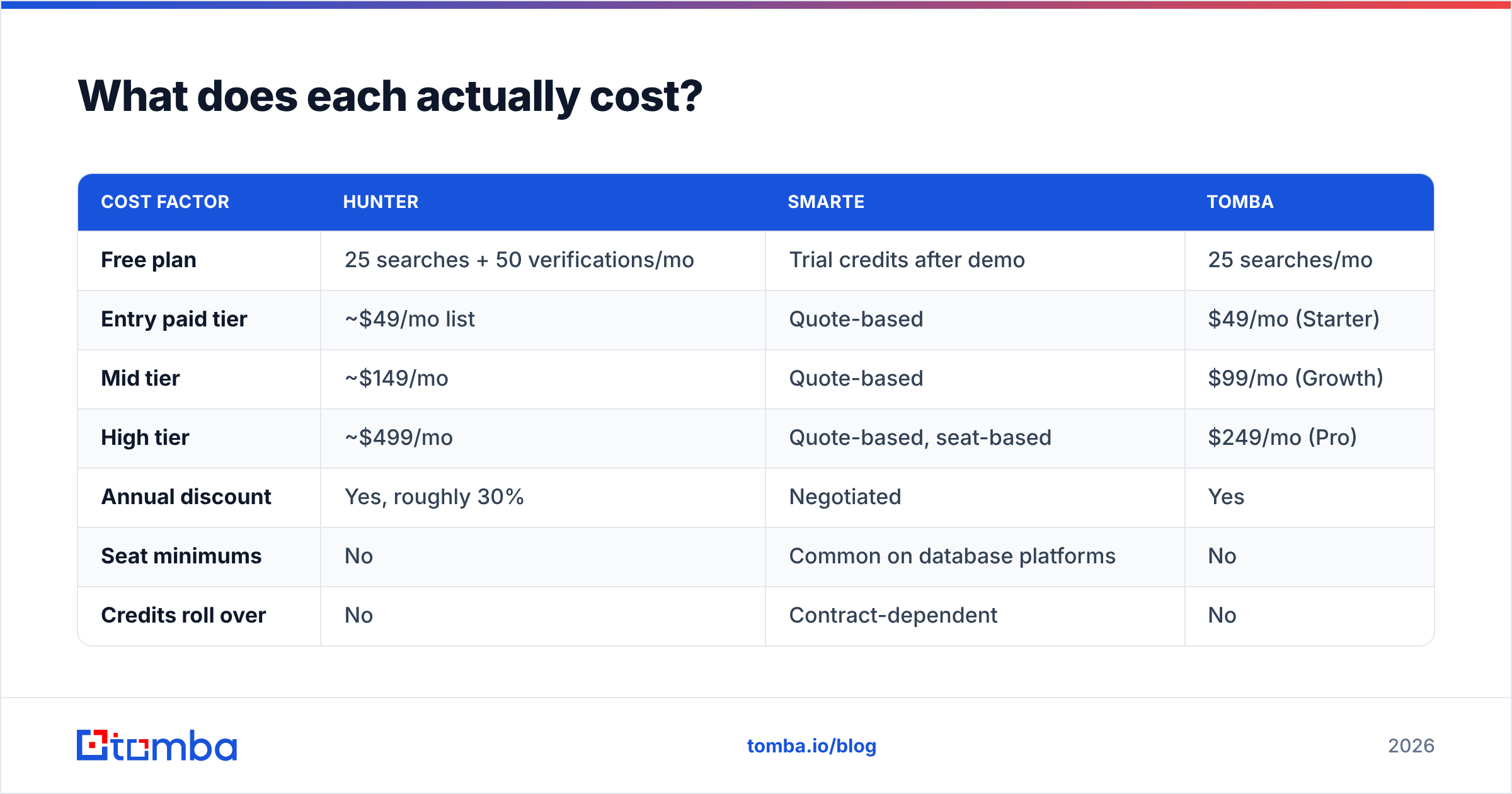
| Cost factor | Hunter | SMARTe | Tomba |
|---|---|---|---|
| Free plan | 25 searches + 50 verifications/mo | Trial credits after demo | 25 searches/mo |
| Entry paid tier | ~$49/mo list | Quote-based | $49/mo (Starter) |
| Mid tier | ~$149/mo | Quote-based | $99/mo (Growth) |
| High tier | ~$499/mo | Quote-based, seat-based | $249/mo (Pro) |
| Annual discount | Yes, roughly 30% | Negotiated | Yes |
| Seat minimums | No | Common on database platforms | No |
| Credits roll over | No | Contract-dependent | No |
Two traps worth flagging in any database-style contract, SMARTe's included: seat minimums and annual commitments with non-rolling credits. If your team is four SDRs and the platform prices for five seats, you are paying 25% overhead from day one. And if credits reset monthly on an annual contract, a slow quarter is money burned. Ask both questions in writing.
For comparison, Tomba pricing runs Free (25 searches/mo), Starter $49/mo, Growth $99/mo, Pro $249/mo, and custom Enterprise - all listed publicly, no seat minimums, no demo gate.
Who should choose Hunter?#
Pick Hunter if most of these are true:
- Email is your dominant channel and phone is an afterthought.
- You already know which companies you're targeting and need addresses, not a prospect list.
- You want to start in the next hour without a procurement conversation.
- Your team is small enough that a self-serve card-on-file tool doesn't create finance friction.
- You value the ecosystem: Hunter has been around long enough that integrations, tutorials, and Zapier recipes exist for almost everything.
Hunter's weakest point is what happens after the search. Its campaign module is deliberately basic, catch-all resolution is limited, and there's no phone data at all. It's a precise tool with a narrow blade.
Who should choose SMARTe?#
Pick SMARTe if most of these are true:
- Your reps make calls, and a mobile number is worth more to you than a third email variant.
- You need list building - "show me VPs of Engineering at 200-1,000 person fintechs in DACH" - not just lookup.
- You operate in regions where compliance documentation is a procurement requirement, not a nice-to-have.
- Your data flows into Salesforce or HubSpot and needs continuous enrichment rather than one-off exports.
- You have budget authority for an annual contract and the volume to justify it.
SMARTe's weakest point is buying friction and opacity. You can't model cost before a call, you likely can't scale down mid-contract, and if your ICP falls outside its strongest coverage regions, you'll discover that after signing rather than during a free trial.
How does Tomba compare to both?#
Fair disclosure: this is our blog, so weigh the following accordingly - but the structural argument holds regardless of vendor.
Tomba was built to close the gap that forces teams to buy two tools. You get domain search and email finding like Hunter, plus a dedicated catch-all verifier for the 20% of domains that break normal verification, plus B2B phone numbers and contact enrichment for the call-heavy side that SMARTe targets. All of it runs through one API with one credit pool, and the pricing is on the website.
| Scenario | Better fit |
|---|---|
| Email-only outbound, under 1,000 lookups/mo | Hunter or Tomba Starter |
| Call-first SDR team, CRM-embedded enrichment | SMARTe or Tomba Growth |
| High catch-all rate in your target list | Tomba (catch-all verifier) |
| Need programmatic lookups inside a product | Tomba API or Hunter API |
| Procurement requires published pricing | Hunter or Tomba |
| Large annual contract, dedicated CSM | SMARTe |
The other practical difference: Tomba ships a bulk email finder and verifier on every paid tier, so enriching a 5,000-row CSV doesn't require a separate product or an upsell call.
What should you actually do before buying either?#
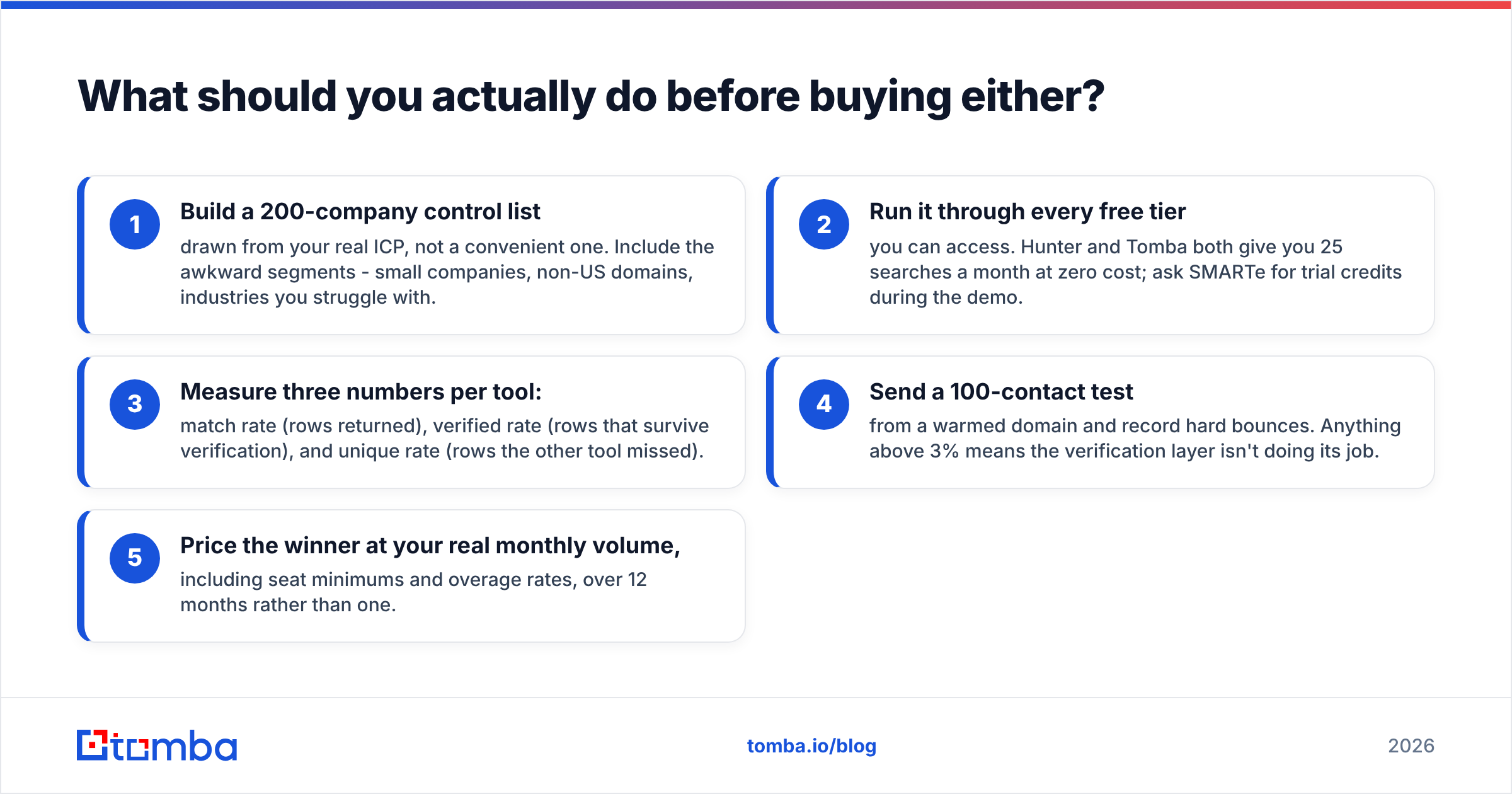
Run a bake-off. It takes about five working days and costs nothing.
- Build a 200-company control list drawn from your real ICP, not a convenient one. Include the awkward segments - small companies, non-US domains, industries you struggle with.
- Run it through every free tier you can access. Hunter and Tomba both give you 25 searches a month at zero cost; ask SMARTe for trial credits during the demo.
- Measure three numbers per tool: match rate (rows returned), verified rate (rows that survive verification), and unique rate (rows the other tool missed).
- Send a 100-contact test from a warmed domain and record hard bounces. Anything above 3% means the verification layer isn't doing its job.
- Price the winner at your real monthly volume, including seat minimums and overage rates, over 12 months rather than one.
Vendor-neutral review sites like G2 are useful for spotting support and billing complaints that never appear in a demo, but they cannot tell you match rate on your list. Only your own test can.
So which one wins?#
There is no universal winner, and any post claiming otherwise is selling something.
Hunter wins on speed, transparency, and cost predictability for email-first teams that already know their targets. It does one job and does it without a sales process.
SMARTe wins on phone coverage, compliance documentation, and CRM-embedded enrichment for teams whose motion depends on reaching people by voice and who can absorb an annual contract.
Neither wins if your real problem is that half your list bounces or sits in catch-all limbo - because that's a verification problem, not a discovery problem, and buying more contacts makes it worse rather than better.
If you want the email-finding precision Hunter is known for, the phone and enrichment data that pulls teams toward SMARTe, and pricing you can read without a calendar invite, start with the Tomba Email Finder. The free tier gives you 25 searches a month - enough to run the bake-off above against your own list before you spend a dollar with anyone.
Related guides#
// get started
Find, verify and enrich your first contacts today
Start on the free plan with 25 searches a month, then scale when your team is ready.
Free plan · No credit card required · GDPR & CCPA
// about the author