Influencersclub vs UpLead: Which Data Platform Wins?
One sells creator and influencer contact data. The other sells verified B2B company contacts. Here is where Influencersclub and UpLead actually differ on coverage, accuracy, credits and cost — and when neither is the right buy.
Short answer: Influencersclub vs UpLead is not a real head-to-head. One sells creator contacts. The other sells verified B2B work emails. Pick by who you need to reach, not by feature count.
TL;DR
- They are not really rivals. Influencers Club is a creator contact database (TikTok, Instagram and YouTube profiles, plus emails). UpLead is a B2B contact database (staff, job titles, tech stack, intent).
- Pick by audience, not by feature list. If your buyer is a creator or a talent manager, UpLead will feel empty. If your buyer is a VP of Engineering, Influencers Club will feel useless.
- UpLead list pricing starts near $99/mo for a few hundred credits. Influencers Club is mostly quote-based. You need a sales call to compare budgets.
- Both charge per record, useful or not. The cheapest fix for bad data is to verify before you send. A bigger plan does not help.
- A dedicated email finder covers the gap in both. Use it when you know the person and the company, but no database has the row.
If you landed here searching "influencersclub vs uplead," you are doing one of two things. Maybe you are comparing two vendors on a shortlist. Maybe you want one tool for both influencer outreach and B2B sales. The answer to the second one is no. Here is the long answer to the first.
What is Influencers Club?#
Influencers Club (influencers.club) is a creator data platform. Its core asset is a searchable index of social profiles: Instagram, TikTok, YouTube and Twitch. Each profile comes with audience stats and, more usefully, contact details. You filter by follower count, engagement rate, niche, audience location, audience age and brand affinity. Then you export creators with emails attached.
The typical buyer is an influencer agency, a DTC brand running gifting campaigns, or a creator platform. They all need to reach thousands of small creators at once. Public bios rarely show a usable business email. And DMing 4,000 creators by hand is not a plan.
What it is not: a source of corporate decision-maker data. You cannot ask a creator database for the CFO of a 200-person logistics firm.
What is UpLead?#
UpLead (uplead.com) is a B2B prospecting database. Think Apollo, Cognism or ZoomInfo. It sells access to tens of millions of business contacts. You filter by job title, seniority, company size, industry, location, revenue, tech stack and intent signals.
Its main pitch has always been verification. UpLead checks the email at the moment you export it. It advertises 95%+ accuracy and refunds credits on bounces. That "do not pay for bad data" line is why it lands on shortlists next to much larger vendors on G2.
What it is not: a creator database. UpLead indexes people by employer, not by audience. A TikTok creator with 300,000 followers and no company simply has no row.
Influencersclub vs UpLead: how do they differ?#
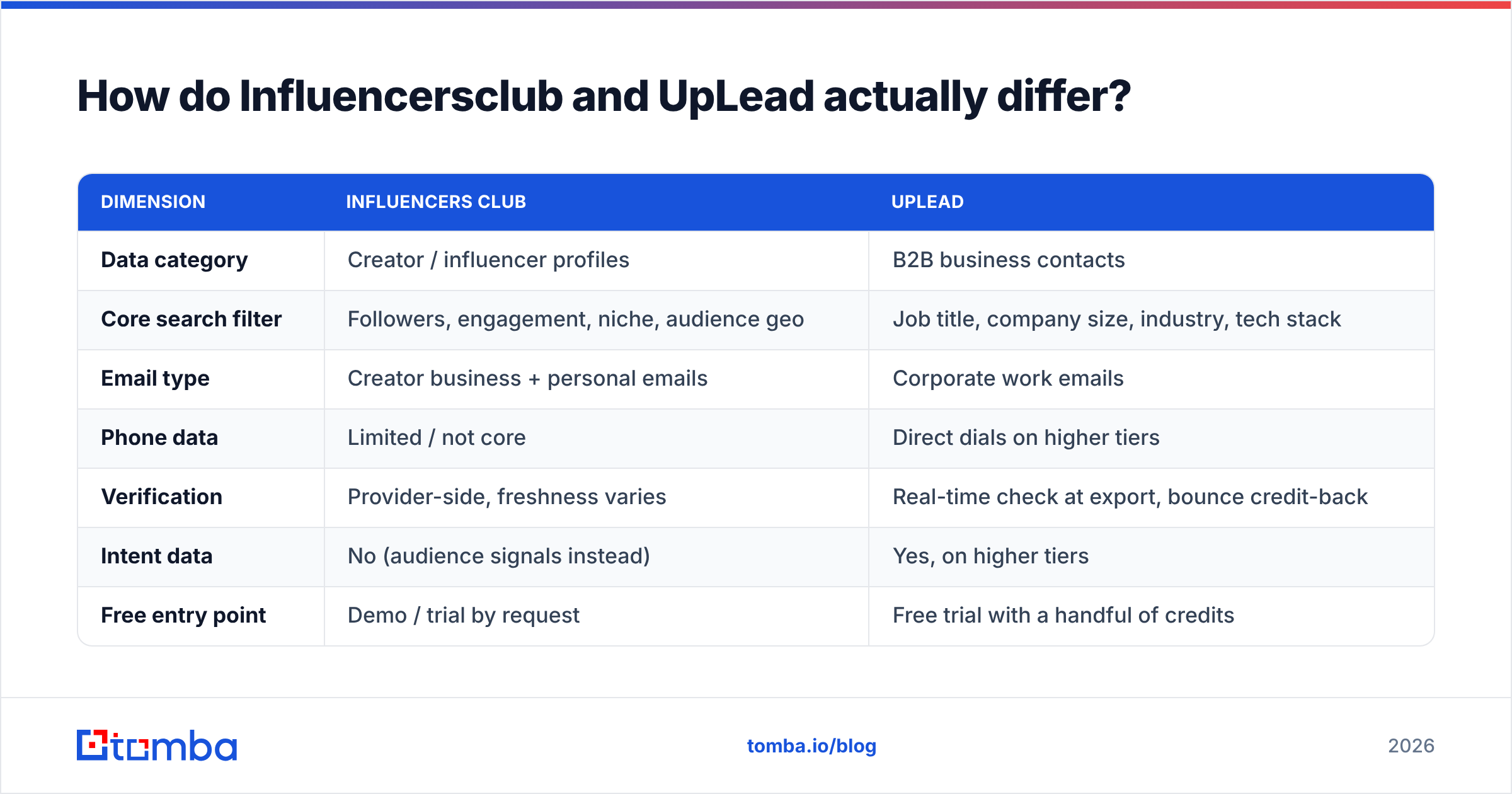
The split is easy to see once you look at the main record. One platform stores a person with an audience. The other stores a person with a job title. Everything else follows from that.
- Primary entity. Influencers Club: a social profile. UpLead: a business contact tied to a company.
- Search filters. Influencers Club: follower band, engagement rate, niche, audience demographics, brand mentions. UpLead: title, seniority, department, headcount, revenue, tech stack, intent topic.
- Contact type. Influencers Club: the emails creators publish for deals, plus social handles. UpLead: work emails and direct dials on a company domain.
- Verification model. Influencers Club: pre-collected data, freshness varies. UpLead: a live check at export, with credits back on bounces.
- Buying motion. Influencers Club: mostly quotes, agency and platform contracts. UpLead: self-serve monthly plans and a small free trial.
- Downstream fit. Influencers Club: outreach and gifting tools, campaign trackers. UpLead: CRMs and sales sequencers (Salesforce, HubSpot, Outreach).
| Dimension | Influencers Club | UpLead |
|---|---|---|
| Data category | Creator / influencer profiles | B2B business contacts |
| Core search filter | Followers, engagement, niche, audience geo | Job title, company size, industry, tech stack |
| Email type | Creator business + personal emails | Corporate work emails |
| Phone data | Limited / not core | Direct dials on higher tiers |
| Verification | Provider-side, freshness varies | Real-time check at export, bounce credit-back |
| Intent data | No (audience signals instead) | Yes, on higher tiers |
| Free entry point | Demo / trial by request | Free trial with a handful of credits |
| Entry price | Quote-based | ~$99/mo list, published tiers |
| Best for | Influencer marketing, creator recruiting | Outbound SDR teams, ABM lists |
| Weakness | No corporate org-chart data | No creator or audience data |
Prices and features move. Check both vendors' current pages before you sign. This table reflects what was published at the time of writing.
Which one has better email accuracy?#
Take neither accuracy claim at face value. The two vendors measure different things.
UpLead's claim is easier to test. It verifies at export, so a bounce is a billing event you can dispute. Teams report solid results on mid-market and enterprise domains. Results thin out on very small companies, non-US regions and catch-all mail servers. Catch-all domains are the classic blind spot. The server accepts every address, so a basic checker marks it "valid." Your bounce then shows up three days later. That is why a catch-all verifier is its own product, not a checkbox.
Influencers Club has a different problem. Creator emails live in bios, link pages and media kits. They go stale fast. A creator who signs with an agency swaps their deals inbox. A creator who blows up stops reading the address they set up as a hobby. Coverage is strong in the middle tier, which is what most brands want. It is weaker at the top, where talent is managed, and at the bottom, where no business email exists yet.

The takeaway is the same either way. Run every export through an independent email verifier before you send. Checking costs a fraction of a cent per record. A 12% bounce rate on a cold domain costs you the domain.
Two habits pay for themselves with any vendor:
- Verify at send time, not at buy time. A list bought in January is a different list in April.
- Put catch-all results in their own campaign. Do not blend them into your main sequence.
Influencersclub vs UpLead pricing: how do the models compare?#
This is where the comparison gets awkward. The two vendors sell in different shapes.
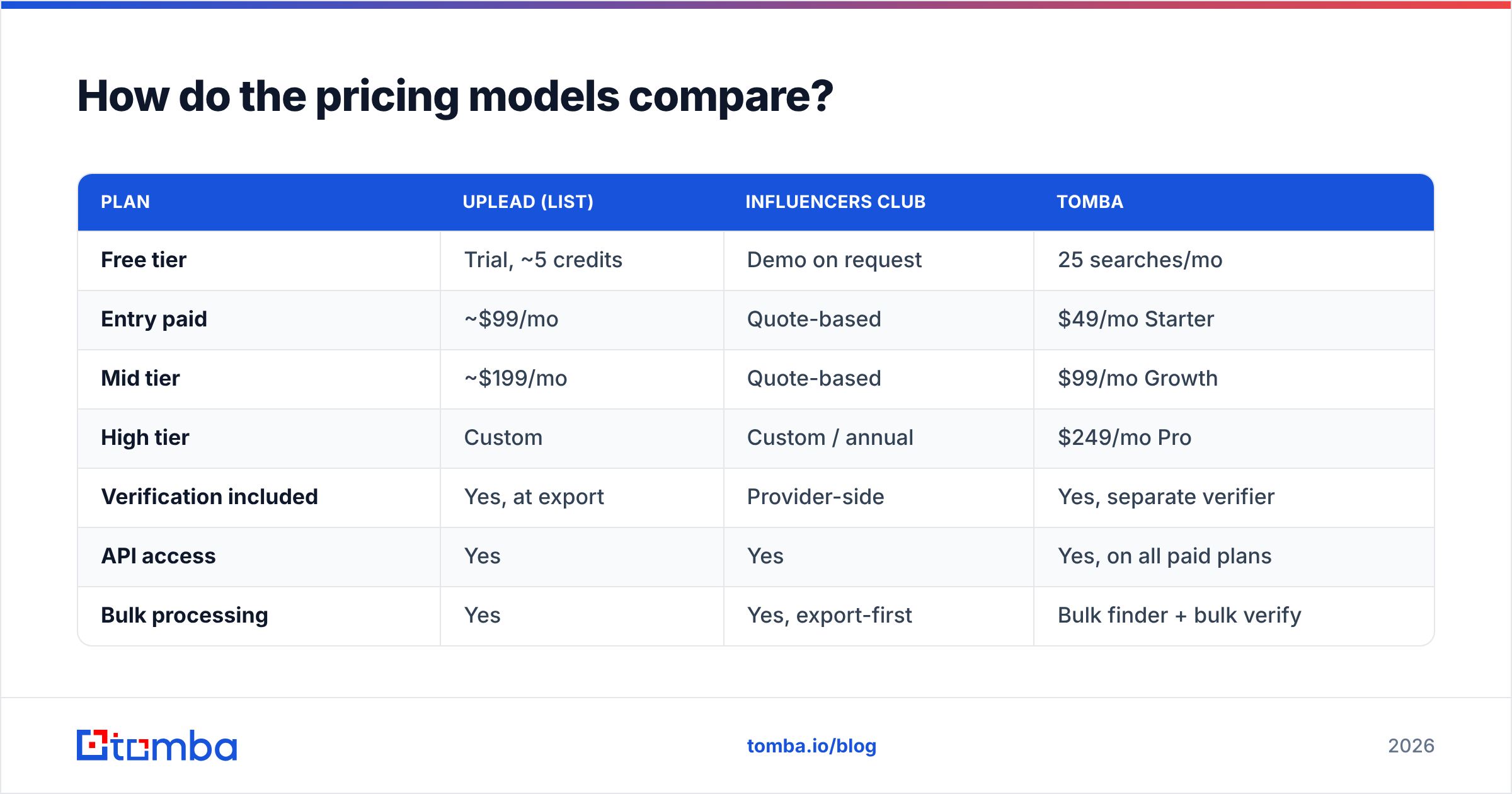
UpLead publishes tiers. The entry plan sits near $99 a month for a few hundred credits. The mid tier roughly doubles both. Anything bigger moves to a custom annual contract. One credit usually equals one revealed contact. Phone numbers and extra fields can cost more. The free trial is small. It is fine for a spot check on your ICP, but too thin to judge coverage.
Influencers Club leans on quotes. Price scales with export volume and the fields you need. Agency deals are usually annual. That makes like-for-like math hard. You are buying a contract, not a subscription.
Say your real need is simple: turn names and domains into verified emails. Then both tools are heavy buys. A focused finder costs far less per record:
| Plan | UpLead (list) | Influencers Club | Tomba |
|---|---|---|---|
| Free tier | Trial, ~5 credits | Demo on request | 25 searches/mo |
| Entry paid | ~$99/mo | Quote-based | $49/mo Starter |
| Mid tier | ~$199/mo | Quote-based | $99/mo Growth |
| High tier | Custom | Custom / annual | $249/mo Pro |
| Verification included | Yes, at export | Provider-side | Yes, separate verifier |
| API access | Yes | Yes | Yes, on all paid plans |
| Bulk processing | Yes | Yes, export-first | Bulk finder + bulk verify |

Full Tomba pricing is public. That is worth saying out loud. If a vendor will not show a number before a call, add two weeks to your evaluation.

Influencersclub vs UpLead: which one should you buy?#
Match the tool to the motion, not to the feature grid.
Buy Influencers Club if: you run creator campaigns at volume. You need audience filters like real engagement, audience country and brand affinity. No B2B database can produce those. Your outreach is counted in creators contacted per month.
Buy UpLead if: you sell to companies. Your ICP is defined by company size, industry and tech stack. You want verified work emails pushed straight into a CRM. The bounce-credit policy cuts the risk of buying a list. The self-serve tier lets you test in a week.
Buy neither if: you already know who you want to reach. This is the most common and most costly mistake here. Teams pay $99 to $299 a month for search filters when the real job is different. It sounds like this: "here are 800 companies from a conference list, get me the head of partnerships at each." That is a domain search and enrichment job, not a database subscription. Load the domains, get the pattern, get the person, verify, send.
Buy both if: you sell to brands and recruit creators. That is agencies, creator marketplaces and commerce platforms. Forcing one vendor to cover both gives you a worse version of each. Budget for a creator database and a B2B source. Then use the same verifier on both, so your bounce numbers stay comparable.
One more note for a wider shortlist. Vendors like BookYourData fill a different slot. They sell pay-as-you-go verified B2B lists with no subscription. That fits if your buying is bursty rather than steady.
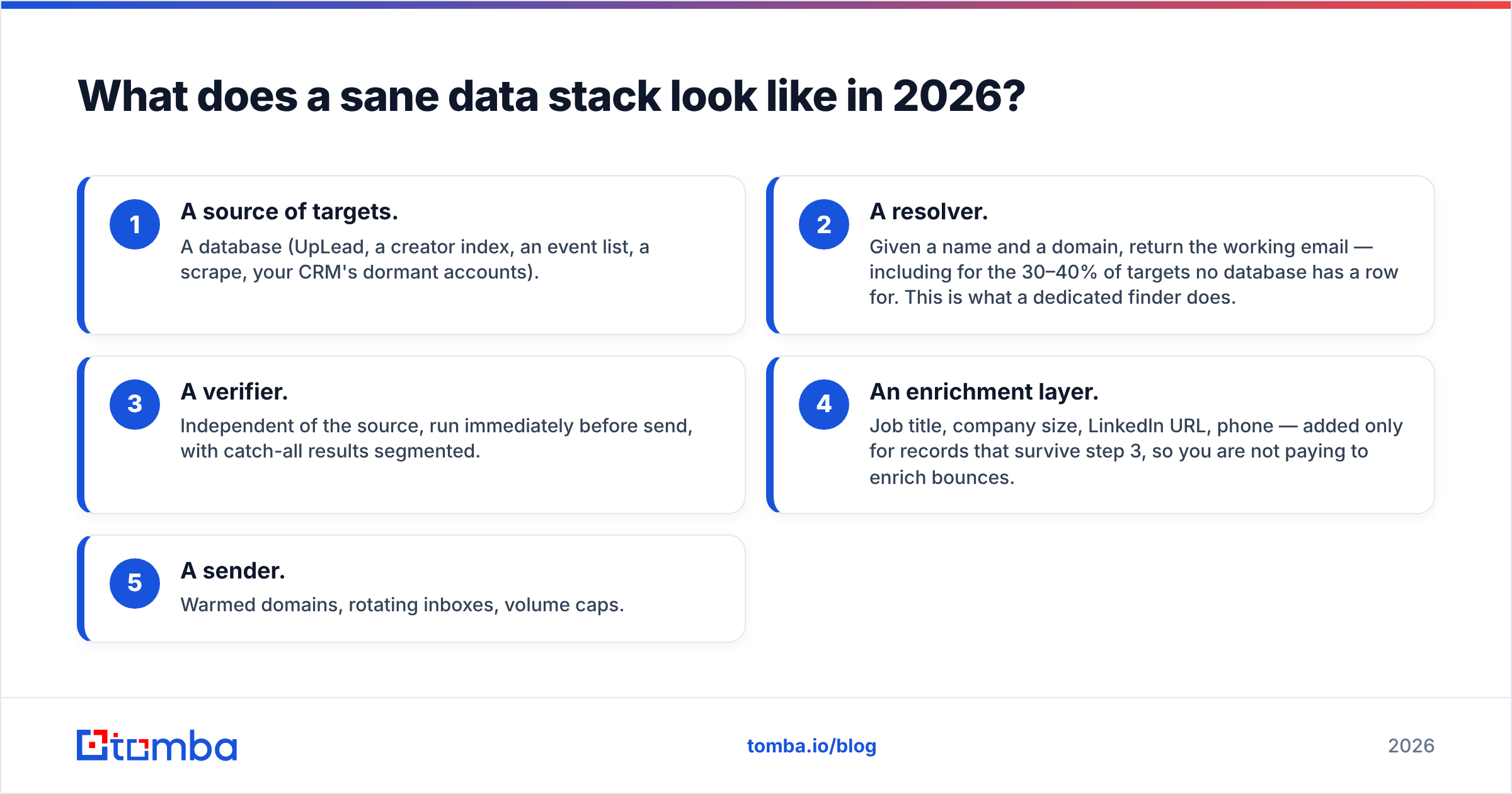
What does a sane data stack look like in 2026?#
The teams with the best delivery rates rarely have the biggest data contract. They run a layered stack:
- A source of targets. A database, a creator index, an event list, a scrape, or your dormant CRM accounts.
- A resolver. Give it a name and a domain, get the working email back. That covers the 30 to 40% of targets no database lists.
- A verifier. Separate from the source, run right before send, with catch-all results split out.
- An enrichment layer. Job title, company size, LinkedIn URL, phone. Add these only for records that survive step 3, so you never pay to enrich a bounce.
- A sender. Warmed domains, rotating inboxes, volume caps.
Step 2 is where most stacks leak money. You may be spending database credits to reveal a contact you could resolve from a name and a domain. That is a search premium on a lookup task. The Tomba API and bulk email finder exist for that layer. Both slot in behind whichever database you picked in step 1.
Audit one more thing: where the data comes from. Vendors that publish their data sources are easier to defend in a GDPR review. Ask during the trial, not after procurement flags it.
The verdict#
Influencersclub vs UpLead has no winner, because there is no shared scoreboard. Influencers Club wins when the target is a person with an audience. UpLead wins when the target is a person with a job title. Its verify-at-export model is a real edge over databases that hand you a stale CSV and wish you luck.
One choice matters more than either vendor. It is what sits between your data source and your sending domain. Buy the database that matches your buyer. Then stop letting unverified records reach your inbox provider.
Start with the layer both platforms make you pay a premium for. The Tomba Email Finder turns a name and a domain into a verified address. You get 25 free searches a month to test it, $49 a month in production, and an API when you want it in your pipeline. Run your next Influencers Club or UpLead export through it before you send. Then compare the bounce rates yourself.
Related guides#
Ready to find emails that actually work?
Join 150,000+ professionals who stopped guessing and started sending. Free credits on signup — no credit card required.
Get the Tomba newsletter
Practical outbound tactics and product updates — once every two weeks.
About the author