Infofree vs Warpleads: Which B2B Lead Database Wins in 2026?
Infofree sells unlimited US records with a built-in CRM. Warpleads sells unlimited bulk exports for cold email. They solve different problems, and only one of them fits your outbound motion. Here is the honest breakdown.
TL;DR
- Infofree is a compiled US business-and-consumer database with a built-in CRM, sold on an unlimited-lookup subscription. It is built for local SMB sellers, insurance agents, and mailing-list marketers.
- Warpleads is a modern bulk-export platform built for cold email at volume: large B2B exports, enrichment, and direct handoff to sending tools like Instantly or Smartlead.
- They are not really competitors. Infofree optimizes for breadth of US records plus phone and address data. Warpleads optimizes for volume of exportable B2B emails.
- Neither replaces a verification layer. Compiled databases decay at roughly 25-30% per year, and bulk exports are only as good as the verification pass you run on them before sending.
- If your problem is "I need the right email for a specific person at a specific company, and I need it to actually land," a targeted finder-plus-verifier stack beats both.
What are Infofree and Warpleads?#
Start with the fact that these two products come from different decades of the data business.
Infofree is a compiled-data product in the lineage of infoUSA, the company that eventually became Data Axle. Compiled data means the records are assembled from public filings, directories, phone books, credit bureaus, and survey sources, then normalized into a searchable database. You get US businesses and US consumers, with firmographics, SIC codes, addresses, phone numbers, and in many cases owner or executive names. The subscription bundles a lightweight CRM so a solo agent can work the list without buying anything else.
Warpleads sits at the other end of the timeline. It was built for the cold-email era: pull a large filtered list of B2B contacts, enrich it, export it as CSV or push it straight into a sending platform, repeat next week. The selling point is export volume rather than record depth. You are not meant to work these leads one at a time in a CRM; you are meant to send to them in sequences.
Here is the practical split:
- Data origin — Infofree compiles from offline and public sources on a refresh cycle. Warpleads assembles from web, professional-network, and partner data with enrichment waterfalls layered on top.
- Record shape — Infofree records lean toward the company and the physical location (address, landline, revenue band). Warpleads records lean toward the person and the inbox (work email, title, company domain).
- Intended motion — Infofree supports door-knocking, direct mail, and cold calling. Warpleads supports high-volume cold email.
- Geography — Infofree is effectively US-only. Warpleads sells global B2B coverage, with the usual density skew toward North America and Western Europe.
- Tooling around the data — Infofree ships a CRM inside the subscription. Warpleads ships integrations and expects your sequencer to be the system of record.
Once you see it that way, "which is better" becomes the wrong question. The right question is which motion you are actually running.
How do Infofree and Warpleads compare head to head?#
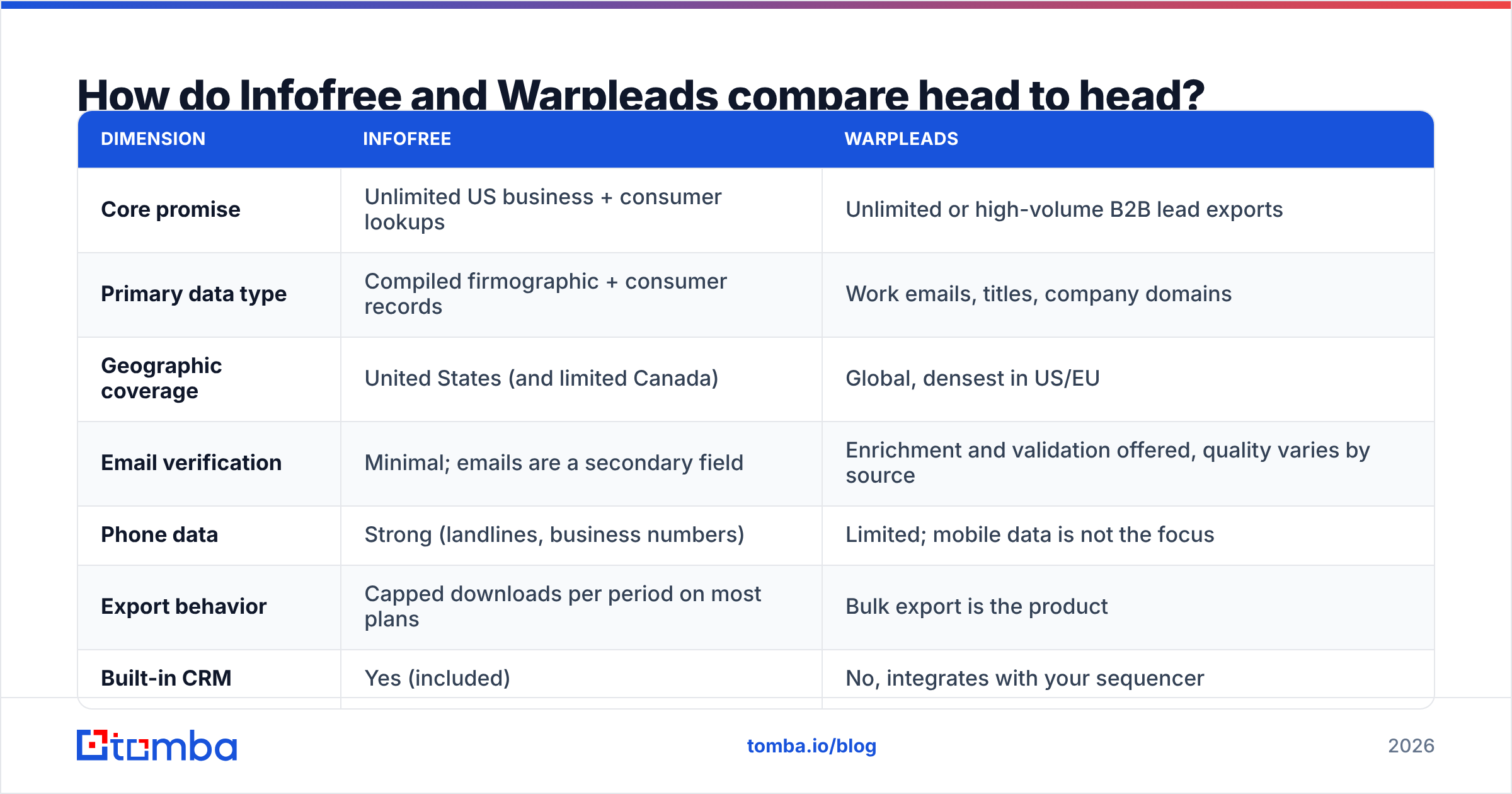
Pricing on both products moves, and both run promotional tiers, so treat these as directional and confirm on the vendor pages before you buy.
| Dimension | Infofree | Warpleads |
|---|---|---|
| Core promise | Unlimited US business + consumer lookups | Unlimited or high-volume B2B lead exports |
| Primary data type | Compiled firmographic + consumer records | Work emails, titles, company domains |
| Geographic coverage | United States (and limited Canada) | Global, densest in US/EU |
| Email verification | Minimal; emails are a secondary field | Enrichment and validation offered, quality varies by source |
| Phone data | Strong (landlines, business numbers) | Limited; mobile data is not the focus |
| Export behavior | Capped downloads per period on most plans | Bulk export is the product |
| Built-in CRM | Yes (included) | No, integrates with your sequencer |
| Typical entry price | Roughly $99/mo for the mainstream plan | Low-to-mid hundreds per month for unlimited export |
| Contract style | Monthly subscription, annual discounts | Monthly subscription, credit and unlimited tiers |
| Best fit | Local SMB sales, insurance, mail, telesales | Agencies and outbound teams sending at volume |
| Worst fit | Global B2B SaaS prospecting | Account-based selling on named accounts |
The row that matters most for anyone doing email outreach is "email verification." Infofree never pretended to be an email tool; its email coverage is thin and its strength is the phone-and-address side. Warpleads does supply emails at scale, but scale and precision pull against each other. When a platform's headline feature is unlimited export, the incentive is to be generous about what counts as a deliverable address.
Whose data is actually more accurate?#
Neither vendor publishes an independently audited accuracy number, and you should be skeptical of anyone in this category who claims one without methodology. What you can reason about is decay and sourcing.
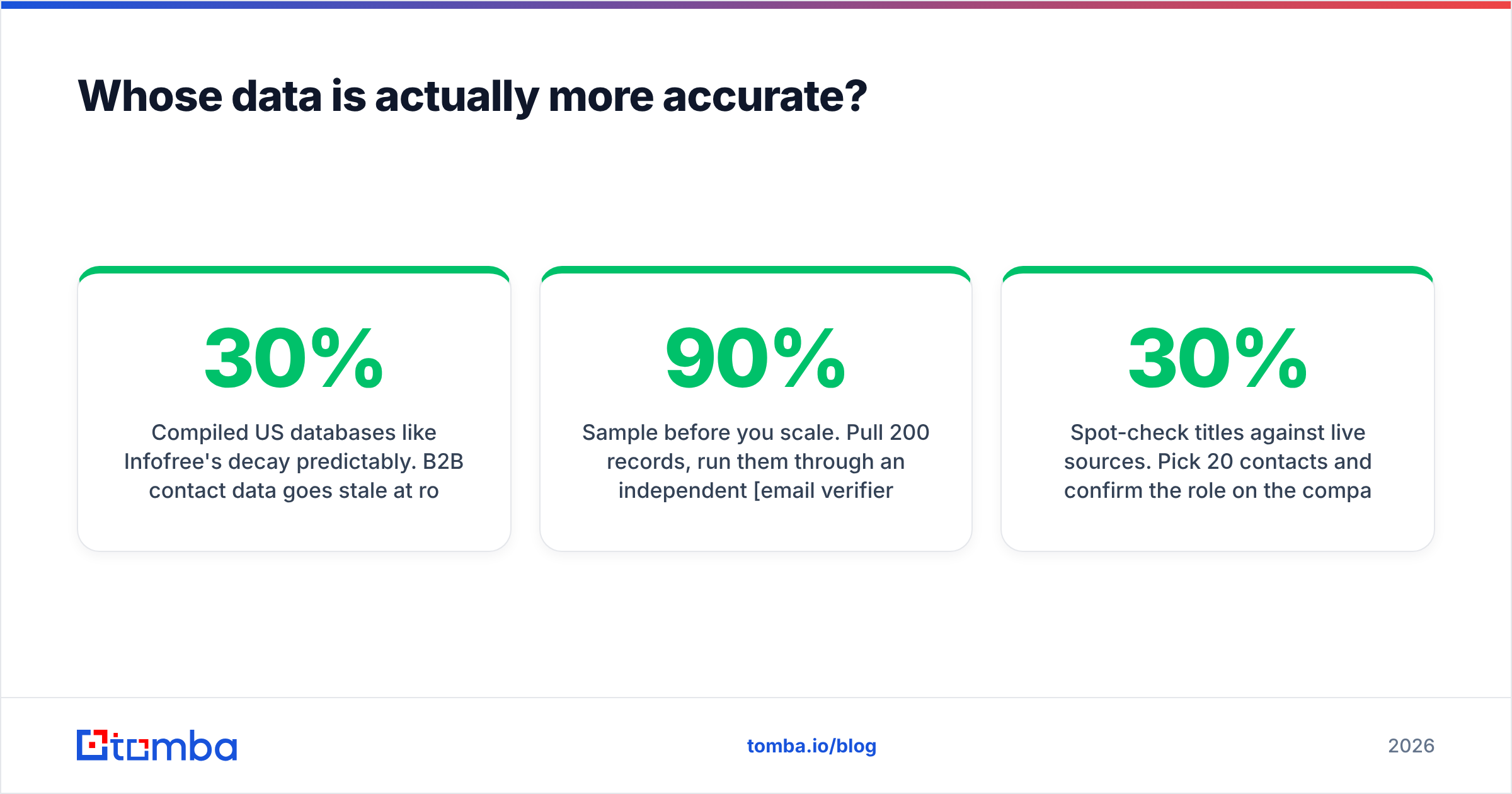
Compiled US databases like Infofree's decay predictably. B2B contact data goes stale at roughly 25-30% a year because people change jobs, businesses close, and phone numbers get reassigned. Infofree's firmographic layer — company name, address, SIC code — holds up far better than its people layer. If you are calling a plumbing contractor in Ohio, the number is probably still good. If you want the name and email of that contractor's new office manager, the record is much likelier to be wrong.
Bulk export platforms like Warpleads have the opposite profile. The person-level data is fresher because it is derived from web and professional-network signals that update continuously. But freshness is not the same as validity. A profile scraped last month tells you someone holds a title; it does not tell you the inferred email pattern resolves to a real mailbox. Guessed-then-lightly-checked addresses are the single biggest source of bounce risk in the bulk-export category.
Three checks to run before you trust either source:
- Sample before you scale. Pull 200 records, run them through an independent email verifier, and measure the real valid rate. If it lands under 90%, your sender reputation will pay for the difference.
- Check the catch-all share. Lists heavy in catch-all domains inflate the apparent valid rate. A proper catch-all verifier tells you which of those are worth risking.
- Spot-check titles against live sources. Pick 20 contacts and confirm the role on the company site or LinkedIn. A 30% title-drift rate means your personalization will read as wrong, which is worse than generic.
Do this once and the "which vendor is more accurate" argument resolves itself with your own numbers instead of theirs.
Who should choose Infofree?#
Pick Infofree when your territory is American, your motion is phone or mail, and your budget is one line item.
Concrete fits:
- Insurance and financial services agents working a local book. Consumer data with homeowner, age, and income attributes is genuinely hard to get elsewhere at this price, and it is the whole basis of the direct-mail play.
- Local services businesses — roofing, HVAC, commercial cleaning — targeting businesses by radius and SIC code.
- Telesales teams that live on the dial. Landline and main-line coverage for US small businesses is Infofree's real moat.
- Anyone who does not want to buy a CRM. The bundled CRM is basic, but "basic and included" beats "good and $50 a seat" for a two-person shop.
Where it falls down: international prospecting, anything involving verified work emails at scale, and modern API-driven workflows. If your plan is to push 10,000 contacts a month into a cold-email sequencer, this is the wrong tool and you will feel it in week two.
Who should choose Warpleads?#
Pick Warpleads when volume is the constraint and email is the channel.
Concrete fits:
- Lead-gen agencies running campaigns for multiple clients, where cost per exported lead is the operative metric.
- Outbound teams testing many ICPs at once, who need to build and burn lists quickly without credit anxiety.
- Founders doing their own outbound before a data budget exists, who would rather over-export and filter hard than under-export and stall.
Where it falls down: named-account selling. If your target list is 200 specific companies and you need the VP of Engineering at each one, a bulk-export platform is an awkward instrument. You will get hundreds of adjacent contacts and still be missing the nine people who matter. That is the job of a targeted email finder pointed at a domain and a name, not a filtered export.
It also falls down on compliance posture. If you sell into the EU or UK, understand where each record came from before you send. Bulk platforms vary a lot in how carefully they document sourcing, and "unlimited" is not a lawful basis for processing.

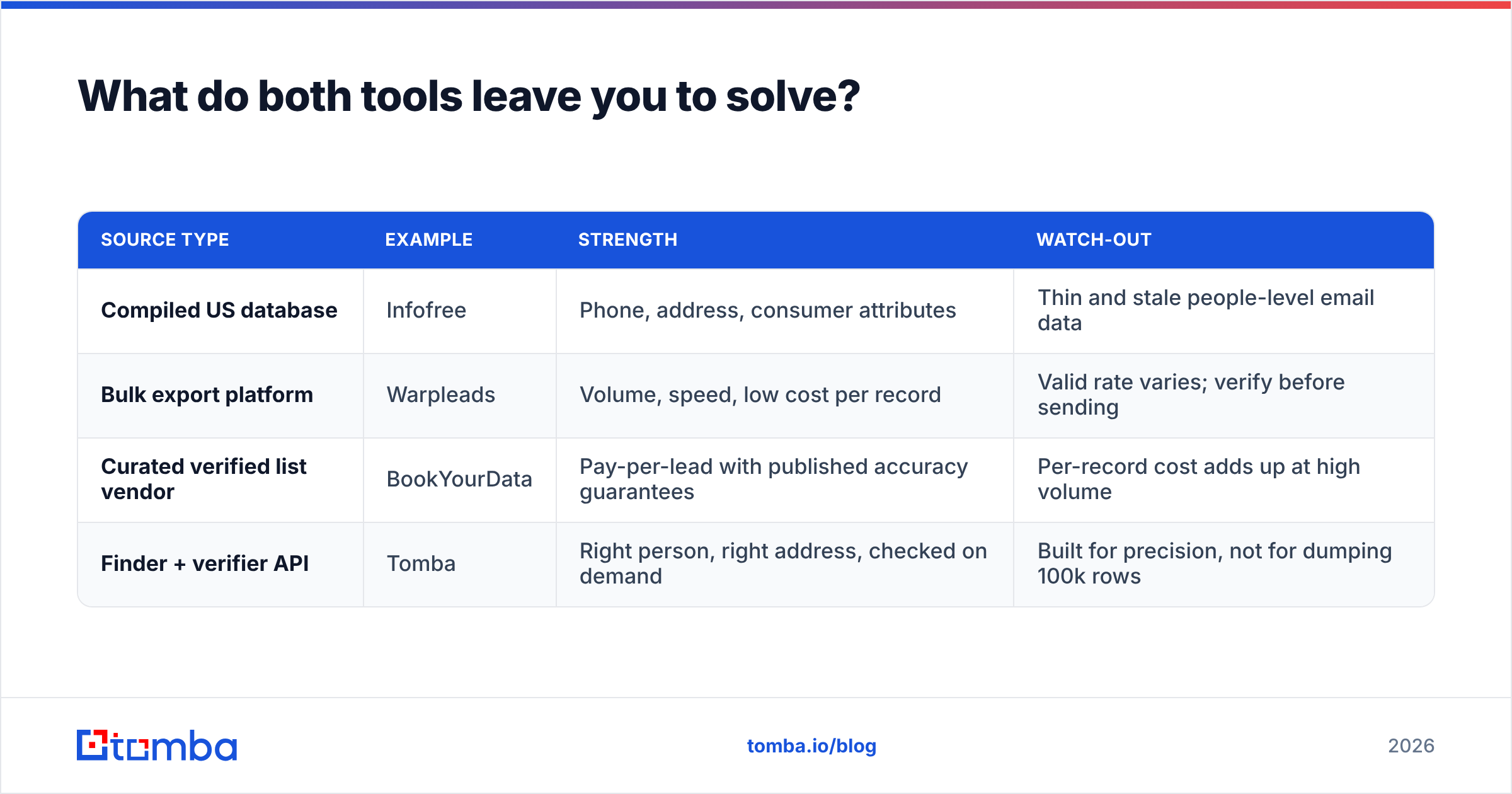
What do both tools leave you to solve?#
Verification and routing. Every list-based product in this category hands you a CSV and wishes you luck; what happens between the export and the send is where campaigns live or die.
| Source type | Example | Strength | Watch-out |
|---|---|---|---|
| Compiled US database | Infofree | Phone, address, consumer attributes | Thin and stale people-level email data |
| Bulk export platform | Warpleads | Volume, speed, low cost per record | Valid rate varies; verify before sending |
| Curated verified list vendor | BookYourData | Pay-per-lead with published accuracy guarantees | Per-record cost adds up at high volume |
| Finder + verifier API | Tomba | Right person, right address, checked on demand | Built for precision, not for dumping 100k rows |
The fourth row is the one most teams skip and then regret. A finder-and-verifier layer is not a competitor to a list vendor — it is the quality gate that sits between the list and your sending domain. You already know the company and the person; what you need is the current, deliverable address for them, confirmed at the moment you send rather than whenever the database was last compiled.
Practically, that looks like: export from whichever list source fits your motion, run the file through a bulk verify pass, drop the invalids, segment the catch-alls into a lower-volume test cohort, and only then load your sequencer. Teams that add this step routinely cut bounce rates from double digits to under 2%, which is the difference between a warm sending domain and a blacklisted one.
Is there a cheaper way to run this stack?#
Usually, yes — because most teams overbuy on records and underbuy on accuracy.
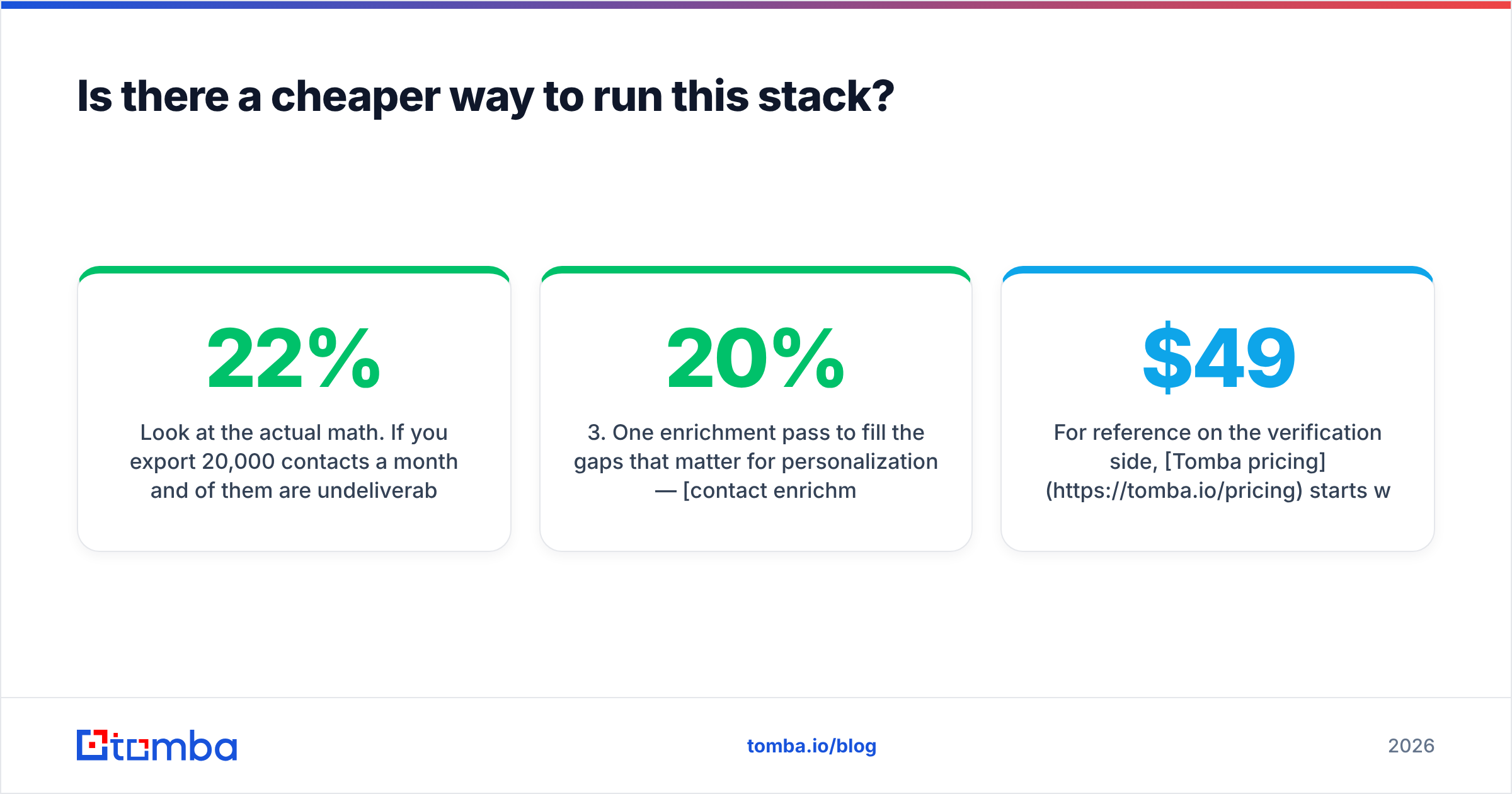
Look at the actual math. If you export 20,000 contacts a month and 22% of them are undeliverable, you did not buy 20,000 leads. You bought 15,600 leads plus a reputation problem. The undeliverable share costs you twice: once in wasted sending capacity, once in the inbox placement you lose for the rest of the quarter.
A leaner configuration for most B2B teams:
- One source of targeting — whichever of Infofree or Warpleads matches your channel. Do not pay for both.
- One verification layer applied to every list regardless of source, with no exceptions for "premium" vendors.
- One enrichment pass to fill the gaps that matter for personalization — contact enrichment on the 20% of records you will actually write custom lines for.
- One sending tool with conservative volume ramps per domain.
For reference on the verification side, Tomba pricing starts with a free tier at 25 searches a month, then $49/mo for Starter, $99/mo for Growth, and $249/mo for Pro. Adding a verification layer at the Starter or Growth level to a list subscription is almost always cheaper than the deliverability damage you avoid.
What is the verdict for 2026?#
Infofree wins for US local sales with a phone-first or mail-first motion. The consumer attributes and landline coverage are legitimately hard to replicate, the bundled CRM removes a decision, and the price is honest for what it is. Buy it if you are an agent, a contractor, or a telesales shop working American territory.
Warpleads wins for high-volume B2B cold email. If your campaigns consume tens of thousands of contacts a month and your cost model is per-lead, an unlimited export tier changes your unit economics in a way credit-based tools cannot match. Buy it if you are an agency or a volume outbound team — and budget for verification on top, not as an optional extra.
Neither wins for account-based outbound. If your list is a named set of companies and roles, you do not need unlimited anything. You need the correct address for each specific person, checked now. That is a different tool category, and pretending otherwise is how teams end up paying for 400,000 records to reach 300 people.
One last honest note: both vendors change plan structures frequently, and both run aggressive trial offers. Test with your own ICP before committing to an annual term. A vendor that performs brilliantly for staffing agencies in Texas may be nearly empty for your segment, and the only way to find out is to pull a sample and measure it.
Ready to fix the accuracy half of the equation? Whatever list source you land on, put a precision layer in front of your sequencer. Tomba Email Finder finds the current professional address for a named person at a named domain, confirms it before you send, and runs through an API, a Chrome extension, Google Sheets, or a bulk upload — whichever fits how your team already works. Start on the free tier with 25 searches, run it against 200 rows of your existing list, and let the valid-rate delta make the decision for you.
Related guides#
// get started
Find, verify and enrich your first contacts today
Start on the free plan with 25 searches a month, then scale when your team is ready.
Free plan · No credit card required · GDPR & CCPA
Get the Tomba newsletter
Product and data updates
// about the author