Insightly vs SugarCRM: Which CRM Wins for B2B Teams?
Insightly is fast to deploy and project-friendly. SugarCRM is heavier, more configurable, and built for complex pipelines. Here is the honest breakdown of pricing, automation, limits, and the data problem neither one fixes.
Insightly vs SugarCRM comes down to speed versus depth. Insightly gets you live in days. SugarCRM bends to fit a complex sales process, but it wants an admin and a budget. Below: pricing, automation, limits, and the data problem neither tool solves.
TL;DR
- Insightly is the lighter, faster-to-deploy option. It bundles CRM with project management. That suits teams that sell the work and then deliver it — agencies, consultancies, services firms.
- SugarCRM is the heavier, more configurable platform. It wins when you have multi-stage pipelines, complex products, and a real admin team. Pick it when you need to model your business instead of bending it to fit a template.
- Pricing flips depending on tier. Insightly's entry plans undercut SugarCRM's mid-tier. But SugarCRM's low-end Essentials plan is cheaper per seat than anything Insightly offers, and the functional limits are tight.
- Both charge for AI and automation as you climb. The cheapest plan on either side leaves out the workflow engine you saw in the demo.
- Neither CRM fixes your data. Both assume contact records arrive complete and correct. They don't. That gap is where most CRM ROI leaks.
What are Insightly and SugarCRM?#
Insightly launched as a lightweight CRM for small businesses. It now ships as a four-product suite: CRM, Marketing, Service, and AppConnect (its integration layer). Its signature feature is native project management. When a deal closes, it turns into a project with tasks, milestones, and pipelines inside the same tool. That single design choice defines who it's for.
SugarCRM started as the open-source alternative to Salesforce. Today it is a commercial platform with three main products: Sugar Sell, Sugar Serve, and Sugar Market. Its pitch is depth: custom modules, deep record configuration, and on-premise or private-cloud hosting. It also scores deals through its SugarPredict engine. It's a platform that expects an administrator.
The short version: in Insightly vs SugarCRM, Insightly optimizes for time-to-value and SugarCRM optimizes for fit. Those are different bets. Pick the wrong one and you pay for it — six months of implementation, or two years of workarounds.
Insightly vs SugarCRM: how do they compare head-to-head?#
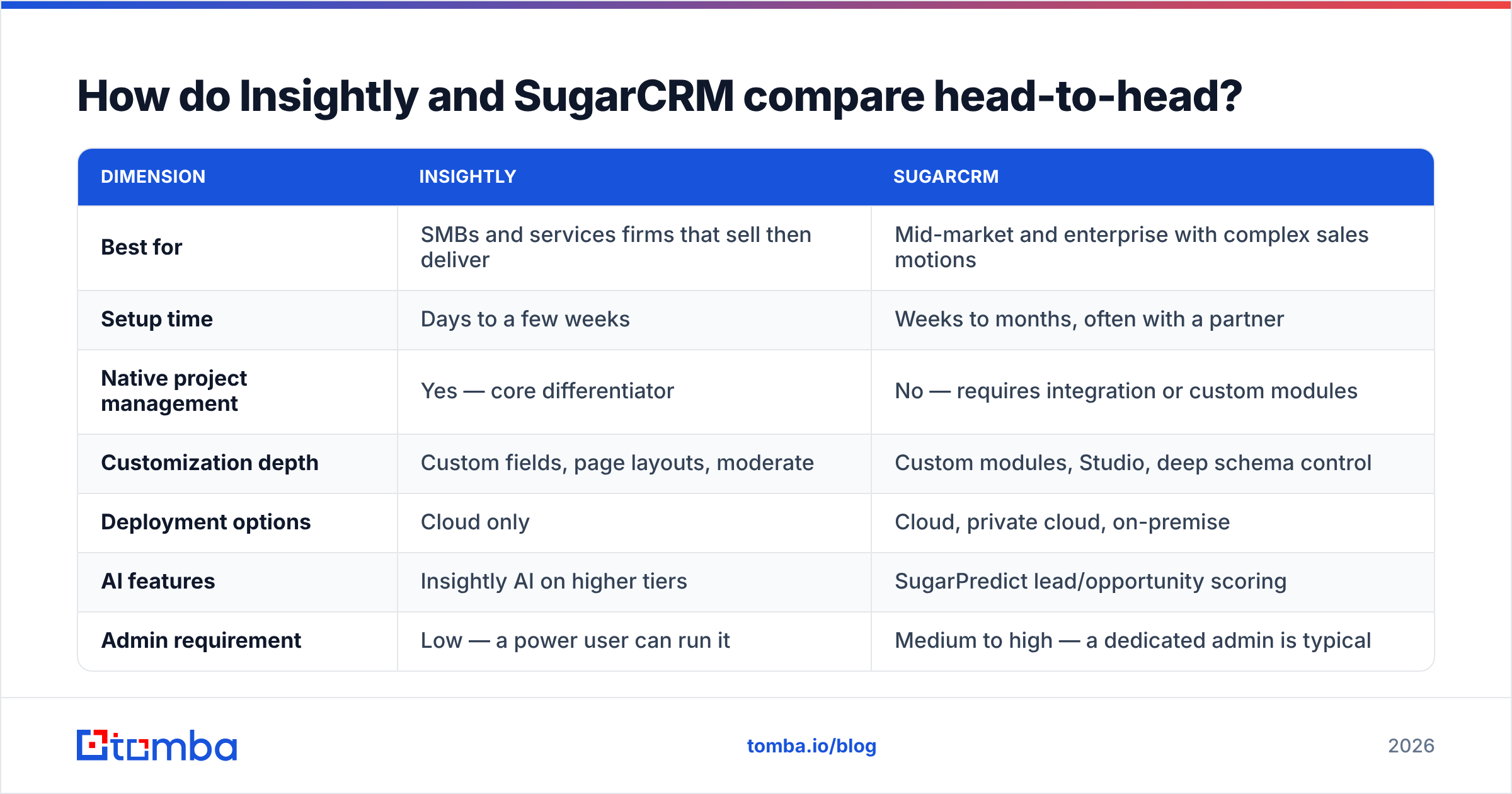
| Dimension | Insightly | SugarCRM |
|---|---|---|
| Best for | SMBs and services firms that sell then deliver | Mid-market and enterprise with complex sales motions |
| Setup time | Days to a few weeks | Weeks to months, often with a partner |
| Native project management | Yes — core differentiator | No — requires integration or custom modules |
| Customization depth | Custom fields, page layouts, moderate | Custom modules, Studio, deep schema control |
| Deployment options | Cloud only | Cloud, private cloud, on-premise |
| AI features | Insightly AI on higher tiers | SugarPredict lead/opportunity scoring |
| Admin requirement | Low — a power user can run it | Medium to high — a dedicated admin is typical |
| API access | Available, plan-dependent | Available across Sell tiers |
| Ecosystem size | Smaller marketplace | Larger, plus open-source heritage modules |
| Learning curve | Gentle | Steep in the first month |
The table hides one gap worth naming. Insightly's ceiling is real. If your sales process involves quoting configured products, multi-entity account hierarchies, or region-specific approval chains, you will hit a wall. Then you start building spreadsheets next to the CRM. SugarCRM's floor is real too. With four salespeople and no operations hire, most of the configuration surface that makes Sugar powerful goes unused — and you still pay for it.
What does each CRM actually cost?#
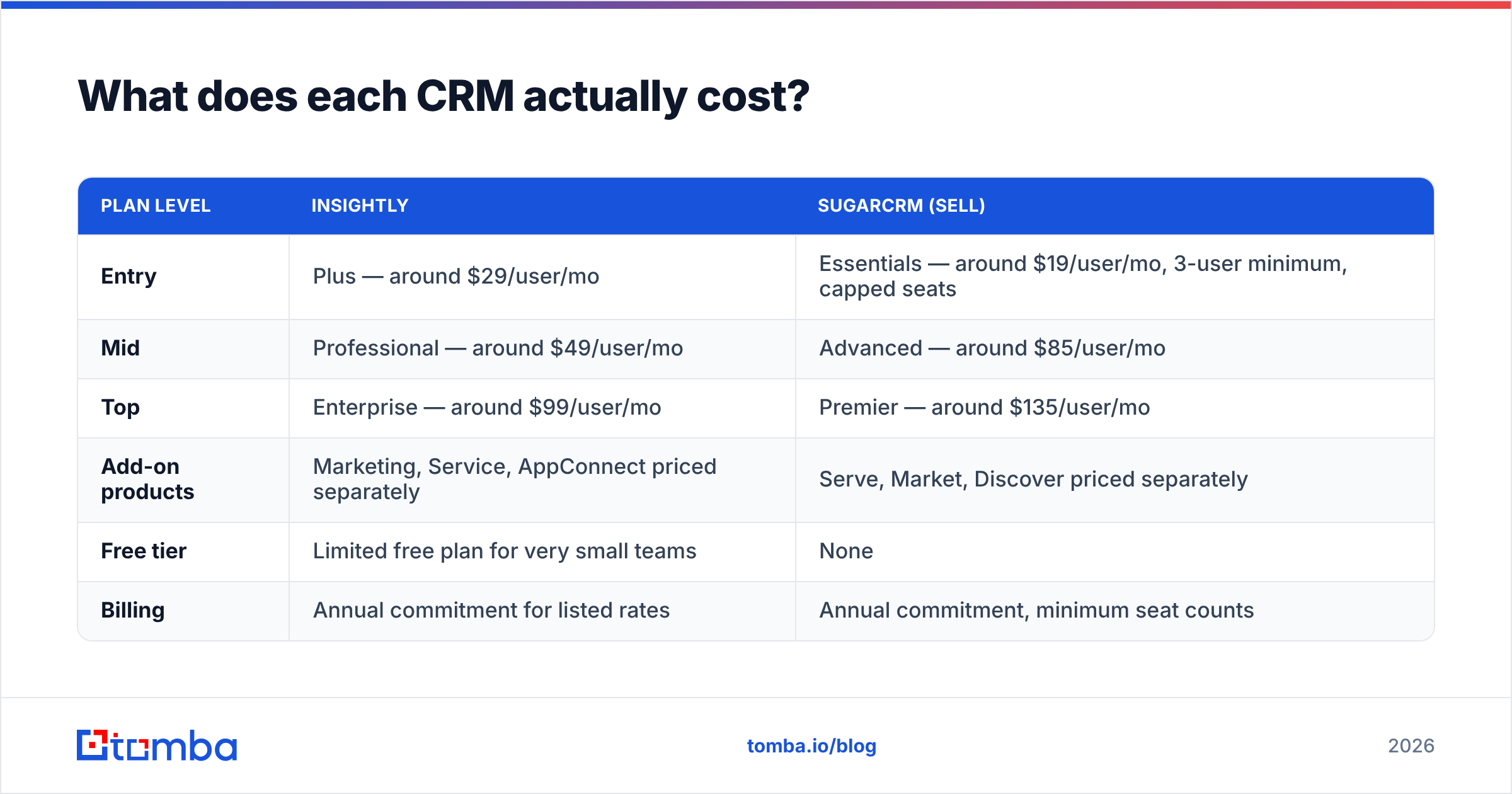
Cost is where most Insightly vs SugarCRM shortlists get decided. List prices move, so treat these as the shape of the pricing rather than a quote. Check both vendors' pricing pages before you budget. Assume annual billing unless stated otherwise.
| Plan level | Insightly | SugarCRM (Sell) |
|---|---|---|
| Entry | Plus — around $29/user/mo | Essentials — around $19/user/mo, 3-user minimum, capped seats |
| Mid | Professional — around $49/user/mo | Advanced — around $85/user/mo |
| Top | Enterprise — around $99/user/mo | Premier — around $135/user/mo |
| Add-on products | Marketing, Service, AppConnect priced separately | Serve, Market, Discover priced separately |
| Free tier | Limited free plan for very small teams | None |
| Billing | Annual commitment for listed rates | Annual commitment, minimum seat counts |
Three things to watch in both quotes.
- Seat minimums. SugarCRM Essentials carries a minimum user count and a maximum. It's deliberately a starter plan you're expected to outgrow. Budget for the jump, not the entry price.
- Module stacking. Neither vendor's CRM price includes marketing automation. Compare Insightly CRM against Sugar Sell and you are comparing like for like. Compare Insightly's full suite against Sugar Sell alone and the math lies.
- Implementation. SugarCRM rollouts often involve a partner. That's a real line item. For a mid-market rollout it can match the first year of licenses. Insightly self-service setups are common and cheap by comparison.
- Storage and API call limits. Both meter these. Heavy enrichment or integration workloads can push you into a higher tier for reasons that have nothing to do with headcount.
Independent review data on G2 is a useful sanity check. Buyers rate Insightly higher on ease of setup. They rate SugarCRM higher on customization and enterprise readiness. That split matches the pricing logic almost perfectly.
Is Insightly better for project-driven teams?#
Yes — and it isn't close when delivery lives in the same team as sales.
Picture the scenario Insightly nails. A marketing agency closes a retainer. The opportunity converts to a project. The scope of work lands as milestones. The account manager sees the same contact record the AE used, and nobody re-keys anything into Asana. That continuity is worth more than any single feature comparison suggests. The alternative is a CRM-to-PM sync that breaks quietly and gets blamed on "the tools."
Where Insightly gets thin:
- Complex quoting. Product catalogs with configuration rules aren't its strength.
- Large data volumes. Performance and reporting flexibility degrade before SugarCRM's does.
- Territory and hierarchy modeling. Multi-level account structures with regional ownership rules require compromise.
- Reporting depth. Dashboards cover the basics well. Advanced cross-object analysis sends you to an external BI tool sooner than you'd like.
A short sales cycle, a service as your product, and revenue that depends on delivering it well — that is the business Insightly was designed for.
Is SugarCRM better for complex sales organizations?#
Also yes — with a caveat about who runs it.
SugarCRM's Studio lets you create whole new modules, not just fields. You can model a manufacturer's distributor network, a healthcare vendor's facility-and-practitioner split, or a financial firm's household relationships as first-class objects. In Insightly you'd approximate those with custom objects and live with some friction.
SugarPredict scores leads and opportunities from past CRM data plus outside signals. It earns its keep once you have enough won and lost deals to train on. On a CRM with 200 lifetime deals, it's decoration. On one with 20,000, it changes forecast accuracy.
Deployment flexibility matters more than people expect. Regulated industries, EU data-residency rules, and security teams that won't approve multi-tenant SaaS all push toward SugarCRM's private-cloud and on-premise options. Insightly has no answer there.
The caveat: SugarCRM rewards ownership. Without someone whose job includes the CRM, configuration drifts, required fields multiply, and adoption falls. That pattern shows up across the negative reviews. It's an operating-model problem, not a software problem.
How do automation and AI differ between them?#
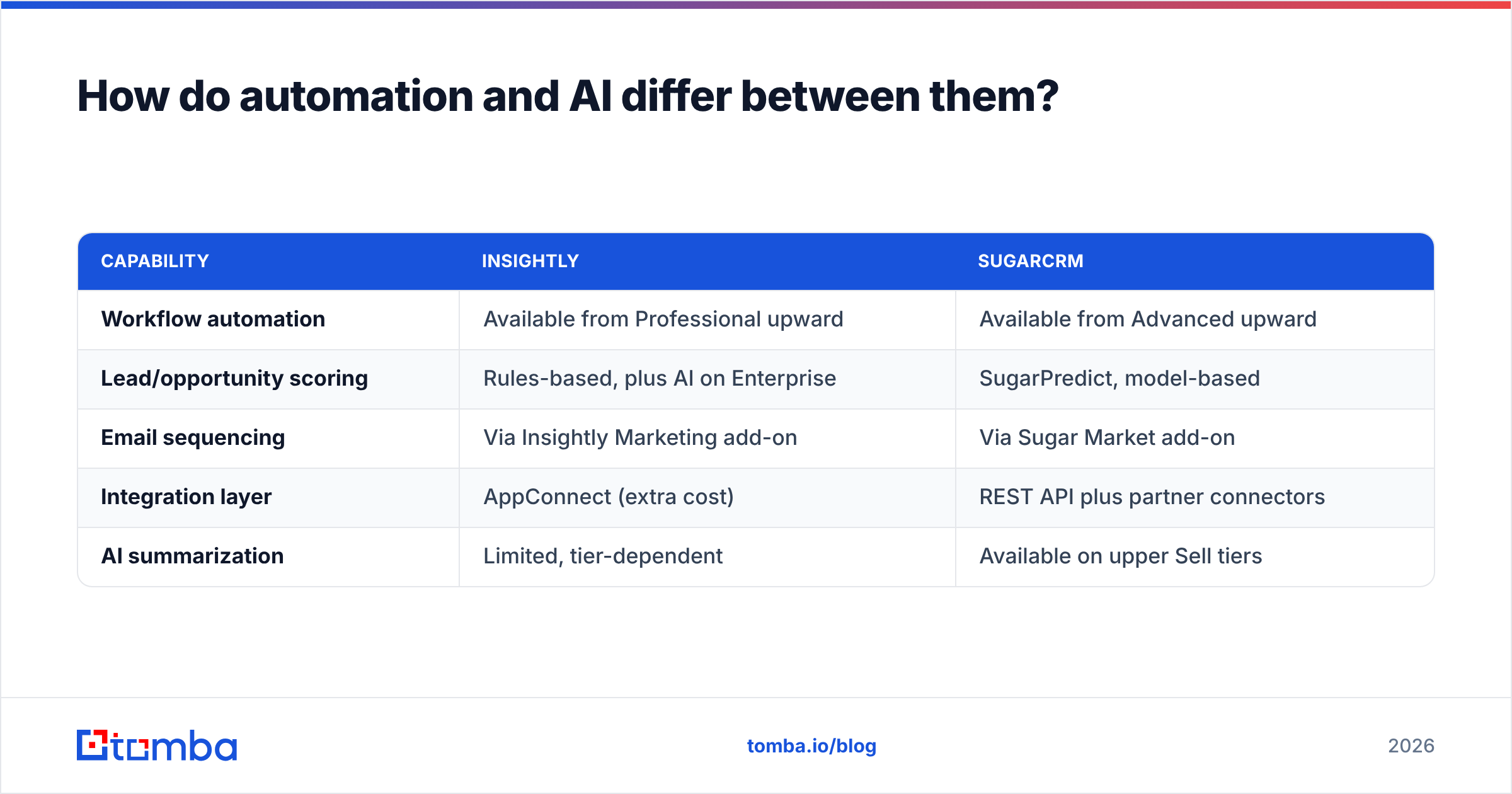
Both vendors have shipped AI features. Both gate the useful ones behind higher tiers.
| Capability | Insightly | SugarCRM |
|---|---|---|
| Workflow automation | Available from Professional upward | Available from Advanced upward |
| Lead/opportunity scoring | Rules-based, plus AI on Enterprise | SugarPredict, model-based |
| Email sequencing | Via Insightly Marketing add-on | Via Sugar Market add-on |
| Integration layer | AppConnect (extra cost) | REST API plus partner connectors |
| AI summarization | Limited, tier-dependent | Available on upper Sell tiers |
The practical read: if automation is your main reason for buying, price the tier that actually contains it. Plenty of teams sign the entry plan and then find the workflow builder is missing. They spend the year doing by hand what they bought the tool to avoid.
What about data quality — the part neither CRM solves?#
Here's the finding that survives every CRM comparison: the platform is rarely the bottleneck. The records are.
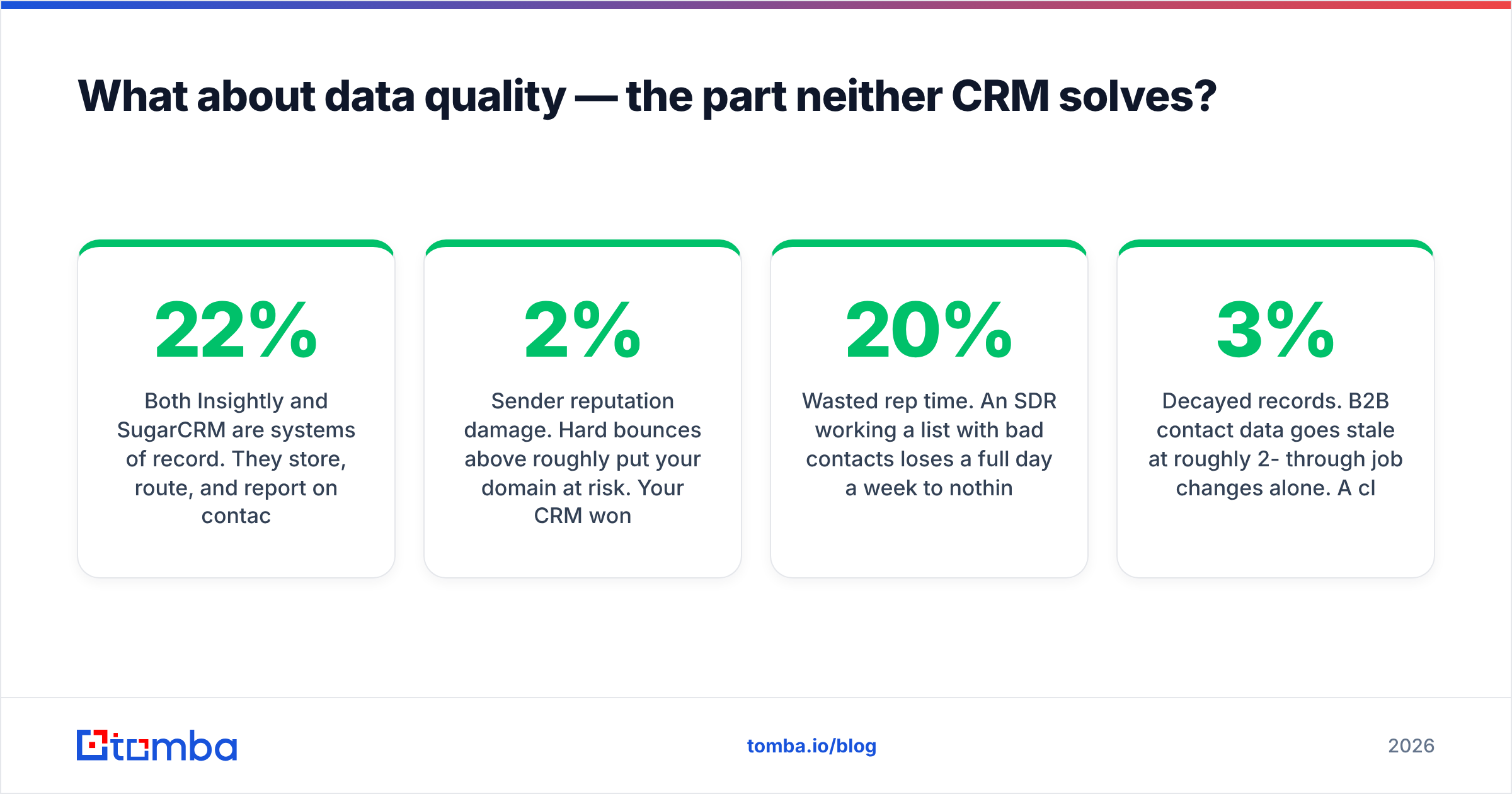
Both Insightly and SugarCRM are systems of record. They store, route, and report on contact data. Neither one creates it, and neither really checks it. Import a list where 22% of the email addresses are dead, and both CRMs will store 22% dead addresses. They will run sequences against them. They will count the bounces as engagement data. Then they hand you a forecast built on that.
The compounding costs are specific:
- Sender reputation damage. Hard bounces above roughly 2% put your domain at risk. Your CRM won't warn you.
- Corrupted reporting. A response rate measured against undeliverable contacts understates your real performance and sends strategy the wrong way.
- Wasted rep time. An SDR working a list with 20% bad contacts loses a full day a week to nothing.
- Decayed records. B2B contact data goes stale at roughly 2-3% per month through job changes alone. A clean import is dirty within a year.
The fix is a layer in front of the CRM, not inside it. Every record should pass through an email verifier before it lands in Insightly or SugarCRM. Fill the gaps with data enrichment instead of leaving blanks for a rep to guess at. Have a domain but no named contacts? Domain search returns the people and email patterns at that company directly.
That layer runs on a schedule, not once. Quarterly re-verification of your active pipeline is the highest-ROI CRM habit there is. It costs a fraction of one seat license.
Which one should you choose?#
Five tests settle Insightly vs SugarCRM for most teams. The first two usually give you the answer.
- Do you deliver the work you sell? If closing a deal kicks off a project your team executes, Insightly's native PM saves you an integration and a whole category of recurring pain. Choose Insightly.
- Do you have a dedicated CRM admin or ops hire? If not, SugarCRM's power will mostly go unused. Choose Insightly. If you do, SugarCRM's configurability pays back.
- Do you need on-premise or private-cloud deployment? If compliance or security requires it, SugarCRM is the only option of the two.
- How complex is your sales object model? More than two or three custom entities with real relationships between them points to SugarCRM.
- What's your realistic implementation budget? Under $10k including services, SugarCRM's total cost will surprise you. Insightly self-serves.
A good default for a 5-25 person revenue team with no ops headcount: start on Insightly. Spend the difference on data quality and outbound tooling. Revisit in 18 months. For a 50+ person org with a real admin function and a non-standard sales process: SugarCRM, budgeted with a partner.
Whichever you pick, decide up front who owns record hygiene. If the answer is "everyone," the answer is nobody. Then the comparison you just ran won't matter in eighteen months.
Feed either CRM with contacts that actually work#
The CRM you choose decides how you manage pipeline. What you put into it decides whether there's a pipeline to manage.
Tomba Email Finder finds verified professional email addresses by name, company, or domain. Each result carries a confidence score and source attribution, so you know why it's trustworthy before it reaches Insightly or SugarCRM. Every result is checked against the email verifier before delivery. The Tomba API plugs it straight into your enrichment workflow, so records arrive clean instead of getting cleaned later.
Start on the free tier with 25 searches a month; paid plans begin at $49/mo. See Tomba pricing for the full breakdown. Then run your current CRM export through verification. The bounce rate you find will tell you more about your revenue problem than any feature comparison will.
Related guides#
// get started
Find, verify and enrich your first contacts today
Start on the free plan with 25 searches a month, then scale when your team is ready.
Free plan · No credit card required · GDPR & CCPA
// about the author