Interseller vs Jet Leads Pro: Which Outreach Tool Wins in 2026?
One is a recruiter-first sourcing and sequencing platform owned by Greenhouse. The other is a budget volume lead tool. Here's how Interseller and Jet Leads Pro actually differ on data, sending, and real cost.
TL;DR
- Interseller is a sourcing-plus-sequencing platform built for recruiters. It was acquired by Greenhouse in 2021 and now lives inside that ecosystem, which shapes both its roadmap and its pricing.
- Jet Leads Pro sits at the opposite end: a low-cost, volume-first lead tool aimed at solo founders and agencies who want lists and sends in one cheap subscription.
- Neither is a pure data vendor. Both bundle contact discovery with sending, which means you pay per seat for a mailbox feature you may already have in Instantly, Smartlead, or Outreach.
- If data quality is your bottleneck, unbundling — a dedicated finder/verifier feeding your existing sequencer — usually costs less and bounces less than either all-in-one.
- Verify current pricing before you buy. Interseller quotes are sales-led; Jet Leads Pro's published tiers change often. Treat every number below as a starting point for your own check.
What are Interseller and Jet Leads Pro?#
They solve the same surface problem — get contacts, email them, track replies — from two very different starting assumptions.
Interseller began as a recruiting tool. Its core loop is: find a candidate or prospect profile, resolve a personal or work email, drop them into a multi-step sequence, and sync the activity back to an ATS or CRM. The recruiter DNA shows everywhere — personal email coverage is unusually strong, the ATS integrations (Greenhouse, Bullhorn, Lever) are first-class, and the "project" model maps to a req, not a campaign.
Jet Leads Pro comes from the growth-hacking side. The pitch is volume at a low monthly price: pull a list, get emails, send from connected inboxes, repeat. There's less emphasis on compliance workflows, ATS sync, or data provenance, and more on credits per dollar.
That difference in origin is the whole comparison. One tool optimizes for finding the right person. The other optimizes for reaching many people cheaply. If you buy the wrong one for your motion, no feature checklist will save you.
How does Interseller actually work?#
Interseller's workflow is browser-extension-led. You surface a profile on LinkedIn or a job board, click the extension, and Interseller runs its lookup against public sources plus its own contact graph. It returns work emails, and often personal ones — the differentiator recruiters pay for, since a candidate's corporate inbox is the worst place to pitch them a new job.
From there, contacts land in a project with a sequence attached. Interseller sends from your connected mailbox (Gmail or Outlook), throttles volume, detects replies, and pauses the sequence automatically. It writes activity back to your ATS so a recruiter doesn't double-touch a candidate another team member already contacted.
What you should know going in:
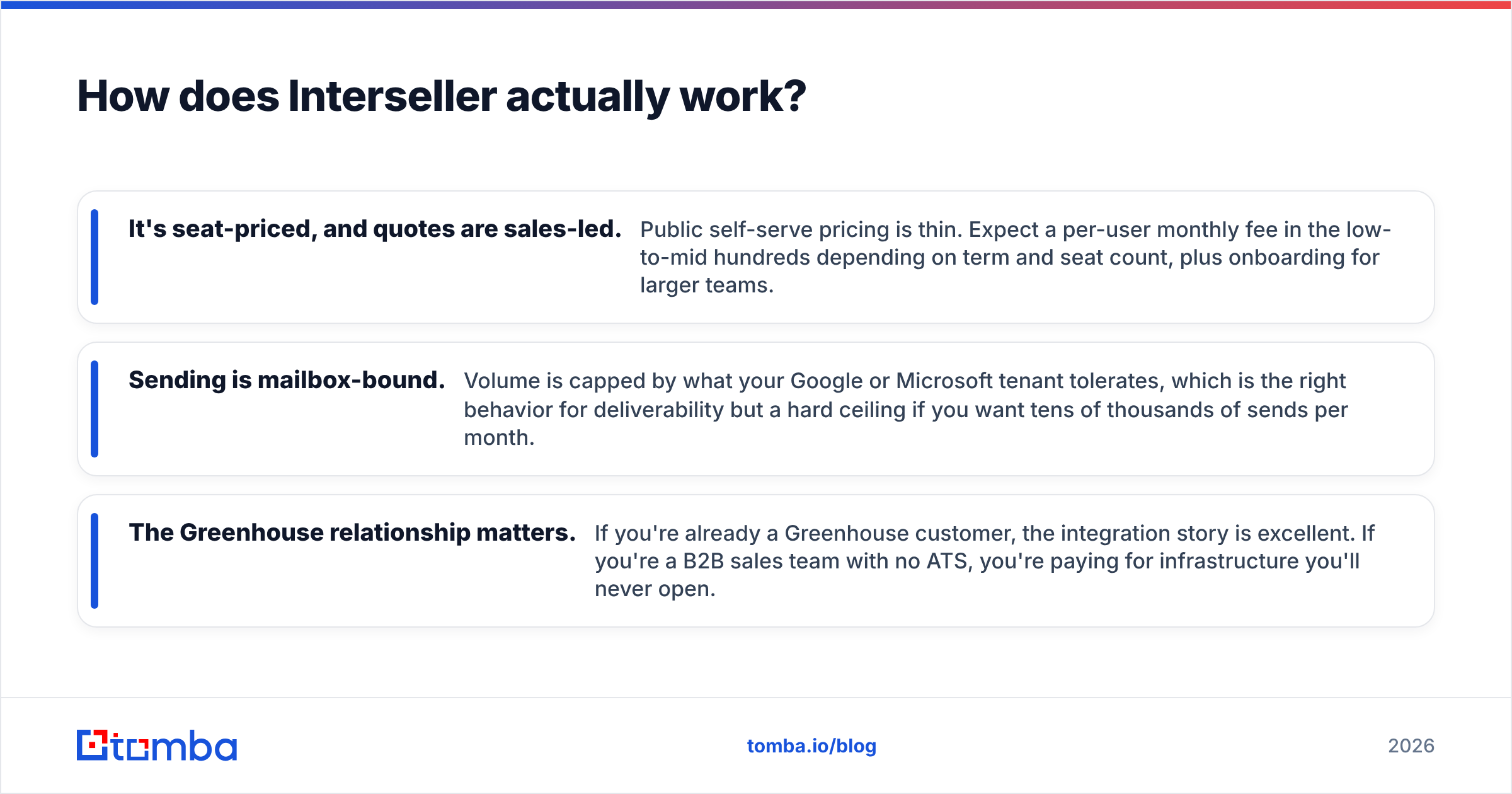
- It's seat-priced, and quotes are sales-led. Public self-serve pricing is thin. Expect a per-user monthly fee in the low-to-mid hundreds depending on term and seat count, plus onboarding for larger teams.
- Sending is mailbox-bound. Volume is capped by what your Google or Microsoft tenant tolerates, which is the right behavior for deliverability but a hard ceiling if you want tens of thousands of sends per month.
- The Greenhouse relationship matters. If you're already a Greenhouse customer, the integration story is excellent. If you're a B2B sales team with no ATS, you're paying for infrastructure you'll never open.

What does Jet Leads Pro do differently?#
Jet Leads Pro's positioning is price-per-lead. You get a search interface over a contact database, some filters (industry, size, title, geography), export to CSV, and a sending module with inbox rotation. The subscription is measured in credits, and the credits are cheap relative to enterprise data vendors.
The trade-offs are the predictable ones for this tier:
- Provenance is thin. It's rarely clear whether a returned email was SMTP-validated at request time, pattern-guessed, or pulled from an aging aggregate list. That matters because a guessed address that looks plausible is more dangerous than no address at all — it bounces, and bounces are what get domains flagged.
- Catch-all handling is where budget tools break. Roughly a fifth of B2B domains are catch-all, accepting anything at the SMTP layer. Cheap verifiers mark these "valid" and move on. You find out the truth when your bounce rate climbs three weeks into a campaign.
- Support and SLA expectations should be modest. At this price point, you're buying software, not a data partnership.
None of that makes it a bad tool. For a solo consultant emailing 300 local businesses a month, the economics are genuinely good, and the alternative — an enterprise seat — is absurd overkill.
Interseller vs Jet Leads Pro: how do they compare head-to-head?#
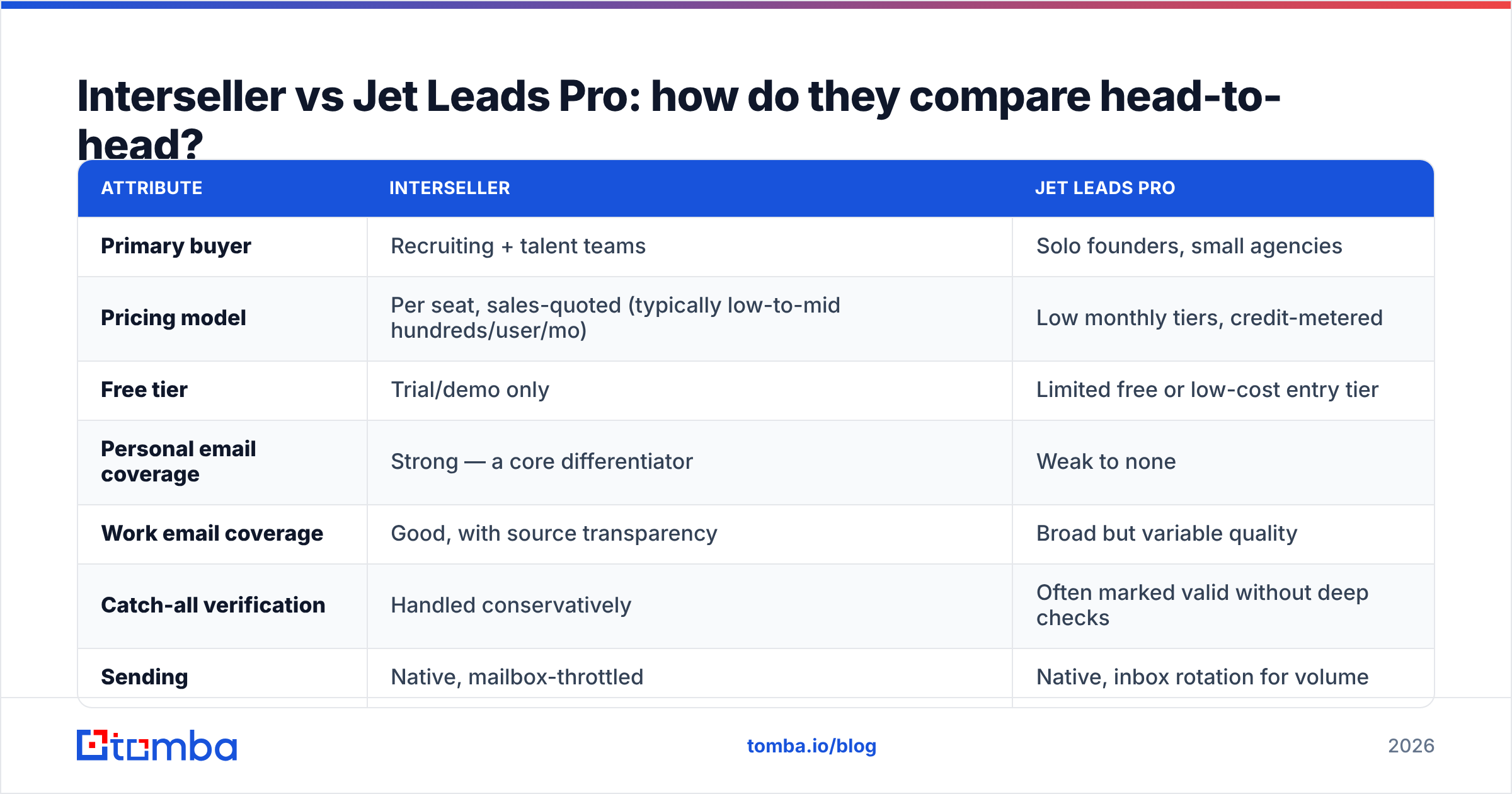
| Attribute | Interseller | Jet Leads Pro |
|---|---|---|
| Primary buyer | Recruiting + talent teams | Solo founders, small agencies |
| Pricing model | Per seat, sales-quoted (typically low-to-mid hundreds/user/mo) | Low monthly tiers, credit-metered |
| Free tier | Trial/demo only | Limited free or low-cost entry tier |
| Personal email coverage | Strong — a core differentiator | Weak to none |
| Work email coverage | Good, with source transparency | Broad but variable quality |
| Catch-all verification | Handled conservatively | Often marked valid without deep checks |
| Sending | Native, mailbox-throttled | Native, inbox rotation for volume |
| ATS/CRM sync | Greenhouse, Bullhorn, Lever, Salesforce | Basic CSV / Zapier-level |
| API access | Limited, partner-oriented | Limited |
| Best at | Precision sourcing for named roles | Cheap breadth for local/SMB lists |
| Worst at | Cost efficiency for high-volume B2B sales | Data hygiene at scale |
Read that table as two different products rather than a winner and a loser. A recruiter who buys Jet Leads Pro will fail to reach candidates. A bootstrapped founder who buys Interseller seats will burn runway on ATS features they never touch.
Which one has better contact data?#
Interseller, for the use case it was built for. Jet Leads Pro, for cost per record. Both lose to a dedicated data layer if accuracy is what you're actually optimizing.
Here's why. Bundled tools have a structural incentive problem: their revenue comes from seats and sends, not from the marginal correctness of any single address. A dedicated email finder has exactly one job, and its churn is directly tied to bounce rates. That focus shows up in the parts of the pipeline nobody demos — pattern inference across subsidiaries, MX-level checks, role-account detection, and honest "risky" labels instead of optimistic "valid" ones.
Three questions to ask either vendor before you sign:
- Was this address verified at query time, or read from a cache? A record from a 2024 crawl is a coin flip in 2026. Roughly 25–30% of B2B contact data decays annually as people change roles.
- What happens on a catch-all domain? The honest answer is "we flag it as unverifiable and give you a confidence score." The dangerous answer is "we return it as valid." A dedicated catch-all verifier exists precisely because this class of domain defeats standard SMTP checks.
- Do you charge for failed lookups? Some tools burn a credit whether or not they find anything. That silently doubles your effective cost per contact.
If a vendor can't answer all three crisply, the price per credit is not the number you should be comparing.
How do pricing and total cost compare?#
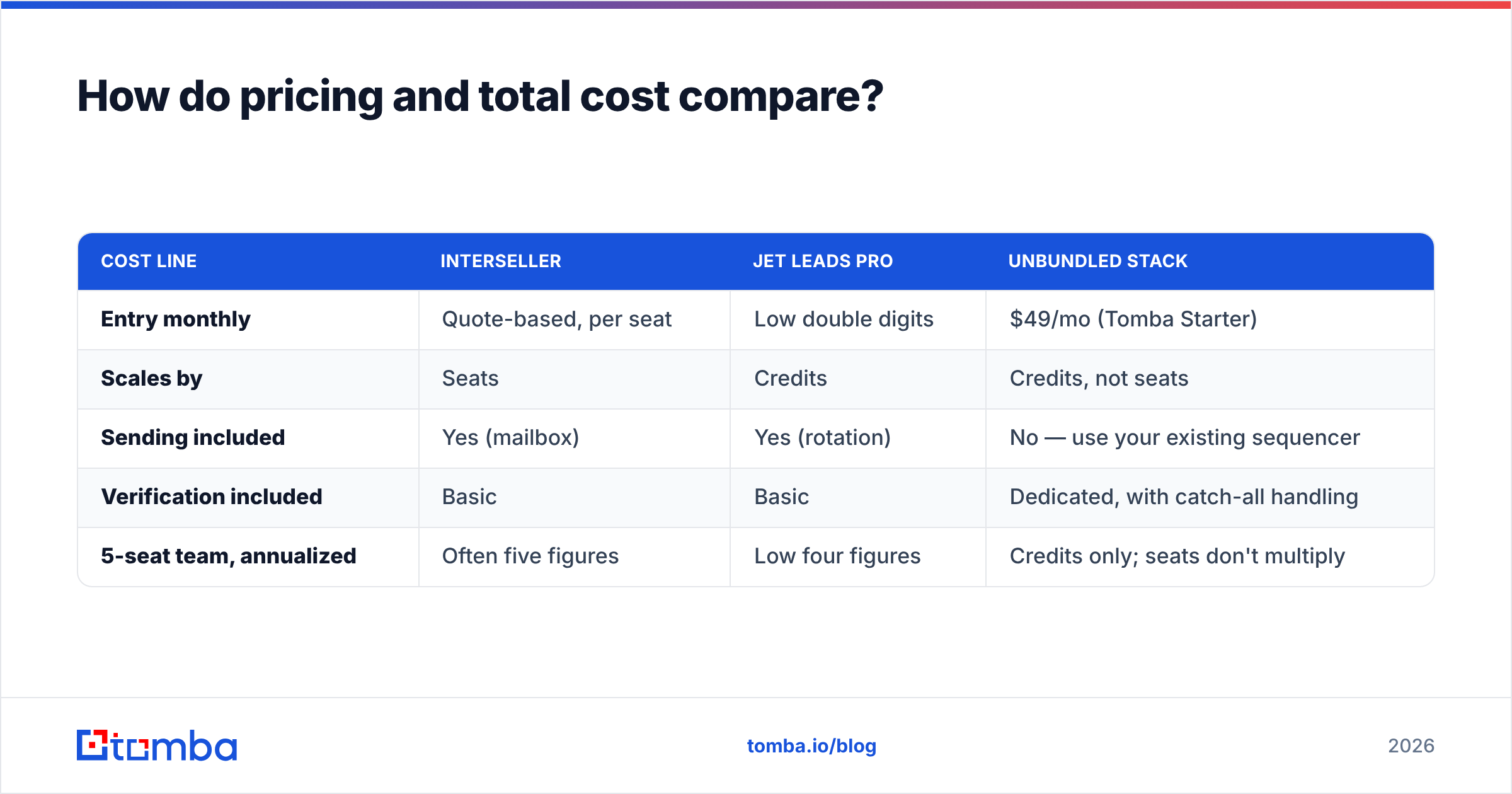
| Cost line | Interseller | Jet Leads Pro | Unbundled stack |
|---|---|---|---|
| Entry monthly | Quote-based, per seat | Low double digits | $49/mo (Tomba Starter) |
| Scales by | Seats | Credits | Credits, not seats |
| Sending included | Yes (mailbox) | Yes (rotation) | No — use your existing sequencer |
| Verification included | Basic | Basic | Dedicated, with catch-all handling |
| 5-seat team, annualized | Often five figures | Low four figures | Credits only; seats don't multiply |
The unbundled column is the one most teams under-model. If you already pay for Instantly, Smartlead, Outreach, or Apollo sequences, the sending capability inside Interseller or Jet Leads Pro is a duplicate purchase. You're paying twice for the same outbound send and adding a second place where deliverability can break.
Tomba's tiers make the arithmetic visible: Free at 25 searches/month, Starter at $49/mo, Growth at $99/mo, Pro at $249/mo, Enterprise custom. Credits are consumed by lookups, not by headcount — so adding a fourth SDR doesn't quadruple your data bill.

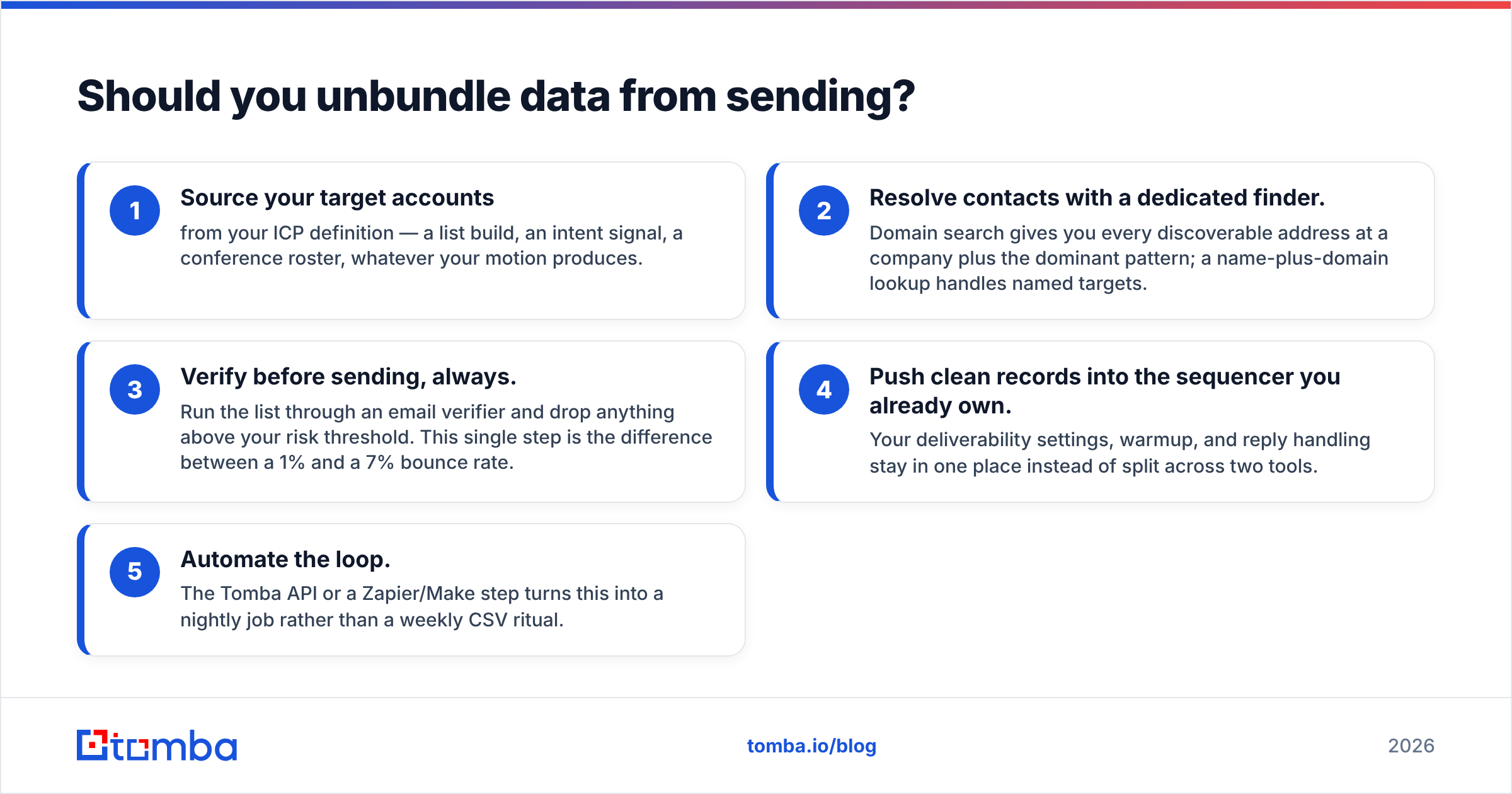
Should you unbundle data from sending?#
For most B2B sales teams in 2026, yes. The all-in-one pitch made sense when connecting a data source to a sequencer required an engineer. It doesn't anymore.
The unbundled pattern looks like this:
- Source your target accounts from your ICP definition — a list build, an intent signal, a conference roster, whatever your motion produces.
- Resolve contacts with a dedicated finder. Domain search gives you every discoverable address at a company plus the dominant pattern; a name-plus-domain lookup handles named targets.
- Verify before sending, always. Run the list through an email verifier and drop anything above your risk threshold. This single step is the difference between a 1% and a 7% bounce rate.
- Push clean records into the sequencer you already own. Your deliverability settings, warmup, and reply handling stay in one place instead of split across two tools.
- Automate the loop. The Tomba API or a Zapier/Make step turns this into a nightly job rather than a weekly CSV ritual.
The result is cheaper, more auditable, and — critically — replaceable. If your data vendor degrades, you swap it without rebuilding your entire outbound motion. With an all-in-one, the data quality and the sending infrastructure churn together.
Which should you pick for your team?#
Pick Interseller if: you're a recruiting or talent-acquisition team, you need personal email coverage, and you're already inside the Greenhouse or Bullhorn ecosystem. The ATS write-back alone justifies the seat cost when five recruiters would otherwise collide on the same candidate. Check current user reviews on G2 for how the post-acquisition roadmap is landing with existing customers before committing to an annual term.
Pick Jet Leads Pro if: you're one or two people, your targets are SMB or local, your average deal size doesn't justify premium data, and you're comfortable doing your own verification pass before you send. Budget separately for a verification step — the money you save on records, you'll spend twice over on a burned domain otherwise.
Pick an unbundled stack if: you're a B2B sales team of any size with an existing sequencer, your ICP is mid-market or enterprise, and bounce rate is a metric someone actually watches. This covers the large majority of teams reading a comparison like this one.
Pick nothing yet if: you haven't defined your ICP tightly enough to say which titles at which company sizes you're targeting. No tool fixes a targeting problem, and both of these will happily sell you volume against a bad definition.
What's the honest verdict?#
There isn't a single winner, because Interseller and Jet Leads Pro aren't really competing for the same buyer — they just look similar on a feature grid. Interseller wins recruiting. Jet Leads Pro wins price-sensitive breadth. Both lose the middle, which is where most B2B sales teams sit: you need accurate work emails at volume, you already have a sending tool, and you don't want to pay per seat for a second one.
That middle is served best by separating the layers. Get your contact data from a tool whose only product is contact data, verify it hard, and send it through the infrastructure you've already tuned.
If that's your situation, start with the Tomba Email Finder. The free tier gives you 25 searches a month — enough to run your own accuracy test against a list of 25 contacts you can independently confirm. Pull the same 25 from Interseller or Jet Leads Pro, compare the hit rate and the bounce rate, and let your own numbers decide instead of a comparison table. That's the test any honest vendor should be happy for you to run.
Related guides#
// get started
Find, verify and enrich your first contacts today
Start on the free plan with 25 searches a month, then scale when your team is ready.
Free plan · No credit card required · GDPR & CCPA
// about the author