Interseller vs Warpleads: Which Lead Tool Wins in 2026?
Interseller sequences a handful of perfect contacts. Warpleads exports thousands at once. We compare data accuracy, pricing, workflow fit, and who each one actually suits in 2026.
TL;DR
- Interseller is a sourcing-and-sequencing tool built for recruiters. It finds a contact, verifies it, sequences it, and writes the activity back to your ATS or CRM. Depth over volume.
- Warpleads is a bulk B2B lead database. Its pitch is unlimited or very high-volume exports at a flat monthly price, aimed at agencies and outbound teams that burn lists fast.
- They are not really competitors. One is a workflow tool priced per seat; the other is a data tap priced per month. Picking between them is a question about your motion, not about features.
- If you run recruiting outreach inside an ATS, Interseller wins. If you feed cold-email infrastructure thousands of contacts a week, Warpleads wins on cost per record.
- If what you actually need is accurate emails on demand — via API, spreadsheet, or bulk upload — without paying for a sequencer or a database subscription, a dedicated email finder is cheaper than both.
What are Interseller and Warpleads?#
Interseller launched as a recruiter's outreach tool: paste a LinkedIn profile, get a personal or work email, drop it into a multi-step sequence, and let the tool stop the sequence when someone replies. Greenhouse acquired it in 2021, which pushed the product further into the recruiting stack — ATS sync, candidate de-duplication, and pipeline reporting are now core to the pitch rather than side features.
Warpleads comes from the opposite direction. It is a lead-generation database that sells volume: filter by industry, headcount, geography, or technology, then export the result set. The differentiator marketed on its site is export ceilings that do not punish you for growing — you pay a flat monthly fee and pull large lists rather than metering every contact.
The confusion between the two happens because both put "find B2B contacts" on the homepage. That is where the overlap ends.
Here is the shape of the difference before we get into numbers:
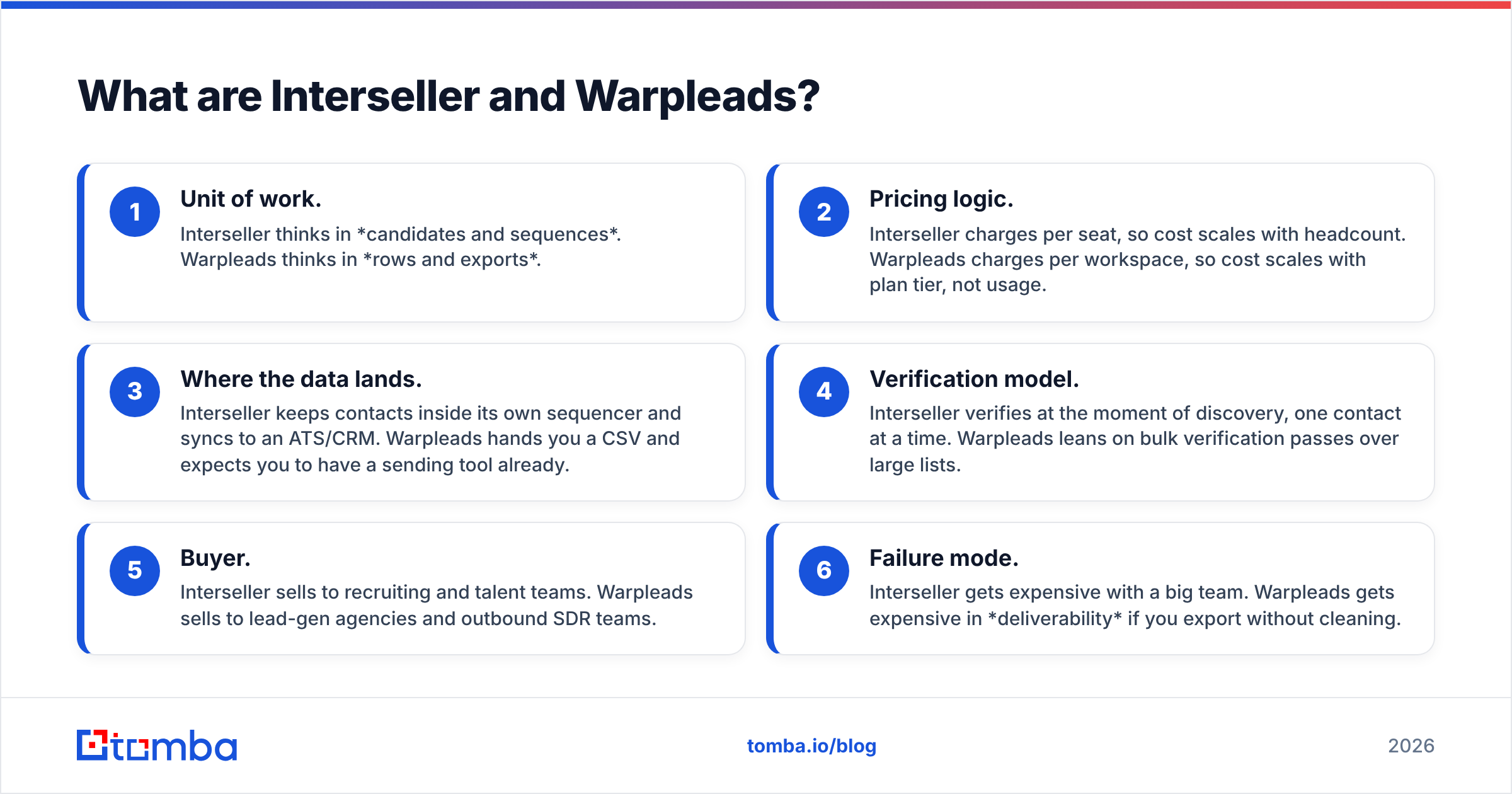
- Unit of work. Interseller thinks in candidates and sequences. Warpleads thinks in rows and exports.
- Pricing logic. Interseller charges per seat, so cost scales with headcount. Warpleads charges per workspace, so cost scales with plan tier, not usage.
- Where the data lands. Interseller keeps contacts inside its own sequencer and syncs to an ATS/CRM. Warpleads hands you a CSV and expects you to have a sending tool already.
- Verification model. Interseller verifies at the moment of discovery, one contact at a time. Warpleads leans on bulk verification passes over large lists.
- Buyer. Interseller sells to recruiting and talent teams. Warpleads sells to lead-gen agencies and outbound SDR teams.
- Failure mode. Interseller gets expensive with a big team. Warpleads gets expensive in deliverability if you export without cleaning.

Which one has better email accuracy?#
Neither vendor publishes an independently audited accuracy figure, so treat any number on either site as marketing until you test it on your own list. That caveat matters more than it sounds: accuracy is not a single property of a tool, it is a property of a tool against a specific segment.
In practice, the two products fail in different places:
- Interseller is strong on individual, high-intent lookups — a named person at a named company, usually with a LinkedIn profile attached. Because it resolves one contact at a time and verifies at discovery, the hit rate on a curated list tends to be respectable, and the misses are visible immediately rather than three weeks later in a bounce report.
- Warpleads is strong on coverage. When you need 5,000 marketing directors in DACH, a database beats a per-contact resolver because the records already exist. The trade-off is staleness: database rows are snapshots, and B2B contact data decays roughly 25–30% per year as people change jobs. Any bulk export needs a verification pass before it touches a sending domain.
That second point is the one teams underestimate. A 10,000-row export with 12% invalid addresses will bounce hard enough to damage sender reputation before you see a single reply. Run every bulk list through an email verifier — Warpleads', Tomba's, or anyone's — and treat catch-all domains as a separate bucket rather than assuming they are valid.

The honest summary: Interseller is more accurate per lookup, Warpleads is more productive per hour, and both are more useful when a verification layer sits between the export and the send.
How do Interseller and Warpleads compare feature by feature?#
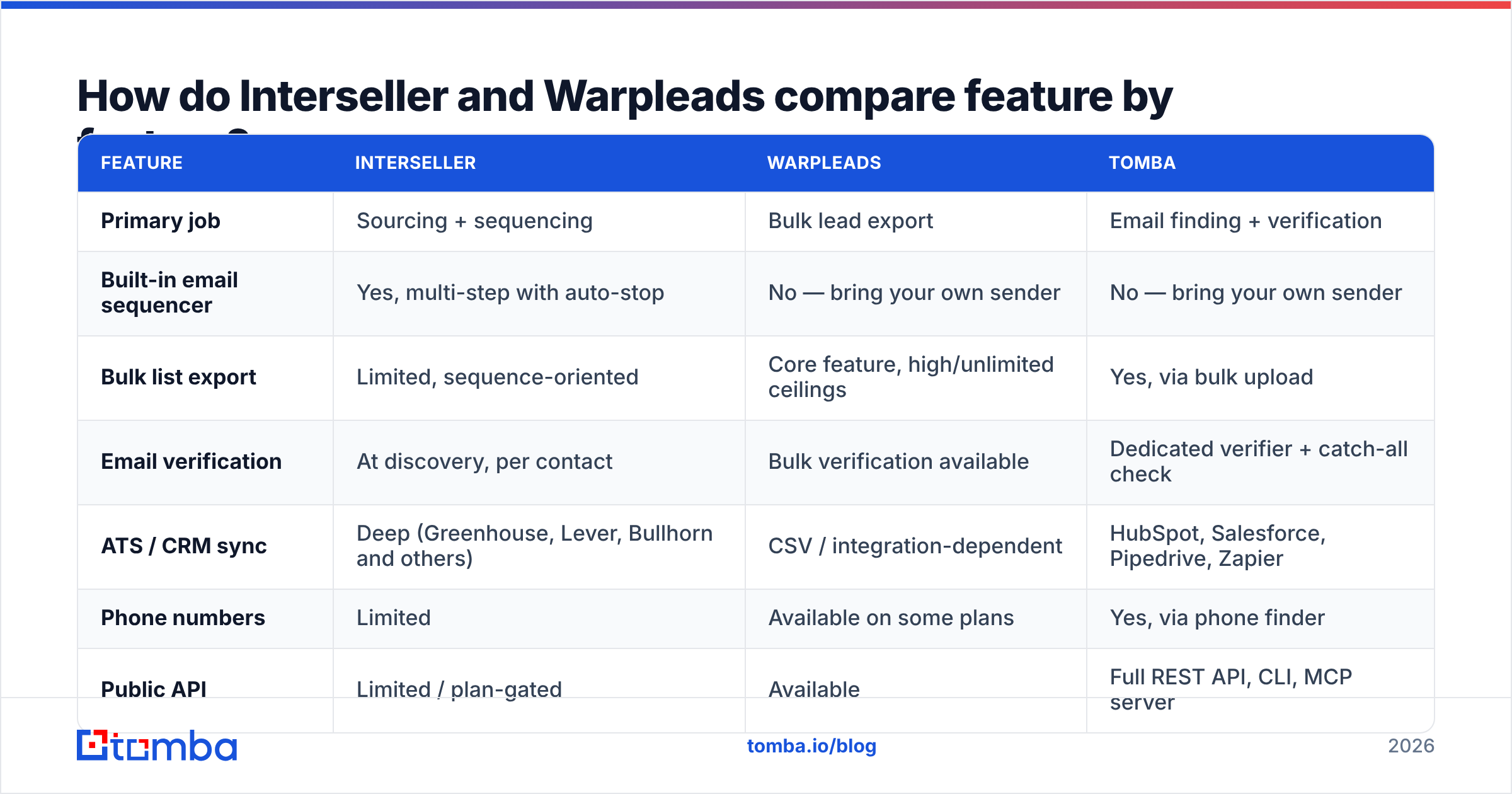
| Feature | Interseller | Warpleads | Tomba |
|---|---|---|---|
| Primary job | Sourcing + sequencing | Bulk lead export | Email finding + verification |
| Built-in email sequencer | Yes, multi-step with auto-stop | No — bring your own sender | No — bring your own sender |
| Bulk list export | Limited, sequence-oriented | Core feature, high/unlimited ceilings | Yes, via bulk upload |
| Email verification | At discovery, per contact | Bulk verification available | Dedicated verifier + catch-all check |
| ATS / CRM sync | Deep (Greenhouse, Lever, Bullhorn and others) | CSV / integration-dependent | HubSpot, Salesforce, Pipedrive, Zapier |
| Phone numbers | Limited | Available on some plans | Yes, via phone finder |
| Public API | Limited / plan-gated | Available | Full REST API, CLI, MCP server |
| Free tier | Trial only | Trial / limited free access | 25 searches per month, no card |
| Entry price | ~$100 per user/mo (quote-based since acquisition) | ~$79–$99/mo flat, plan-dependent | $49/mo Starter |
| Best fit | Recruiting teams in an ATS | Agencies running high-volume cold email | Teams that need clean data anywhere |

Two notes on that table. First, Interseller's public pricing has been inconsistent since the Greenhouse acquisition — several tiers are now quote-based and bundled with Greenhouse contracts, so the ~$100/seat figure is a floor, not a quote. Second, Warpleads' "unlimited" export tiers come with fair-use language. Read it before you plan a 500,000-row month around it.
What does each one actually cost?#
Cost comparisons between a per-seat tool and a per-workspace tool only make sense once you fix a scenario. Take a five-person outbound team pulling 8,000 new contacts a month.
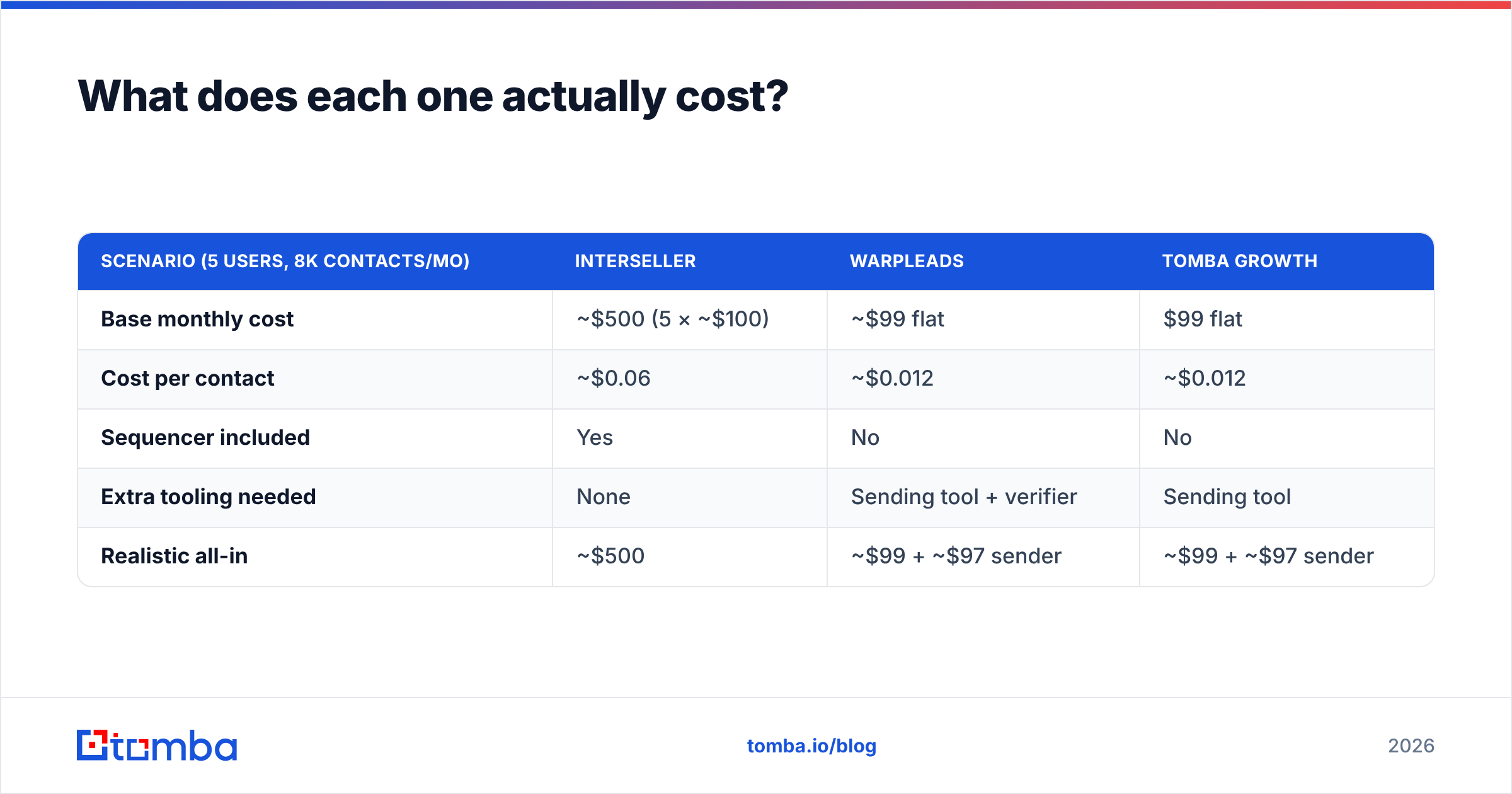
| Scenario (5 users, 8k contacts/mo) | Interseller | Warpleads | Tomba Growth |
|---|---|---|---|
| Base monthly cost | ~$500 (5 × ~$100) | ~$99 flat | $99 flat |
| Cost per contact | ~$0.06 | ~$0.012 | ~$0.012 |
| Sequencer included | Yes | No | No |
| Extra tooling needed | None | Sending tool + verifier | Sending tool |
| Realistic all-in | ~$500 | ~$99 + ~$97 sender | ~$99 + ~$97 sender |
Interseller looks expensive in this table because you are paying for a sequencer, an ATS integration, and reporting that the other two do not include. If your team already owns Instantly, Smartlead, or Outreach, you are paying twice. If it does not, Interseller's number is closer to fair than it first appears.
Warpleads and Tomba land in the same price band for different reasons. Warpleads sells you a large static pool you filter down. Tomba sells you resolution on demand — you supply the target (a domain, a name, a LinkedIn URL) and get a verified address back. If your ICP is well defined and stable, a database is efficient. If your targets come from scraped lists, event attendees, podcast guests, or inbound signals, on-demand resolution wins because no database has those rows pre-built.
Check current numbers directly — Tomba pricing is public and flat (Free 25 searches/mo, Starter $49/mo, Growth $99/mo, Pro $249/mo), while both competitors gate some tiers behind a sales conversation.

Who should use Interseller?#
Choose Interseller if three things are true:
- You recruit. Interseller's model — find a person, sequence them, stop on reply, log to ATS — is built around candidate outreach, and the Greenhouse relationship makes that integration path the smoothest in the category.
- Your team is small. Per-seat pricing is fine at three seats and painful at fifteen. Do the multiplication before you sign.
- You do not already own a sequencer. The sequencing engine is a real part of the value. If it duplicates Outreach or Salesloft, you are buying air.
Where Interseller struggles: non-recruiting outbound at volume, API-first workflows, and anyone who needs to enrich an existing 20,000-row CRM rather than work contact by contact. The tool is deliberately narrow, and that is a strength until it isn't.
Who should use Warpleads?#
Choose Warpleads if:
- You run agency-style volume. Multiple client campaigns, new lists every week, and a cost-per-record target measured in fractions of a cent.
- Your ICP is firmographic. Industry + headcount + geography filters describe your buyer well. If your ICP is "companies that just posted a job for a Rails engineer," a static database is the wrong shape.
- You already have deliverability infrastructure. Warm domains, rotation, a verification step, and someone who watches bounce rates. Handing a raw 10,000-row export to a cold domain is how sending reputations die.
Where Warpleads struggles: freshness on long-tail companies, personal-email coverage, and anything requiring a real-time lookup inside an app or workflow. It is a warehouse, not a service.
It's worth noting that Warpleads is not alone in the flat-rate bulk-data lane. BookYourData is a well-regarded peer with a pay-as-you-go model and a published accuracy guarantee, and it is worth a look if you want volume without a subscription commitment. Comparing two or three database vendors on the same 200-row test segment is the only way to know which one actually covers your niche.
Is there a better option than either for email data alone?#
Often, yes — because most teams buying Interseller or Warpleads are really buying one thing: correct email addresses. The sequencer and the database are packaging.
If you strip the problem down to "give me a verified address for this person or this company," a dedicated finder does it cheaper and fits into more places:
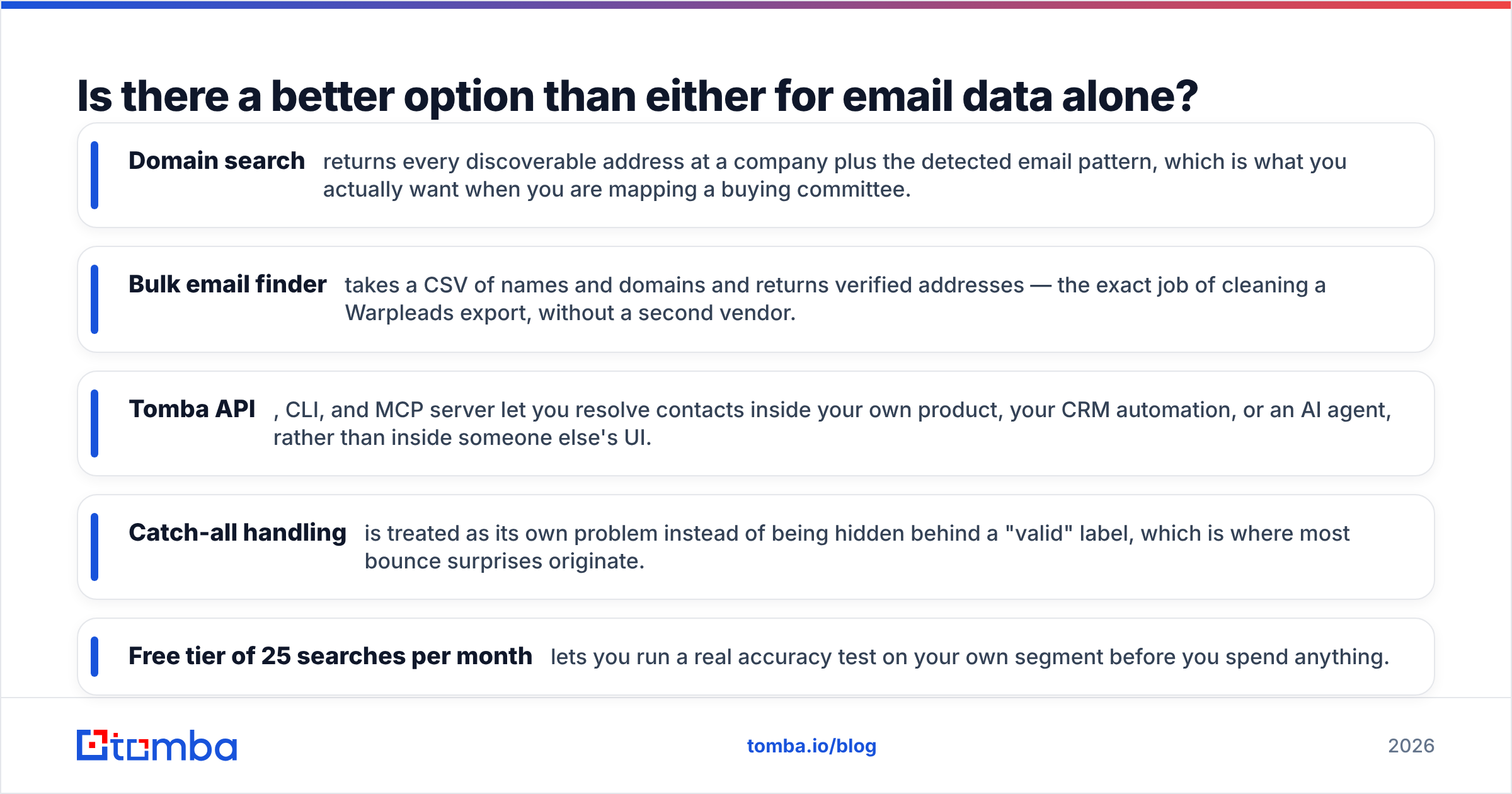
- Domain search returns every discoverable address at a company plus the detected email pattern, which is what you actually want when you are mapping a buying committee.
- Bulk email finder takes a CSV of names and domains and returns verified addresses — the exact job of cleaning a Warpleads export, without a second vendor.
- Tomba API, CLI, and MCP server let you resolve contacts inside your own product, your CRM automation, or an AI agent, rather than inside someone else's UI.
- Catch-all handling is treated as its own problem instead of being hidden behind a "valid" label, which is where most bounce surprises originate.
- Free tier of 25 searches per month lets you run a real accuracy test on your own segment before you spend anything.
The trade-off is honest: Tomba does not send email and does not sell you a pre-built list of 200 million contacts. You bring the targets; it returns clean data. For a lot of teams, that's the piece that was broken.
Interseller vs Warpleads: the verdict#
Recruiters with an ATS: Interseller. Nothing else in this comparison writes candidate activity back to Greenhouse or Bullhorn as cleanly, and the sequencer removes a tool from your stack.
Agencies and high-volume outbound: Warpleads. The cost per record is an order of magnitude better than per-seat sourcing tools, provided you pair it with real verification and warmed infrastructure.
Everyone else — SaaS sales teams, RevOps, founders doing their own prospecting: neither, exactly. You need accurate emails on demand, an API that plugs into what you already built, and a bill that does not scale with headcount.
Run the test yourself before committing to any of the three. Pull 100 contacts from your real ICP, run them through each tool, send to a seed list, and count hard bounces. That 30-minute exercise will tell you more than any comparison post, including this one.
Start with the free tier of the Tomba Email Finder — 25 searches a month, no card required — and benchmark it against whatever you're paying for now. If the accuracy holds on your segment, Starter at $49/mo replaces a line item several times that size.
Related guides#
Ready to find emails that actually work?
Join 150,000+ professionals who stopped guessing and started sending. Free credits on signup — no credit card required.
Get the Tomba newsletter
Practical outbound tactics and product updates — once every two weeks.
About the author