9 Best Interzoid Alternatives in 2026 for Data Quality APIs
Interzoid's matching and validation APIs are developer-friendly but narrow. Here are nine alternatives ranked by accuracy, coverage, pricing model, and how painful the migration actually is.
TL;DR
- Interzoid is a developer-first set of data quality APIs — fuzzy matching for company names, addresses, and city data, plus email and phone validation. It is genuinely good at similarity matching and genuinely limited everywhere else.
- Most teams search for Interzoid alternatives for one of three reasons: they need contact discovery (not just cleanup), they need a UI their RevOps team can use without writing code, or they need higher-volume pricing than per-call credits allow.
- If your real problem is "our CRM has 40,000 records and half the emails bounce," you need a finder plus verifier, not a string-similarity endpoint.
- Best all-round replacement for B2B contact data: Tomba. Best for postal/address-heavy work: Melissa. Best for enterprise record linkage: Data Ladder or Talend. Best for ready-built lists: BookYourData.
- Migration is usually a two-week job, not a quarter-long project — as long as you map fields before you swap endpoints.
What is Interzoid, and what does it actually do?#
Interzoid sells cloud data quality as a collection of small, single-purpose REST endpoints. You send a string, you get back a normalized value or a "similarity key" — a hashed representation that makes Acme Corp., ACME Corporation, and Acme Corp Inc collapse into the same bucket. That similarity key approach is the product's actual innovation, and it works well.
The catalogue spans company name matching, individual name matching, address standardization, city/state/postal normalization, email validation, phone validation, plus a handful of reference APIs (currency rates, weather, time zones). It's distributed directly and through cloud marketplaces, so procurement is easy if you're already on AWS or Azure committed spend.
What Interzoid is not: a contact database, a prospecting tool, or a platform with a workspace your sales ops lead can log into on a Tuesday and fix a list. It assumes there is an engineer in the loop. For a lot of teams that assumption held in 2021 and stopped holding somewhere around the second round of GTM headcount cuts.

Why do teams look for Interzoid alternatives?#
Five patterns come up repeatedly when people describe why they're shopping:
- Cleanup isn't the bottleneck — acquisition is. Normalizing a bad record still leaves you with a bad record. If 30% of your CRM rows have no email at all, a matching API can't help; you need something that finds the address from a name and domain.
- No interface for non-engineers. Every enrichment request routes through a developer ticket. That's fine at 500 records a month and miserable at 50,000.
- Per-call pricing gets uncomfortable at scale. Credit-metered endpoints are cheap to trial and expensive to run continuously across a warehouse sync.
- Validation depth. Syntax and MX checks catch obvious garbage. They don't catch a valid-looking mailbox that was deprovisioned nine months ago, and they don't resolve catch-all domains — which is where most bounce risk actually lives.
- Coverage outside the US. Address and postal normalization quality varies sharply by country across every vendor in this space, Interzoid included. If you sell into DACH, Japan, or LATAM, test before you commit.
What should you compare when replacing Interzoid?#
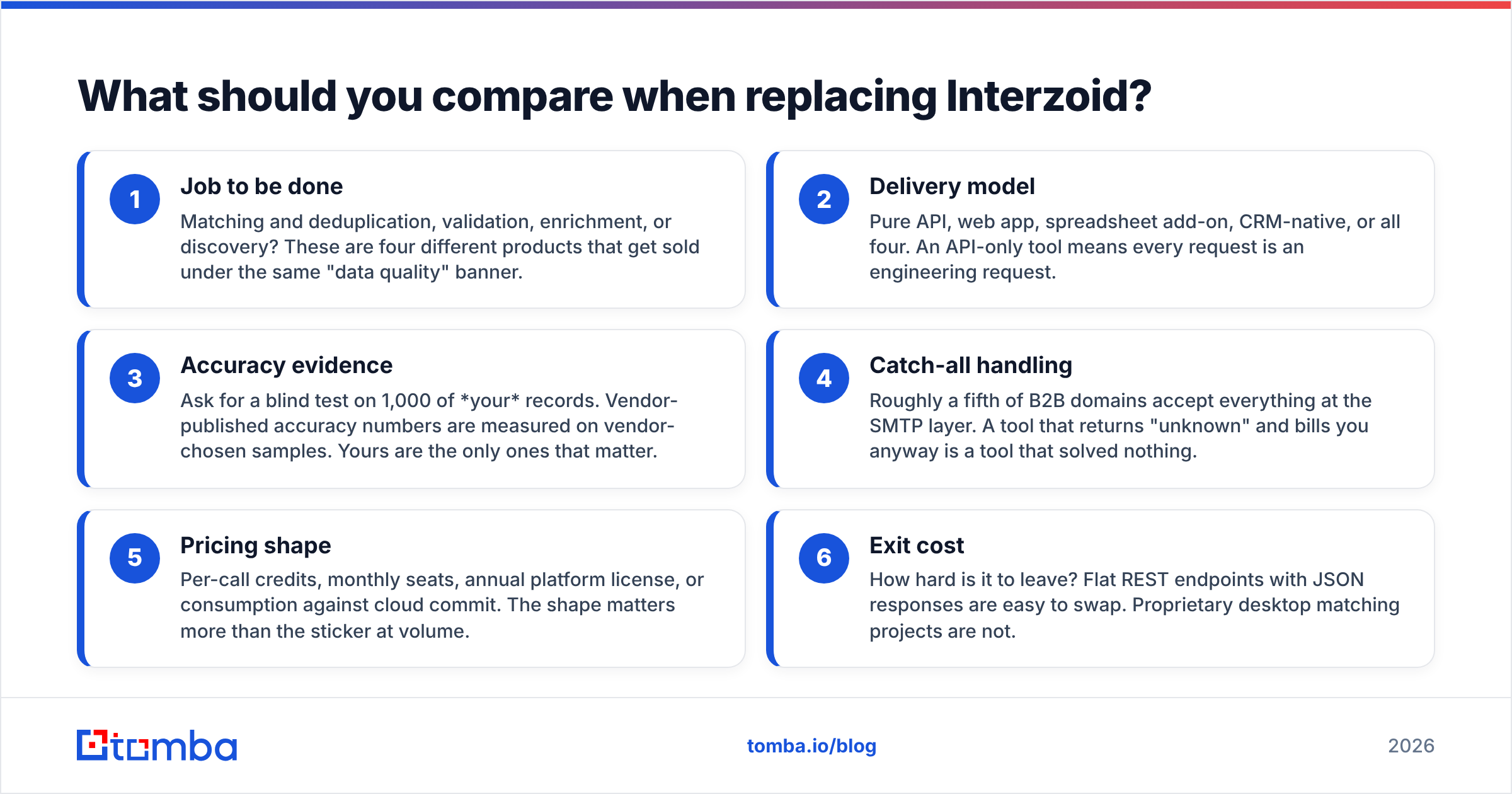
Before you look at a single vendor page, decide which of these six dimensions you're actually optimizing for. Most teams pick the wrong alternative because they compared on price against a feature set they don't need.
- Job to be done — Matching and deduplication, validation, enrichment, or discovery? These are four different products that get sold under the same "data quality" banner.
- Delivery model — Pure API, web app, spreadsheet add-on, CRM-native, or all four. An API-only tool means every request is an engineering request.
- Accuracy evidence — Ask for a blind test on 1,000 of your records. Vendor-published accuracy numbers are measured on vendor-chosen samples. Yours are the only ones that matter.
- Catch-all handling — Roughly a fifth of B2B domains accept everything at the SMTP layer. A tool that returns "unknown" and bills you anyway is a tool that solved nothing.
- Pricing shape — Per-call credits, monthly seats, annual platform license, or consumption against cloud commit. The shape matters more than the sticker at volume.
- Exit cost — How hard is it to leave? Flat REST endpoints with JSON responses are easy to swap. Proprietary desktop matching projects are not.
Which Interzoid alternatives are worth evaluating in 2026?#
Here is the shortlist, grouped by what they replace rather than by vanity ranking.
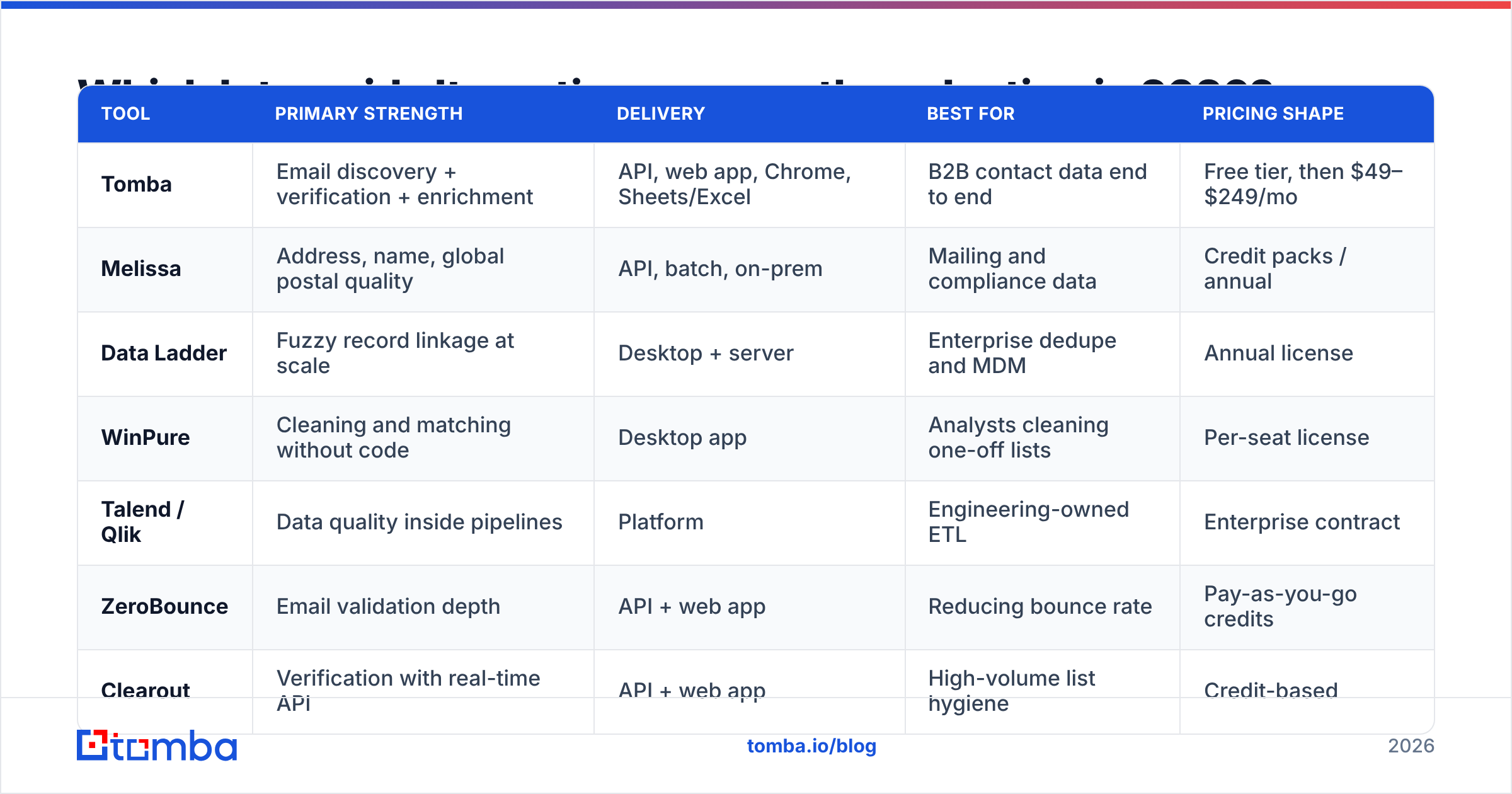
| Tool | Primary strength | Delivery | Best for | Pricing shape |
|---|---|---|---|---|
| Tomba | Email discovery + verification + enrichment | API, web app, Chrome, Sheets/Excel | B2B contact data end to end | Free tier, then $49–$249/mo |
| Melissa | Address, name, global postal quality | API, batch, on-prem | Mailing and compliance data | Credit packs / annual |
| Data Ladder | Fuzzy record linkage at scale | Desktop + server | Enterprise dedupe and MDM | Annual license |
| WinPure | Cleaning and matching without code | Desktop app | Analysts cleaning one-off lists | Per-seat license |
| Talend / Qlik | Data quality inside pipelines | Platform | Engineering-owned ETL | Enterprise contract |
| ZeroBounce | Email validation depth | API + web app | Reducing bounce rate | Pay-as-you-go credits |
| Clearout | Verification with real-time API | API + web app | High-volume list hygiene | Credit-based |
| AbstractAPI | Micro-APIs for single checks | API only | Developers wanting one endpoint | Free tier + monthly |
| BookYourData | Prebuilt, verified B2B contact lists | Self-serve list builder | Teams who need records now | Pay-per-record credits |
1. Tomba — best overall if your data is B2B contacts#
Tomba replaces the part of Interzoid most people are actually using it for: making contact records usable. The difference is directional. Interzoid cleans what you already have; Tomba finds what you're missing and then verifies it.
The stack covers find email addresses from a name and domain, domain search to pull every published address at a company, a catch-all verifier that resolves the ambiguous 20% other tools give up on, data enrichment for firmographics, and a phone finder. Everything is available through the same Tomba API, a CLI, Sheets and Excel add-ons, and a browser extension — so the RevOps team stops filing tickets.
Pricing is transparent and seat-free: a free tier at 25 searches per month, Starter at $49/mo, Growth at $99/mo, Pro at $249/mo, and custom enterprise terms. Full Tomba pricing is public, which is not universally true in this category.
Where it isn't the answer: if your problem is postal address standardization for physical mail, or deduplicating a 9-million-row customer master, Tomba is the wrong shape. Use Melissa or Data Ladder for that.
2. Melissa — best for address and global postal quality#
Melissa has been doing address verification since the 1980s and it shows in the coverage. Global address validation across 240+ countries, name parsing, geocoding, property data, and identity verification. If Interzoid's getaddressinfo endpoint is the one you call most, Melissa is the straight upgrade.
It's heavier than Interzoid — more surface area, more configuration, real onboarding. But for anything compliance-adjacent (KYC, insurance, shipping), the depth is the point.
3. Data Ladder — best for enterprise record linkage#
DataMatch Enterprise from Data Ladder is what you buy when "fuzzy matching" means reconciling four systems with three million records each and defending the survivorship rules to an auditor. Phonetic, numeric, and domain-specific algorithms, tunable thresholds, and a match review UI.
It is a licensed platform, not a per-call API, so the economics invert: expensive to start, cheap per record at volume. Wrong choice for a startup, right choice for an MDM program.
4. WinPure — best no-code cleaning for analysts#
WinPure sits between a spreadsheet and Data Ladder. Desktop application, visual matching setup, connectors to SQL and CRM sources. An analyst can dedupe a 200,000-row list in an afternoon without writing a line of code.
The trade-off is automation: it's a tool a human drives, not a service your pipeline calls at 3am.
5. Talend / Qlik Data Quality — best if engineering owns the pipeline#
If your data quality rules belong inside ETL rather than beside it, Talend (now part of Qlik) folds profiling, standardization, and matching directly into the job graph. You stop making HTTP calls per row and start enforcing quality as a transformation step.
This is a platform commitment with a platform price. Evaluate it when data quality is a program, not a task.

6. ZeroBounce — best pure email validation depth#
Interzoid's email validation is a competent syntax-plus-MX check. ZeroBounce goes further: catch-all detection, abuse and spam-trap flagging, activity data, and an appended-data layer. If your KPI is bounce rate, this is a meaningful step up.
It's also single-purpose. You'll still need something else for finding addresses and something else again for matching. Worth comparing against Tomba's email verifier, which bundles verification with discovery instead of billing them separately — and see our ZeroBounce alternative breakdown if you want the side-by-side.
7. Clearout — best budget verification at volume#
Clearout covers the same job as ZeroBounce with aggressive credit pricing and a solid real-time API for form-level validation. Popular with agencies running large, lower-margin list cleaning. Fewer enrichment extras, faster to plug in.
8. AbstractAPI — closest philosophical match to Interzoid#
If what you liked about Interzoid was the shape — small, independent, well-documented endpoints you can drop into any service — AbstractAPI is the nearest analogue. Email validation, phone validation, company enrichment, IP geolocation, each as its own API with its own free tier.
It's a developer convenience layer, not a data quality program. Match quality on company enrichment is lighter than the specialists above.
9. BookYourData — best when you need records, not cleanup#
Different answer to the same underlying problem. Instead of fixing or finding contacts one at a time, BookYourData lets you build and buy a filtered B2B list outright — by title, industry, geography, tech stack — with verification applied before delivery and a pay-per-record model with no subscription lock-in.
It's a legitimately strong option when the constraint is time rather than tooling, and it pairs well with a verifier on your side to re-check records before a send. Teams often run BookYourData for net-new list acquisition and an API-based tool for ongoing hygiene.
How do you choose between them?#
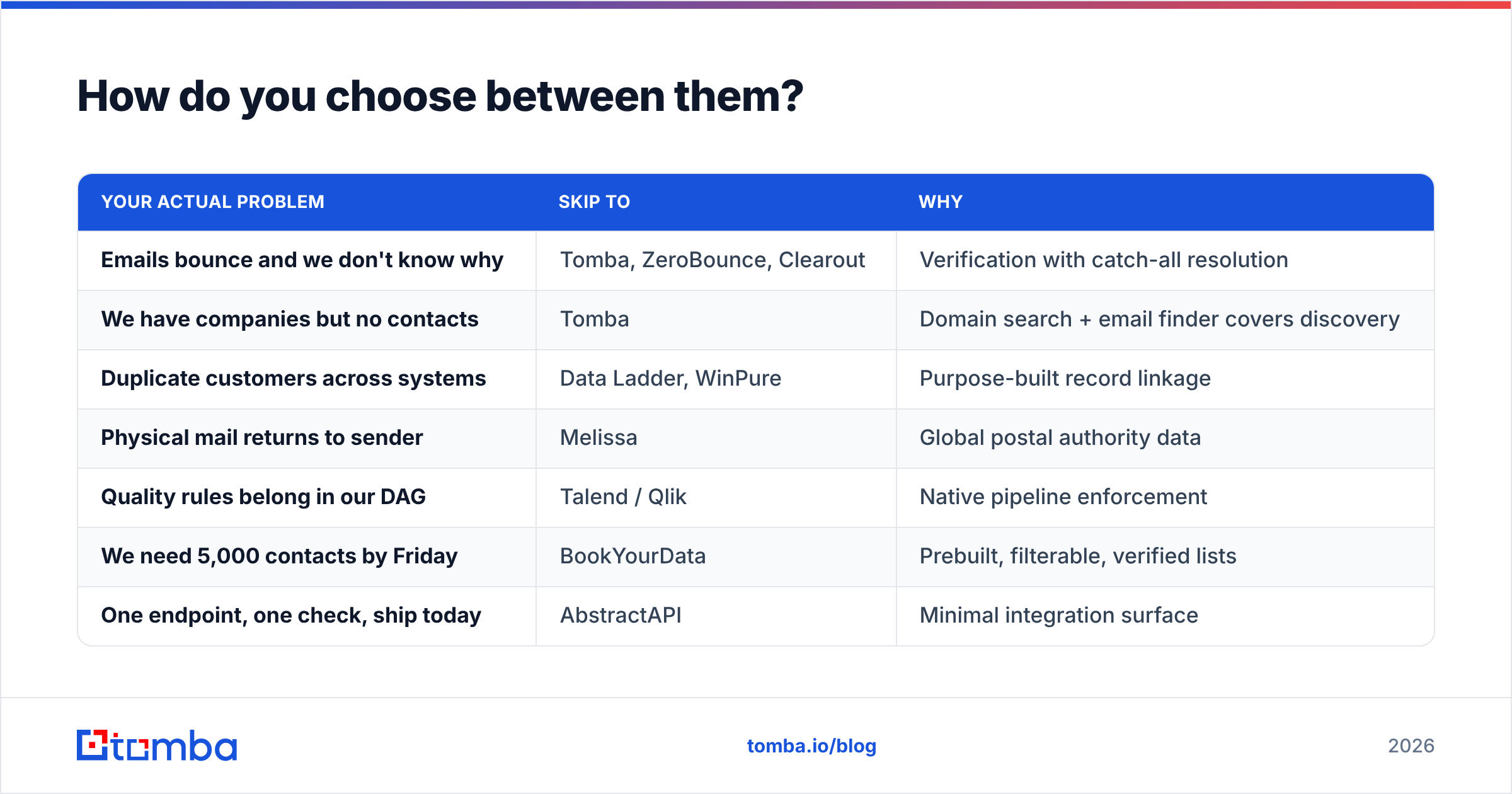
Map the job, not the vendor:
| Your actual problem | Skip to | Why |
|---|---|---|
| Emails bounce and we don't know why | Tomba, ZeroBounce, Clearout | Verification with catch-all resolution |
| We have companies but no contacts | Tomba | Domain search + email finder covers discovery |
| Duplicate customers across systems | Data Ladder, WinPure | Purpose-built record linkage |
| Physical mail returns to sender | Melissa | Global postal authority data |
| Quality rules belong in our DAG | Talend / Qlik | Native pipeline enforcement |
| We need 5,000 contacts by Friday | BookYourData | Prebuilt, filterable, verified lists |
| One endpoint, one check, ship today | AbstractAPI | Minimal integration surface |
The common mistake: buying a matching platform when you have an acquisition problem. Matching improves the records you have. It cannot create the ones you don't. Contact data decays somewhere around 25–30% a year through job changes alone, which means a pure-cleanup strategy loses ground every quarter no matter how good the algorithm is.
How do you migrate off Interzoid without breaking things?#
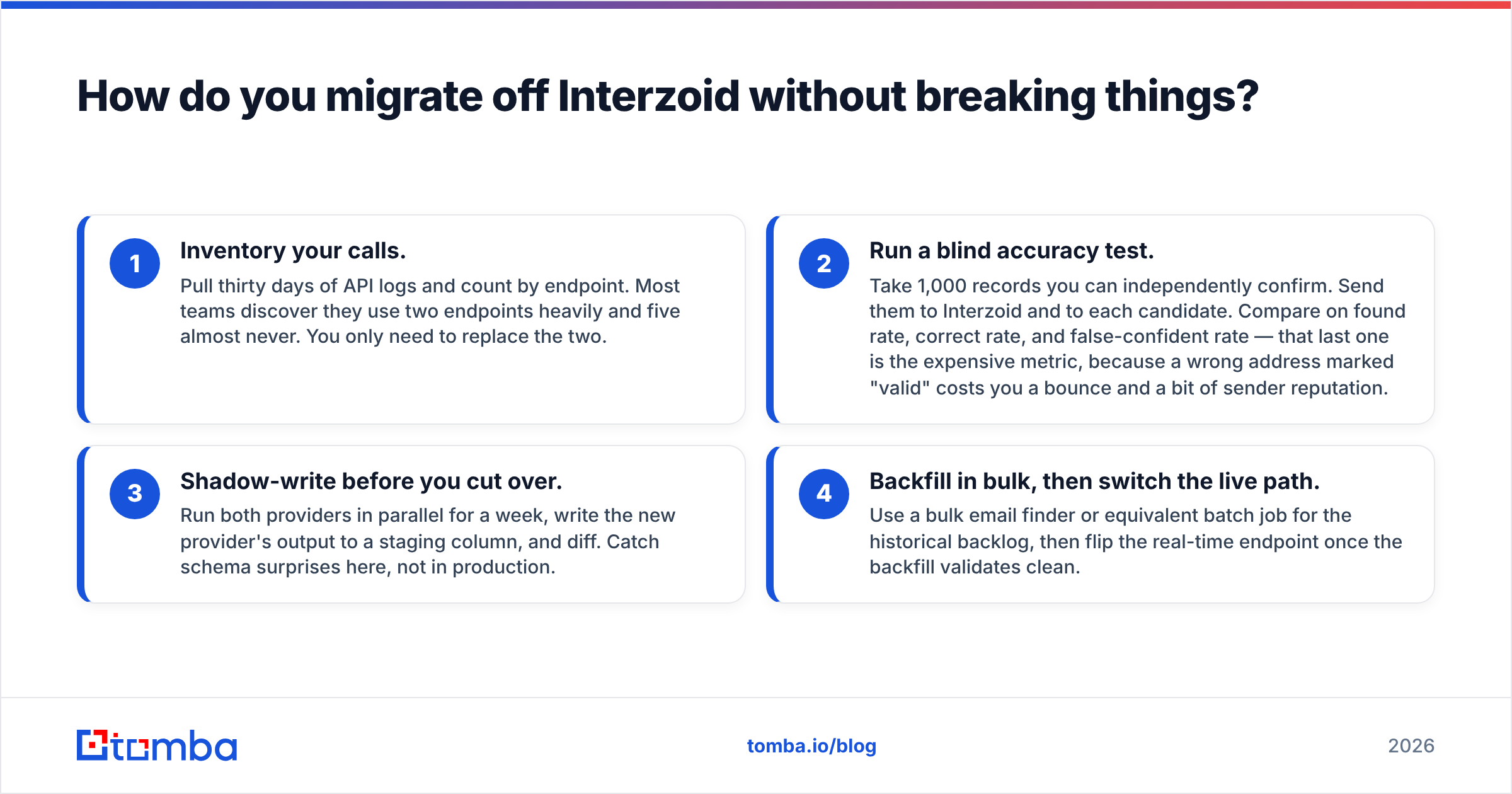
Four steps, roughly two weeks of real work:
- Inventory your calls. Pull thirty days of API logs and count by endpoint. Most teams discover they use two endpoints heavily and five almost never. You only need to replace the two.
- Run a blind accuracy test. Take 1,000 records you can independently confirm. Send them to Interzoid and to each candidate. Compare on found rate, correct rate, and false-confident rate — that last one is the expensive metric, because a wrong address marked "valid" costs you a bounce and a bit of sender reputation.
- Shadow-write before you cut over. Run both providers in parallel for a week, write the new provider's output to a staging column, and diff. Catch schema surprises here, not in production.
- Backfill in bulk, then switch the live path. Use a bulk email finder or equivalent batch job for the historical backlog, then flip the real-time endpoint once the backfill validates clean.
Keep response schemas normalized behind your own internal interface. The teams who find migrations painful are the ones who let a vendor's JSON shape leak into forty downstream services. Check G2's data quality category for current user reviews before you shortlist, but treat aggregate scores as a filter, not a decision.
What's the honest verdict?#
Interzoid remains a reasonable tool for exactly what it was built for: lightweight, developer-driven similarity matching and normalization, billed per call, procurable through a cloud marketplace. If that's your workload and it's working, there's no urgent reason to move.
Move when the job changes. The moment your constraint shifts from "these records are messy" to "these records are missing, stale, or unreachable," a matching API is the wrong instrument — and no amount of tuning fixes an instrument mismatch.
Start where the leverage is. If your pipeline depends on reaching real people at real companies, put discovery and verification in the same system instead of stitching three vendors together. Tomba Email Finder finds addresses from a name and domain, verifies them before they enter your CRM, and resolves catch-all domains other tools skip — with a free tier at 25 searches a month, so you can run your own blind accuracy test before you spend anything.
Related guides#
// get started
Find, verify and enrich your first contacts today
Start on the free plan with 25 searches a month, then scale when your team is ready.
Free plan · No credit card required · GDPR & CCPA
// about the author