Istari.ai vs Tomba (2026): Which B2B Data Tool Wins?
Istari.ai reads the web to tell you what a company does. Tomba tells you who to email there. Here is the honest breakdown of where each one wins, what each costs, and when using both beats picking one.
Istari.ai vs Tomba is not the head-to-head it looks like. One tool tells you which companies to chase. The other tells you who to email there. Here is where each one wins, what each costs, and when running both beats picking one.
TL;DR
- Istari.ai vs Tomba is really a comparison of two different jobs. Istari.ai builds company-level intelligence by mining web content. Tomba finds and verifies the person-level email addresses you actually send to.
- Pick Istari.ai if your bottleneck is account selection: sorting industries, spotting technology or sustainability signals, or mapping a market across thousands of firms.
- Pick Tomba if your bottleneck is contactability: you already know the accounts and need verified emails, phone numbers, and enrichment at a set price.
- Pricing is the sharpest practical difference. Tomba publishes its plans: a free tier, $49/mo Starter, $99/mo Growth, and $249/mo Pro. Istari.ai is quote-based, so expect a sales call before you see a number.
- For most outbound teams in 2026, the best setup is both, in order. Use web signals to choose accounts, then contact data to reach them.
Istari.ai vs Tomba: what each tool actually does#
Start with the honest framing. Most Istari.ai vs Tomba comparisons on the web pretend these two tools do the same job. They don't.
Istari.ai is a web-intelligence company based in Mannheim, Germany. Its core idea is simple. A company's own website is the freshest description of what that company does — fresher than a registry filing or a static industry code.
So Istari.ai crawls company web content at scale and runs NLP models over it. The output is structured signals: what the business sells, which technologies it mentions, whether it talks about AI, digital tools, or sustainability, and how it should be classified. It sells mainly to research institutions, economic-development bodies, consultancies, and enterprise strategy teams.
Tomba is a B2B contact-data platform. Its centre of gravity is the email finder. Give it a name and a domain, or just a domain, and it returns professional email addresses with a confidence score and the public sources behind them.
Around that sit an email verifier, domain search, catch-all verification, a phone finder, and data enrichment. The job is narrow and deep: turn a company or a person into a contact point you can use.
So the real question is not which tool is better. It is which half of the prospecting problem is costing you money right now.
Istari.ai vs Tomba: the head-to-head table#
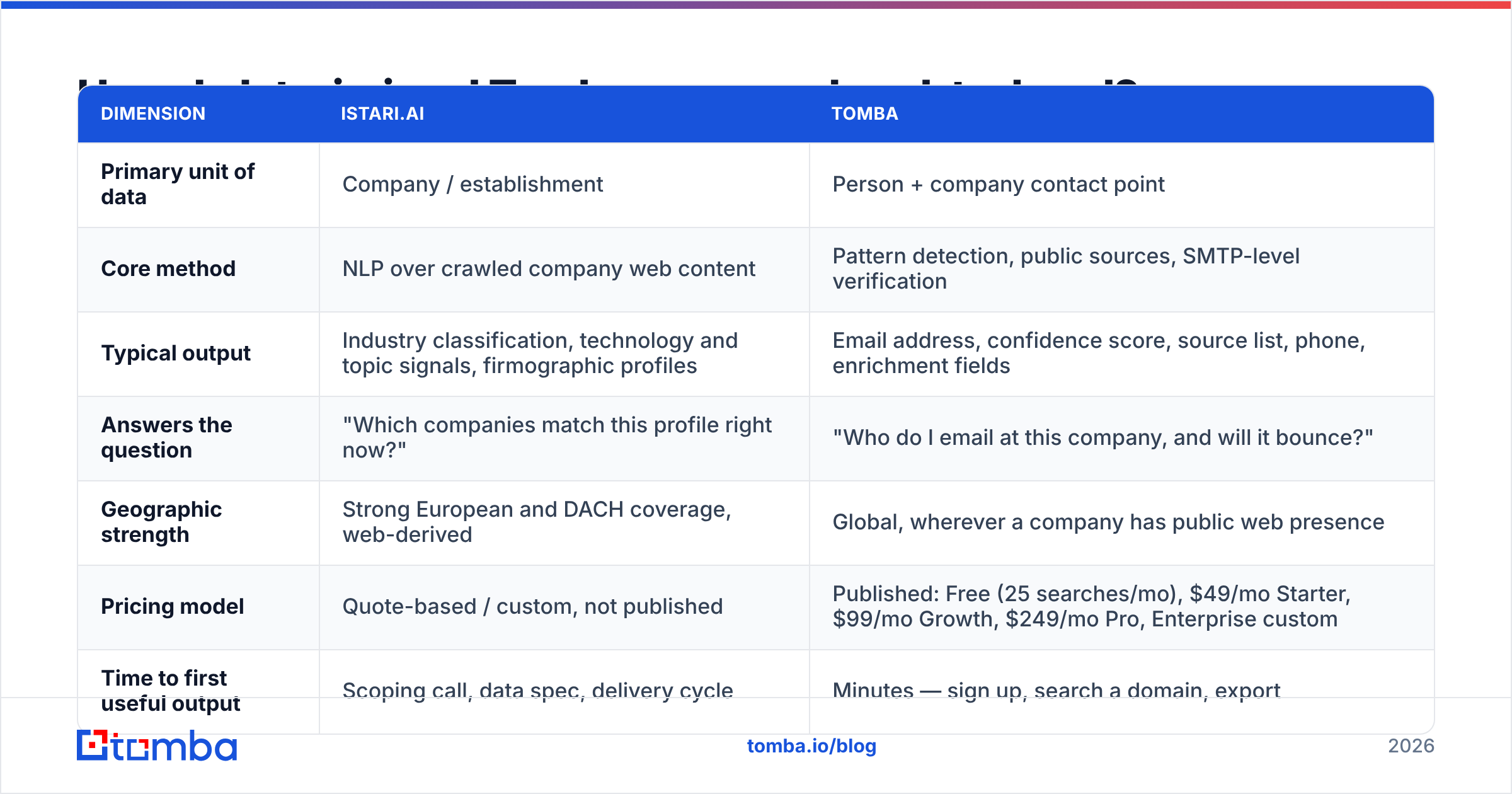
| Dimension | Istari.ai | Tomba |
|---|---|---|
| Primary unit of data | Company / establishment | Person + company contact point |
| Core method | NLP over crawled company web content | Pattern detection, public sources, SMTP-level verification |
| Typical output | Industry classification, technology and topic signals, firmographic profiles | Email address, confidence score, source list, phone, enrichment fields |
| Answers the question | Which companies match this profile right now? | Who do I email at this company, and will it bounce? |
| Geographic strength | Strong European and DACH coverage, web-derived | Global, wherever a company has public web presence |
| Pricing model | Quote-based / custom, not published | Published: Free (25 searches/mo), $49/mo Starter, $99/mo Growth, $249/mo Pro, Enterprise custom |
| Time to first useful output | Scoping call, data spec, delivery cycle | Minutes — sign up, search a domain, export |
| Best-fit buyer | Research teams, analysts, enterprise market intelligence | SDR teams, agencies, founders, recruiters, RevOps |
| API access | Yes, enterprise-oriented | Yes, self-serve Tomba API with CLI, Sheets, and Chrome extension |
Read that table as a division of labour, not a scoreboard. Istari.ai sits upstream of the email. Tomba is the email.
Istari.ai vs Tomba: which one solves the expensive problem?#
Here is the part most teams get wrong. They assume the hard part of outbound is finding contacts. In practice, the costly failure sits further up the funnel. You emailed the wrong 2,000 companies flawlessly.
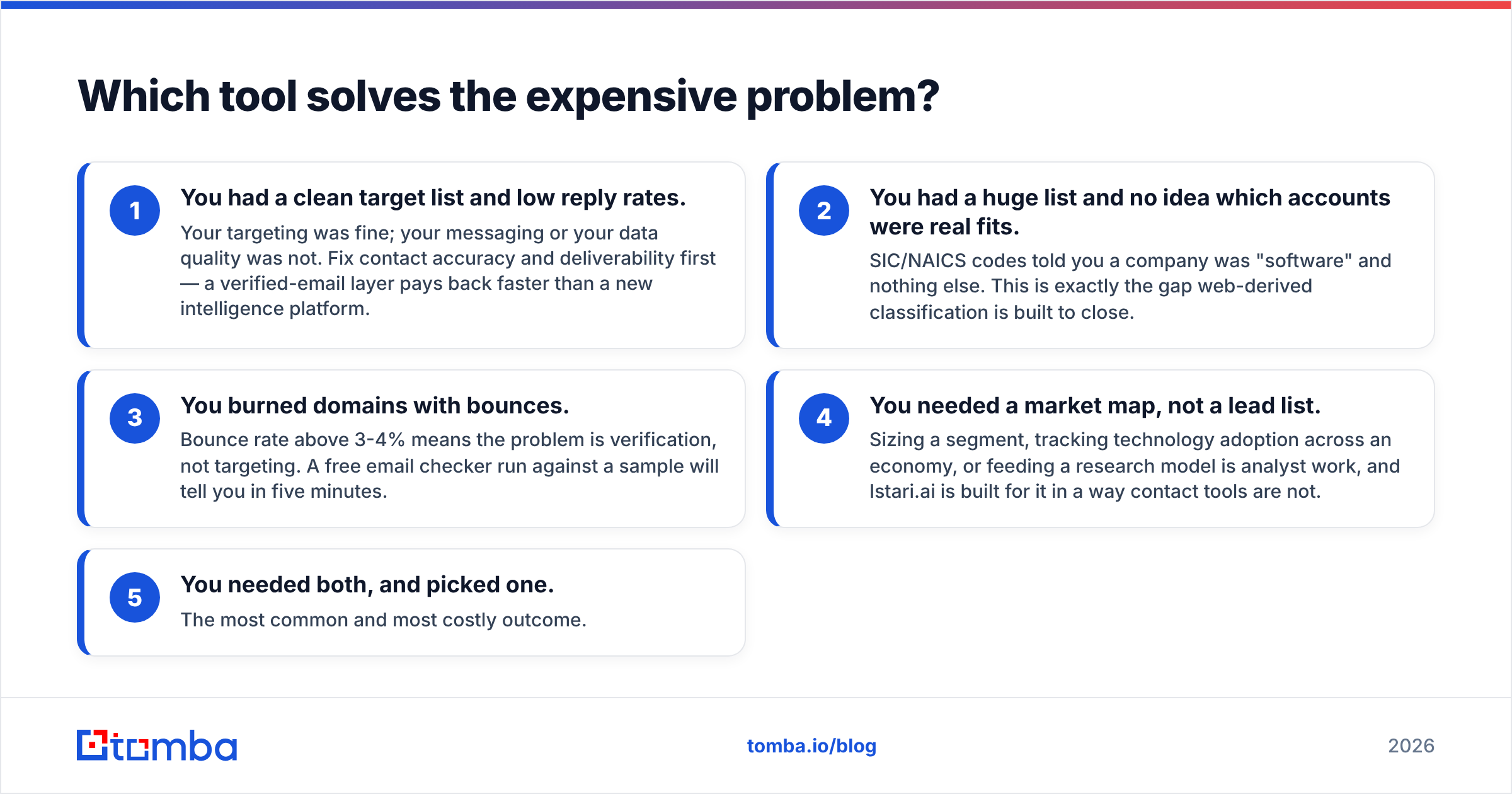
Work out which of these describes your last quarter:
- You had a clean target list and low reply rates. Your targeting was fine. Your messaging or your data quality was not. Fix contact accuracy and deliverability first — a verified-email layer pays back faster than a new intelligence platform.
- You had a huge list and no idea which accounts were real fits. SIC/NAICS codes told you a company was software and nothing else. This is the exact gap web-derived classification is built to close.
- You burned domains with bounces. A bounce rate above 3-4% means the problem is verification, not targeting. A free email checker run against a sample will tell you in five minutes.
- You needed a market map, not a lead list. Sizing a segment or tracking technology adoption across an economy is analyst work. Istari.ai is built for it in a way contact tools are not.
- You needed both, and picked one. The most common outcome, and the most costly.

Istari.ai vs Tomba: how accurate is each one?#
Accuracy means different things here. That is why head-to-head accuracy claims between these two products are mostly noise.
For Istari.ai, accuracy is a classification question. Does the model correctly label what a firm does, based on its web text? You measure that statistically, with precision and recall against a labelled sample.
The score drops in a predictable way when a company has a thin, old, or brochure-style website. A firm with a one-page site gives the model almost nothing to work with. Istari.ai is open about this. Its signal comes from web presence, which is both a real strength (fresh, behavioural) and a real limit: no web presence, no signal.
For Tomba, accuracy is a deliverability question. Will this address accept mail? That is measurable in a way classification never is. You send, and you either bounce or you don't.
Tomba attaches a confidence score and the public sources it used to every result. You can audit why an address came back instead of trusting a black box. The workflow is simple. Treat anything below your confidence threshold as unverified, run it through the verifier, and send catch-all domains to the catch-all verifier rather than guessing.
One warning applies to both. No vendor's marketing number survives contact with your own ICP. A provider quoting 98% accuracy on a global sample may deliver 70% on Nordic manufacturers with 12 staff. Test on 200 rows of your list before you commit budget. Both vendors make that easy — Tomba through its free tier, Istari.ai through a scoped pilot.
Istari.ai vs Tomba pricing: what does each cost?#
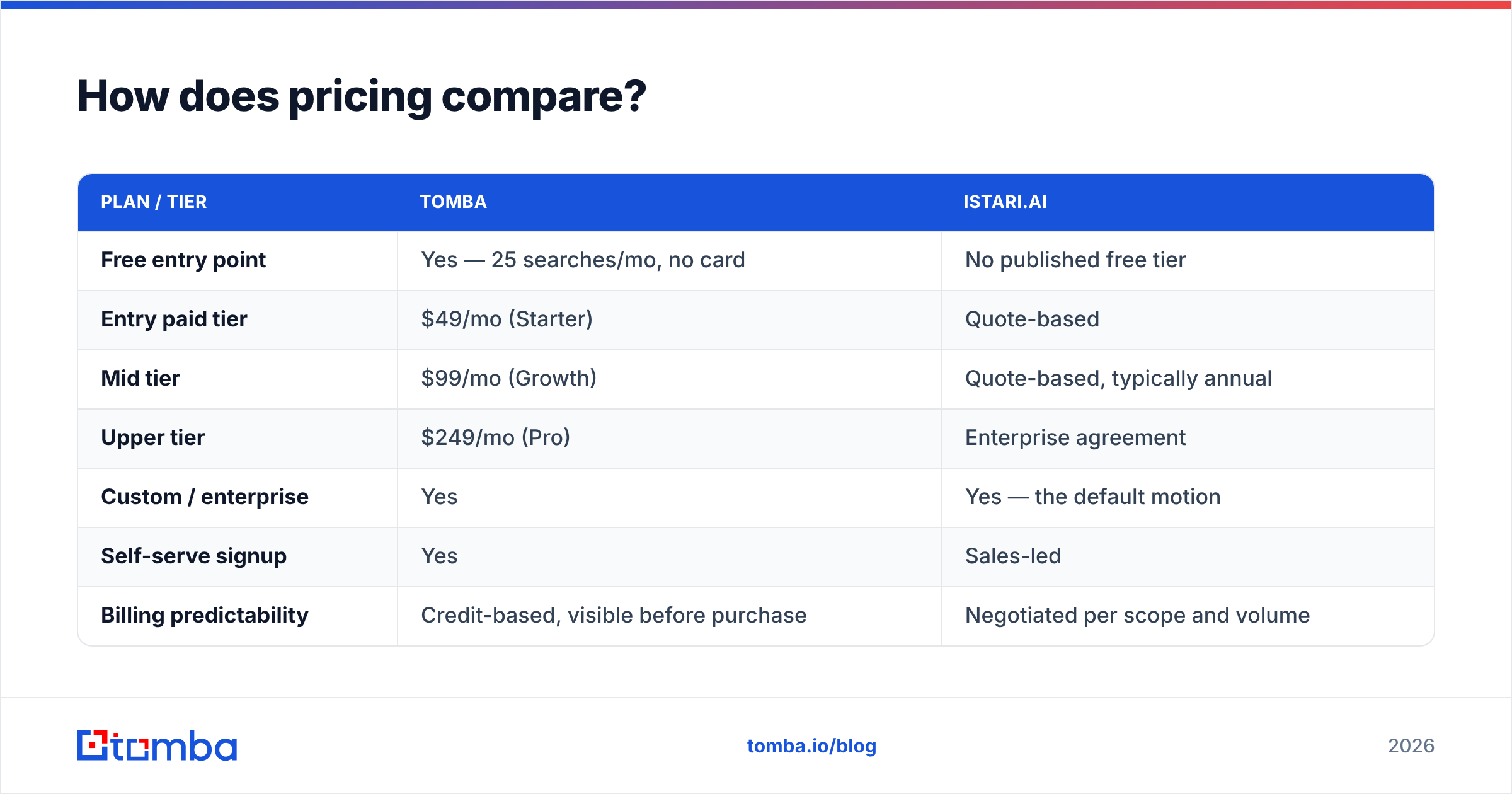
| Plan / tier | Tomba | Istari.ai |
|---|---|---|
| Free entry point | Yes — 25 searches/mo, no card | No published free tier |
| Entry paid tier | $49/mo (Starter) | Quote-based |
| Mid tier | $99/mo (Growth) | Quote-based, typically annual |
| Upper tier | $249/mo (Pro) | Enterprise agreement |
| Custom / enterprise | Yes | Yes — the default motion |
| Self-serve signup | Yes | Sales-led |
| Billing predictability | Credit-based, visible before purchase | Negotiated per scope and volume |
Full Tomba pricing is public, and that matters more than it sounds. A three-person startup can test the tool on a Tuesday afternoon. No call, no scoping document, no wait.
Istari.ai's sales-led model is normal for enterprise data. Scope really does vary per customer, and a research institute buying a national dataset signs a different contract from a consultancy buying one sector. But it turns a two-week evaluation into a two-month buying cycle. For a small team, that delay is a real cost.
Neither model is wrong. They aim at different buyers with different approval processes.
Is Istari.ai better than Tomba for outbound sales?#
For running outbound, no — and Istari.ai would not claim otherwise. Istari.ai produces company-level intelligence. It does not hand your SDR a verified inbox to write to. You still need a contact-data layer on top: Tomba, an alternative, or manual research.
For choosing who to run outbound at, Istari.ai is genuinely strong. That shows up most in European markets, where web-derived classification beats stale registry codes. Say your ICP is German mid-market manufacturers adopting industrial AI. A keyword-plus-NAICS filter in a generic sales database returns a mess. Web-text classification does not.
The Istari.ai vs Tomba decision rule is short:
- Account selection is your weak point → Istari.ai, or a similar web-intelligence layer.
- Contactability is your weak point → Tomba.
- Both are weak and budget is tight → Fix contactability first. Even average targeting with deliverable emails produces pipeline. Perfect targeting with bouncing emails produces a damaged sending domain.
That last point deserves emphasis. Poor list hygiene compounds. Every hard bounce chips away at sender reputation. Once mailbox providers throttle you, even a well-targeted campaign lands in spam.

Can you use both together?#
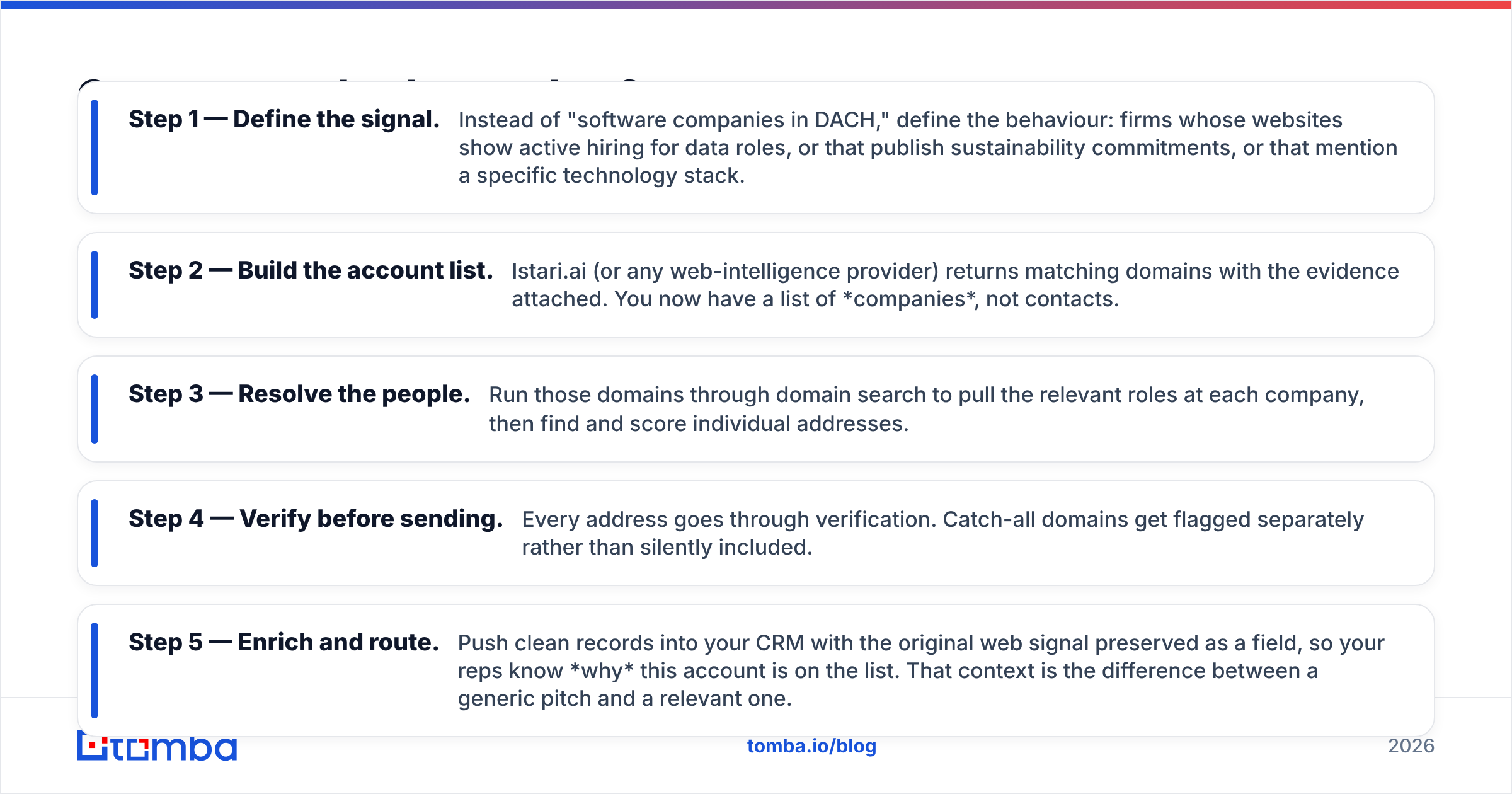
Yes. For most teams, the real answer to Istari.ai vs Tomba is both, in this order:
- Step 1 — Define the signal. Skip vague labels like software companies in DACH. Define the behaviour instead: firms hiring for data roles, or publishing sustainability commitments, or naming a specific technology stack.
- Step 2 — Build the account list. Istari.ai, or any web-intelligence provider, returns matching domains with the evidence attached. You now have a list of companies, not contacts.
- Step 3 — Resolve the people. Run those domains through domain search to pull the relevant roles, then find and score individual addresses.
- Step 4 — Verify before sending. Every address goes through verification. Catch-all domains get flagged separately, not quietly included.
- Step 5 — Enrich and route. Push clean records into your CRM and keep the original web signal as a field, so reps know why the account is on the list.
Step 5 is the one teams skip, and it is the one that lifts reply rates. A rep who knows the account was picked because it published an AI roadmap writes a different first line. A rep staring at a bare row of firmographics does not.
If you are comparing a wider field, vendor-neutral review data on G2 is worth an hour. It also helps to know what firmographics can and cannot tell you before you pay for a dataset built on them.
What are the honest drawbacks of each?#
Istari.ai's limits. Coverage depends on web presence, so small firms with thin sites are underserved. Classification gives you confidence, not certainty, and edge cases need a human to check them. The sales-led motion slows small buyers down. And it never closes the loop to a contactable human, so it is not a complete outbound stack on its own.
Tomba's limits. It is a contact-data tool, not a market-intelligence platform. It will not tell you which industries are heating up or which firms just pivoted. It will not invent an address for someone with no public footprint, and it shouldn't. Catch-all domains stay ambiguous for every vendor in this category, which is why they get their own workflow instead of being folded into a headline accuracy number.
A limit both share. Neither one writes your email. Data quality raises your ceiling. It does not raise your floor. A verified address on a badly targeted, badly written message is still a badly targeted, badly written message.
Istari.ai vs Tomba: which should you choose in 2026?#
Choose Istari.ai if you are an analyst, researcher, consultancy, or enterprise strategy team. Your core question is which companies look like this right now. You work mainly in European markets, and you have the budget and the patience for an enterprise data agreement.
Choose Tomba if you are an SDR team, agency, founder, or RevOps lead. Your core question is how to reach the decision-maker without bouncing. You want to start today, and you want to see the price before you talk to anyone.
Choose both if outbound is a material revenue channel and you have already felt the pain of spraying a badly chosen list, or of failing to reach a well-chosen one.
Start where the leverage is highest for you right now. If that is contactability, the Tomba Email Finder takes you from a domain to verified, source-backed addresses in minutes. The free tier gives you 25 searches a month, with no card and no scoping call.
Test it against 200 rows of your own list, measure the bounce rate, and let the numbers decide instead of the marketing copy.
Related guides#
// get started
Find, verify and enrich your first contacts today
Start on the free plan with 25 searches a month, then scale when your team is ready.
Free plan · No credit card required · GDPR & CCPA
// about the author