Jet Leads Pro vs RampedUp: Which B2B Data Tool Wins in 2026?
RampedUp is an established B2B data and enrichment platform. Jet Leads Pro is far less documented. Here is how the two stack up on coverage, verification, pricing transparency, and exactly what to test before you sign anything.
TL;DR
- RampedUp is an established B2B contact-data and enrichment platform with a real public footprint: a live site, CRM integrations, and third-party reviews you can read before you buy.
- Jet Leads Pro is a much thinner proposition. Public documentation, pricing, and independent reviews are scarce, which means the burden of proof sits entirely on the vendor's demo.
- Neither tool publishes self-serve pricing you can sanity-check in thirty seconds, so budget comparisons require a sales call — a real cost in evaluation time.
- The deciding factor is almost never the raw record count. It is deliverable records: verified, recently refreshed, and matched to the right person.
- If your core job is finding and verifying work emails at scale, a focused email-finder API usually beats a broad "sales intelligence suite" on cost per usable contact.
What are Jet Leads Pro and RampedUp?#
Start with what each one actually is, because the category label "B2B lead data" hides enormous differences.
RampedUp (rampedup.io) is a sales-intelligence and contact-data platform. It sells access to a B2B database of companies and people, plus enrichment that pushes data into your CRM. Historically it has been strongest with staffing, recruiting, and mid-market sales teams — the sort of buyer who needs to append missing fields to an existing CRM rather than build a prospect list from nothing. It integrates with mainstream CRMs and applicant-tracking systems, and it has an independent review presence on G2 and Capterra you can read before you talk to a rep.
Jet Leads Pro is the harder half of this comparison to write honestly. It presents itself as a lead-generation and contact-finding product, but there is very little independently verifiable material about it: no substantial review corpus, no public pricing page you can cite, no engineering documentation that tells you how the data is sourced or refreshed. That is not automatically damning — plenty of good tools start small and quiet. It does mean you should treat every claim as unverified until you've run your own test list through it.
A useful rule: when a vendor's own site is the only source of truth about that vendor, your trial has to do double duty. It is not just a feature check. It is the entire evidence base.

How do Jet Leads Pro and RampedUp compare at a glance?#
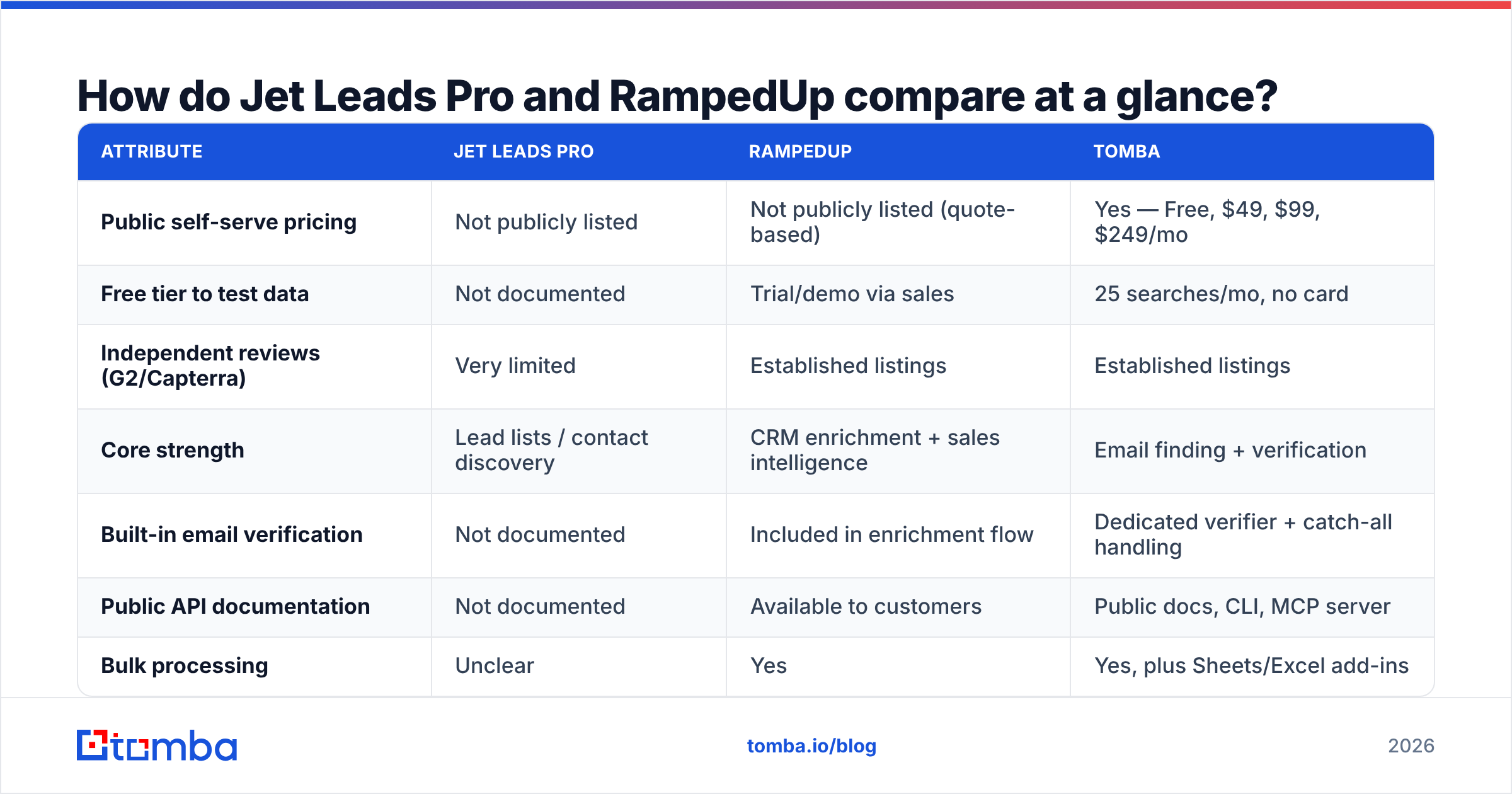
Here is the honest side-by-side. Where a value is not publicly documented, this table says so rather than inventing a number — which is itself a meaningful signal about how each vendor operates.
| Attribute | Jet Leads Pro | RampedUp | Tomba |
|---|---|---|---|
| Public self-serve pricing | Not publicly listed | Not publicly listed (quote-based) | Yes — Free, $49, $99, $249/mo |
| Free tier to test data | Not documented | Trial/demo via sales | 25 searches/mo, no card |
| Independent reviews (G2/Capterra) | Very limited | Established listings | Established listings |
| Core strength | Lead lists / contact discovery | CRM enrichment + sales intelligence | Email finding + verification |
| Built-in email verification | Not documented | Included in enrichment flow | Dedicated verifier + catch-all handling |
| Public API documentation | Not documented | Available to customers | Public docs, CLI, MCP server |
| Bulk processing | Unclear | Yes | Yes, plus Sheets/Excel add-ins |
| Best fit | Unverified — test first | Teams enriching an existing CRM | Teams building and cleaning lists |
Two things jump out. First, neither incumbent lets you price the tool without a conversation, which slows procurement and makes true cost-per-contact hard to model. Second, the "unclear" cells in the Jet Leads Pro column are not an editorial jab — they are the practical reality of evaluating a vendor with a thin public record.
What does RampedUp do well?#
RampedUp's real value is enrichment rather than discovery. If you already have ten thousand CRM records with half the fields blank — no title, no direct phone, no company size, stale employer — RampedUp is built to fill those gaps and keep them from rotting again.
Specifically, it tends to land well when:
- Your CRM is the system of record. Enrichment that writes back into Salesforce or HubSpot without a CSV round-trip saves genuine operations time. If you are still exporting, cleaning in a spreadsheet, and re-importing, you are paying a hidden salary tax every week.
- You recruit as well as sell. Staffing teams need person-level data — current employer, tenure, role history — that pure email-finder tools do not model.
- You want a managed relationship. A quote-based vendor with an account manager is slower to buy but easier to escalate to when data quality slips.
- You care about firmographics, not just contacts. Company-level attributes drive territory planning and scoring in a way a bare email address never will.
Where it is weaker: cost transparency, speed of onboarding, and the developer experience. If your workflow is "programmatically resolve a name plus a domain into a verified email, at volume, inside our own app," a full sales-intelligence suite is a heavy and expensive way to do a narrow job.
Where does Jet Leads Pro fit?#
Treat Jet Leads Pro as a candidate, not a known quantity. The category it targets — affordable lead lists and contact lookup for small teams — is legitimate and crowded, and smaller vendors sometimes win on price per record.
But price per record is the wrong metric. What matters is price per record that reaches a human inbox. A list that costs a third as much and bounces at 18% is not cheaper. It is more expensive, plus it damages your sender reputation, which quietly taxes every campaign you run for the next quarter.
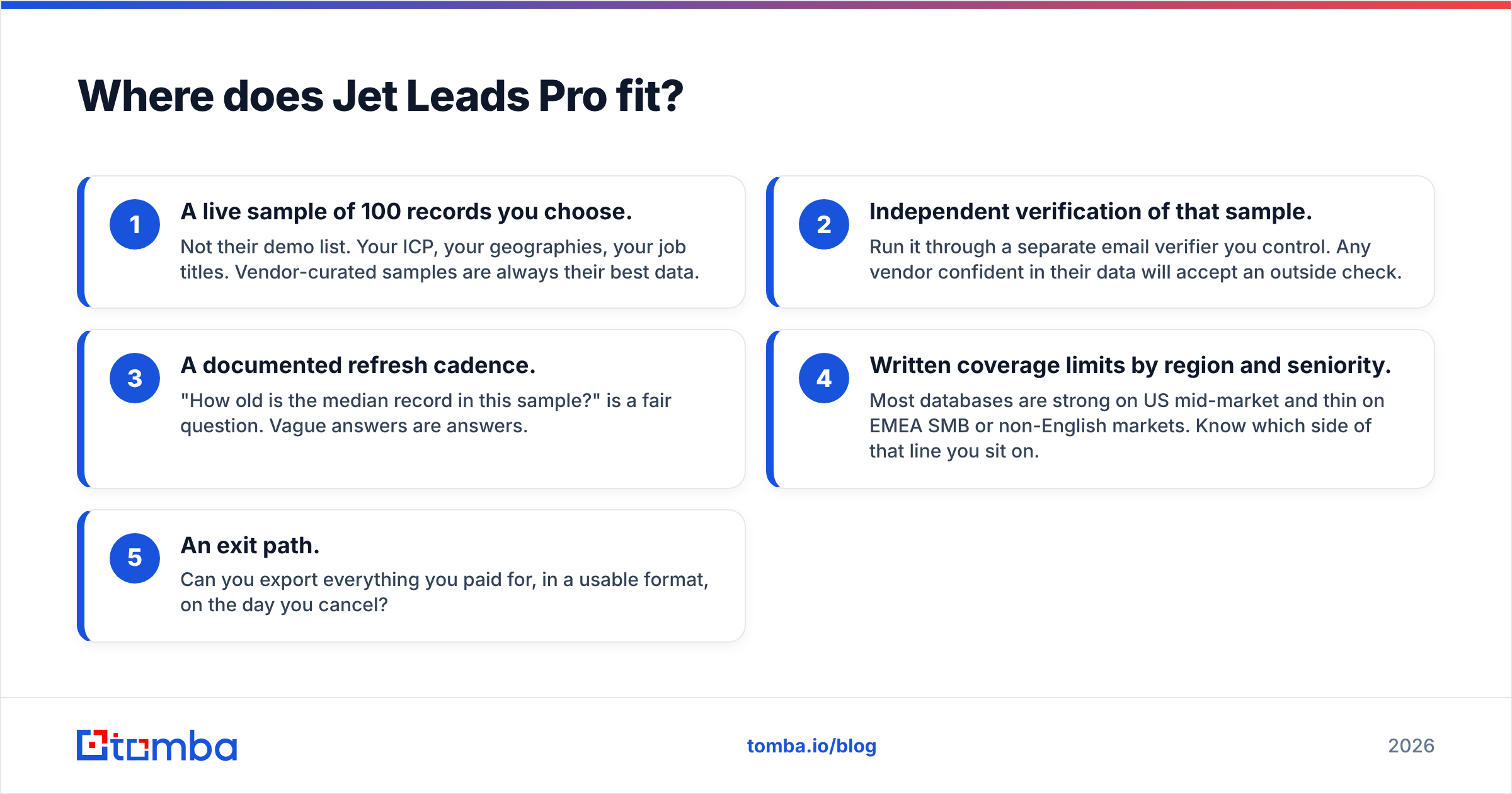
So if Jet Leads Pro is on your shortlist, insist on the following before any contract:
- A live sample of 100 records you choose. Not their demo list. Your ICP, your geographies, your job titles. Vendor-curated samples are always their best data.
- Independent verification of that sample. Run it through a separate email verifier you control. Any vendor confident in their data will accept an outside check.
- A documented refresh cadence. "How old is the median record in this sample?" is a fair question. Vague answers are answers.
- Written coverage limits by region and seniority. Most databases are strong on US mid-market and thin on EMEA SMB or non-English markets. Know which side of that line you sit on.
- An exit path. Can you export everything you paid for, in a usable format, on the day you cancel?
That checklist applies to every data vendor, including the well-known ones. It just matters more when the public record is thin.
Is data accuracy really the deciding factor?#
Yes — and it is measurable, which is why so many buyers avoid measuring it.
Run the same 200-contact test through both tools and score three numbers:
- Match rate: what percentage of your input rows returned any contact at all?
- Verified rate: of those, how many pass an independent SMTP-level check as valid rather than "accept-all" or "unknown"?
- Bounce rate in production: the only number that actually spends your money.
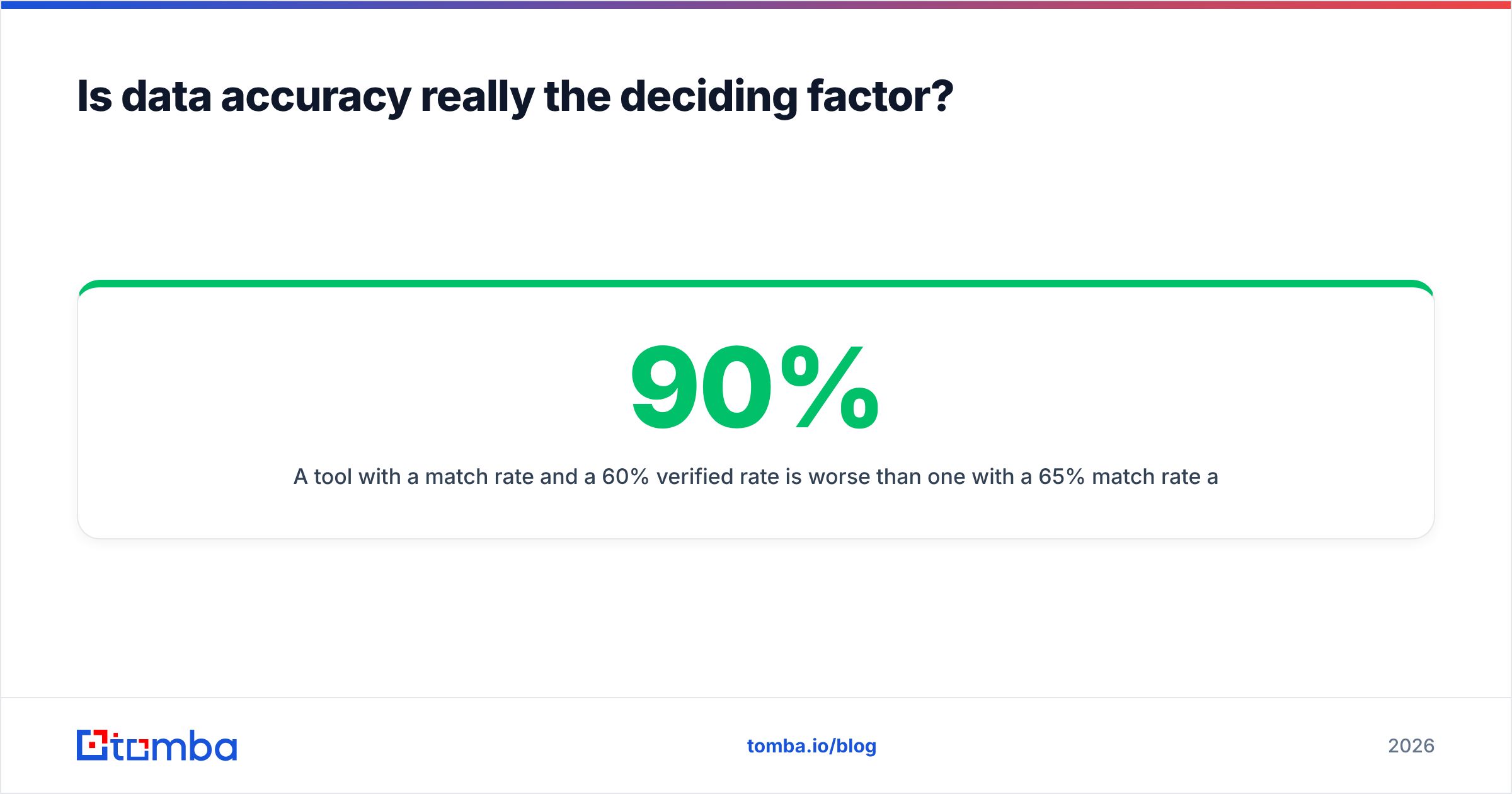
A tool with a 90% match rate and a 60% verified rate is worse than one with a 65% match rate and a 95% verified rate. The first floods your sequence with guesses; the second gives you fewer, better rows. Most buyers optimise the first number because it is the one vendors quote.
Catch-all domains are where this gets genuinely hard. A catch-all server accepts mail for every address at the domain, so naive verification returns "valid" for addresses that do not exist. If a meaningful slice of your ICP sits behind catch-all infrastructure — common in enterprise and in security-conscious industries — you need a tool with explicit catch-all verification rather than one that silently marks them deliverable. Ask both vendors directly how they handle catch-alls. The quality of the answer tells you a lot about the engineering behind the product.

What about pricing and hidden costs?#
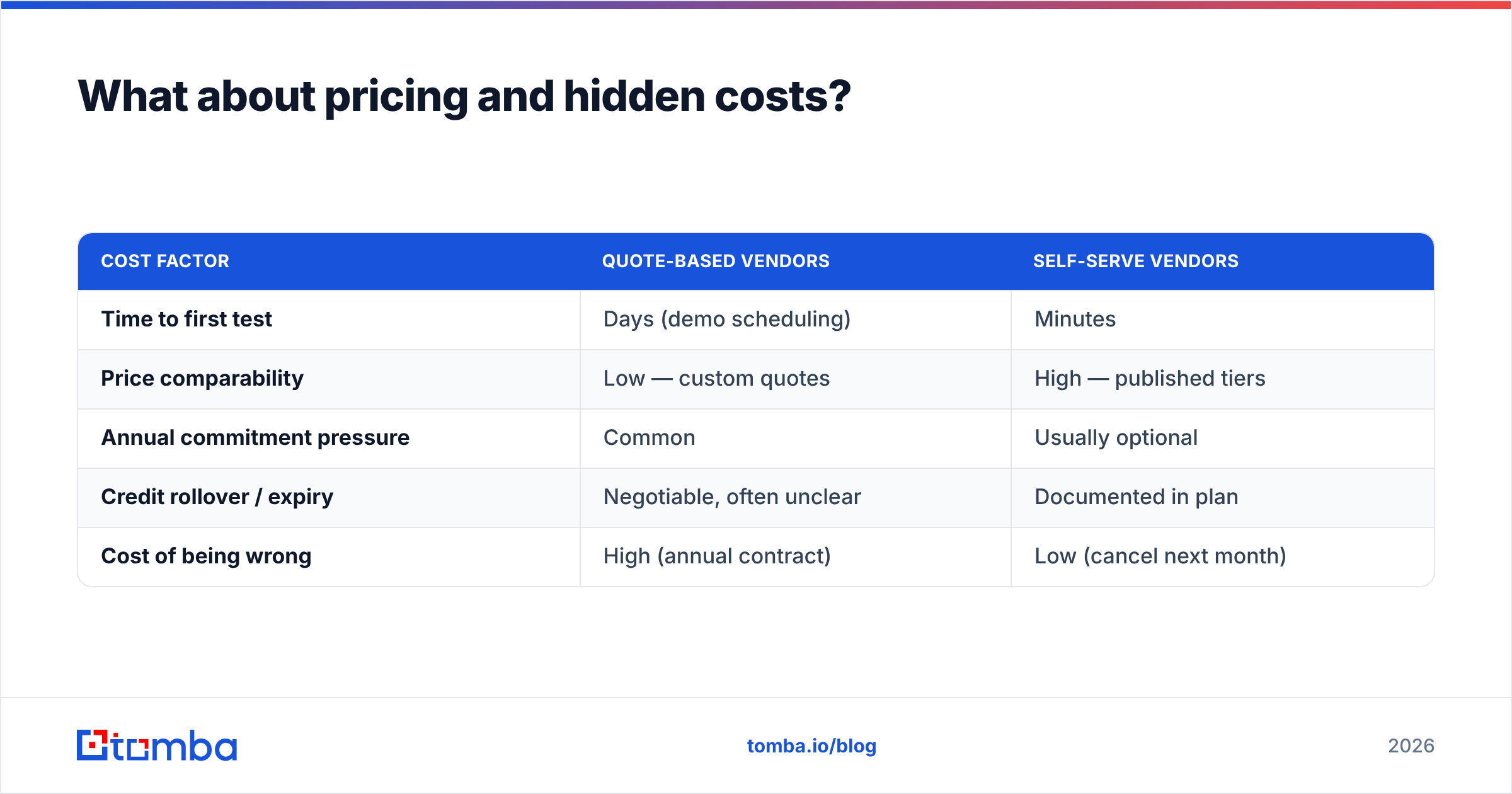
Neither Jet Leads Pro nor RampedUp publishes a price you can act on without a call. That is a defensible go-to-market choice for enterprise-leaning products, but it has consequences for you as a buyer:
| Cost factor | Quote-based vendors | Self-serve vendors |
|---|---|---|
| Time to first test | Days (demo scheduling) | Minutes |
| Price comparability | Low — custom quotes | High — published tiers |
| Annual commitment pressure | Common | Usually optional |
| Credit rollover / expiry | Negotiable, often unclear | Documented in plan |
| Cost of being wrong | High (annual contract) | Low (cancel next month) |
For reference on the self-serve end of the market, Tomba pricing runs a free tier at 25 searches per month, Starter at $49/mo, Growth at $99/mo, and Pro at $249/mo, with Enterprise custom. The point is not that cheaper is better — it is that a published number lets you build a cost-per-verified-contact model on a spreadsheet this afternoon instead of next Thursday after two calls.
Watch for these hidden costs in any quote:
- Credits that expire monthly rather than rolling over, which punishes campaign-based usage patterns.
- Separate charges for verification on top of discovery, so the headline price covers only half the job.
- Seat minimums that force you to buy five licences for a three-person team.
- Export restrictions that make your own data hard to remove.
Which one should you choose?#
Here is the decision framed by job, not by brand.
Choose RampedUp if your primary problem is a CRM full of decaying records and your primary user is a RevOps or recruiting lead who lives inside Salesforce or an ATS. Enrichment-in-place is the workflow it is designed around, and the account-managed relationship is worth something when data quality questions arise.
Consider Jet Leads Pro only after a self-funded test. Pull a sample, verify it independently, and compare the verified-record cost against a published-price alternative. If it wins that test on your ICP, the thin public record matters less. If it will not give you an unfiltered sample, that is your answer.
Choose a focused email-finder instead if your real job is turning names, domains, or LinkedIn profiles into verified, sendable addresses — and you would rather not pay suite prices for a narrow, high-volume task. That is a different product category, and for that specific job it is usually the cheaper and more accurate one.
A practical hybrid many teams land on: use a sales-intelligence platform for account research and firmographics, and a dedicated finder-plus-verifier for the contact layer. The two are not really competitors; they solve adjacent problems, and buying one suite to do both often means overpaying for one half.
How should you run the bake-off?#
Keep it to one afternoon:
- Build a 200-row test file from your real ICP: first name, last name, company domain. Mix regions and seniority levels so the results are not flattered by an easy segment.
- Run it through each candidate and record match rate, cost, and time.
- Verify all outputs with a neutral third tool so no vendor grades its own homework. Use domain search to spot-check whether the email pattern each tool returned matches the pattern the company actually uses.
- Send a small, real campaign — 100 addresses per tool, same copy, same sending domain — and compare bounce rates.
- Calculate cost per delivered contact, not cost per credit. That single number ends most of these debates.
If a vendor's data survives that process, buy it. If it does not, you have saved yourself an annual contract and a damaged sending domain.
Ready to test the contact layer yourself?#
If the outcome you actually need is verified work emails — not another dashboard — start with the Tomba Email Finder. The free tier gives you 25 searches a month with no card, which is enough to run the 200-row bake-off above against whatever else is on your shortlist. Feed it names and domains, check the confidence scores, verify the results, and see how the numbers compare to a quote you have to schedule a call to receive. Let the delivered-contact math pick the winner.
Related guides#
// get started
Find, verify and enrich your first contacts today
Start on the free plan with 25 searches a month, then scale when your team is ready.
Free plan · No credit card required · GDPR & CCPA
Get the Tomba newsletter
Product and data updates
// about the author