Jet Leads Pro vs Salutary Data: B2B Data Compared (2026)
Two very different B2B contact data vendors: one sells self-serve lead lists, the other sells curated, contract-priced records. Here is how Jet Leads Pro and Salutary Data actually compare on coverage, accuracy, pricing and export rights.
TL;DR
Jet Leads Pro vs Salutary Data is a choice between two business models, not two feature lists.
- Jet Leads Pro is a self-serve lead-list tool. You log in, filter a database, and export contacts yourself. Speed and low friction are the selling points.
- Salutary Data sits at the other end. It sells a curated, compliance-forward B2B contact file through a sales call, usually as a licensed dataset or a per-record purchase.
- Neither one posts a clear self-serve price. That makes budgets harder to plan for a team under 20 reps.
- Need emails for accounts you already picked? A search-and-verify tool (Tomba, Hunter, Findymail) beats both. You pay for hits, not for a database you barely touch.
- Buy the database when you need discovery at scale. Buy a finder when you need accuracy on a known list. Most teams need the second one more often than they think.
Jet Leads Pro vs Salutary Data: what are they?#
Both tools solve the same surface problem: "get me contact records for B2B buyers." They solve it in opposite ways.
Jet Leads Pro is a self-serve B2B lead platform. You log in, filter by industry, title, location and company size, then export a CSV. Apollo, Seamless and UpLead play in the same space. They compete on volume, filter depth and price per record.
The upside is speed. The downside is simple: your export came from the same shared sources everyone else licenses, and nobody checks it again at the moment you download it.
Salutary Data is a data provider, not a prospecting app. It sells a curated contact file — emails, direct dials, mobile numbers and company details. Buyers load that file into their own systems: a CRM, a data warehouse, an enrichment job or a sequencer. You talk to a person, you scope volumes and fields, you get a quote. You can read the company's own pitch at salutarydata.com.
That one difference drives almost everything else in this comparison. One company sells software access. The other sells data.

Jet Leads Pro vs Salutary Data: how do the two models differ?#
Look past the feature checkboxes first. Five differences matter more than anything on a pricing page.
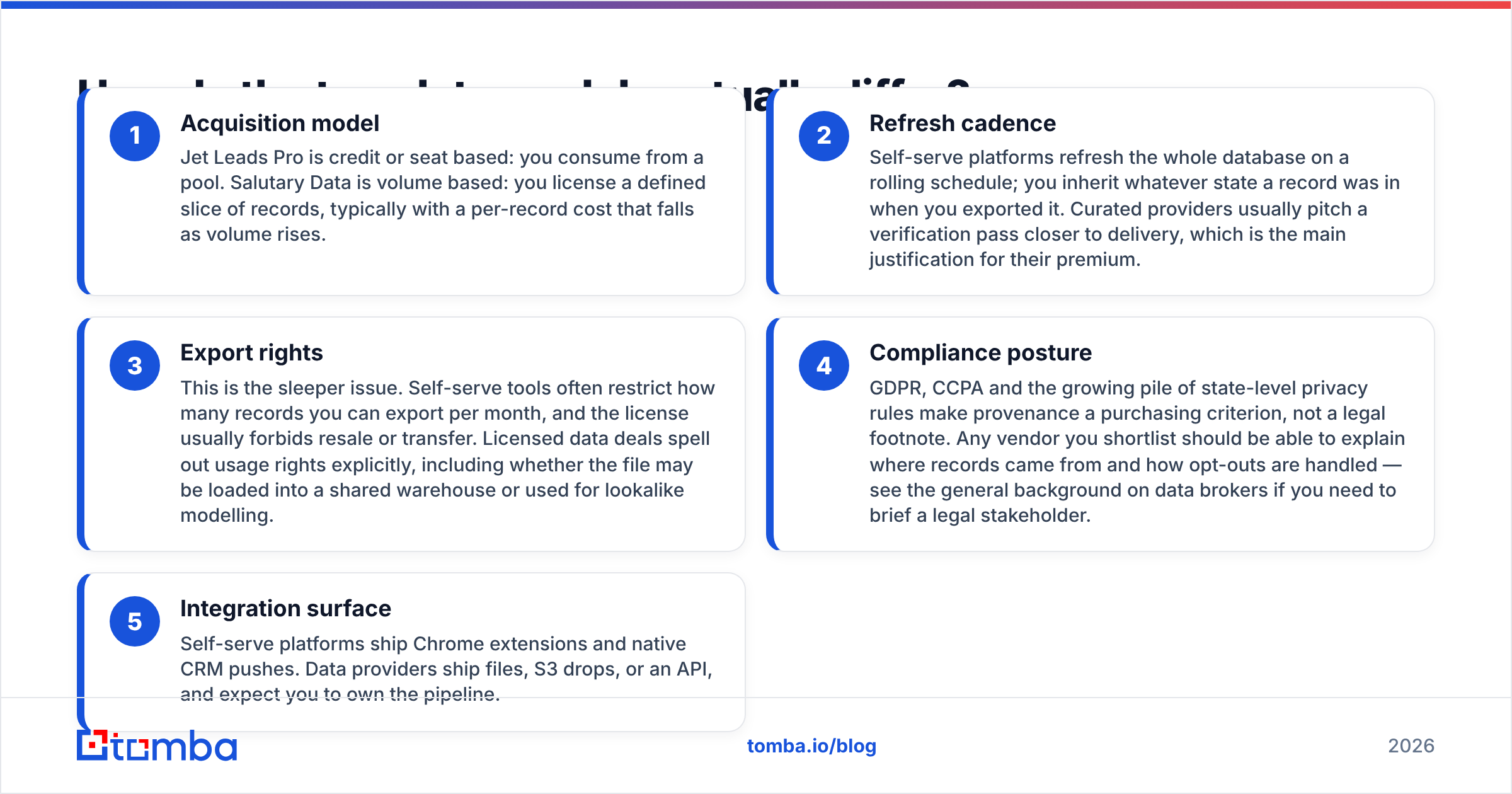
- How you buy. Jet Leads Pro sells seats or credits, so you draw from a pool. Salutary Data sells volume. You license a set slice of records, and the price per record drops as volume rises.
- How often data is refreshed. Self-serve platforms refresh the whole database on a rolling schedule. You inherit whatever state a record was in on export day. Curated providers pitch a fresh check closer to delivery. That is the main reason they cost more.
- Export rights. This is the sleeper issue. Self-serve tools often cap monthly exports, and the license usually bans resale. Data licenses spell out the rules up front, including whether you may load the file into a shared warehouse.
Those three shape the contract. The last two shape the work your team does after you sign.
- Privacy and consent. GDPR, CCPA and a growing pile of state rules turn "where did this come from?" into a buying question. Any vendor on your shortlist should explain its sources and how opt-outs work. The background on data brokers helps if you need to brief a lawyer.
- How it connects. Self-serve platforms ship Chrome extensions and native CRM push. Data providers ship files, S3 drops or an API, and expect you to own the pipeline.
If you remember only one of those, make it export rights.
Teams buy a platform, build a workflow on top of the export, then find out the monthly cap makes that workflow impossible at scale.
Jet Leads Pro vs Salutary Data: which one is more accurate?#
Neither vendor publishes an audited accuracy number. Treat any figure in a sales deck as a claim, not a fact.
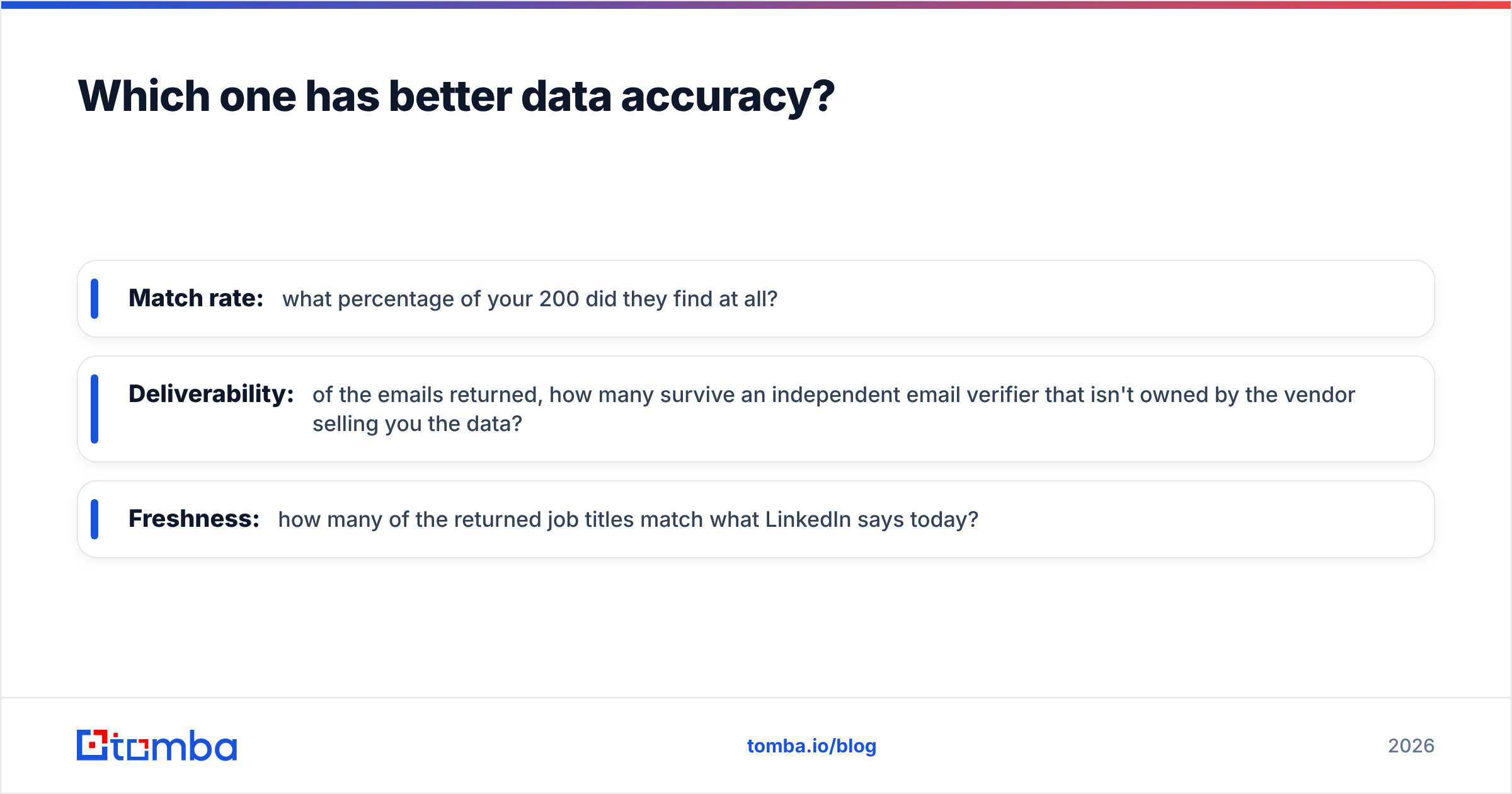
Run your own test instead. Take 200 contacts you know are good: closed-won accounts, current customers, people who replied to you last quarter. Ask each vendor to return records for them. Then measure three things.
- Match rate: how many of the 200 did they find at all?
- Deliverability: of the emails they sent back, how many pass an independent email verifier that the vendor does not own?
- Freshness: how many of the job titles still match LinkedIn today?
In practice, curated files like Salutary Data win on deliverability and lose on raw match rate. The file is smaller because weak records get dropped. Broad databases like Jet Leads Pro do the reverse, because a stale record still counts as a match.

The pattern above is worth keeping in mind. On the same test list, the best and worst vendors differ by 20 to 30 points of valid email. That gap is the difference between a 2% reply rate and a burned sending domain.
Accuracy tests also miss one thing: catch-all domains. Many large companies accept every address at the mail server, so "verified" can mean almost nothing. If you sell to enterprise, ask both vendors how they treat catch-alls. Then test the answer with a catch-all verifier before you sign.
Jet Leads Pro vs Salutary Data: pricing and features#
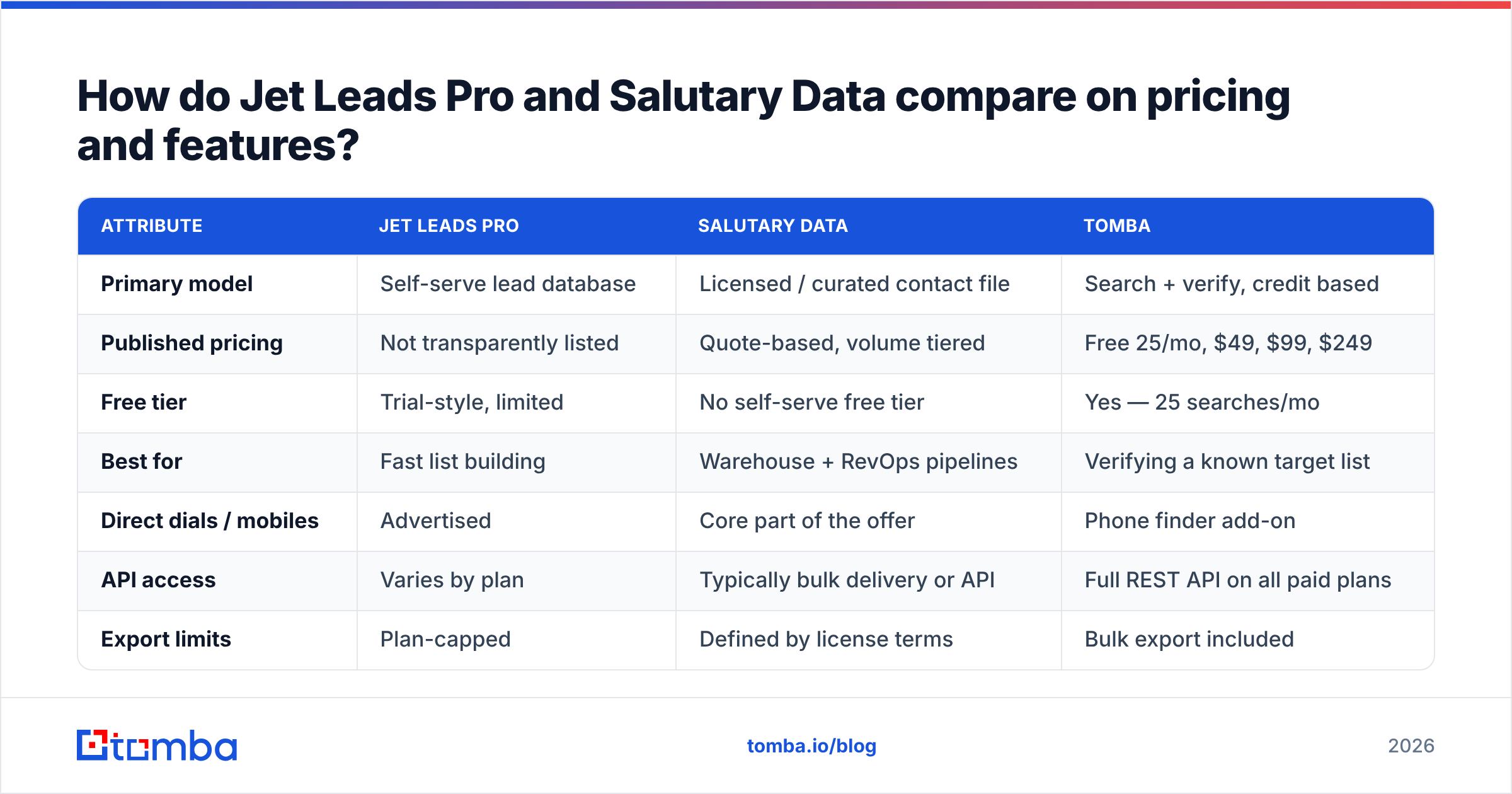
Both vendors sell through quotes today, so the table below compares models rather than made-up numbers. Tomba is here as a transparent reference point, because its list prices are public.

| Attribute | Jet Leads Pro | Salutary Data | Tomba |
|---|---|---|---|
| Primary model | Self-serve lead database | Licensed / curated contact file | Search + verify, credit based |
| Published pricing | Not transparently listed | Quote-based, volume tiered | Free 25/mo, $49, $99, $249 |
| Free tier | Trial-style, limited | No self-serve free tier | Yes — 25 searches/mo |
| Best for | Fast list building | Warehouse + RevOps pipelines | Verifying a known target list |
| Direct dials / mobiles | Advertised | Core part of the offer | Phone finder add-on |
| API access | Varies by plan | Typically bulk delivery or API | Full REST API on all paid plans |
| Export limits | Plan-capped | Defined by license terms | Bulk export included |
| Time to first record | Minutes | Days (sales cycle) | Minutes |
| Contract | Monthly / annual SaaS | Annual data license typical | Monthly, cancel anytime |
Two honest notes on this table.
First, "quote-based" is not automatically bad. Buying 500,000 records for a warehouse? A negotiated license beats any credit-based app on price per record, and it grants usage rights a SaaS contract will not. But if you are five people who need 2,000 emails a month, the same model is pure overhead. You wait two weeks to buy what you could have self-served.
Second, "self-serve" is not automatically cheap. Lead databases bundle a big credit balance into a mid-tier plan, then cap exports so you cannot really use it. Read the export cap before the credit count. You can check that against published Tomba pricing in about thirty seconds, which is the point.

Which one fits your workflow better?#
Match the vendor to the motion, not to the feature list.
Choose Jet Leads Pro if you run high-volume outbound to a broad market. Your reps build their own lists. You want a Chrome extension and a CSV the same afternoon, and your deal sizes are too small to justify a buying process. Discovery is your bottleneck: you do not know who to target yet, and you want filters to tell you.
Choose Salutary Data if you have a RevOps function. Contact data feeds a warehouse, a scoring model or a CRM job rather than a rep's browser tab. You need mobile numbers at volume, and legal will ask where the records came from. You already know your account universe; you need it filled in and kept current.
Choose a search-and-verify tool if your account list comes from somewhere else. A conference list. A funding announcement. A CRM export full of blanks. An ICP you built in your own analytics. You just need the right person's email at each of those companies.
That third case is the most common one in the real world. It is also the one both database vendors serve worst, because you end up paying for a million records to use two thousand.
A domain search workflow fits it better. Give it a company domain, get back the people and the email pattern, verify, push to your sequencer. No database subscription, no export cap, no buying process.
What should you check before you sign?#
Run this checklist in the demo, not after it.
- Ask for a 200-record test file against your own list. A confident vendor will say yes. A refusal is information too.
- Verify that file with a neutral tool. Vendor-reported validity is marketing. Third-party results are evidence.
- Get the export cap in writing. Monthly, annual and per-seat caps all exist, and they are rarely on the pricing page.
- Ask what happens at renewal. Data deals often price year one low and year two at list.
- Confirm usage rights for AI and modelling. Plan to feed records into a scoring model or an LLM? Most standard contracts are silent or restrictive. Ask.
- Read the reviews that are not on the vendor's site. G2 and similar sites surface the month-three complaints, usually about refresh rates and support.
Is there a middle option?#
Yes, and most teams should start there. Pay for the emails you actually need, checked at the moment you ask for them.
That is how Tomba works. The email finder takes a name and a domain. It returns the address with a confidence score and the sources behind it. The free tier gives you 25 searches a month. Starter is $49/mo, Growth is $99/mo and Pro is $249/mo. No quote call, no annual lock-in, no export cap to negotiate.
For bigger jobs, bulk email finder runs whole lists. The Tomba API drops the same lookups into a pipeline you already built, which is often what decides it for engineering-led teams.
This is not a full B2B database, and it will not fix a discovery problem. If you cannot name your target accounts, you need filters, and either vendor here may be the right buy. But most teams with a defined ICP can name them. Buying a database to solve an email problem is an expensive way to get a CSV.
The verdict: Jet Leads Pro vs Salutary Data#
Salutary Data wins on data quality and usage rights. Curated files with clear sourcing suit a RevOps-owned data stack, and direct dials at volume are a real edge. The cost is a sales cycle and a budget line you have to defend.
Jet Leads Pro wins on speed and access. If a rep needs 500 contacts before Thursday, self-serve filters beat a buying process every time. The cost is uneven accuracy and export caps you will hit sooner than the plan page implies.
Neither one wins if your real job is email accuracy on a known list. That is a different tool category. Paying database prices for it is the most common overspend in the outbound stack.
So settle Jet Leads Pro vs Salutary Data with a test, not a demo. Two hundred records, your own accounts, neutral verification. Whichever vendor survives that test deserves the contract. If neither clears your bar, that is the cheapest negative result you will ever buy.
Ready to test the third path? Run your target account list through the Tomba Email Finder. You get 25 free searches a month, verified results with confidence scores and source attribution, and published pricing from $49/mo when you scale. No demo call required.
Related guides#
// get started
Find, verify and enrich your first contacts today
Start on the free plan with 25 searches a month, then scale when your team is ready.
Free plan · No credit card required · GDPR & CCPA
// about the author