Jet Leads Pro vs Thomson Data: B2B Data Compared (2026)
Both sell B2B contact lists, but they sell them very differently. Here is an honest breakdown of data sourcing, accuracy, pricing models, compliance and the moment a bought list stops making sense at all.
TL;DR
- Thomson Data is an established list-brokerage and database-marketing company selling pre-built, segmented B2B lists (industry, technology, healthcare, geography) under quote-based, per-record pricing. It is the safer pick if you genuinely need a large, sliced-by-SIC-code list and you have a procurement process.
- Jet Leads Pro positions itself as a cheaper, faster, self-serve lead-list source aimed at small teams and agencies that want a CSV today rather than a sales call. Less transparency, less enterprise infrastructure, lower entry cost.
- Neither publishes bounce rates you can independently verify. Both quote accuracy figures in the 85–95% range; in practice, purchased lists commonly land materially lower once they hit a real inbox.
- The core structural difference matters more than the vendor difference: both sell static snapshots. A list bought in January is decaying by February at roughly 2–3% per month as people change jobs.
- If your ICP is narrow and your volume is modest, an on-demand finder plus verification (Tomba, and peers like BookYourData for pre-built verified lists) usually beats buying 50,000 rows you will never email.
What are Jet Leads Pro and Thomson Data?#
Think of it like buying produce. Thomson Data is the wholesale distributor with a warehouse, a catalogue and an account manager who calls you back. Jet Leads Pro is the market stall — faster, cheaper, fewer questions asked, and you inspect the goods yourself.
Thomson Data has been operating in the database-marketing space for well over a decade. Its model is classic list brokerage: you describe a target segment (say, "IT decision-makers at US manufacturers with 200+ employees"), a rep scopes it, and you receive a counted, priced, deduplicated file. It sells industry lists, technology-install lists, healthcare provider lists, and append/enrichment services against your existing CRM records.
Jet Leads Pro sits in the newer, lighter tier of the same market: self-serve or lightly-assisted lead lists, marketed on speed and price rather than on depth of segmentation. Vendors in this bracket typically aggregate from public web sources, business directories, resold data pools and scraped professional profiles, then run a verification pass before delivery.
The honest framing: these are not two competing technologies. They are two service levels of the same product — a spreadsheet of people you have never spoken to.

How do Jet Leads Pro and Thomson Data compare head-to-head?#
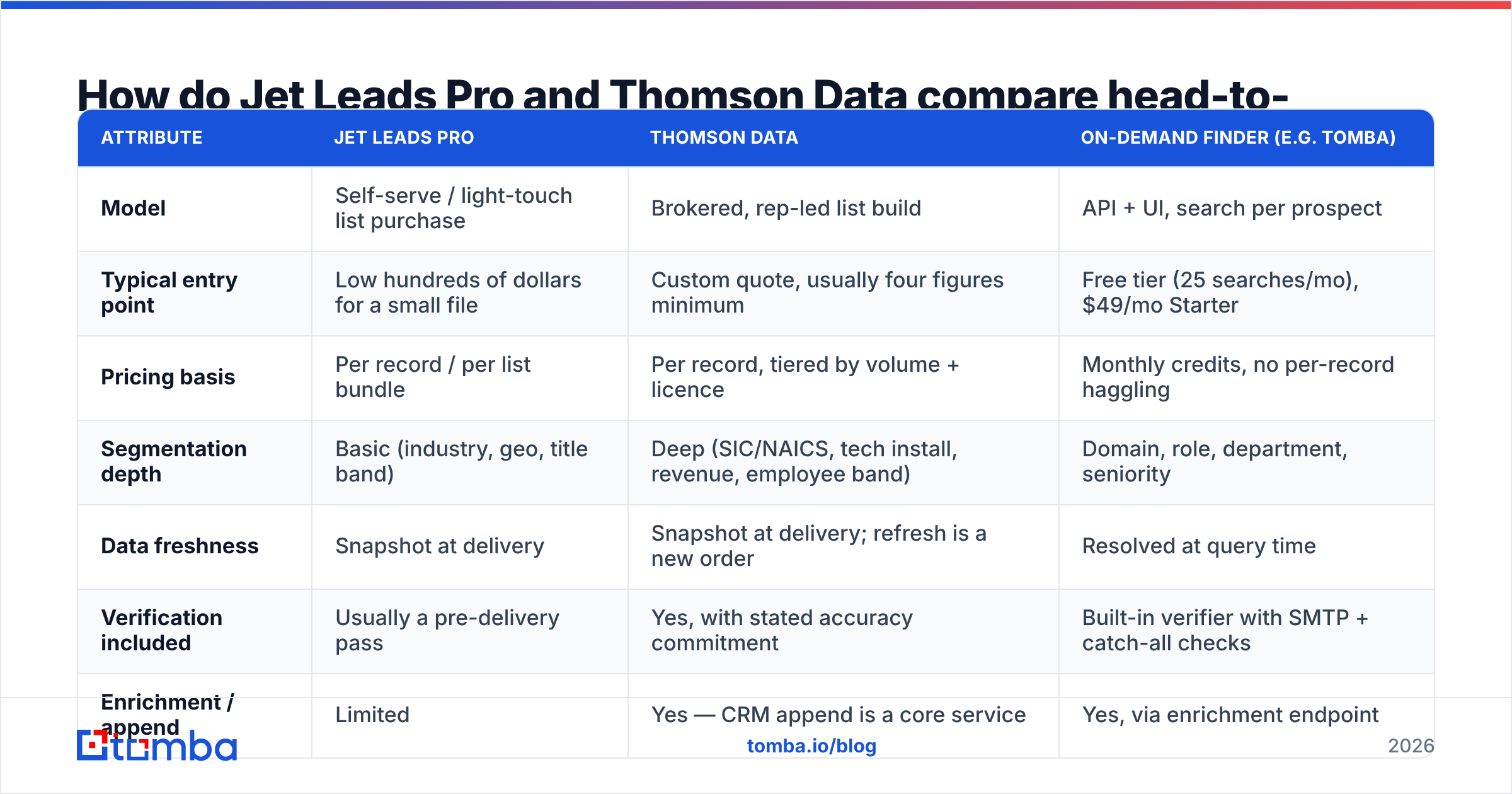
Pricing for both is quote-driven and varies enormously by segment, volume and licence terms, so treat the ranges below as what buyers typically report rather than published rate cards. Always demand a written accuracy guarantee before signing.
| Attribute | Jet Leads Pro | Thomson Data | On-demand finder (e.g. Tomba) |
|---|---|---|---|
| Model | Self-serve / light-touch list purchase | Brokered, rep-led list build | API + UI, search per prospect |
| Typical entry point | Low hundreds of dollars for a small file | Custom quote, usually four figures minimum | Free tier (25 searches/mo), $49/mo Starter |
| Pricing basis | Per record / per list bundle | Per record, tiered by volume + licence | Monthly credits, no per-record haggling |
| Segmentation depth | Basic (industry, geo, title band) | Deep (SIC/NAICS, tech install, revenue, employee band) | Domain, role, department, seniority |
| Data freshness | Snapshot at delivery | Snapshot at delivery; refresh is a new order | Resolved at query time |
| Verification included | Usually a pre-delivery pass | Yes, with stated accuracy commitment | Built-in verifier with SMTP + catch-all checks |
| Enrichment / append | Limited | Yes — CRM append is a core service | Yes, via enrichment endpoint |
| Contract friction | Minimal | Procurement, MSA, licence terms | Self-serve, cancel anytime |
| Best for | Agencies needing volume fast on a budget | Enterprise campaigns needing defensible segmentation | Precision outbound, ABM, small verified batches |
What do you actually receive from each vendor?#
Here is where the two diverge in ways that hit your campaign directly:
- File composition. Thomson Data files tend to arrive with richer firmographic columns — revenue band, employee count, SIC code, sometimes technology install signals. Jet Leads Pro files skew toward the essentials: name, title, company, email, sometimes LinkedIn URL. If your sequencing depends on personalisation tokens beyond
{{first_name}}, that column gap is real work. - Licence terms. This is the clause people skip. Broker files are frequently licensed for a fixed number of uses or a fixed window, not sold outright. Read whether you have perpetual use or a 12-month term, and whether you may load the file into your CRM permanently.
- Replacement guarantee. Both vendors advertise accuracy commitments. The question that matters is the remedy: do you get credits, a replacement file, or a refund — and what bounce threshold triggers it? Get the number in writing. "95% accurate" with no remedy clause is marketing.
- Turnaround. Self-serve delivers in hours. A brokered build with custom criteria realistically takes two to five business days once scoping is done. If your campaign launches Monday, that gap decides the vendor for you.
- Suppression handling. Ask whether the vendor suppresses against your existing customer and opt-out lists before delivery. Emailing a current customer as a cold prospect is a fast way to lose internal credibility.
- Support model. Thomson Data assigns a contact. Lower-cost providers generally do not. If something is wrong with 8,000 rows, that difference is the whole experience.
Whose data is more accurate in practice?#
Neither vendor's published number should be taken at face value — and that is not a knock on either of them specifically. It is how the whole list industry works.
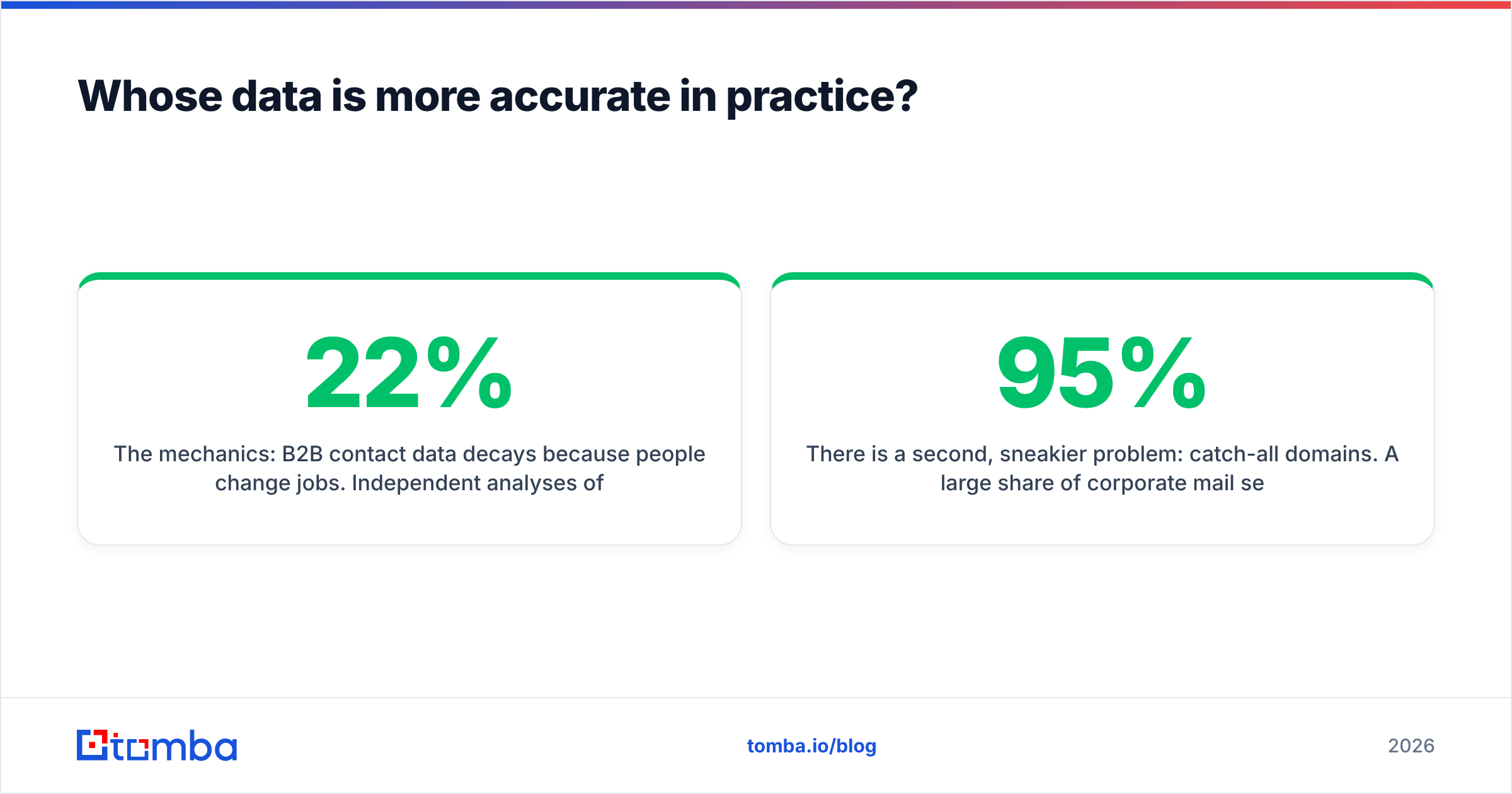
The mechanics: B2B contact data decays because people change jobs. Independent analyses of B2B database quality consistently put annual decay somewhere between 22% and 30%, which works out to roughly 2–3% of your file going stale every month. A list verified honestly in March will still under-perform if you email it in September. Reviews on G2 across the list-vendor category reflect exactly this pattern: strong reviews from buyers who mailed immediately, poor reviews from buyers who sat on the file.
There is a second, sneakier problem: catch-all domains. A large share of corporate mail servers accept every address at the domain, so a naive verifier marks them "valid." They are not valid — they are unknown. Vendors quoting 95%+ accuracy are often counting catch-alls as good. If you want the real picture, run a delivered file through a catch-all verifier before your first send and see what fraction is actually unresolvable.
Practical protocol before you mail any purchased file, from either vendor:
- Sample 500 random rows and run them through an independent email verifier.
- Segment results into valid / catch-all / invalid. Mail only the valid tier first.
- Compare measured bounce rate against the vendor's guarantee. If it misses, invoke the remedy clause immediately — most have a claim window of 14–30 days.
- Never send a fresh 10,000-record file from a warm domain. Ramp it.
How does pricing really compare?#
Cost per record is the wrong metric. Cost per reply is the metric.
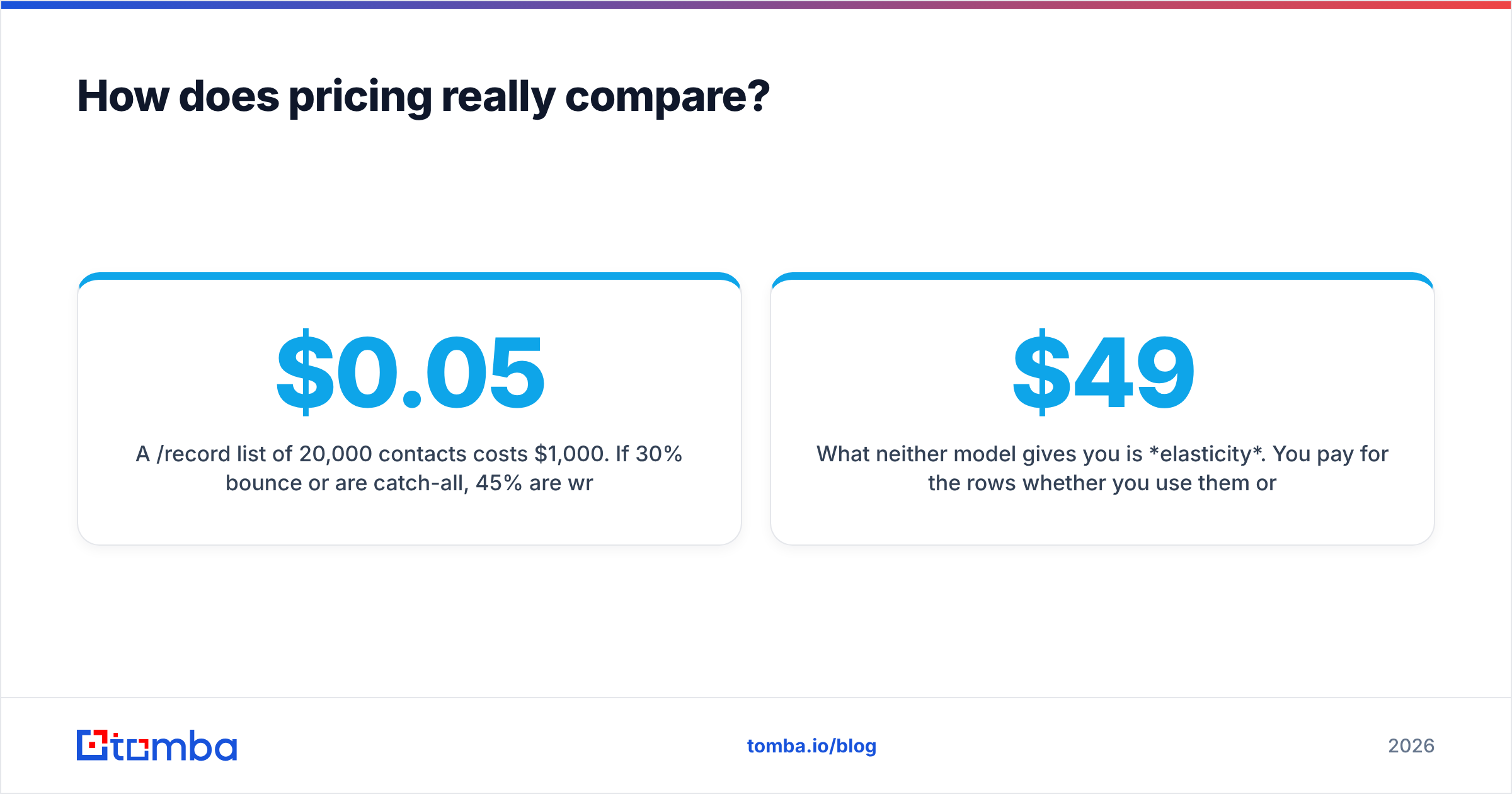
A $0.05/record list of 20,000 contacts costs $1,000. If 30% bounce or are catch-all, 45% are wrong-seniority, and your reply rate on the remainder is 2%, you bought roughly 154 conversations' worth of raw material and burned sender reputation getting there. A $49/mo plan that surfaces 1,000 precisely-targeted, verified contacts at 95% deliverability with correct titles will usually out-produce it — and it will not torch your domain.
Thomson Data's per-record pricing drops steeply with volume, which is exactly why it suits enterprise campaigns with wide ICPs: if you genuinely need every hospital administrator in three states, brokered volume pricing is rational. Jet Leads Pro's appeal is the opposite end — small files, low commitment, no procurement cycle. Both are defensible for their respective buyers.
What neither model gives you is elasticity. You pay for the rows whether you use them or not. Credit-based tools invert that: Tomba pricing runs a free tier at 25 searches a month, Starter at $49/mo, Growth at $99/mo and Pro at $249/mo, and unused precision costs you nothing because you only spend a credit when you look someone up.

Which is safer on compliance?#
Neither purchase is automatically compliant, and both vendors will tell you compliance is your responsibility as the sender. That is legally accurate.
Under CAN-SPAM, cold B2B email to US recipients is permitted provided you identify yourself, do not use deceptive headers, include a physical address, and honour opt-outs promptly. Buying the list is not itself the violation.
GDPR is the harder terrain. For EU-based individuals you need a lawful basis — usually legitimate interest — plus the ability to demonstrate it, and you must be able to tell the recipient where their data came from if they ask. That last point is the one that separates vendors: can the provider tell you the source of a given record? Thomson Data, operating as a formal data business with enterprise clients, is generally better equipped to produce sourcing documentation. Smaller self-serve vendors frequently cannot, which leaves you unable to answer a subject access request.
Ask both vendors, in writing:
- What is the lawful basis for processing the EU records in this file?
- Can you provide source attribution per record?
- How do you handle erasure requests that reach you after delivery?
- Are DPA terms available?
If a provider cannot answer those, restrict your purchase to non-EU records. For a transparent view of how sourcing disclosure should look, compare against published data sources documentation.
When should you skip both and find emails on demand?#
Buy a list when: your ICP is broad, you need tens of thousands of records at once, segmentation criteria are firmographic rather than behavioural, and you will mail the file within weeks of delivery.
Find on demand when any of the following are true:
- Your ICP is narrow. If your total addressable market is 800 companies, a 50,000-row file is 98% waste. Run a domain search against your target account list instead and get every relevant contact per company.
- You are doing ABM. Account-based motions need the right five people at one company, not five thousand at random companies.
- Your trigger is timing-based. Funding rounds, new hires, tech installs — a static file cannot represent a moving event. You need to resolve contacts at the moment the trigger fires, ideally through the Tomba API inside your workflow.
- You are protecting a young sending domain. High-volume bought-list sends are the fastest route to a reputation problem. Small verified batches are how you build sender reputation instead of spending it.
- You already have partial records. If your CRM has company and name but no email, you do not need a new list. You need data enrichment against what you already own — usually a fraction of the cost.
It is also worth noting that the market has a middle tier. Providers such as BookYourData offer pre-built, verified lists with self-serve checkout and per-record accuracy guarantees, which splits the difference between broker-grade segmentation and self-serve speed. That is a legitimate option if you want a list but not a procurement cycle.
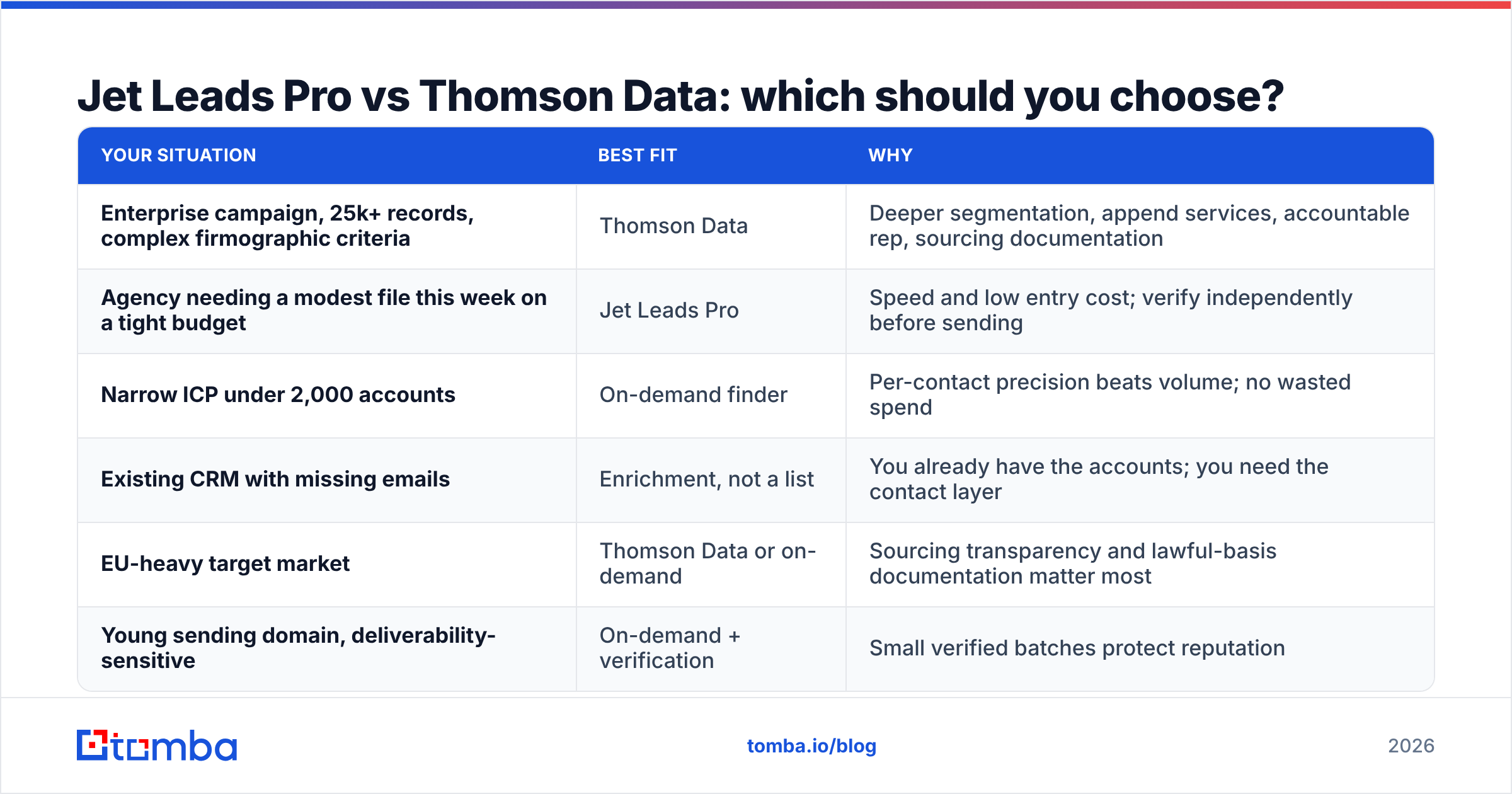
Jet Leads Pro vs Thomson Data: which should you choose?#
| Your situation | Best fit | Why |
|---|---|---|
| Enterprise campaign, 25k+ records, complex firmographic criteria | Thomson Data | Deeper segmentation, append services, accountable rep, sourcing documentation |
| Agency needing a modest file this week on a tight budget | Jet Leads Pro | Speed and low entry cost; verify independently before sending |
| Narrow ICP under 2,000 accounts | On-demand finder | Per-contact precision beats volume; no wasted spend |
| Existing CRM with missing emails | Enrichment, not a list | You already have the accounts; you need the contact layer |
| EU-heavy target market | Thomson Data or on-demand | Sourcing transparency and lawful-basis documentation matter most |
| Young sending domain, deliverability-sensitive | On-demand + verification | Small verified batches protect reputation |
The verdict is not "one vendor beats the other." Thomson Data is the stronger choice when the job genuinely requires brokered scale and defensible segmentation, and it has the operational maturity to back that. Jet Leads Pro is the pragmatic choice when the job is small, fast and price-sensitive. Both share the same structural weakness — you are buying a photograph of a moving target — so both demand independent verification before you press send.
The mistake we see most often is not picking the wrong vendor. It is buying 40,000 records to run a campaign that needed 600 of them, then blaming the data when reply rates disappoint.
Ready to stop buying rows you will never email?#
Start with the Tomba Email Finder. Point it at the accounts you actually want, get verified work emails for the specific people who matter, and spend credits only on prospects that fit your ICP. The free tier gives you 25 searches a month to test the accuracy yourself against whatever list you are considering — run the same 25 names through both and compare. That single test will tell you more than any vendor's accuracy claim.
Related guides#
// get started
Find, verify and enrich your first contacts today
Start on the free plan with 25 searches a month, then scale when your team is ready.
Free plan · No credit card required · GDPR & CCPA
Get the Tomba newsletter
Product and data updates
// about the author