9 Best Kiamo Alternatives in 2026: Compared and Ranked
Kiamo's routing engine is strong, but pricing is quote-only and the ecosystem is Europe-heavy. Here are nine contact center alternatives compared on channels, deployment, price and migration effort.
TL;DR
- Kiamo is a French omnichannel interaction-management platform built around a strong routing engine — voice, email, chat, social and SMS in one queue. It is quote-only, partner-led, and strongest in EU mid-market and public-sector deployments.
- Most teams shop for Kiamo alternatives for three reasons: opaque pricing, a smaller integration marketplace than the global CCaaS players, and limited self-serve AI tooling.
- The realistic shortlist in 2026: Genesys Cloud CX, Odigo, Diabolocom, Talkdesk, Five9, Ringover, Zendesk, Vocalcom and 3CX.
- Price per seat is the least important number. Routing parity, telephony contracts, CRM connectors and data residency decide whether a migration lands on time.
- Whatever you pick, the platform routes conversations — it does not create them. Outbound and CX teams still need a separate source of verified contact data.
What is Kiamo, and who actually uses it?#
Kiamo is an omnichannel customer-interaction platform from the French vendor of the same name (kiamo.com). Think of it as an air-traffic controller for customer conversations: every inbound signal — a call, an email, a web chat, a WhatsApp message, a form — enters one queue, and a rules engine decides which agent gets it, in what order, under which SLA.
That routing engine is genuinely the product. Kiamo's differentiator is unified, skills-based distribution across channels rather than separate silos bolted together, plus deployment flexibility (cloud, on-premise or hybrid) that appeals to organisations with data-residency constraints. Typical buyers are European mid-market service desks, insurers, utilities, retailers and public bodies, often introduced through an integrator rather than a self-serve trial.
The trade-offs are the mirror image of those strengths. Pricing is quote-based, so you cannot benchmark it without entering a sales cycle. The partner-led model means implementation quality varies. And compared with the global CCaaS vendors, the app marketplace and out-of-the-box AI features are narrower.
Why do teams look for Kiamo alternatives?#
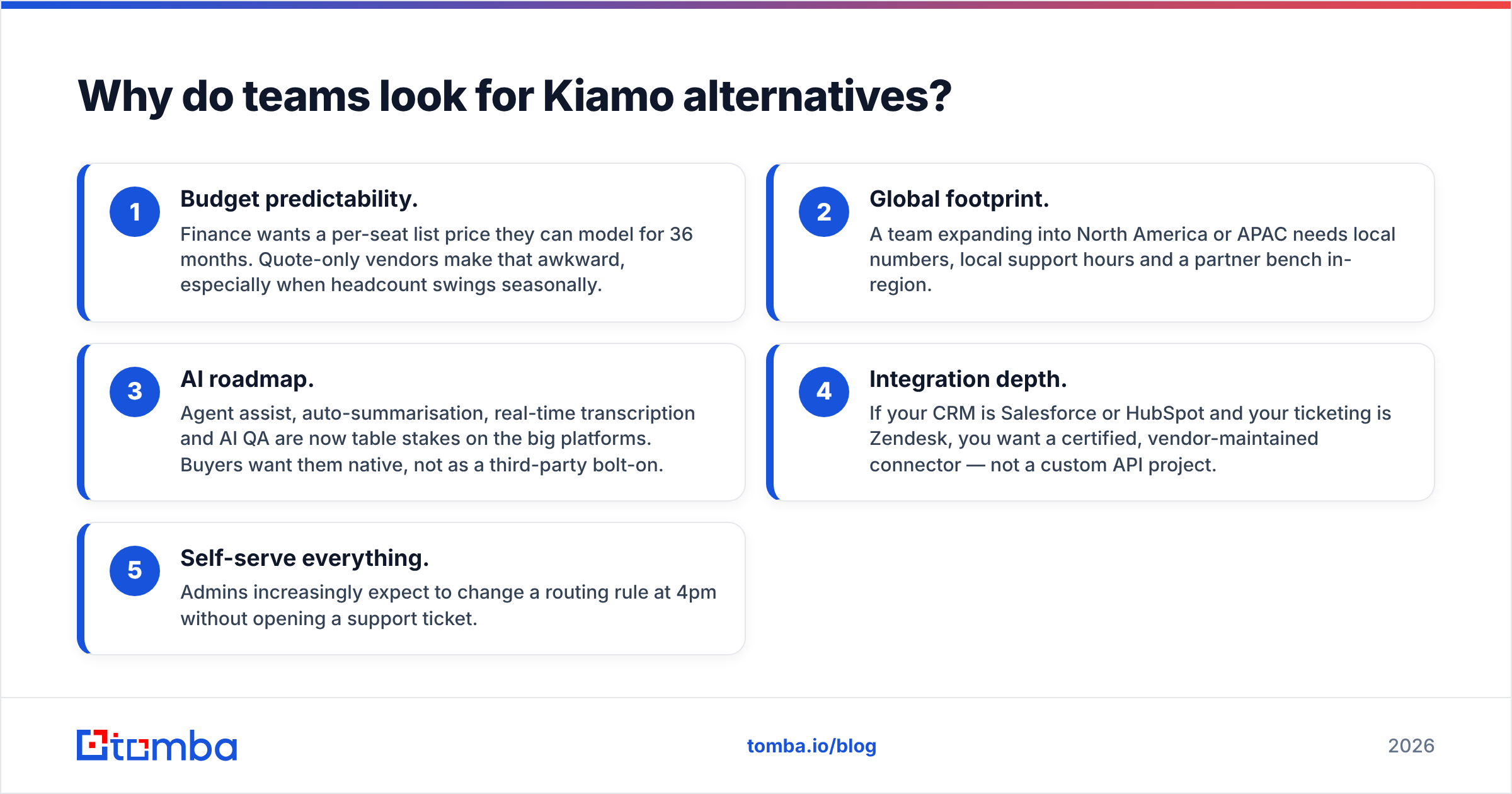
From buyer conversations and public review sites like G2, the same five triggers come up:
- Budget predictability. Finance wants a per-seat list price they can model for 36 months. Quote-only vendors make that awkward, especially when headcount swings seasonally.
- Global footprint. A team expanding into North America or APAC needs local numbers, local support hours and a partner bench in-region.
- AI roadmap. Agent assist, auto-summarisation, real-time transcription and AI QA are now table stakes on the big platforms. Buyers want them native, not as a third-party bolt-on.
- Integration depth. If your CRM is Salesforce or HubSpot and your ticketing is Zendesk, you want a certified, vendor-maintained connector — not a custom API project.
- Self-serve everything. Admins increasingly expect to change a routing rule at 4pm without opening a support ticket.
None of that makes Kiamo a bad product. It makes it a specific product. The question is whether your constraints match the ones it was built for.

What should you compare before switching?#
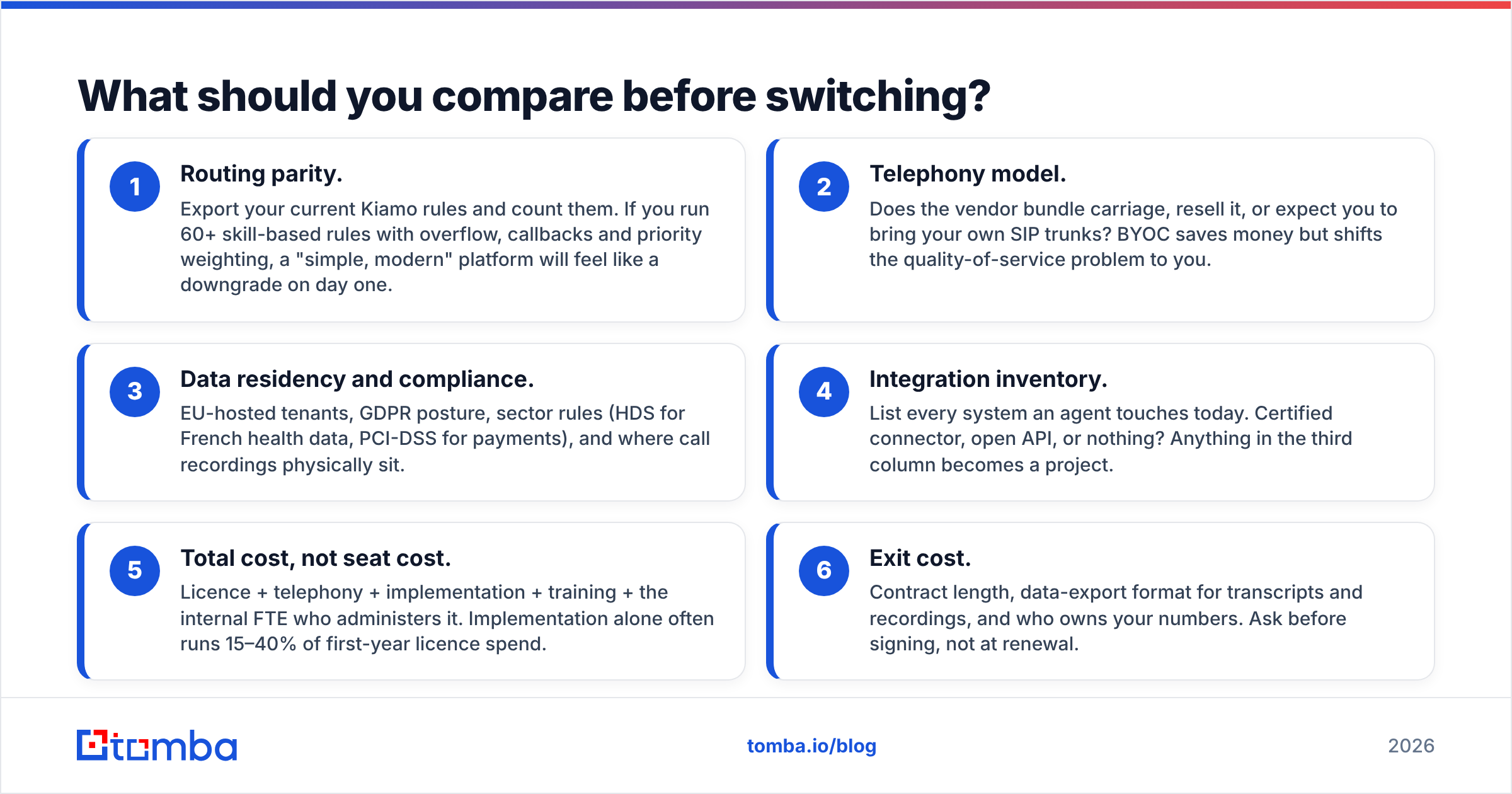
Score every vendor on these six dimensions before you look at a single demo. Weight them for your own situation — a 40-seat retailer and a 900-seat insurer will not agree on the ranking.
- Routing parity. Export your current Kiamo rules and count them. If you run 60+ skill-based rules with overflow, callbacks and priority weighting, a "simple, modern" platform will feel like a downgrade on day one.
- Telephony model. Does the vendor bundle carriage, resell it, or expect you to bring your own SIP trunks? BYOC saves money but shifts the quality-of-service problem to you.
- Data residency and compliance. EU-hosted tenants, GDPR posture, sector rules (HDS for French health data, PCI-DSS for payments), and where call recordings physically sit.
- Integration inventory. List every system an agent touches today. Certified connector, open API, or nothing? Anything in the third column becomes a project.
- Total cost, not seat cost. Licence + telephony + implementation + training + the internal FTE who administers it. Implementation alone often runs 15–40% of first-year licence spend.
- Exit cost. Contract length, data-export format for transcripts and recordings, and who owns your numbers. Ask before signing, not at renewal.
Which are the best Kiamo alternatives in 2026?#
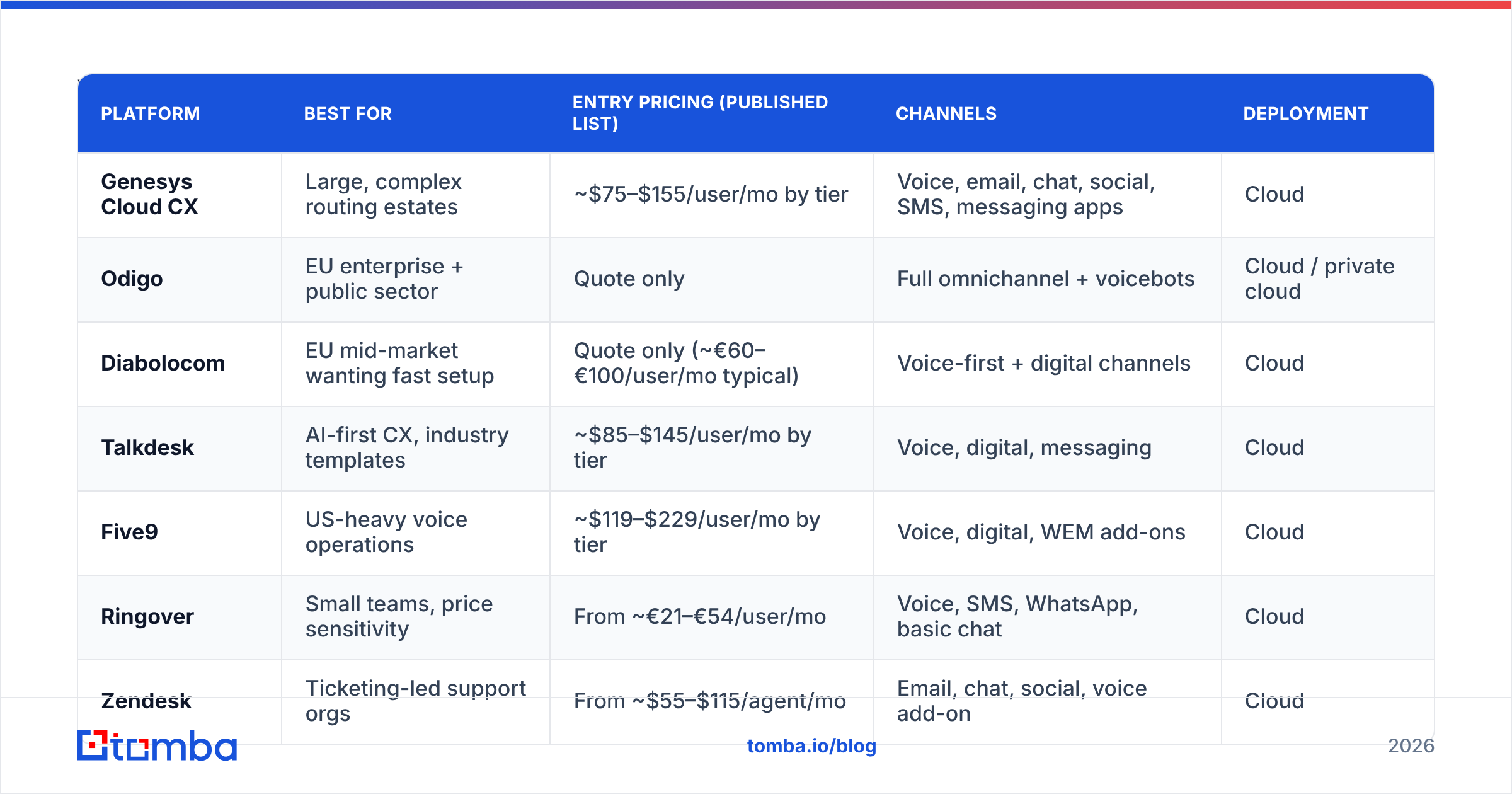
| Platform | Best for | Entry pricing (published list) | Channels | Deployment |
|---|---|---|---|---|
| Genesys Cloud CX | Large, complex routing estates | ~$75–$155/user/mo by tier | Voice, email, chat, social, SMS, messaging apps | Cloud |
| Odigo | EU enterprise + public sector | Quote only | Full omnichannel + voicebots | Cloud / private cloud |
| Diabolocom | EU mid-market wanting fast setup | Quote only (~€60–€100/user/mo typical) | Voice-first + digital channels | Cloud |
| Talkdesk | AI-first CX, industry templates | ~$85–$145/user/mo by tier | Voice, digital, messaging | Cloud |
| Five9 | US-heavy voice operations | ~$119–$229/user/mo by tier | Voice, digital, WEM add-ons | Cloud |
| Ringover | Small teams, price sensitivity | From ~€21–€54/user/mo | Voice, SMS, WhatsApp, basic chat | Cloud |
| Zendesk | Ticketing-led support orgs | From ~$55–$115/agent/mo | Email, chat, social, voice add-on | Cloud |
| Vocalcom | Outbound-heavy and BPO floors | Quote only | Voice dialers + digital | Cloud / hybrid |
| 3CX | Budget PBX with light contact centre | Free tier, then low per-system fees | Voice, chat, WhatsApp | Self-host or hosted |
Prices are published list rates observed in 2026 and move constantly — treat them as an ordering signal, not a quote. Every vendor discounts at volume, and every one of them prices telephony separately.
Genesys Cloud CX#
The safest choice when routing complexity is the whole problem. Genesys handles the deepest rule sets, has the widest partner network, and ships workforce engagement and AI features natively. You pay for it — both in licence and in the specialist admin skills it demands. Overkill below roughly 50 seats.
Odigo#
The closest like-for-like swap for EU enterprises leaving Kiamo. French-rooted, strong on public-sector and regulated-industry requirements, credible voicebot stack, private-cloud options. Quote-only pricing and enterprise-length sales cycles, so it is not the fast route.
Diabolocom#
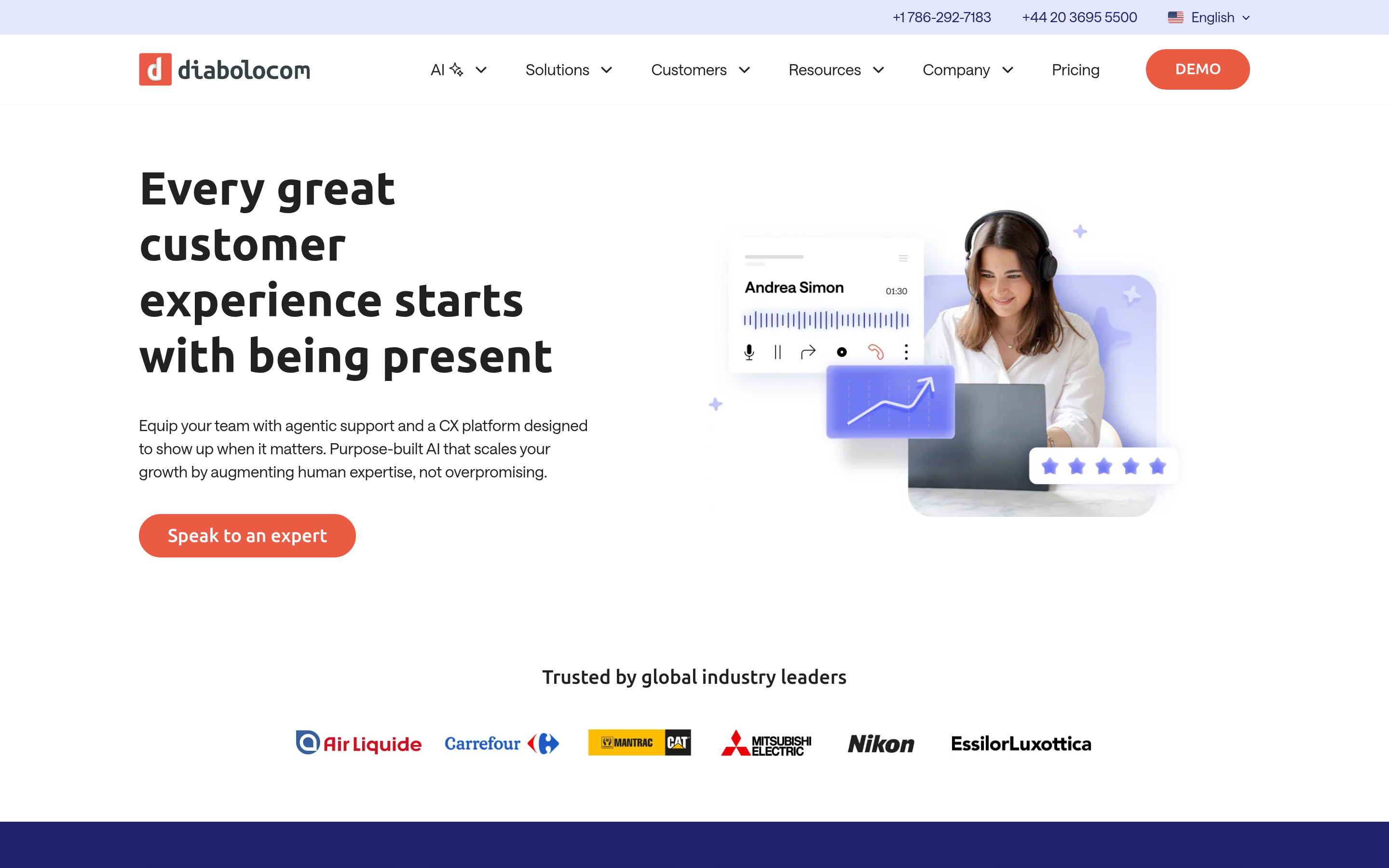
The pragmatic European middle. Voice quality is its calling card (it operates its own carrier infrastructure), setup is measured in weeks rather than quarters, and the Salesforce and Zendesk connectors are maintained in-house. Digital channels are less deep than Genesys.
Talkdesk#
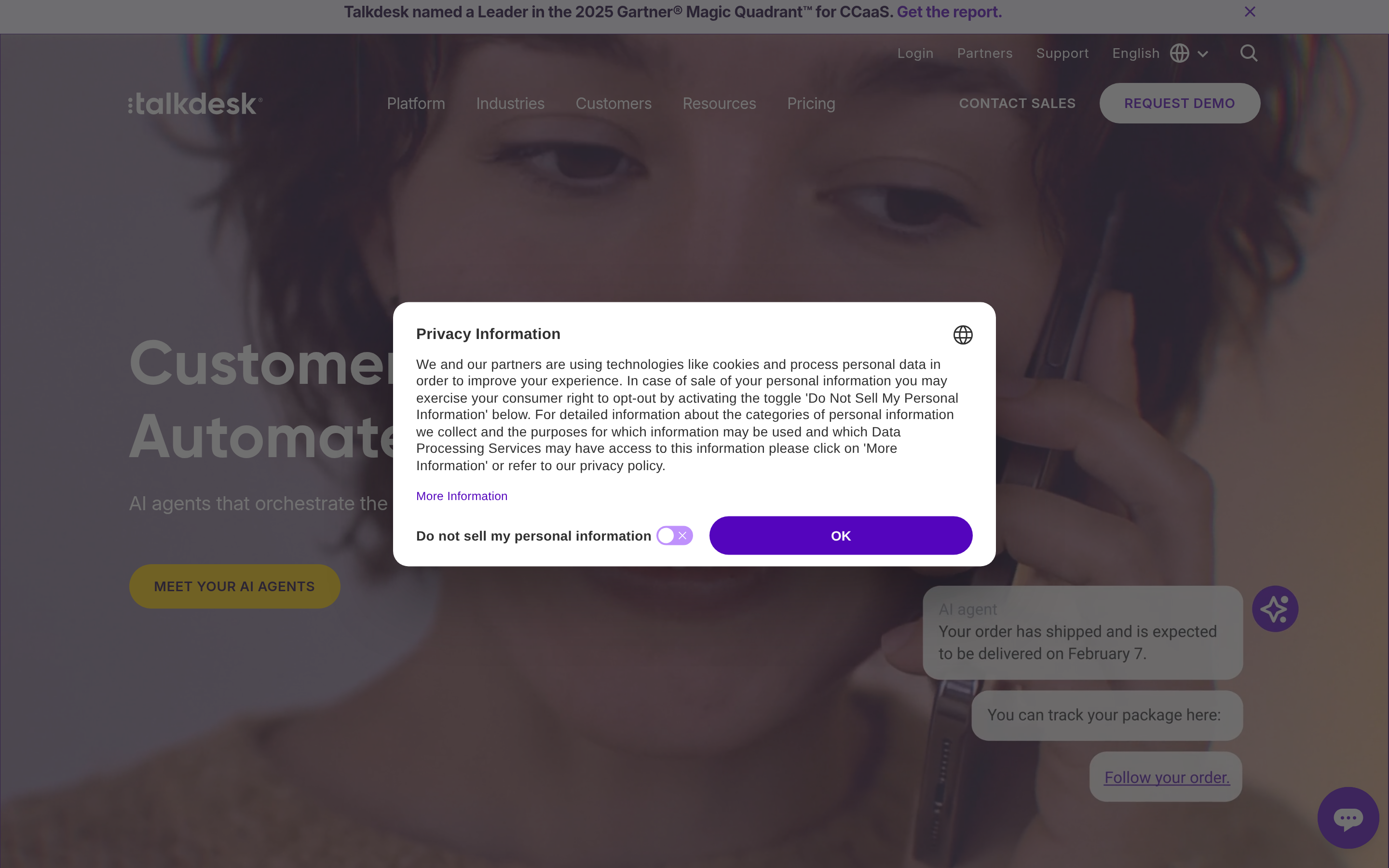
The AI-forward pick. Prebuilt industry experiences for healthcare, financial services and retail shorten configuration meaningfully, and autopilot/agent-assist features are mature. See talkdesk.com for the current tier breakdown. Weaker fit if your requirements are unusual enough that the templates fight you.
Five9#
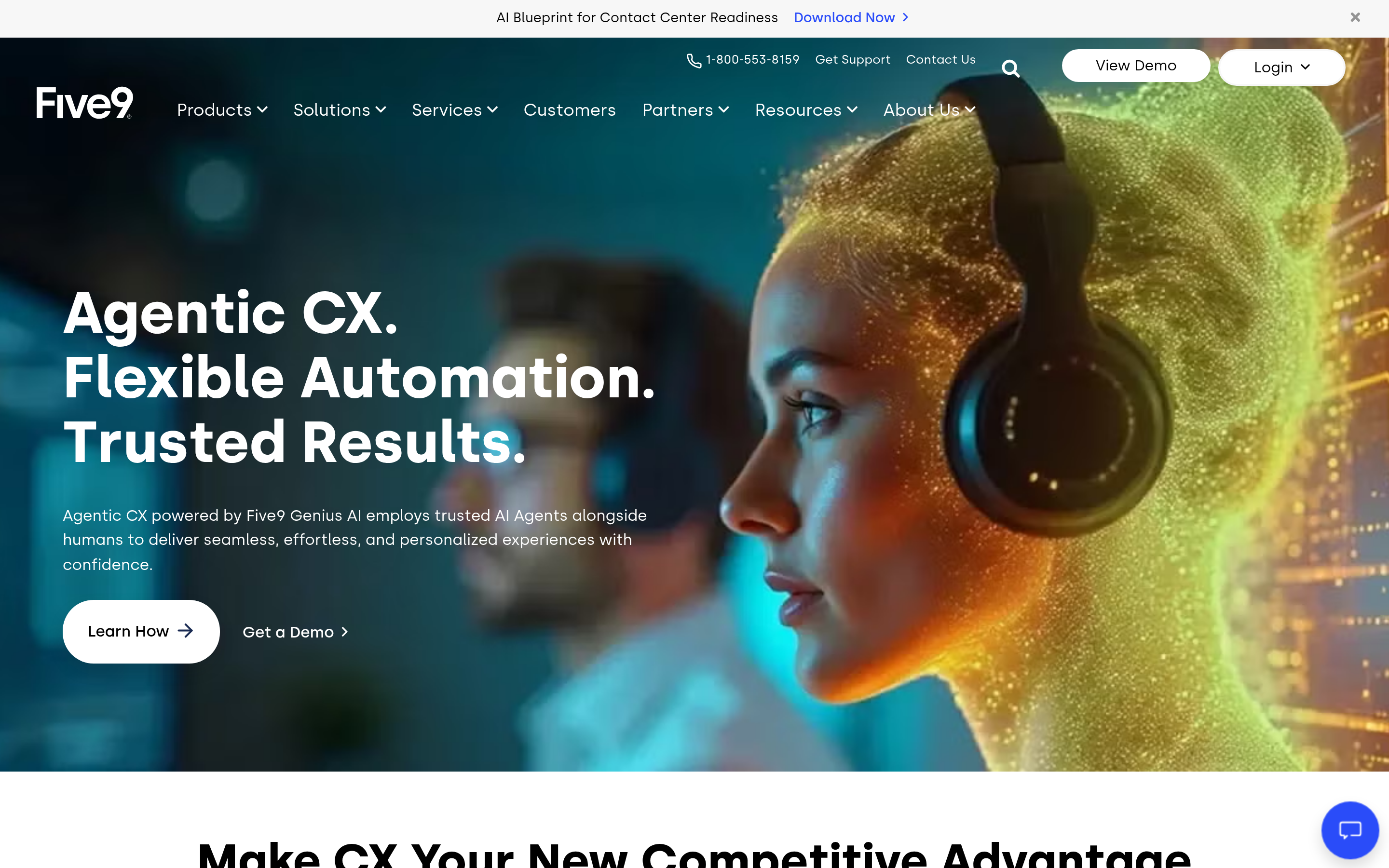
Strong voice DNA, particularly for blended inbound/outbound floors in North America. Practical AI agents, solid dialer. EU teams should scrutinise data residency and local support coverage before committing.
Ringover#
The honest budget option. If what you actually need is a modern business phone system with call queues, SMS, WhatsApp and a CRM sidebar — not a true omnichannel routing engine — this costs a fraction of the alternatives above. Do not expect Kiamo-grade rule depth.
Zendesk#
Right answer when tickets, not calls, are the centre of gravity. Its routing lives inside a support suite rather than the other way round, voice is an add-on, and the marketplace is enormous. Wrong answer for a high-volume voice floor.
Vocalcom#
Built for outbound and BPO economics: predictive dialing, campaign management, agent occupancy dashboards. Quote-only, and the UI shows its age next to newer entrants — but it does the dialer job well.
3CX#
Cheapest by a distance, licensed per system instead of per agent. A real option for teams under ~25 seats who need queues, recording and a WhatsApp inbox. Not a CCaaS platform, and it does not pretend to be.
How do you migrate off Kiamo without breaking SLAs?#
Assume three to six months for a mid-market cutover, not three weeks. The work that actually consumes the calendar:
- Rule archaeology. Someone built routing exceptions in 2021 that nobody documented. Export everything, then interview the supervisors about which rules still matter. Typically 20–30% can be retired.
- Number porting. Carrier-dependent and the single most common cause of slipped go-live dates. Start it first.
- Historical data. Decide what moves (usually: nothing) and what stays queryable in an archive. Recordings and transcripts have retention obligations that survive the vendor change.
- Parallel running. Route one low-volume queue to the new platform for two weeks before touching the main line. Every migration that skipped this step regretted it.
- Agent training. Budget 4–8 hours per agent. Adoption failure looks exactly like product failure in the post-mortem.
Is the cheapest Kiamo alternative the right one?#
Usually not, and the reason is arithmetic. A platform that saves you $40/seat/month across 60 seats returns $28,800 a year. One extra internal admin hired to babysit a system with weak self-serve configuration erases that entirely. So does a two-month go-live delay during peak season.
Rank on fit first, then negotiate price. The vendors above all discount — publicly listed rates are opening positions, particularly on multi-year commitments and when you consolidate telephony with the licence.
Where does contact data fit into any of this?#
Here is the gap nobody puts in the RFP: a contact centre platform routes conversations that already exist. It does not create pipeline, and it does not know whether the email address on an account record still resolves.
That matters for three concrete jobs that sit next to your CCaaS stack:
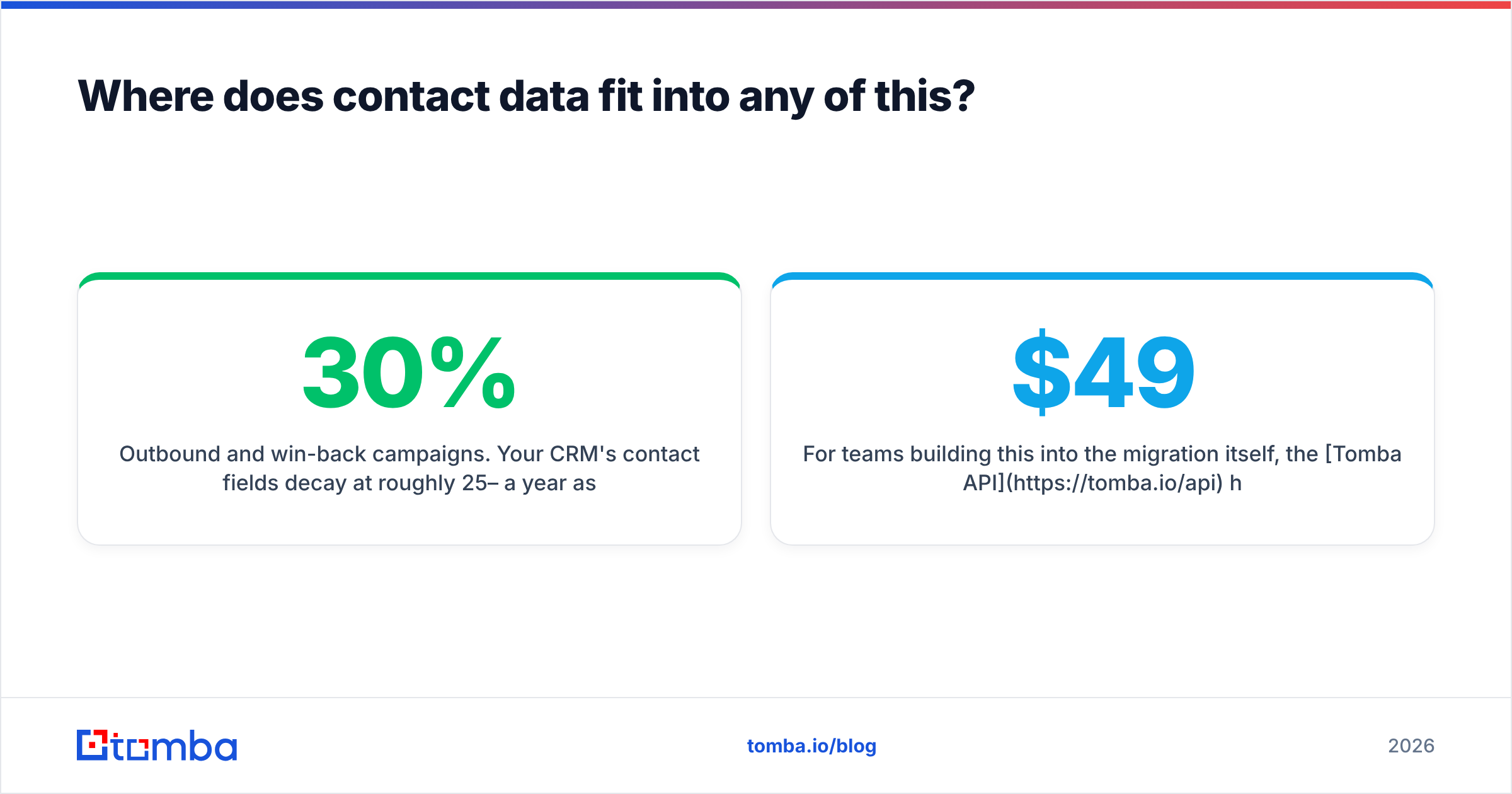
- Outbound and win-back campaigns. Your CRM's contact fields decay at roughly 25–30% a year as people change roles. Campaigns built on stale records burn sender reputation before they reach a queue.
- Account escalation. When a support case needs the buyer's manager and not the person who filed the ticket, someone has to find that person fast.
- CRM hygiene before migration. Moving dirty data into a new platform just relocates the problem. A dedupe-and-verify pass before cutover is the cheapest quality win in the whole project.
That is a data problem, not a routing problem, and it is solved with a separate tool. Running records through an email verifier before a campaign strips the hard bounces that damage deliverability. Data enrichment fills the role, seniority and company fields your routing rules and QA reports depend on. And when you need to reach a named decision-maker at a specific account, domain search returns the published addresses at that company along with the pattern it uses.
For teams building this into the migration itself, the Tomba API handles verification and enrichment in-flight, so records get cleaned on the way into the new platform rather than in a spreadsheet afterwards. Pricing runs from a free tier at 25 searches a month up through Starter at $49/mo and Growth at $99/mo — see Tomba pricing for the full breakdown.
What is the verdict?#
Pick by constraint, not by feature count:
- Routing complexity is your bottleneck → Genesys Cloud CX.
- EU enterprise or public sector → Odigo or Diabolocom.
- You want AI capability out of the box → Talkdesk.
- Voice-heavy North American floor → Five9.
- Tickets matter more than calls → Zendesk.
- Budget is the hard constraint → Ringover or 3CX.
- Outbound campaigns are the business → Vocalcom.
And stay honest about the boundary: none of these platforms fixes the quality of the contact data feeding them.
Cleaning up your contact records before the migration? Start with the Tomba Email Finder — find and confirm professional email addresses by domain, name or company, so the records you move into your new platform are ones that actually reach someone. The free tier is enough to test it against a sample of your CRM this afternoon.
Related guides#
// get started
Find, verify and enrich your first contacts today
Start on the free plan with 25 searches a month, then scale when your team is ready.
Free plan · No credit card required · GDPR & CCPA
// about the author