Lead Carrot vs ZoomInfo (2026): Which B2B Data Tool Wins?
One tool sells $50-a-month local business lists. The other sells five-figure enterprise contracts. Here is an honest breakdown of Lead Carrot vs ZoomInfo — coverage, real cost, and who each one actually fits.
Lead Carrot vs ZoomInfo is a strange matchup. One tool sells $50-a-month lists of local businesses. The other sells five-figure contracts for enterprise contact data. Here is what each one costs, what its data really covers, and why most teams need neither.
TL;DR
- They are not really competitors. Lead Carrot sells cheap local-business lists to agencies. ZoomInfo sells deep contact data on mid-market and enterprise accounts. Your buyer picks the winner.
- The cost gap is huge. Lead Carrot costs tens of dollars a month. ZoomInfo deals often run five figures a year, with annual terms and seat minimums.
- Neither is cheap per verified contact. Lead Carrot scrapes data that goes stale fast. ZoomInfo goes deep, but you pay for coverage you rarely use.
- Sell to local shops? Pick Lead Carrot. Sell to a VP at a 500-person SaaS firm? Pick ZoomInfo. Lead Carrot is not even in the race.
- Already know your target accounts? A pay-as-you-go finder plus verification (Tomba starts at $49/mo) usually beats both on cost per usable email.
What are Lead Carrot and ZoomInfo, exactly?#
Most Lead Carrot vs ZoomInfo pages blur this on purpose. The two tools solve different problems.
Lead Carrot is a lead-gen tool for marketing agencies and local-service sellers. You search by niche and place — "dentists in Phoenix," "roofers in Leeds." It hands back business listings with contact details. It also flags website faults like "no SSL," "not mobile responsive," or "no Google Business profile." Those flags are the real product. They give an agency a reason to email. The tool is built for high-volume outreach to small firms.
ZoomInfo is a go-to-market data platform. It holds a big B2B contact and company database: direct dials, org charts, tech stacks, firm data, and buyer-intent signals. On top sits a workflow layer — Copilot, sequences, CRM enrichment, website visitor ID. RevOps and sales leaders buy it on annual contracts, priced per seat plus credits.
So: Lead Carrot answers "who are the 800 plumbers near me and which ones have bad websites?" ZoomInfo answers "which 40 accounts in my territory are researching data warehouses right now, and who are the five people on the buying committee?"
If you read that and one of them obviously matched your motion, you already have your answer. Read on for the cost math anyway — that is where both tools get expensive in ways the pricing page does not show.
Lead Carrot vs ZoomInfo: how do they compare head-to-head?#
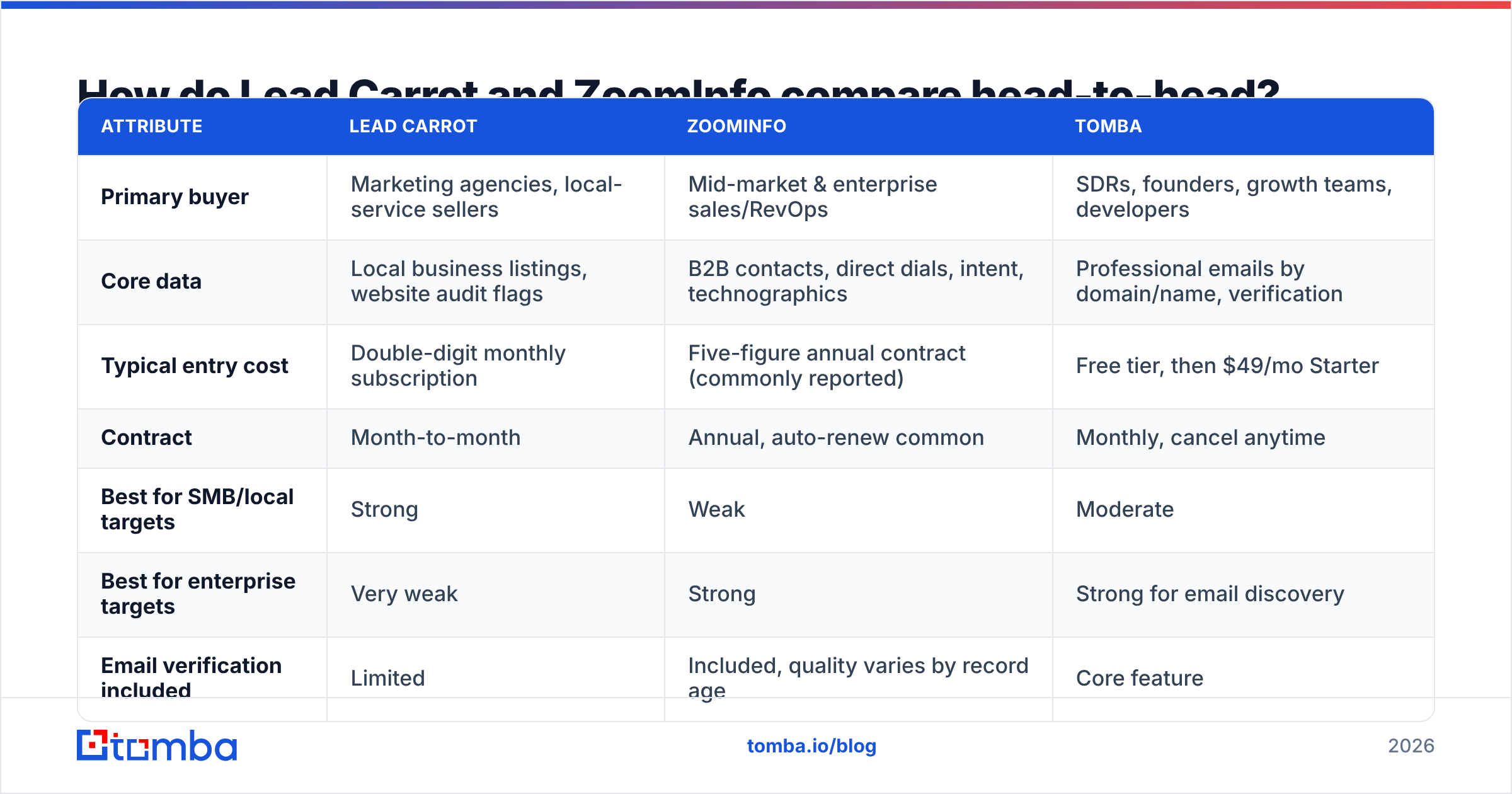
| Attribute | Lead Carrot | ZoomInfo | Tomba |
|---|---|---|---|
| Primary buyer | Marketing agencies, local-service sellers | Mid-market & enterprise sales/RevOps | SDRs, founders, growth teams, developers |
| Core data | Local business listings, website audit flags | B2B contacts, direct dials, intent, technographics | Professional emails by domain/name, verification |
| Typical entry cost | Double-digit monthly subscription | Five-figure annual contract (commonly reported) | Free tier, then $49/mo Starter |
| Contract | Month-to-month | Annual, auto-renew common | Monthly, cancel anytime |
| Best for SMB/local targets | Strong | Weak | Moderate |
| Best for enterprise targets | Very weak | Strong | Strong for email discovery |
| Email verification included | Limited | Included, quality varies by record age | Core feature |
| API access | Limited | Yes (enterprise tiers) | Yes, on all paid plans |
| Free trial / tier | Trial offered | Demo-gated, limited free samples | Free tier, 25 searches/mo |
The pattern is consistent across G2 reviews for both categories: cheap scraping tools win on price and lose on accuracy; enterprise data platforms win on depth and lose on procurement friction and shelfware.

Lead Carrot vs ZoomInfo pricing: what does each cost in 2026?#
Lead Carrot vs ZoomInfo pricing moves often, so treat these numbers as directional and confirm with the vendor. The structural gap is what matters.
Lead Carrot is a flat monthly subscription with search limits. There is no procurement cycle, no seat minimum, no sales call required to see a price. Agencies commonly run it for a few months, pull large regional lists, then pause. The real cost is not the subscription — it is the bounce rate. When a scraped local list bounces at 15–30%, the subscription savings evaporate into damaged sender reputation and blocked inboxes.
ZoomInfo is quoted, not published. Commonly reported structures include:
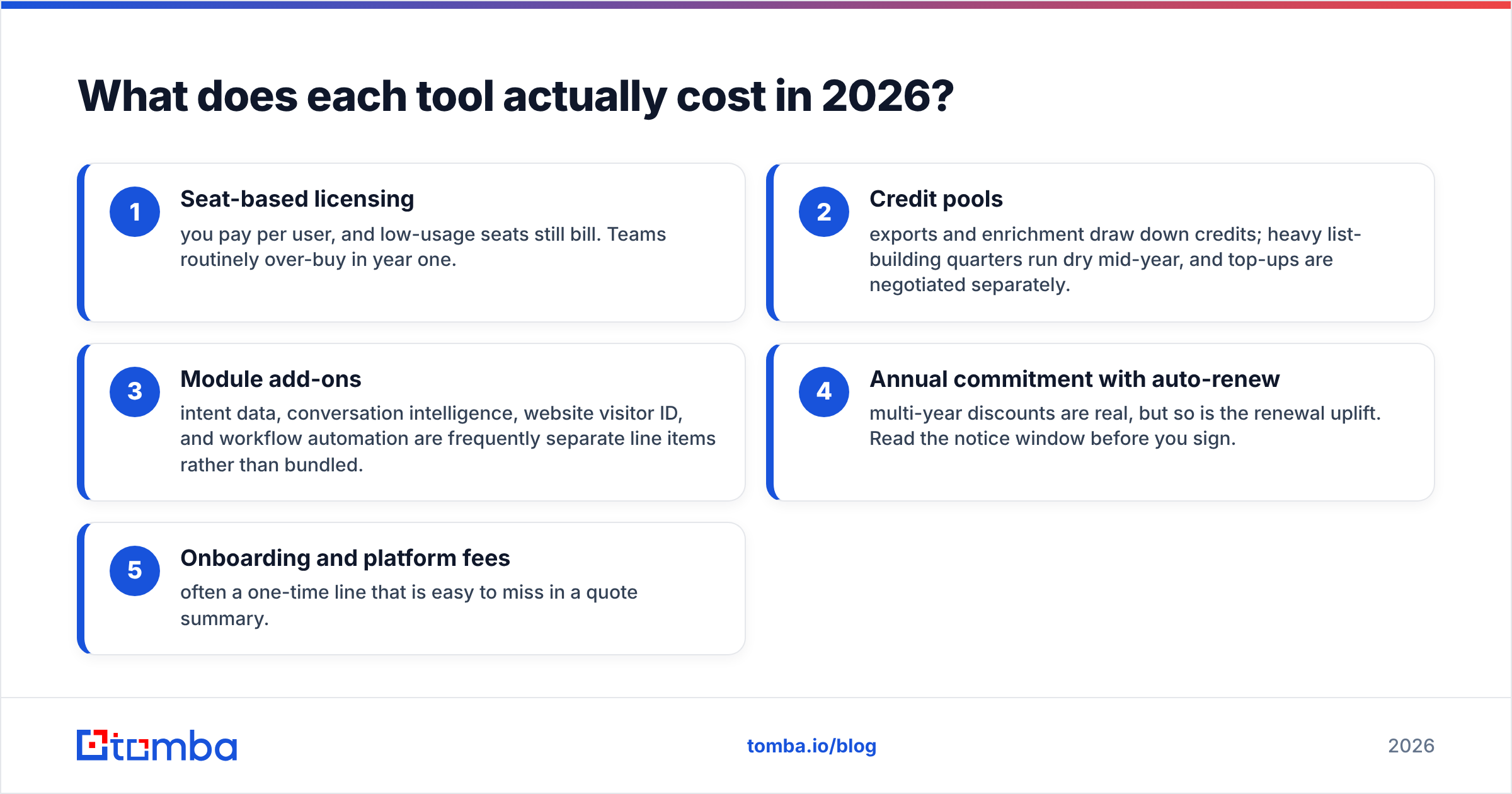
- Seat-based licensing — you pay per user, and low-usage seats still bill. Teams routinely over-buy in year one.
- Credit pools — exports and enrichment draw down credits; heavy list-building quarters run dry mid-year, and top-ups are negotiated separately.
- Module add-ons — intent data, conversation intelligence, website visitor ID, and workflow automation are frequently separate line items rather than bundled.
- Annual commitment with auto-renew — multi-year discounts are real, but so is the renewal uplift. Read the notice window before you sign.
- Onboarding and platform fees — often a one-time line that is easy to miss in a quote summary.
The honest framing: ZoomInfo is not overpriced for a 40-rep team running territory-based outbound into enterprise. It is wildly overpriced for a three-person agency emailing chiropractors. And Lead Carrot is not "worse data" — it is a completely different dataset that happens to be nearly useless above the SMB line.
Lead Carrot vs ZoomInfo: which has better data coverage?#
It depends on the segment. Both have a failure mode you can predict.
Where Lead Carrot is strong: businesses with a physical presence and a public listing. Trades, clinics, restaurants, gyms, local retail, small professional services. Coverage in this segment is broad because the source material — maps listings, directories, websites — is public and dense.
Where Lead Carrot falls apart: anything without a storefront. Remote SaaS companies, agencies with no local footprint, enterprise divisions, named decision-makers. It will often return a generic info@ address rather than a person. Generic inboxes are not prospects; they are a queue someone triages on Fridays.
Where ZoomInfo is strong: named contacts at companies above roughly 50 employees, direct dial phone numbers, org structure, and intent signals. The depth per record is genuinely hard to replicate.
Where ZoomInfo gets criticized: record decay. Every large B2B database inherits the same problem — people change jobs, and the database lags. A contact captured 18 months ago at a company with high churn is a coin flip. Coverage outside North America is also uneven, which surprises teams expanding into EMEA or APAC.
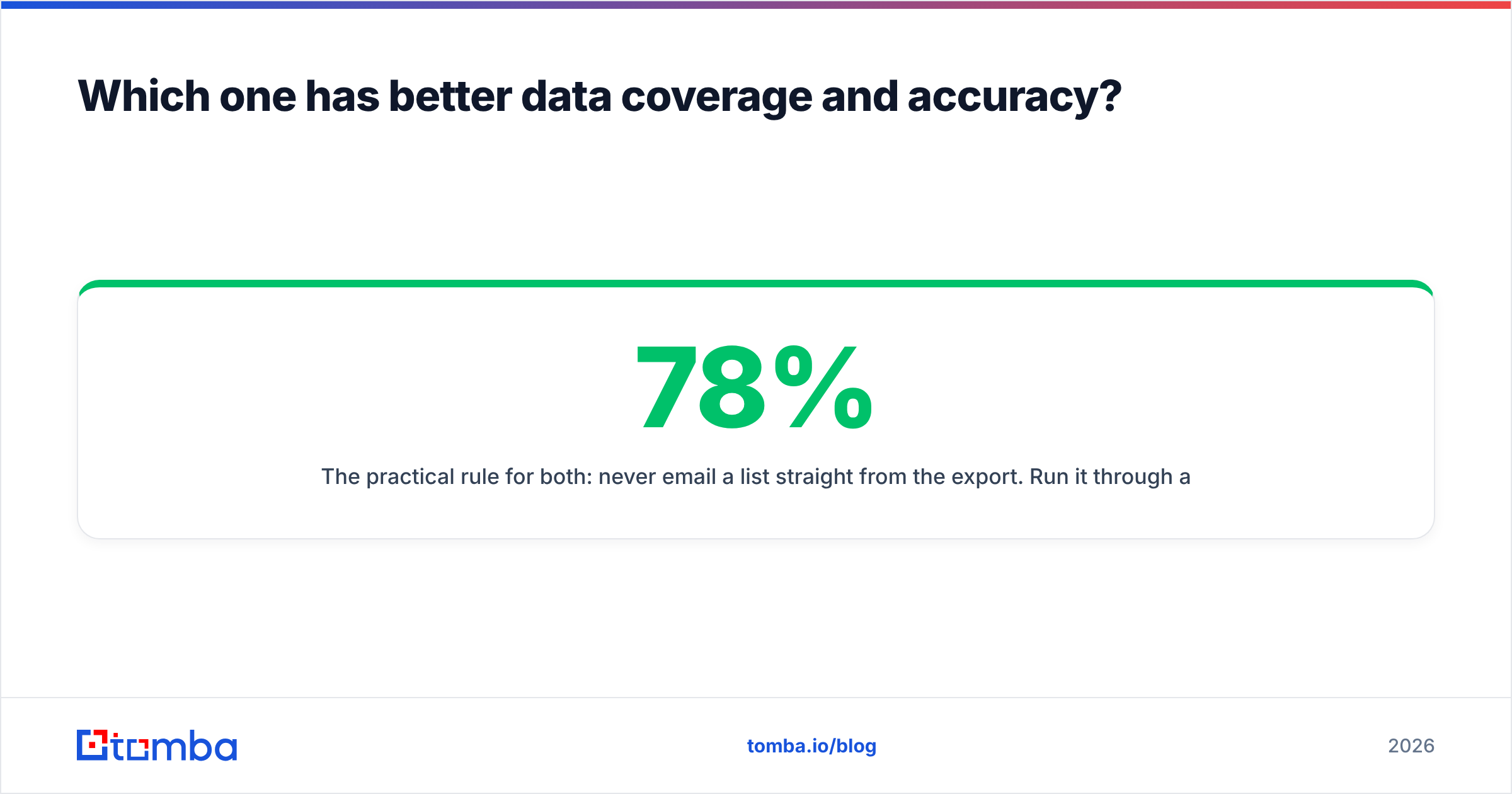
The practical rule for both: never email a list straight from the export. Run it through an email verifier first. A list that is 78% valid and known to be 78% valid is far more useful than a list you assume is 95% valid and is actually 70%.

Who should pick Lead Carrot?#
Choose Lead Carrot if most of these describe you:
- You sell to local businesses. Web design, SEO, reputation management, HVAC software, POS systems, staffing for trades.
- Your qualifier is observable from the outside. "No mobile site," "no reviews in 12 months," "running an outdated CMS." Lead Carrot's diagnostics are a genuine differentiator here — they hand you the first line of the email.
- You are cost-sensitive and volume-tolerant. You would rather send 2,000 emails at a 1% reply rate than 200 at 6%.
- You need month-to-month flexibility. No procurement, no legal review, cancel when a client campaign ends.
Do not choose it if you need named executives, direct dials, headcount-based filtering, or any account above the local SMB tier. It is the wrong tool and no workaround fixes that.
Who should pick ZoomInfo?#
Choose ZoomInfo if most of these describe you:
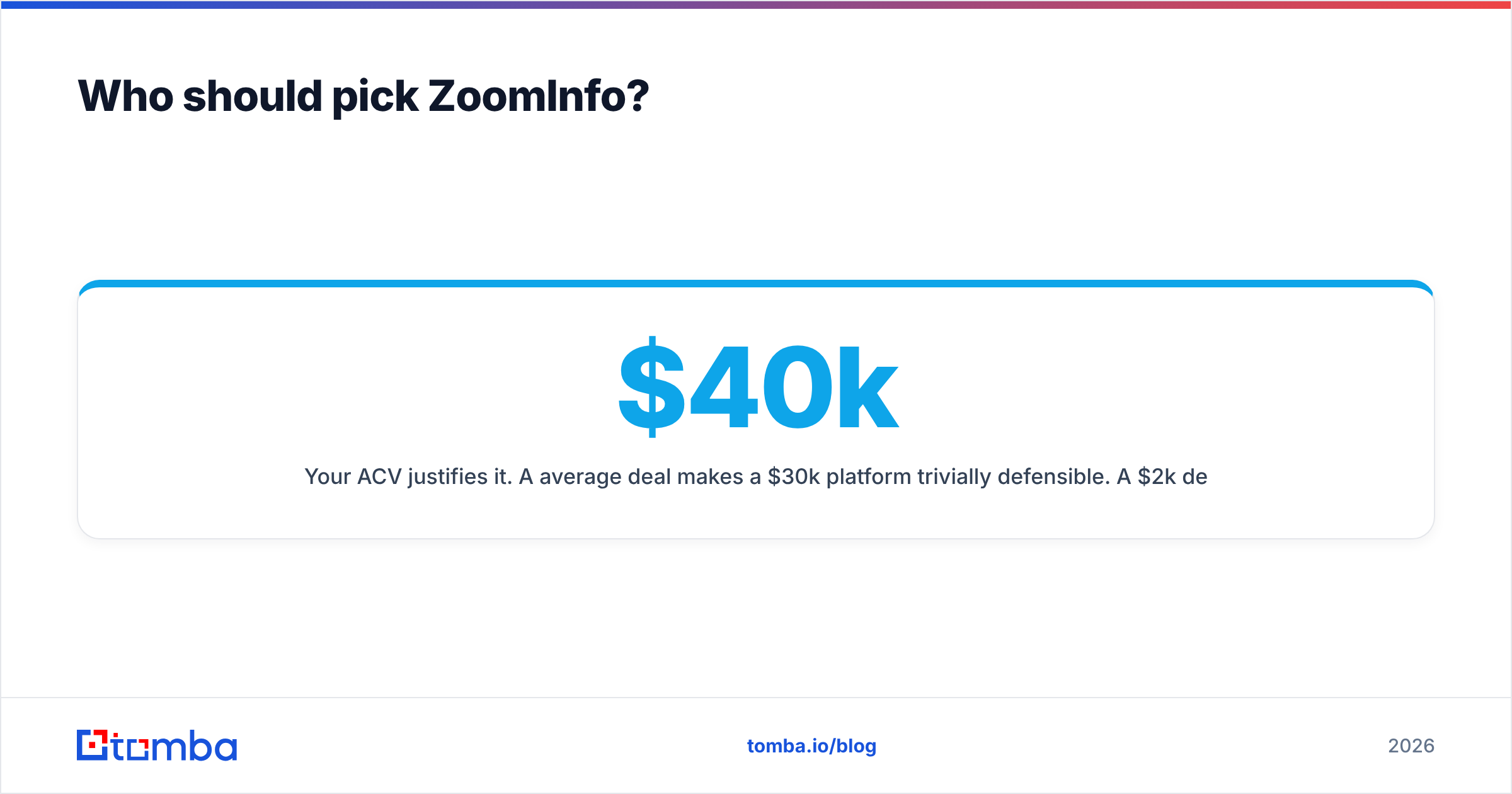
- Your ACV justifies it. A $40k average deal makes a $30k platform trivially defensible. A $2k deal does not.
- You run territory-based outbound with multiple reps. The value compounds across seats, CRM enrichment, and routing — not in a single user's search bar.
- Buying committees matter. Multi-threading into six stakeholders is where org-chart data earns its price.
- You want intent signals wired into your workflow. If you will actually action intent data weekly, it is one of the strongest arguments for the platform. If it will sit unused, subtract it from the quote.
- You have RevOps to own it. Unowned data platforms decay into expensive search bars within two quarters.
If you want ZoomInfo's depth without the contract, the realistic path is a narrower stack: a database for account discovery, a finder for contact-level email, and enrichment on top. Plenty of teams assemble that from Apollo alternatives, a verified B2B list provider like BookYourData for purchased segments, and a dedicated finder for the accounts they already know.
Is there a cheaper way to get the same outcome?#
Usually, yes — because most teams do not need a database. They need emails for a list of companies they can already name.
That distinction is the whole ballgame. Databases charge you to discover accounts. If you already have the accounts — from a conference list, a funding tracker, a LinkedIn search, your CRM, a scraped directory, even a Lead Carrot export — you are paying database prices for a lookup problem.
For that job the workflow is simple:
- Start from a domain list. Run domain search to pull every public email pattern and known contact at each company.
- Find the specific person. Use an email finder with first name, last name, and domain when you know exactly who you want.
- Verify before sending. Catch-all domains, role accounts, and dead mailboxes get filtered out instead of burning your domain.
- Enrich what survives. Add titles, company size, and social profiles via data enrichment so your segmentation is not guesswork.
- Batch it. For anything over a few hundred rows, bulk email finder processing beats one-at-a-time lookups.
Cost comparison for a team pulling 5,000 contacts a quarter: Lead Carrot gets you volume but weak person-level data; ZoomInfo gets you both and bills accordingly; a finder-plus-verifier stack on a $49–$99/mo plan covers the lookup half at a fraction of either. Check Tomba pricing against your actual monthly contact volume rather than your imagined one — that single honest number kills most over-buying.
What should you check before signing either contract?#
Five things, in order. This applies to any data vendor, not just these two.
- Run a blind sample. Send 50 companies from your real ICP — not their demo list. Check the output with a free email checker. That hit rate is your real hit rate.
- Ask what "accuracy" means. Syntax-valid? Deliverable at last check? Last check when? A 95% claim from collection day is not a 95% claim today.
- Model cost per verified contact. Divide the annual cost by the contacts you will really email. That number compares across vendors. List price does not.
- Read the renewal clause. Auto-renew with a 60- or 90-day notice window is standard. Put the notice date on your calendar the day you sign.
- Confirm export rights. Some deals limit what you keep after you leave. If you are building a long-term B2B database, that clause beats the discount.
Lead Carrot vs ZoomInfo: so which one wins?#
Lead Carrot wins for local SMB prospecting at low cost. ZoomInfo wins for enterprise account intelligence at high cost. There is no overlap worth arguing about, and any post that declares a single winner is selling something.
The more useful verdict on Lead Carrot vs ZoomInfo: most teams reading this need neither. If you can name your target companies, the expensive part is not discovery — it is getting a correct, deliverable address for the right human, then confirming it before you send. That is a $49/mo problem, not a $30k/yr one.
Start with the cheap half of the stack. Run your next 100 target accounts through the Tomba Email Finder — the free tier covers 25 searches a month, verification is built in, and you will know your true hit rate before you commit a single dollar to an annual contract. Then, if the coverage gap is real, you will be negotiating from evidence instead of a demo.
Related guides#
// get started
Find, verify and enrich your first contacts today
Start on the free plan with 25 searches a month, then scale when your team is ready.
Free plan · No credit card required · GDPR & CCPA
Get the Tomba newsletter
Product and data updates
// about the author