Lead Generation Canada: The 2026 B2B Playbook That Works
Canadian B2B lead gen runs on different rules: CASL consent, PIPEDA data handling, bilingual outreach, and a market where 10 provinces behave like 10 countries. Here is what actually works in 2026.
TL;DR
- Lead generation Canada is not US lead gen at a smaller scale. CASL makes unsolicited commercial email a regulated act. Fines reach $10 million per violation for organizations. Your US cold-email motion cannot be copy-pasted north.
- The B2B exemptions inside CASL are real and usable. Conspicuous publication, an existing business relationship, and inquiry-based implied consent cover most honest outbound. You just have to document which one applies.
- Quebec adds Law 25. It layers stricter privacy consent and French-language duties on top of federal PIPEDA rules.
- Market shape matters. Roughly 55% of Canadian business head offices sit in Ontario and Quebec, so territory design beats spray-and-pray.
- The winning 2026 lead generation Canada stack is small: verified contact data, a consent log, bilingual sequencing, and LinkedIn as a warm-up layer rather than a closing channel.
Lead generation Canada vs. the US: what actually changes?#
Three things: a consent law with teeth, a bilingual market, and a buyer base the size of California spread over a huge landmass.
Start with the law. The Canadian Anti-Spam Legislation (CASL) took effect in 2014. Unlike the American CAN-SPAM Act, it is an opt-in regime. CAN-SPAM lets you email a stranger, as long as you honour unsubscribes and do not lie in the header. CASL is stricter. You generally need consent — express or implied — before the first commercial email lands.
Lead generation Canada teams learn this the hard way. The Government of Canada's official CASL portal spells out the rules. The CRTC has fined Canadian companies hundreds of thousands of dollars for getting them wrong.
Then there is scale and shape. Canada has roughly 1.2 million active business establishments. The spread is lopsided. Ontario and Quebec hold most head offices. Alberta concentrates energy and agri-tech. British Columbia concentrates software, film, and cleantech. Build territories the way you would for the US — by state, evenly — and you will waste half your headcount on provinces with a few thousand qualifying accounts.
Third: language. Quebec is not a "nice to have" translation project. Since Law 25 and the stronger Charter of the French Language, business buyers in Quebec expect commercial messages in French. They notice when you skip it.

Is cold email legal in Canada under CASL?#
Yes — with conditions. Most US teams miss one detail: CASL recognises implied consent, and several implied-consent categories were built for B2B.
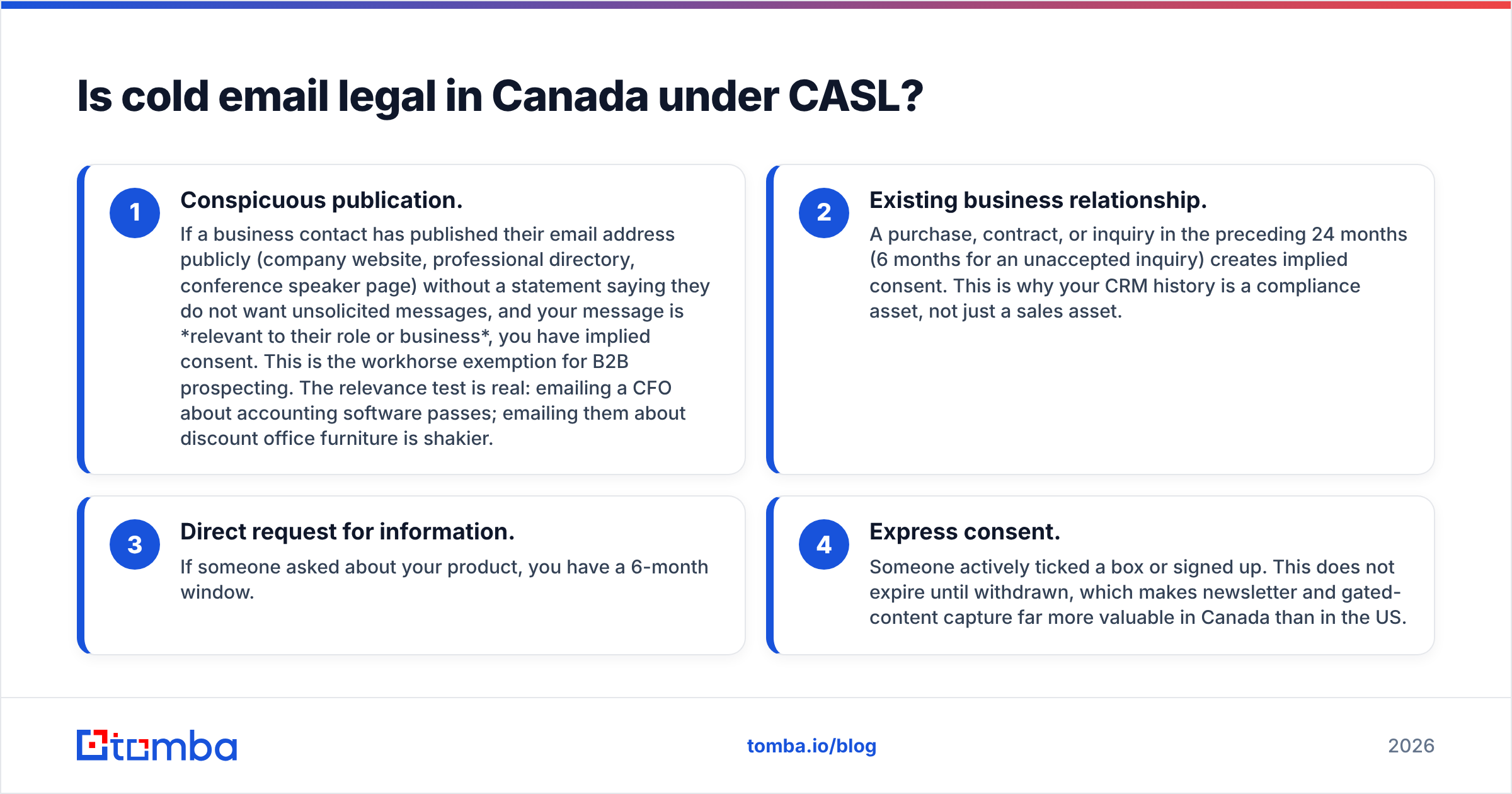
Four routes matter for outbound:
- Conspicuous publication. Say a business contact publishes their email address in public — a company website, a directory, a conference speaker page. If they did not add a note refusing unsolicited mail, and your message is relevant to their role, you have implied consent. This is the workhorse exemption for B2B. The relevance test is real. Emailing a CFO about accounting software passes. Emailing the same CFO about discount office furniture is shakier.
- Existing business relationship. A purchase, contract, or inquiry in the past 24 months creates implied consent. An inquiry that went nowhere gives you 6 months. Your CRM history is a compliance asset, not just a sales asset.
- Direct request for information. If someone asked about your product, you have a 6-month window.
- Express consent. Someone ticked a box or signed up. It does not expire until they withdraw it. That makes newsletter and gated-content capture far more valuable here than in the US.
Every message must identify the sender, whatever route you used. It also needs a physical mailing address and a working unsubscribe link. The link has to work for at least 60 days, and you must honour requests within 10 business days.
So your Canadian list needs a provenance column. Record which consent basis applies to each contact, and where the proof sits. If the CRTC ever asks, the burden of proof is on you, not on the regulator.
What are the real CASL vs CAN-SPAM vs GDPR differences?#
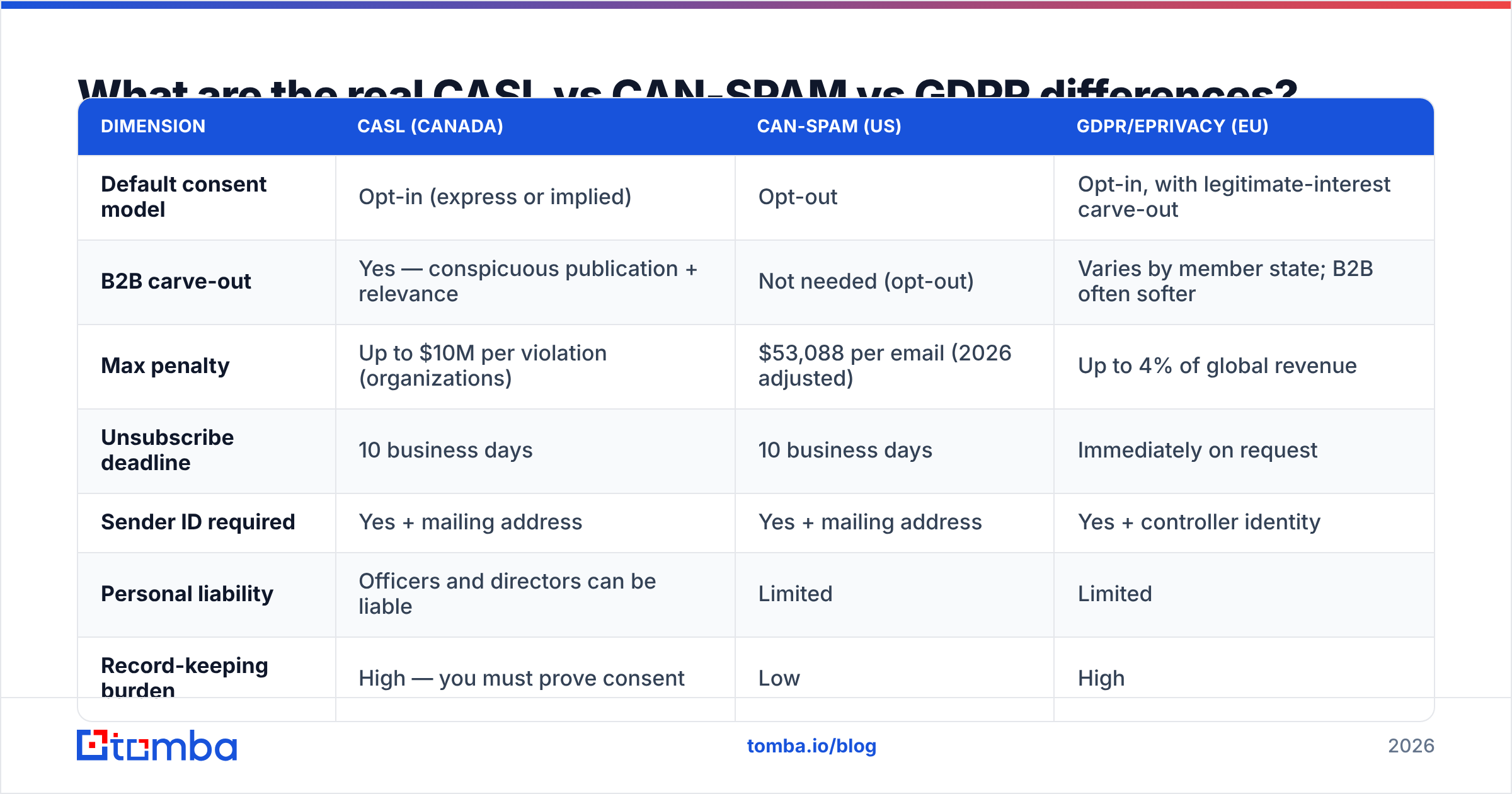
| Dimension | CASL (Canada) | CAN-SPAM (US) | GDPR/ePrivacy (EU) |
|---|---|---|---|
| Default consent model | Opt-in (express or implied) | Opt-out | Opt-in, with legitimate-interest carve-out |
| B2B carve-out | Yes — conspicuous publication + relevance | Not needed (opt-out) | Varies by member state; B2B often softer |
| Max penalty | Up to $10M per violation (organizations) | $53,088 per email (2026 adjusted) | Up to 4% of global revenue |
| Unsubscribe deadline | 10 business days | 10 business days | Immediately on request |
| Sender ID required | Yes + mailing address | Yes + mailing address | Yes + controller identity |
| Personal liability | Officers and directors can be liable | Limited | Limited |
| Record-keeping burden | High — you must prove consent | Low | High |
The last column should change your behaviour. Under CAN-SPAM, nobody asks you to prove anything. Under CASL, a complaint triggers a request for evidence. "We bought a list" is not evidence.
GDPR works the same way. That is why teams selling into both Canada and the EU usually run one stricter process instead of two.
How do you build a compliant Canadian prospect list?#
Data quality is where lead generation Canada quietly succeeds or fails. Canadian contact data is thinner than US data in most commercial databases. Fewer aggregators scrape Canadian sources. Plenty of mid-market Canadian firms also run catch-all mail servers, which defeat naive verification.
A workable process:
- Start from the domain, not the person. Use domain search to pull the verified pattern and known addresses for a Canadian company first. Do not guess at individuals. Pattern confidence beats name-based guessing, especially when French accented characters (é, à, ç) get mangled in transliteration.
- Verify before you send, always. Canadian ISPs and the large Canadian email hosts are unforgiving on bounce rates. Run every address through an email verifier. Treat anything below "valid" as a LinkedIn touch instead of an email touch.
- Handle catch-alls deliberately. A catch-all domain accepts everything and tells you nothing. A dedicated catch-all verifier gives you a probabilistic read instead of a coin flip.
- Log the consent basis at enrichment time. When you enrich leads, add a field for how you got the address: public directory, website footer, inbound form, event list. Doing it later never happens.
- Segment Quebec separately from day one. Different language, different privacy law, different sequence. Mix it into a national list and you will send an English sequence to a Montreal buyer who expects French.
Accuracy matters more here than in a US campaign, because your total addressable market is smaller. Say you have 3,000 qualified accounts in a Canadian vertical instead of 40,000. Burning 15% of them on bounces is not a rounding error. It is a quarter.
Which channels actually produce pipeline in Canada?#
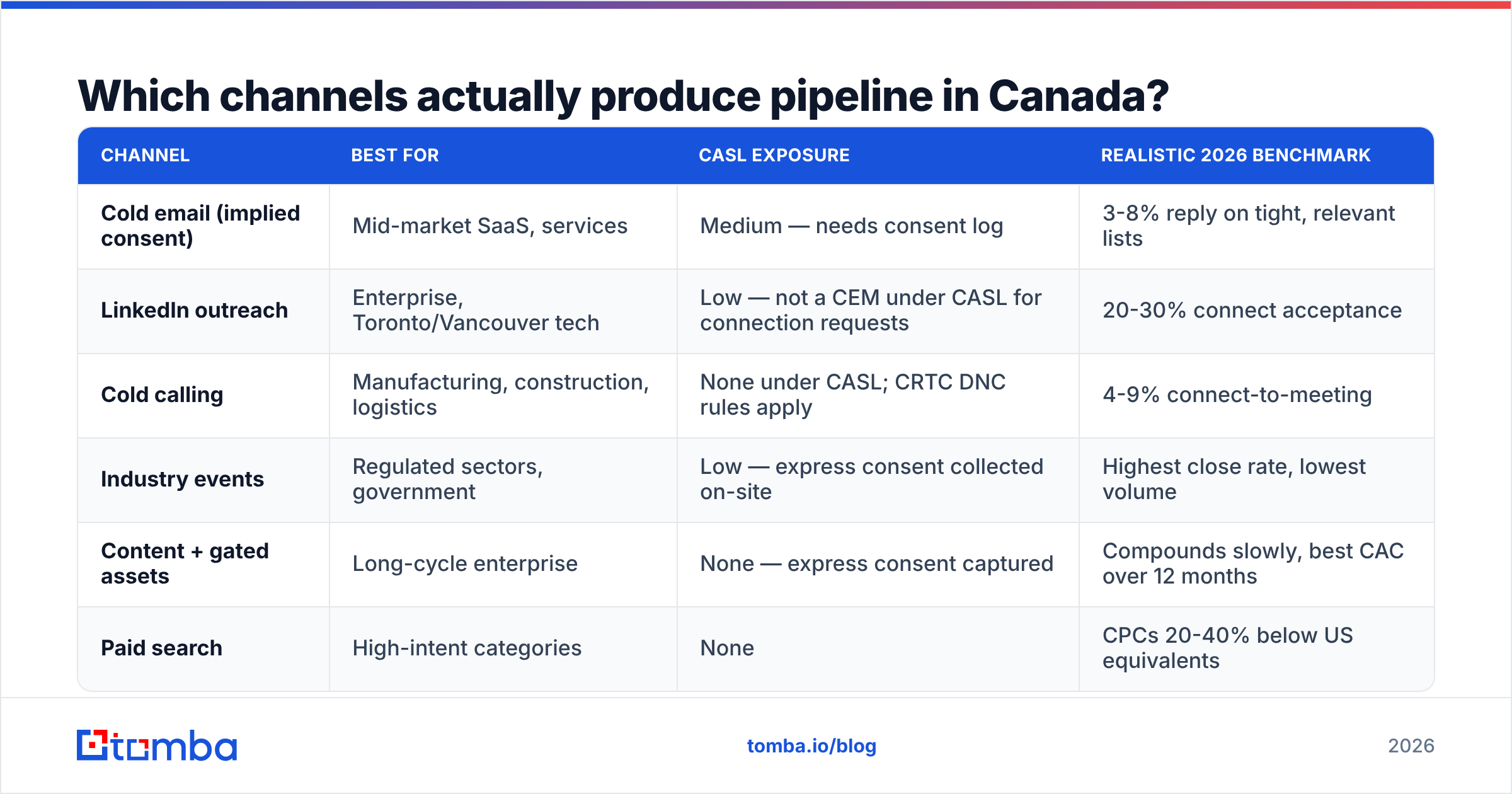
| Channel | Best for | CASL exposure | Realistic 2026 benchmark |
|---|---|---|---|
| Cold email (implied consent) | Mid-market SaaS, services | Medium — needs consent log | 3-8% reply on tight, relevant lists |
| LinkedIn outreach | Enterprise, Toronto/Vancouver tech | Low — not a CEM under CASL for connection requests | 20-30% connect acceptance |
| Cold calling | Manufacturing, construction, logistics | None under CASL; CRTC DNC rules apply | 4-9% connect-to-meeting |
| Industry events | Regulated sectors, government | Low — express consent collected on-site | Highest close rate, lowest volume |
| Content + gated assets | Long-cycle enterprise | None — express consent captured | Compounds slowly, best CAC over 12 months |
| Paid search | High-intent categories | None | CPCs 20-40% below US equivalents |
Two channel notes are specific to lead generation Canada.
Cold calling is underrated. The CRTC keeps a National Do Not Call List, but it covers consumer numbers. B2B lines are generally exempt when you call a business about business. Inboxes here are locked down by CASL anxiety, so the phone is less crowded than in the US. Building a calling motion? Then sourcing verified B2B phone numbers matters more than it does in a US motion, where email volume can carry you.
LinkedIn connection requests are not commercial electronic messages under most readings. But send a commercial pitch through LinkedIn InMail and you are back in CASL territory. Use connections to warm people up. Then move to a channel where consent is documented.

What does provincial targeting look like in practice?#
Canada behaves like ten markets, not one. Territory design should reflect that:
- Ontario — roughly 40% of national GDP, the Toronto-Waterloo tech corridor, and a cluster of financial services. Competition is highest here, and the inbox is as noisy as the US.
- Quebec — aerospace, AI research in Montreal, gaming, manufacturing. French-first outreach, Law 25 compliance, and a strong preference for a local presence or local partners.
- British Columbia — software, cleantech, film and VFX, Asia-Pacific trade. The time zone matches the US West Coast, so it is the easiest province for California teams.
- Alberta — energy, agri-tech, logistics. Buying cycles track commodity cycles. Timing your sequences around quarterly energy reporting beats a generic cadence.
- Atlantic provinces — ocean tech, fisheries, fewer companies overall. High reply rates, low volume. Relationships and referrals drive the deals.
- Prairies and North — agriculture, mining, public sector. Long cycles, procurement-driven, low email saturation.
A practical rule: assign rep capacity by qualified account count, not by population or map size. One rep can usually cover Atlantic Canada plus the Prairies. Ontario alone may need three.
How should you price and package for Canadian buyers?#
Canadian B2B buyers watch price more closely than their US counterparts. They also dislike currency ambiguity. Three things cost deals again and again:
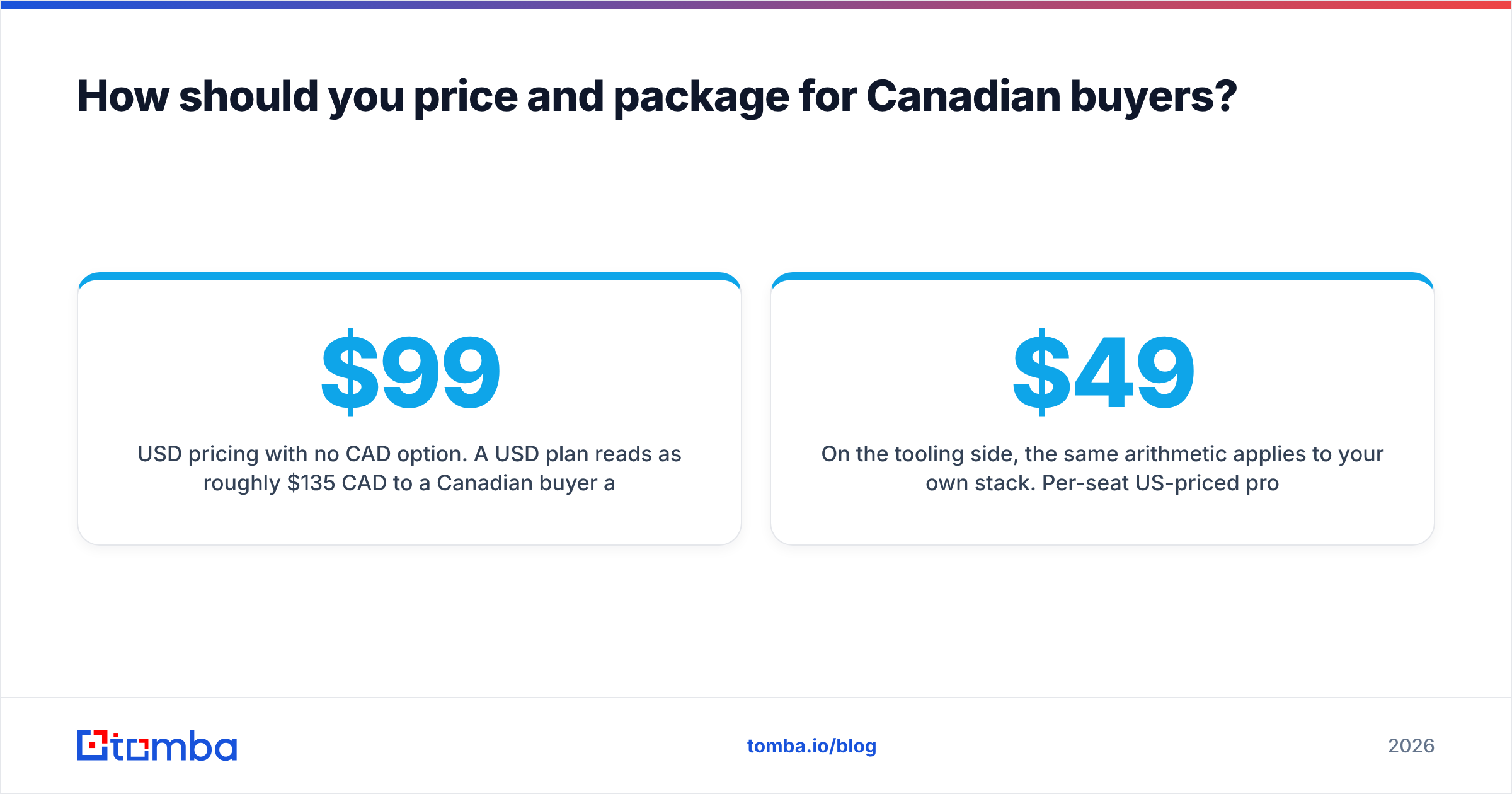
USD pricing with no CAD option. A $99 USD plan reads as roughly $135 CAD. Your buyer will do that math out loud on the call. Quote in CAD, or state the exchange assumption up front.
Data residency questions you cannot answer. Canadian buyers ask where data is stored, especially in healthcare, financial services, and anything touching government. Under PIPEDA, cross-border transfer is legal with the right safeguards. But "we're on US-East and that's it" ends public-sector conversations.
No French documentation. In Quebec, contracts and key commercial documents in French are becoming a procurement requirement, not a courtesy.
The same math applies to your own stack. Per-seat US-priced prospecting platforms get expensive fast once the CAD conversion lands. Credit-based models fit Canadian team sizes better.
Tomba pricing starts with a free tier at 25 searches per month. Starter is $49/mo and Growth is $99/mo. That covers most two-to-five-person Canadian sales teams without an enterprise commitment. Seat-based platforms often push a three-person team past four figures a month before it sends a single email.
What does a 2026 Canadian outbound sequence look like?#
A sequence that respects CASL and still converts:
- Day 0 — LinkedIn view + connection request. No pitch. Not a CEM. It builds familiarity before the email lands.
- Day 2 — Email one. Reference the conspicuous-publication source if it reads naturally ("saw your note on the OBIO panel"). Include full sender identification, a physical address, and an unsubscribe link. Give one specific, role-relevant reason for the message.
- Day 5 — Phone attempt. B2B line, business purpose. Leave a voicemail that references the email.
- Day 9 — Email two. New angle, not a "just bumping this." Name a Canadian customer or a Canadian regulatory driver if you have one.
- Day 14 — LinkedIn message. Short. If they engaged with anything, reference it.
- Day 21 — Breakup email. Explicit, clean, easy to say no to. Canadian buyers reply to these far more often than to a third follow-up.
Keep total touches lower than a US sequence. An 11-touch US cadence reads as aggressive here. The legal default in Canada is "do not contact me without permission." Six to eight touches over three weeks is the range where Canadian response rate holds up.
What are the most common lead generation Canada mistakes?#
- Buying a "Canadian list" with no provenance. If the vendor cannot tell you the consent basis per record, you have inherited their liability. Legitimate providers — including BookYourData, which sells verified B2B contacts with documented sourcing — will tell you where records come from. Ask before you buy.
- Treating Quebec as an afterthought. Sending English to Montreal is the fastest way to lose a quarter of your TAM.
- Ignoring the unsubscribe clock. Ten business days is a hard deadline. Manual suppression lists fail at scale, so automate it.
- Assuming CASL only covers email. It also covers text messages, some instant messages, and social messages sent to an electronic address. The scope is broader than most teams assume.
- Over-indexing on Toronto. Toronto is crowded. Calgary, Ottawa, Halifax, and Winnipeg have real buyers and a fraction of the inbound noise.
- No French landing page for French outreach. If the email is in French and the link opens in English, you have advertised that you do not really operate in the market.
How do you measure lead generation Canada performance?#
Use the same funnel metrics you use elsewhere. Just calibrate the benchmarks: lower on volume, higher on quality. Canadian outbound usually produces:
- Lower meeting volume per rep than a comparable US territory, because the TAM is smaller
- Higher meeting-to-opportunity conversion, because most provinces are quieter
- Longer sales cycles in regulated and public-sector segments
- Much lower cost per acquired customer on paid channels
Track bounce rate weekly. Treat anything over 3% as an incident, not a metric.
Track your consent-basis mix as a health metric too. If more than 60% of your list sits on "conspicuous publication," you lean on one exemption too hard. You are also under-investing in express consent, which never expires.
Check vendor and tooling claims against independent sources like G2 before you commit budget. Canadian data coverage varies widely between platforms that look identical on a feature grid.
Getting started#
Lead generation Canada is not harder than US lead generation. It is more deliberate. Smaller lists, cleaner consent, better targeting, fewer touches. Teams that accept those limits often find the economics better than the US: less noise, higher reply rates, and buyers who stay longer.
Start with the data layer, because everything downstream depends on it. The Tomba Email Finder pulls verified professional addresses by company domain or name.
That is the shape a lead generation Canada motion needs: domain-first discovery, verified before send, and pattern detection that handles French name formats without garbling them. The free tier gives you 25 searches a month. Run it against twenty Canadian companies in your ICP and see what comes back before you spend anything.
Build the consent log on day one. Verify before every send. Segment Quebec separately. That is most of the game.
Related guides#
Ready to find emails that actually work?
Join 150,000+ professionals who stopped guessing and started sending. Free credits on signup — no credit card required.
Get the Tomba newsletter
Practical outbound tactics and product updates — once every two weeks.
About the author