LeadIQ vs Revli (2026): Contact Capture vs Funding Signals Compared
LeadIQ and Revli both promise a pipeline but answer different questions. LeadIQ helps you reach a known person. Revli tells you which companies just raised money. Here is which one fits your outbound motion.
TL;DR
- LeadIQ is a prospecting and contact-capture tool. It pulls emails and phone numbers from LinkedIn and Sales Navigator, syncs them to your CRM and sequencer, and tracks job changes. Use it when you already know who you want to reach.
- Revli is a funding-intelligence tool. Every week it publishes lists of recently funded startups with decision-maker contacts. Use it when you want to know which companies to target right now.
- On price, Revli's paid plans are flat monthly fees (about $79 and $149/mo at the time of writing). LeadIQ charges per seat, and each plan comes with a monthly credit allowance. Once you have more than two reps, LeadIQ usually costs more.
- These tools don't really compete with each other. Plenty of teams use Revli to pick accounts and then a contact tool to find and verify the right people.
- If what you actually need is verified emails at a lower cost per contact, a dedicated email finder can cover both workflows.
What is the real difference between LeadIQ and Revli?#
Most "LeadIQ vs Revli" searches treat them as rivals. They aren't. They sit at two different stages of the same outbound process.
Think of a fishing trip. Revli shows you where the fish are biting this week: companies that just closed a Seed, Series A, or Series B round and now have budget to spend. LeadIQ is your rod and reel. It helps you land one specific person once you've picked a spot.
In practice:
- Revli answers "who should we target?" Its core product, Funding Insights, is a weekly list of newly funded companies. You can filter by funding stage, amount, industry, and location, and each company comes with contacts for founders and executives.
- LeadIQ answers "how do I reach this person?" You browse LinkedIn, Sales Navigator, or a company website, click the Chrome extension, and LeadIQ returns work emails and direct dials. It then pushes the contact into Salesforce, HubSpot, Outreach, or Salesloft.
So the useful question isn't which tool is better. It's which bottleneck is slowing you down: finding accounts or reaching people.
How do LeadIQ and Revli compare feature by feature?#
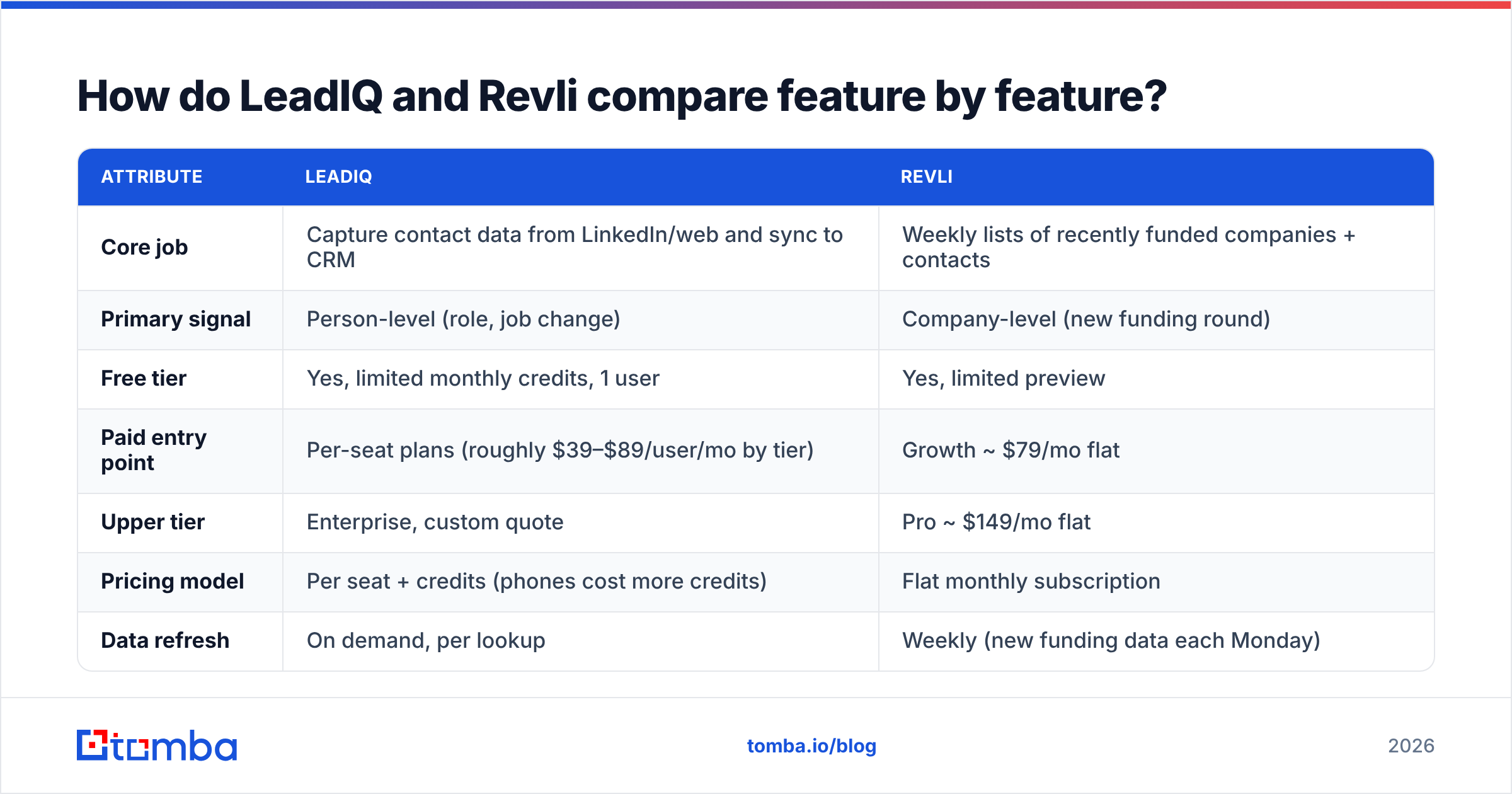
Here is the side-by-side, based on public product pages and third-party listings as of 2026. Check current details on each vendor's site before you buy, because both change packaging regularly.
| Attribute | LeadIQ | Revli |
|---|---|---|
| Core job | Capture contact data from LinkedIn/web and sync to CRM | Weekly lists of recently funded companies + contacts |
| Primary signal | Person-level (role, job change) | Company-level (new funding round) |
| Free tier | Yes, limited monthly credits, 1 user | Yes, limited preview |
| Paid entry point | Per-seat plans (roughly $39–$89/user/mo by tier) | Growth ~ $79/mo flat |
| Upper tier | Enterprise, custom quote | Pro ~ $149/mo flat |
| Pricing model | Per seat + credits (phones cost more credits) | Flat monthly subscription |
| Data refresh | On demand, per lookup | Weekly (new funding data each Monday) |
| Chrome extension | Yes, core workflow | Not the core workflow |
| CRM / sequencer sync | Salesforce, HubSpot, Outreach, Salesloft, Gong Engage | CSV export for CRM import |
| Job change tracking | Yes | No |
| AI email writing | Yes (Scribe) | No |
| Best for | SDR teams running account-based outbound | Agencies, SaaS, and service firms selling to startups |
The table shows the split clearly. LeadIQ is built around a rep's daily workflow and connects to everything. Revli is closer to a data subscription: a new batch of accounts arrives every week, and you decide what to do with them.
What does LeadIQ do well, and where does it fall short?#
LeadIQ has been an established SDR tool for years, and it has earned that spot. Its strengths:
- Capture in one click. From a Sales Navigator search you can save a whole list of prospects, with emails and phones, straight into a sequence. Reps don't have to switch tabs or paste CSVs.
- CRM hygiene. It checks for duplicates against Salesforce or HubSpot before writing, so you don't end up with three records for one VP.
- Job change alerts. When a past champion moves to a new company, LeadIQ flags it. Job-change outreach is one of the highest-converting plays in B2B.
- Scribe. Built-in AI drafts personalized emails from the prospect's profile. It's useful for getting a first draft down quickly.
Where it falls short:
- The per-seat math adds up quickly. A ten-rep team on a mid-tier plan pays ten times the list price. According to LeadIQ's G2 pricing page and several third-party breakdowns, Enterprise contracts for mid-size teams commonly land in five figures a year.
- Phones use a lot of credits. Direct dials usually cost several credits each, so a phone-heavy workflow runs out of its allowance well before month-end.
- It doesn't tell you who to target. LeadIQ assumes you already have a target account list. If your ICP is vague, you'll spend credits on the wrong people.

What does Revli do well, and where does it fall short?#
Revli has a narrow focus and does it well. Recently funded companies are among the most reliable buying signals in B2B. They have fresh cash, hiring plans, and a board expecting growth. Revli packages that signal into a list you can act on.
Strengths:
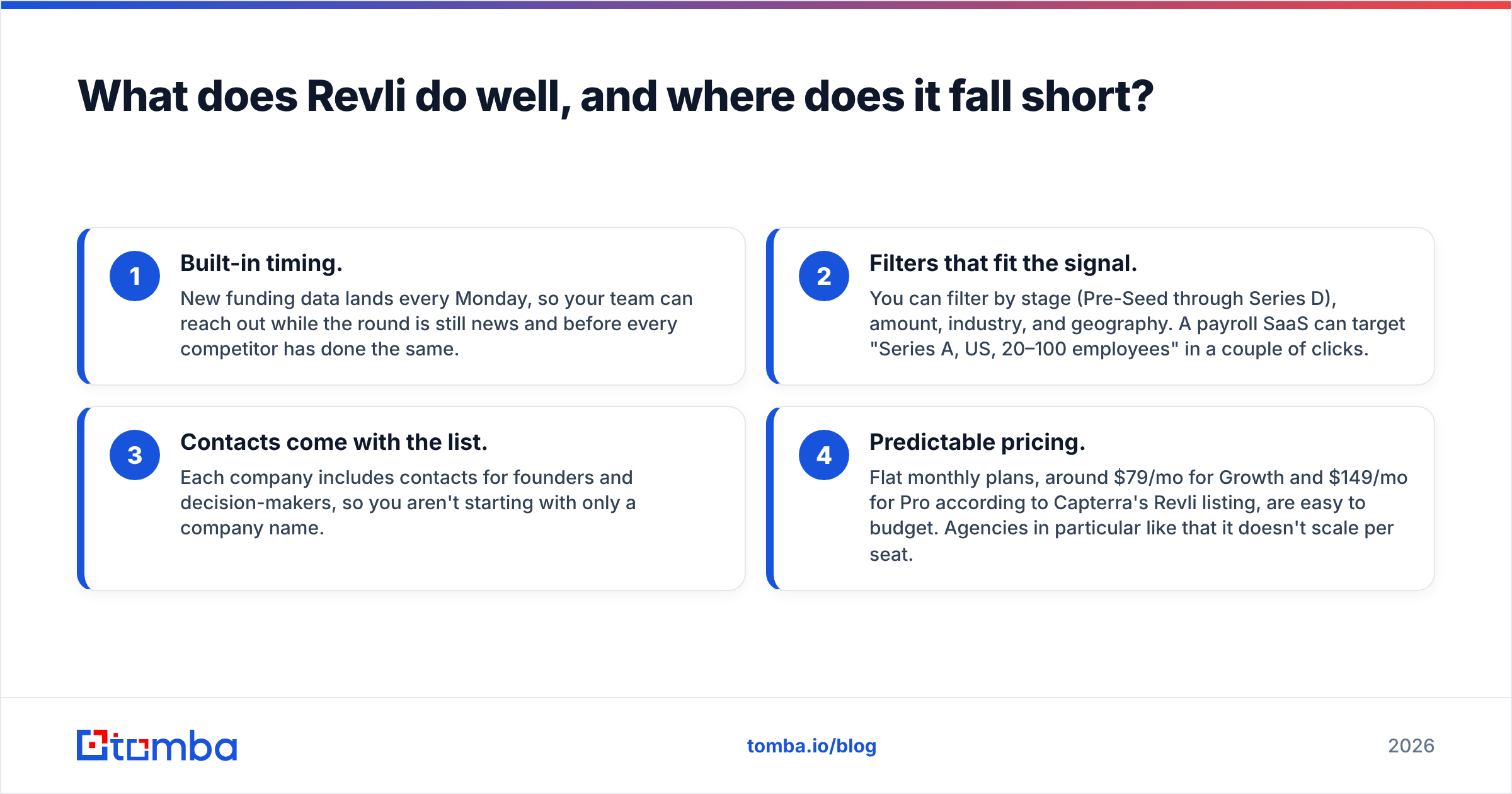
- Built-in timing. New funding data lands every Monday, so your team can reach out while the round is still news and before every competitor has done the same.
- Filters that fit the signal. You can filter by stage (Pre-Seed through Series D), amount, industry, and geography. A payroll SaaS can target "Series A, US, 20–100 employees" in a couple of clicks.
- Contacts come with the list. Each company includes contacts for founders and decision-makers, so you aren't starting with only a company name.
- Predictable pricing. Flat monthly plans, around $79/mo for Growth and $149/mo for Pro according to Capterra's Revli listing, are easy to budget. Agencies in particular like that it doesn't scale per seat.
Where it falls short:
- It covers one signal only. If your ICP includes bootstrapped companies, mid-market firms, or enterprises, Revli won't show most of them.
- A weekly batch isn't a live workflow. There's no Chrome extension for grabbing a contact while you research, and no two-way CRM sync. You get CSVs.
- Contact depth is limited. You usually get founders and senior executives. If your buyer is a Head of RevOps or an IT manager at a 200-person company, you'll need a separate tool to find that person.
- Everyone sees the same list. Your competitors can subscribe to the same funding feed. Timing helps, but a generic "congrats on the raise" email won't stand out.
Which one is cheaper for a real sales team?#
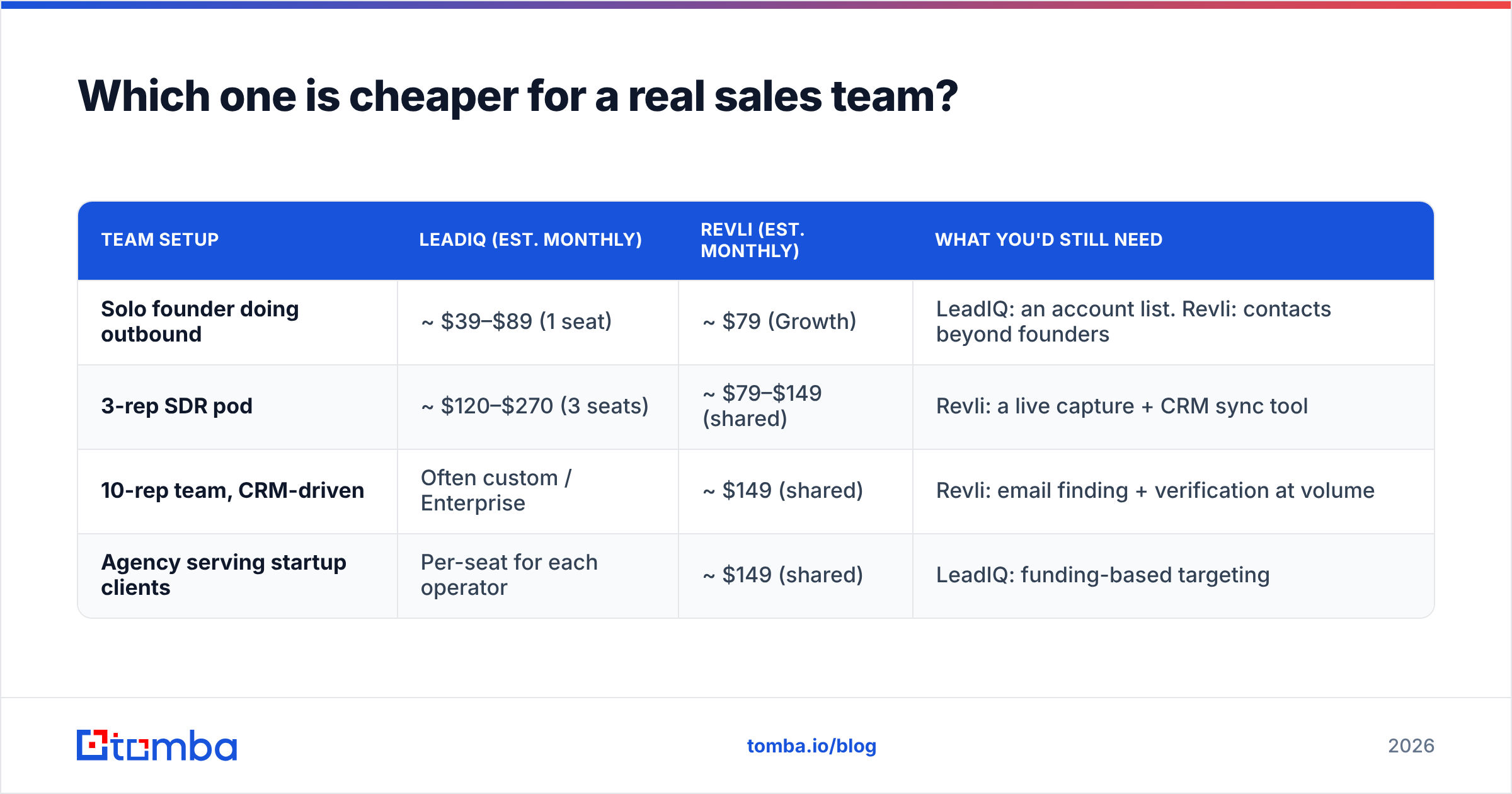
This is where the two tools differ most in practice. Here are three typical team setups, using approximate list prices (confirm the numbers on each vendor's site before you buy):
| Team setup | LeadIQ (est. monthly) | Revli (est. monthly) | What you'd still need |
|---|---|---|---|
| Solo founder doing outbound | ~ $39–$89 (1 seat) | ~ $79 (Growth) | LeadIQ: an account list. Revli: contacts beyond founders |
| 3-rep SDR pod | ~ $120–$270 (3 seats) | ~ $79–$149 (shared) | Revli: a live capture + CRM sync tool |
| 10-rep team, CRM-driven | Often custom / Enterprise | ~ $149 (shared) | Revli: email finding + verification at volume |
| Agency serving startup clients | Per-seat for each operator | ~ $149 (shared) | LeadIQ: funding-based targeting |
The pattern: Revli stays cheap as you add people because it's a shared list. LeadIQ gets expensive as you add people because every rep needs a seat. Revli, however, only covers the targeting half of the job. In most setups you still have to pay for something that finds and verifies emails for the people who actually buy.
Which tool gives you better data quality?#
It's hard to compare these directly because they measure different things.
- LeadIQ's quality depends on email and phone accuracy. It verifies emails before delivering them, but like every contact database it has trouble with catch-all domains and with people who changed jobs recently. Phone coverage varies by region.
- Revli's quality depends mostly on the funding data itself (was the round real, when did it close, how much was raised) and then on the contacts attached to it. Funding announcements are public and well documented, so the company-level data tends to be solid. The attached contacts are the weaker part.
Whichever tool you choose, run every exported list through an email verifier before it goes into a sequence. A 5% bounce rate on a fresh domain can damage your sender reputation for weeks, and neither tool's vendor pays for that damage.
How do you decide between LeadIQ and Revli?#
Use this checklist. Pick the first one that matches your situation:
- Your ICP is recently funded startups. Start with Revli. The signal matches your market, and the flat price is easy to justify.
- You have a defined target account list and live in Sales Navigator. Start with LeadIQ. The capture-and-sync workflow will save your reps hours every week.
- You sell to both startups and established companies. Use Revli for the funded segment and a contact tool for everyone else. Don't try to force either tool to cover the whole market.
- Budget is tight and you have more than three reps. Skip per-seat pricing. Pair a shared account source with a credit-based email finder that isn't billed per seat.
- You mainly need verified emails, not workflow features. Neither tool is the cheapest way to get them. A dedicated email finder will usually cost less per contact.

Can you use LeadIQ and Revli together?#
Yes, and many teams do. A common stack looks like this:
- Monday: Revli publishes new funded companies. RevOps filters them down to your ICP.
- Monday afternoon: Reps open each company on LinkedIn and use LeadIQ to capture the actual buyers (VP Sales, Head of Marketing, whoever your champion usually is), not only the founders.
- Tuesday: Contacts sync to the CRM and enter a sequence that references the funding round in a specific, non-generic way ("You're hiring 6 AEs post-Series A. Here's how teams at that stage ramp them faster").
- Ongoing: LeadIQ's job-change tracking re-engages champions when they move to other funded companies.
It works well, but it's expensive: a Revli subscription plus a LeadIQ seat for every rep. If you're price-sensitive, the capture step (step 2) is the easiest place to save money. A domain search on each newly funded company returns every public email tied to that domain, with the role and a confidence score. Often that's all you need to find the right buyer without paying per seat.
Are there alternatives worth considering?#
If neither tool fits exactly, look at how the category breaks down:
- Other funding-signal sources: Crunchbase Pro and PitchBook cover funding data in more depth, though at a higher price and with more of a research focus than a prospecting one.
- Other contact-capture tools: Apollo, ZoomInfo, Lusha, and RocketReach all compete with LeadIQ, with different trade-offs on price, coverage, and sequencing features. If LeadIQ's per-seat pricing is the sticking point, see our LeadIQ alternative breakdown.
- Email finders with enrichment: Tools like Tomba sit between the two. You bring a domain, a name, or a list, and you get verified emails, phone numbers, and company data back. There's no weekly funding feed, and no per-seat pricing.
For broader context on how buyers evaluate these categories, HubSpot's guide to sales prospecting is a useful neutral reference.
FAQ: LeadIQ vs Revli#
Is Revli a replacement for LeadIQ? No. Revli tells you which companies recently raised money. LeadIQ helps you capture contact data for specific people. Revli includes some contacts, but it doesn't offer LeadIQ's Chrome extension workflow, CRM deduplication, or job-change tracking.
Is LeadIQ good for targeting funded startups? You can do it by combining LeadIQ with Sales Navigator filters, but LeadIQ doesn't provide funding-round data itself. You'd need Revli, Crunchbase, or a similar source to build the list first.
Which is better for agencies? Revli's flat pricing and startup focus usually suit agencies better, especially ones selling dev, design, recruiting, or growth services to newly funded companies. Add an email finder to get contacts beyond the founders.
Do either offer a free plan? Both have limited free tiers, enough to test data quality but not to run a real outbound program.
So which should you choose?#
If your best customers are startups that just raised money, Revli gives you the most relevant signal at a predictable flat price. If your team works off a defined account list and needs contacts flowing into Salesforce or Outreach with minimal friction, LeadIQ is the stronger workflow tool, but budget for per-seat costs as you grow.
If your real constraint is getting accurate, verified emails for the right people at a reasonable cost per contact, you don't have to buy both. Tomba Email Finder finds professional emails by domain, name, or company, and verification is built in, starting with a free tier and paid plans from $49/mo (see Tomba pricing). Run it on your Revli list, your Sales Navigator exports, or any account list you already have, and send outreach to people who will actually receive it.
Related guides#
// get started
Find, verify and enrich your first contacts today
Start on the free plan with 25 searches a month, then scale when your team is ready.
Free plan · No credit card required · GDPR & CCPA
// about the author