LeadRocks vs Pubrio (2026): Pricing, Data Coverage and Our Pick
LeadRocks sells cheap credits and a LinkedIn scraper. Pubrio sells APAC-heavy data and buying signals. Here is how the two compare on price per credit, coverage, accuracy and workflow, and which team each one suits.
TL;DR
- LeadRocks is the cheaper, simpler tool. Paid plans start at $29/mo for 1,000 credits, and the LinkedIn Chrome extension is the main reason people buy it. It suits solo founders and small SDR teams that prospect mostly from LinkedIn.
- Pubrio costs more to get in ($125/mo for 6,000 credits), but each credit is cheaper at volume. It also adds AI search, hiring and news signals, and much stronger Asia-Pacific coverage.
- Accuracy is the weak spot for both. LeadRocks advertises 98%+ email accuracy, but independent reviewers have reported far lower valid rates. Pubrio claims about 90%. Verify every export before you send to it.
- Our pick: choose Pubrio if you sell into APAC or need buying signals. Choose LeadRocks if you want LinkedIn-first prospecting on a small budget. Either way, run a separate verification step.
What are LeadRocks and Pubrio, in one sentence each?#
LeadRocks is a low-cost B2B contact database with more than 100M records. You mostly use it through a LinkedIn Chrome extension that reveals emails and phone numbers from profiles and search results. It also has basic sequencing and a built-in verifier.
Pubrio is a B2B data and sales intelligence platform. It says it indexes 300M+ records gathered from more than a billion public web sources across 130+ countries. Its angle is Asia-Pacific coverage plus AI search over company signals such as hiring, technology adoption and news.
The two overlap on one job: you give them a target account or person, and they give you a contact. Most of the differences come from everything built around that job.
A simple way to picture it: LeadRocks is a vending machine. You put in a credit, press the LinkedIn button and a contact comes out. Pubrio is closer to a research desk. It helps you decide which companies to go after first, then pulls the contacts.
How do LeadRocks and Pubrio compare side by side?#
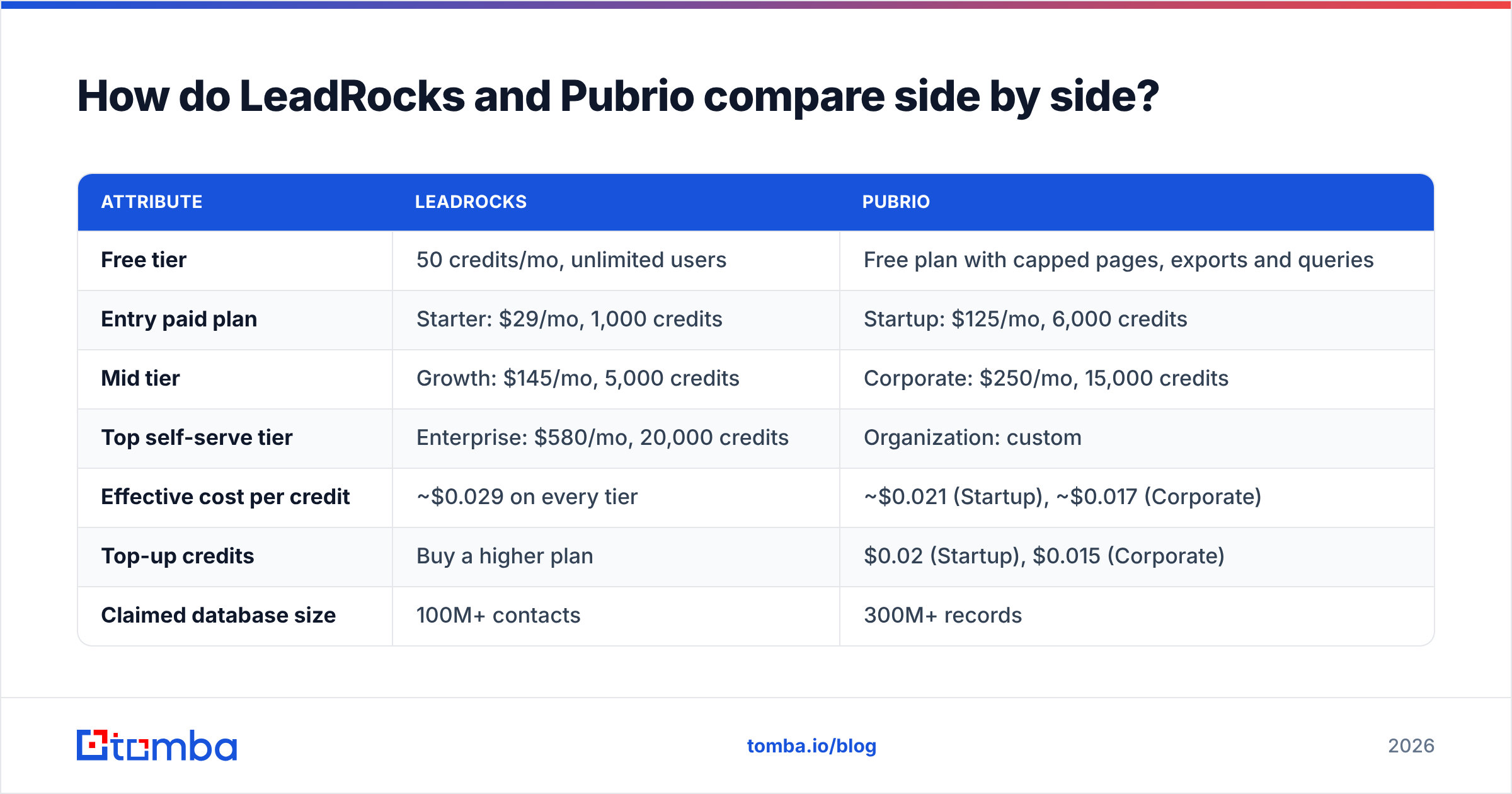
Pricing below comes from each vendor's published tiers and third-party listings (SaaSworthy, GetApp, Capterra) as of September 2026. Credit plans change often, so check the vendor's pricing page before you buy.
| Attribute | LeadRocks | Pubrio |
|---|---|---|
| Free tier | 50 credits/mo, unlimited users | Free plan with capped pages, exports and queries |
| Entry paid plan | Starter: $29/mo, 1,000 credits | Startup: $125/mo, 6,000 credits |
| Mid tier | Growth: $145/mo, 5,000 credits | Corporate: $250/mo, 15,000 credits |
| Top self-serve tier | Enterprise: $580/mo, 20,000 credits | Organization: custom |
| Effective cost per credit | ~$0.029 on every tier | ~$0.021 (Startup), ~$0.017 (Corporate) |
| Top-up credits | Buy a higher plan | $0.02 (Startup), $0.015 (Corporate) |
| Claimed database size | 100M+ contacts | 300M+ records |
| Regional strength | Global, LinkedIn-driven | APAC focus, 130+ countries |
| Signals / intent | None to speak of | Hiring, tech adoption, news, website visitor ID |
| Outreach | Basic email sequences | Multichannel (email, LinkedIn, WhatsApp) |
| Chrome extension | Core product, rated about 4.6/5 | Available, but secondary |
| API | Limited | Yes, including on the free tier |
| Lifetime deal history | AppSumo LTD (~$79) | AppSumo listing |
| Vendor accuracy claim | 98%+ | ~90% |
Two things in that table deserve a closer look. First, LeadRocks charges the same rate per credit on every tier (about 2.9 cents), so a bigger plan buys more volume but no discount. Pubrio gets cheaper per credit as you move up. Second, the two vendors don't define a credit the same way. Before you compare, find out how many credits one email reveal costs, how many a phone reveal costs, and whether a lookup that returns nothing still uses a credit. Third-party reviews note that LeadRocks charges for lookups that come back blank or invalid, which raises your real cost per usable contact.
Which one gives you more accurate emails?#
Neither vendor's accuracy number should be trusted without testing it yourself.
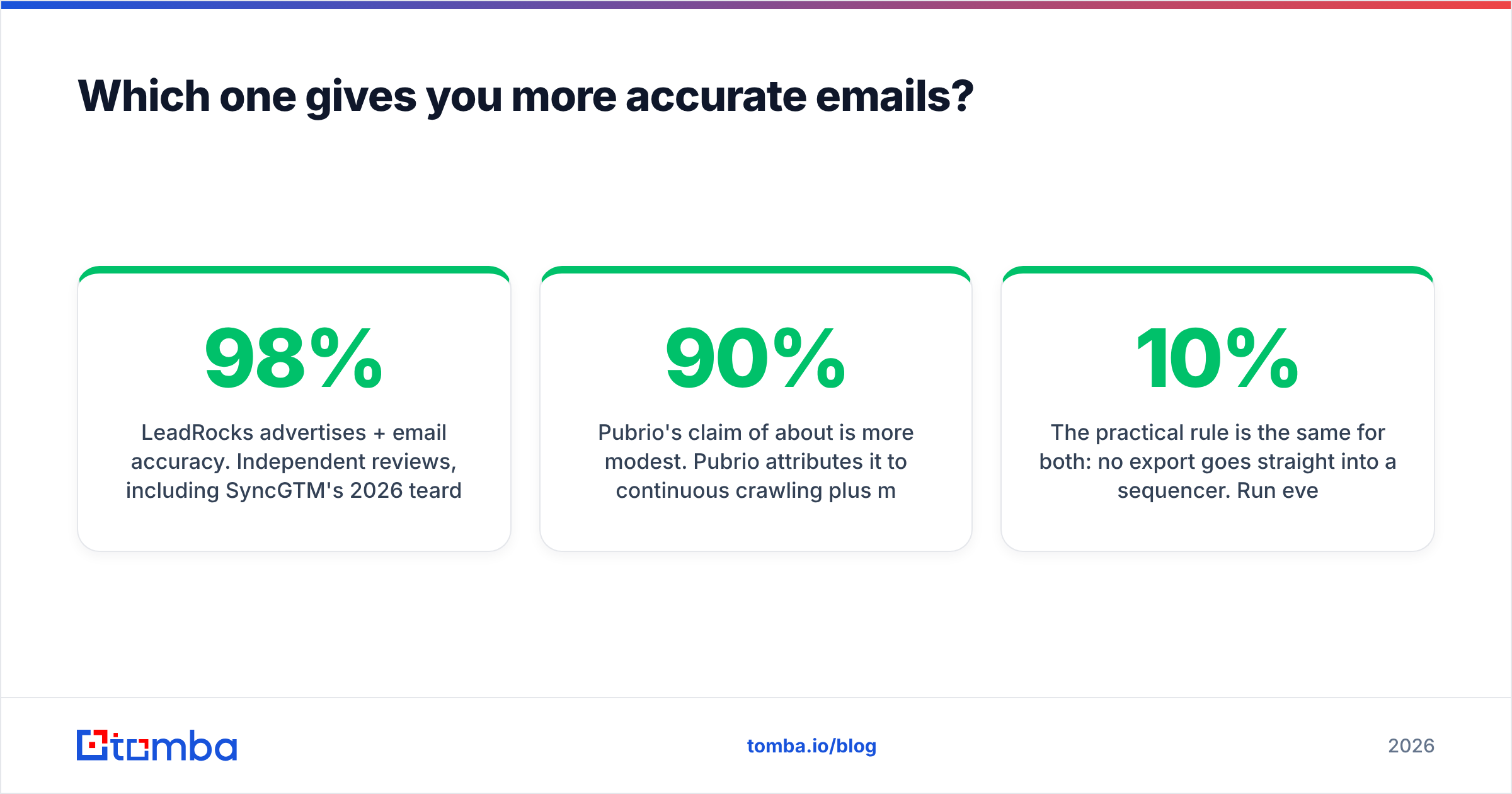
LeadRocks advertises 98%+ email accuracy. Independent reviews, including SyncGTM's 2026 teardown, report much lower valid rates once exports go through a third-party verifier, in some tests well under half. Chrome Web Store reviews also mention personal Gmail and old AOL addresses showing up where a work email should be. That pattern usually points to aggregated consumer data rather than fresh corporate records.
Pubrio's claim of about 90% is more modest. Pubrio attributes it to continuous crawling plus manual checks of phones and emails. Fewer independent audits of Pubrio exist, so treat 90% as the vendor's claim, not a benchmark result. If you prospect in APAC, test there specifically, because that is where Pubrio says it performs best.

The practical rule is the same for both: no export goes straight into a sequencer. Run every list through a dedicated email verifier first. Send any "accept-all" results to a catch-all verifier, because catch-all domains are where most "valid" emails from contact databases quietly bounce. A 10% bounce rate on a new domain can damage your sender reputation for weeks. Paying a fraction of a cent to verify is cheaper than that.
How do you run a fair LeadRocks vs Pubrio trial?#
Both tools have free tiers, so you can test on your own accounts before you pay. Use this five-step bake-off, which takes about an afternoon:
- Build a 100-contact truth set. Take 100 people you already have confirmed work emails for, such as customers, past replies or closed-lost deals. Mix regions if you sell globally.
- Look up the same 100 in each tool. Use the LeadRocks extension on their LinkedIn profiles, and use Pubrio search by name plus company. Record hit rate (any email returned) and the number of credits used.
- Score matches against your truth set. Count exact matches, wrong-but-valid emails (usually an old employer), personal addresses and blanks.
- Verify everything that didn't match. Push the unmatched emails through a verifier and split them into valid, invalid, catch-all and unknown.
- Calculate cost per verified contact. Divide the dollars spent by the number of verified, correct emails. This is the only number worth comparing. Headline price per credit tells you very little.
Most teams find the winner changes by region. A tool that looks cheap on US tech accounts can lose badly on Singaporean manufacturers, and the reverse can happen too.
Is Pubrio better than LeadRocks for APAC prospecting?#
Yes, based on everything the two vendors publish and what reviewers report. APAC is the main reason Pubrio exists. It markets local data partnerships, search in languages other than English, and "70% more" APAC coverage than traditional databases. If your ICP includes Hong Kong, Singapore, Japan, Southeast Asia or Australia, Pubrio will probably find companies that LinkedIn-scraped databases don't have.
LeadRocks is built on LinkedIn. That works well in North America and Western Europe, where LinkedIn profiles are dense and current. It works less well in markets where decision-makers don't keep LinkedIn up to date, or where business happens on WeChat, LINE or WhatsApp.
The signals layer matters here too. Pubrio shows hiring activity, technology adoption and company news, so you can rank accounts by timing rather than firmographics alone. LeadRocks gives you the contact but no reason to reach out this week.
Is LeadRocks better for LinkedIn-first solo prospecting?#
For a solo founder or a one-to-three person SDR team working mostly from LinkedIn Sales Navigator searches, LeadRocks is the easier tool to live with:
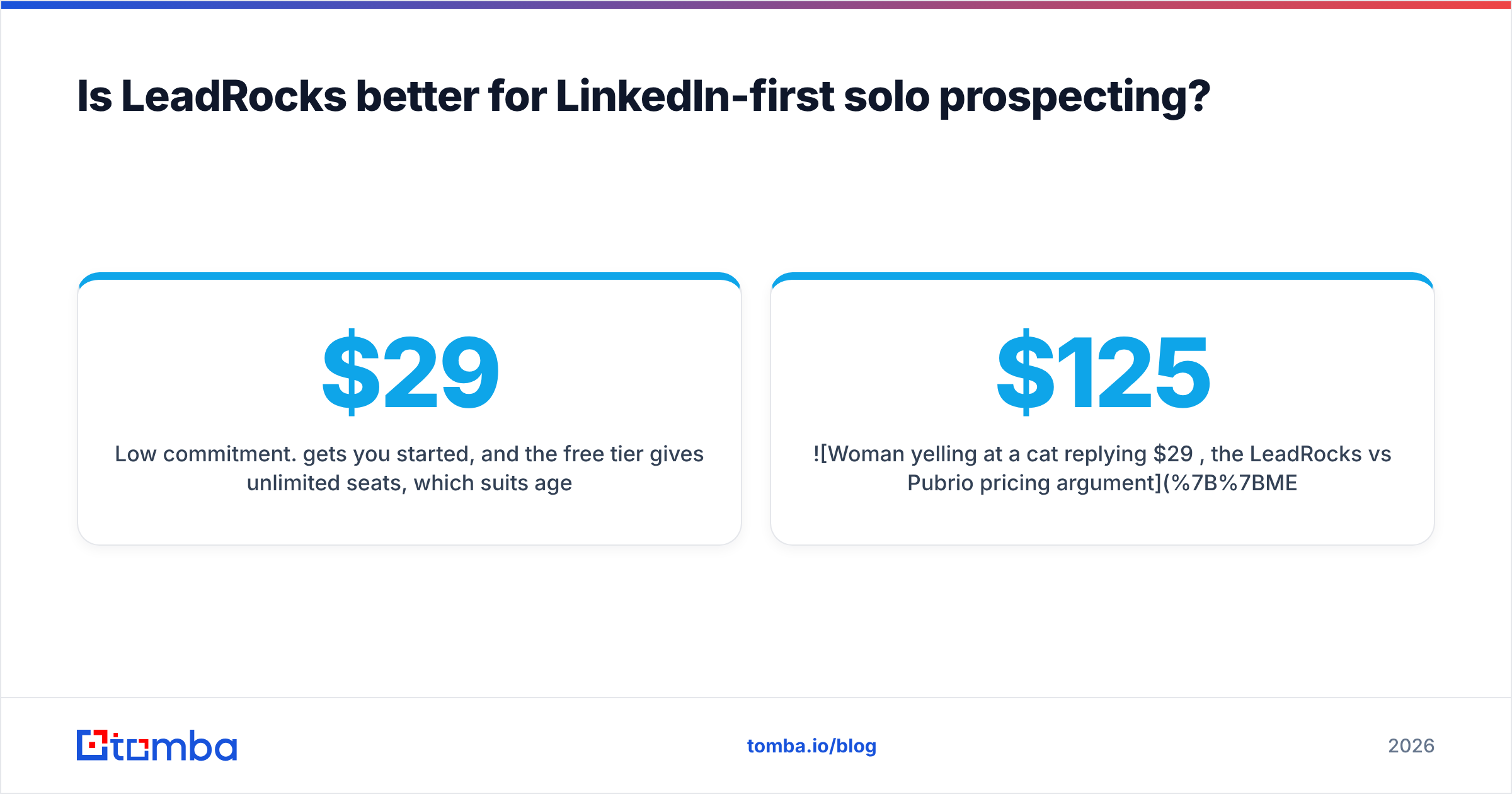
- Low commitment. $29/mo gets you started, and the free tier gives unlimited seats, which suits agencies with rotating freelancers.
- Extension-first workflow. You stay in LinkedIn, scan a search page and export. There is almost nothing to learn.
- Good enough sequencing. If you only need simple email follow-ups, you can skip a separate sequencer at first.
What you give up: no volume discount, weaker accuracy according to independent tests, and no account intelligence. If your volume grows past about 5,000 lookups a month, Pubrio's Corporate rate (about 1.7 cents per credit versus LeadRocks' 2.9 cents) starts to add up. That assumes both tools charge a similar number of credits per reveal.
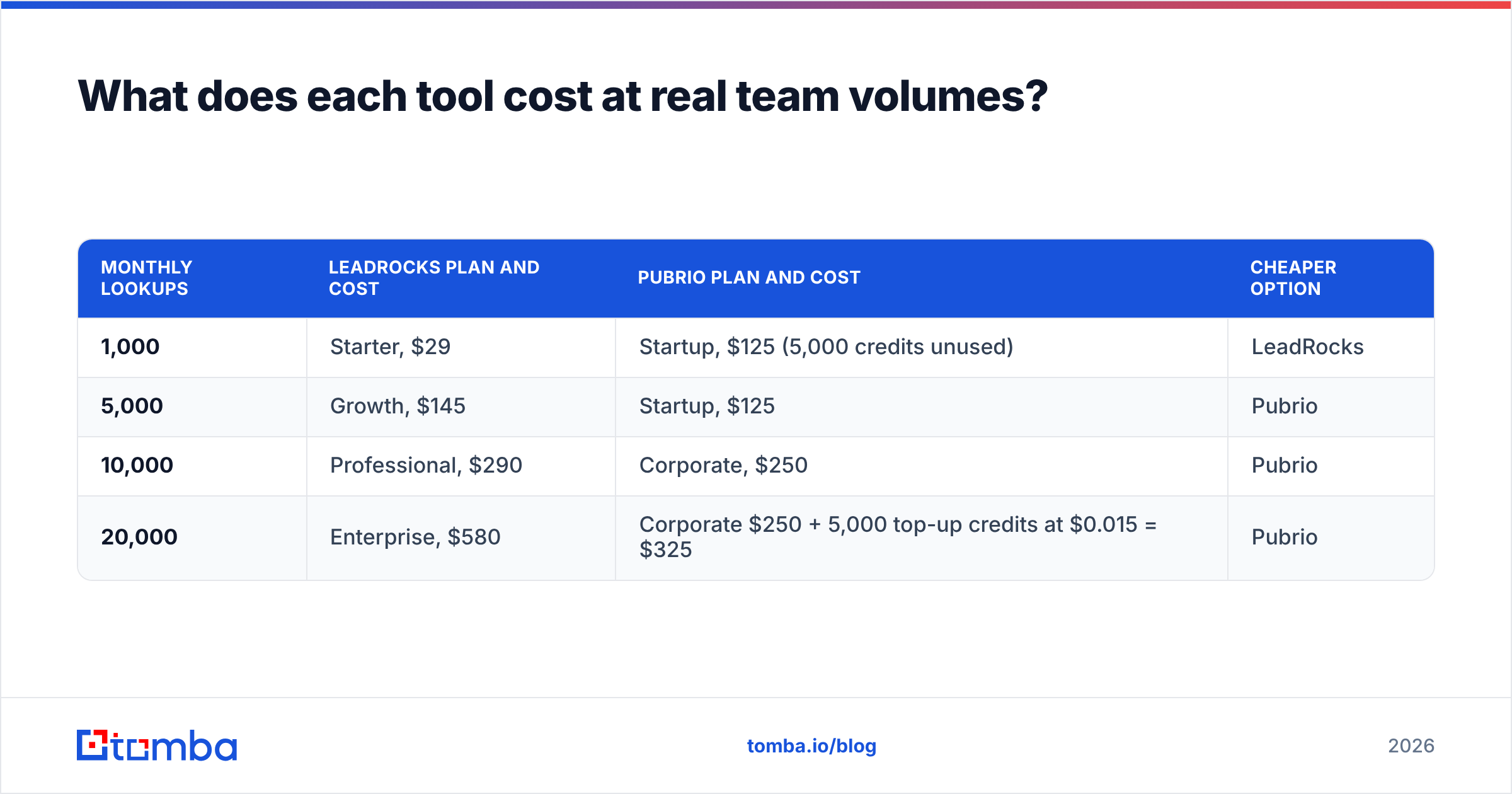
What does each tool cost at real team volumes?#
Here is the monthly spend at three typical volumes, assuming one credit per contact reveal (confirm this for your use case):
| Monthly lookups | LeadRocks plan and cost | Pubrio plan and cost | Cheaper option |
|---|---|---|---|
| 1,000 | Starter, $29 | Startup, $125 (5,000 credits unused) | LeadRocks |
| 5,000 | Growth, $145 | Startup, $125 | Pubrio |
| 10,000 | Professional, $290 | Corporate, $250 | Pubrio |
| 20,000 | Enterprise, $580 | Corporate $250 + 5,000 top-up credits at $0.015 = $325 | Pubrio |
Below about 4,000 lookups a month, LeadRocks is cheaper. Above that, Pubrio wins on sticker price. Then adjust for accuracy. If one tool's verified-correct rate is 40% and the other's is 70%, the cheaper tool per credit can end up costing more per usable contact.
Where do both tools fall short?#
Both are all-in-one prospecting databases, and that brings the same tradeoffs:
- Verification is an afterthought. LeadRocks has a verifier in the dashboard and Pubrio mentions validation, but neither is a specialist deliverability tool. Catch-all handling in particular tends to be shallow.
- Credits burn on misses. Blank or invalid results still use your quota on LeadRocks, according to reviewers. Check Pubrio's policy in your trial.
- Review volume is thin. Neither has the thousands of reviews on G2 that Apollo or ZoomInfo have, so you have fewer outside signals about data freshness.
- Lifetime-deal baggage. Both have been sold on AppSumo. That's good for early users. For buyers, it can mean the roadmap favors LTD holders' feature requests over enterprise needs.
If your main job is "give me the correct work email for this person at this company," a dedicated email finder with verification built in will usually beat either platform on cost per verified contact. You can keep Pubrio for account research and signals, or LeadRocks for LinkedIn scraping, and use the finder for the final email.
Which should you choose: LeadRocks or Pubrio?#

Choose LeadRocks if:
- You prospect almost only from LinkedIn in North America or Europe
- You need fewer than about 4,000 lookups a month
- You want unlimited seats on a free or near-free plan
- You're fine adding a separate verification step before every send
Choose Pubrio if:
- Your ICP includes APAC markets
- You want hiring, technology and news signals to rank accounts
- You'll run 5,000+ lookups a month and want a lower cost per credit
- You want API access and multichannel outreach (email, LinkedIn, WhatsApp) in one place
Choose neither as your only data source if:
- Bounce rate is already hurting your domain
- You need auditable accuracy on every contact before it reaches your CRM
- You mostly have names and domains, not LinkedIn URLs
Frequently asked questions#
Is LeadRocks free?#
Yes, there is a free plan with 50 credits a month and unlimited users. Paid plans start at $29/mo for 1,000 credits.
Does Pubrio have a free plan?#
Yes. Pubrio's free tier includes access to its database and API, with caps on pages viewed, exports and monthly queries. Paid plans start at $125/mo.
Which is more accurate, LeadRocks or Pubrio?#
Neither has published independent accuracy audits. Independent tests of LeadRocks have reported valid rates well below its 98% claim, and Pubrio's 90% figure is self-reported. Run the 100-contact trial above and verify every result.
Can I use LeadRocks and Pubrio together?#
Yes. Some teams use Pubrio to pick and rank accounts by buying signals, use LeadRocks to scrape LinkedIn contacts at those accounts, and then verify the combined list before loading it into a sequencer.
What's the smartest next step?#
Whichever database you choose, the email itself decides whether a campaign lands or bounces. If you want a correct work email from just a name and a company domain, with verification in the same lookup, try the Tomba Email Finder. It's free for 25 searches a month, so you can run it through the same 100-contact test you give LeadRocks and Pubrio and compare cost per verified contact directly. When you're ready to scale, Tomba pricing starts at $49/mo on Starter, with Growth at $99/mo and Pro at $249/mo.
Related guides#
// get started
Find, verify and enrich your first contacts today
Start on the free plan with 25 searches a month, then scale when your team is ready.
Free plan · No credit card required · GDPR & CCPA
// about the author