Listmint vs Seamless.AI (2026): Verifier or Contact Database?
Listmint verifies emails, including catch-alls. Seamless.AI finds contacts. Here is how their pricing, accuracy, and contract terms compare, and which one your outbound stack is actually missing.
Listmint vs Seamless.AI is a common search, but the two tools do different jobs. One checks emails. The other finds them. Here is how they compare and which one your stack needs.
TL;DR
- These are two different kinds of tool. Listmint is an email verifier built around catch-all domains. Seamless.AI is a contact database and prospecting search engine. You're comparing a quality check with a place to source leads.
- Pricing works differently. Listmint sells verification credits by the month, starting at $99/mo for 20,000 standard plus 5,000 catch-all credits. Seamless.AI's Basic plan is listed at $147 per user per month on annual billing, with 250 contact credits a month. Pro and Enterprise are quote-only.
- Choose Listmint if you already have lead lists and your problem is bounces and "unknown" catch-all results.
- Choose Seamless.AI if you have no contacts yet and want a large searchable database with a Chrome extension.
- Many teams need both jobs done. Either you pair the two tools, or you use one platform that finds and verifies, such as Tomba.
What is Listmint?#
Listmint is a B2B email verification platform for outbound sales teams, agencies, and data vendors. Its focus is narrow: take a list you already have and tell you which addresses you can safely send to.
Most verifiers run standard SMTP checks. Listmint keeps going when a domain is catch-all. That means the mail server accepts every address. A normal SMTP check can't confirm the mailbox exists. Most verifiers mark those addresses "risky" or "unknown" and leave the decision to you. Listmint tries to resolve them. It also tells you whether a result was a normally valid address or a "catch-all deliverable", which is useful when you set up sending rules.
What Listmint publishes about itself:
- Standard SMTP verification returning valid, invalid, catch-all, or unknown
- Catch-all verification, with a vendor-claimed recovery rate of up to 84% valid on catch-all addresses
- A real-time API for verifying at the point of capture or inside a CRM
- A native Clay integration, documented in Clay University, so you can verify inside enrichment waterfalls
- Bulk list uploads for agency-sized jobs
On G2, Listmint has a small set of reviews averaging 5 stars. Most of them praise the catch-all coverage and the support team. That's a good sign, but the sample is too small to treat as proof at scale.
What Listmint doesn't do is find contacts for you. It has no people search, no persona filters, and no LinkedIn prospecting extension. You bring the list.
What is Seamless.AI?#
Seamless.AI is a sales-intelligence platform. You search for people by title, company, industry, location, and other filters. Seamless then returns contact data: emails, direct dials, and mobile numbers. It says it finds and checks this data in real time. Most people run it from its Chrome extension on LinkedIn or from the web app. The results then go into a CRM or sequencer.
Its main features:
- A people and company search across a large B2B database
- A Chrome extension that pulls contact data while you browse LinkedIn and company sites
- Phone numbers, including direct dials and mobiles, which Listmint doesn't offer at all
- Buyer intent and job-change signals on the higher tiers
- CRM integrations with Salesforce, HubSpot, and the main sequencers
The trade-offs come up again and again in public reviews. It uses a credit system: every reveal or export costs a credit. The Basic tier has a modest monthly credit allowance. Paid plans are sold on annual contracts. Several third-party reviews describe a 60-day cancellation notice window before auto-renewal. Read the contract before you sign.
Listmint vs Seamless.AI: how do they compare side by side?#
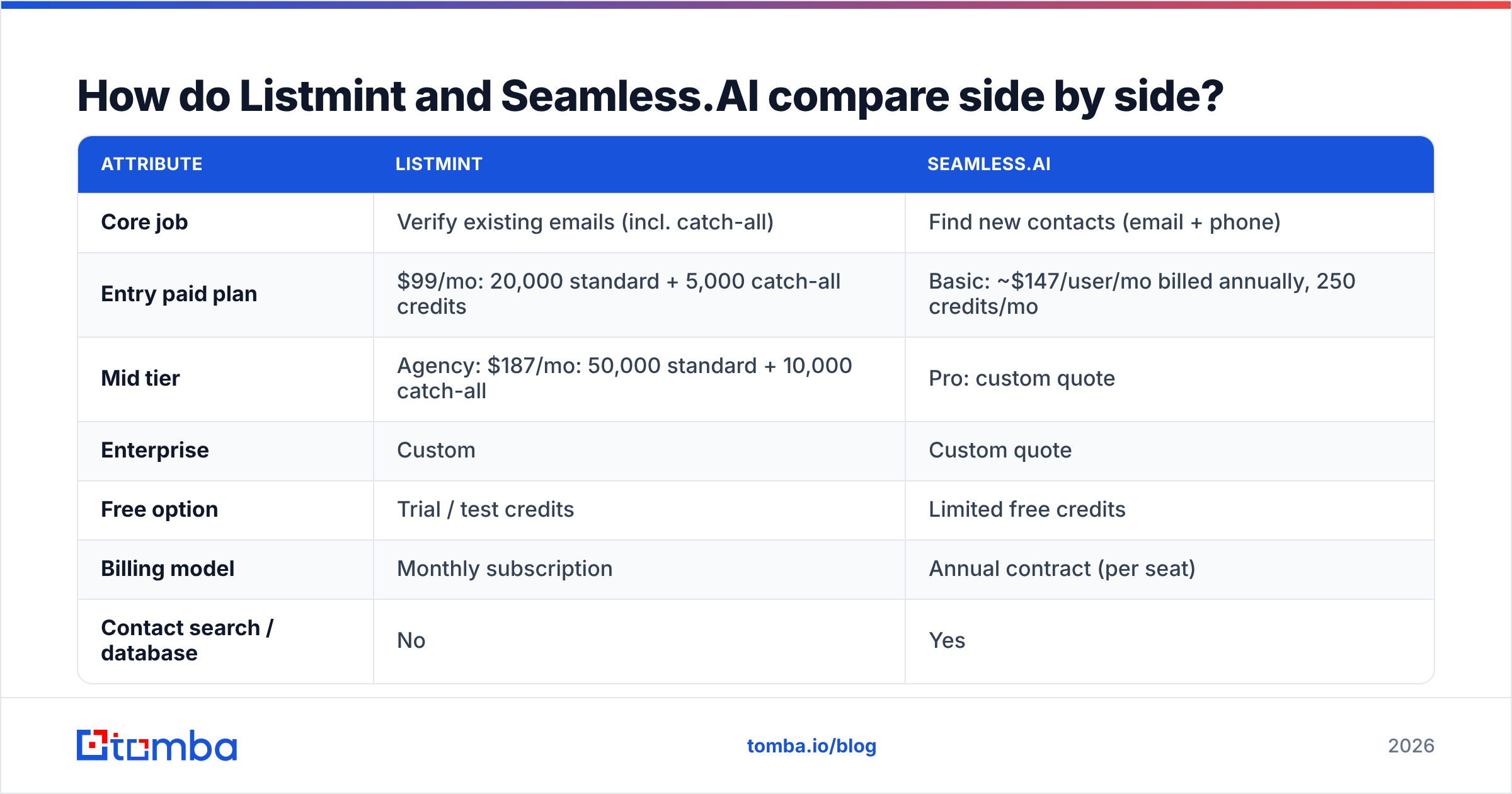
This table lines up the attributes that decide the purchase. Prices come from each vendor's public pricing and from third-party breakdowns as of 2026. Credit allowances change often, so confirm them on the vendor's site before you buy.
| Attribute | Listmint | Seamless.AI |
|---|---|---|
| Core job | Verify existing emails (incl. catch-all) | Find new contacts (email + phone) |
| Entry paid plan | $99/mo: 20,000 standard + 5,000 catch-all credits | Basic: ~$147/user/mo billed annually, 250 credits/mo |
| Mid tier | Agency: $187/mo: 50,000 standard + 10,000 catch-all | Pro: custom quote |
| Enterprise | Custom | Custom quote |
| Free option | Trial / test credits | Limited free credits |
| Billing model | Monthly subscription | Annual contract (per seat) |
| Contact search / database | No | Yes |
| Phone numbers | No | Yes (direct dials, mobiles) |
| Catch-all resolution | Yes, core feature | Not a dedicated feature |
| API | Yes, real-time verification | Yes, on higher tiers |
| Clay integration | Native | Via third-party workflows |
| Best for | Agencies, list buyers, Clay power users | SDR teams without a data source |
Look at the credits. On Listmint, a credit verifies one address. On Seamless.AI, a credit reveals one contact. So 20,000 Listmint credits and 250 Seamless.AI credits aren't comparable numbers. They pay for different work.
What does each tool actually cost you per usable email?#
Price per credit tells you little. What you need is the cost per email you can safely send to. Here's how that plays out in three common situations.
- You buy a 10,000-row list from a data vendor. Listmint's $99 plan covers it with room to spare. If about 30% of the list sits on catch-all domains and Listmint resolves a good share of them, you recover addresses you'd otherwise throw away. Seamless.AI doesn't fit this job, because you already own the contacts.
- You need 200 new decision-makers a month and have nothing to start from. Listmint can't help, since there's nothing to verify. Seamless.AI's Basic plan covers roughly that volume for one seat, but only on an annual commitment.
- You need 2,000 new contacts a month across a team of three. Seamless.AI goes to per-seat pricing and a Pro quote. That's where total contract value climbs fast, and where some buyers start looking for a Seamless.AI alternative with plain monthly plans.
The pattern: Listmint gets cheaper per address as your volume grows. Seamless.AI's cost follows seats and reveals, and the annual lock-in means you pay for credits whether you use them or not.
Is Listmint more accurate than Seamless.AI?#
The two tools measure accuracy in different ways, so you can't compare their claims directly.
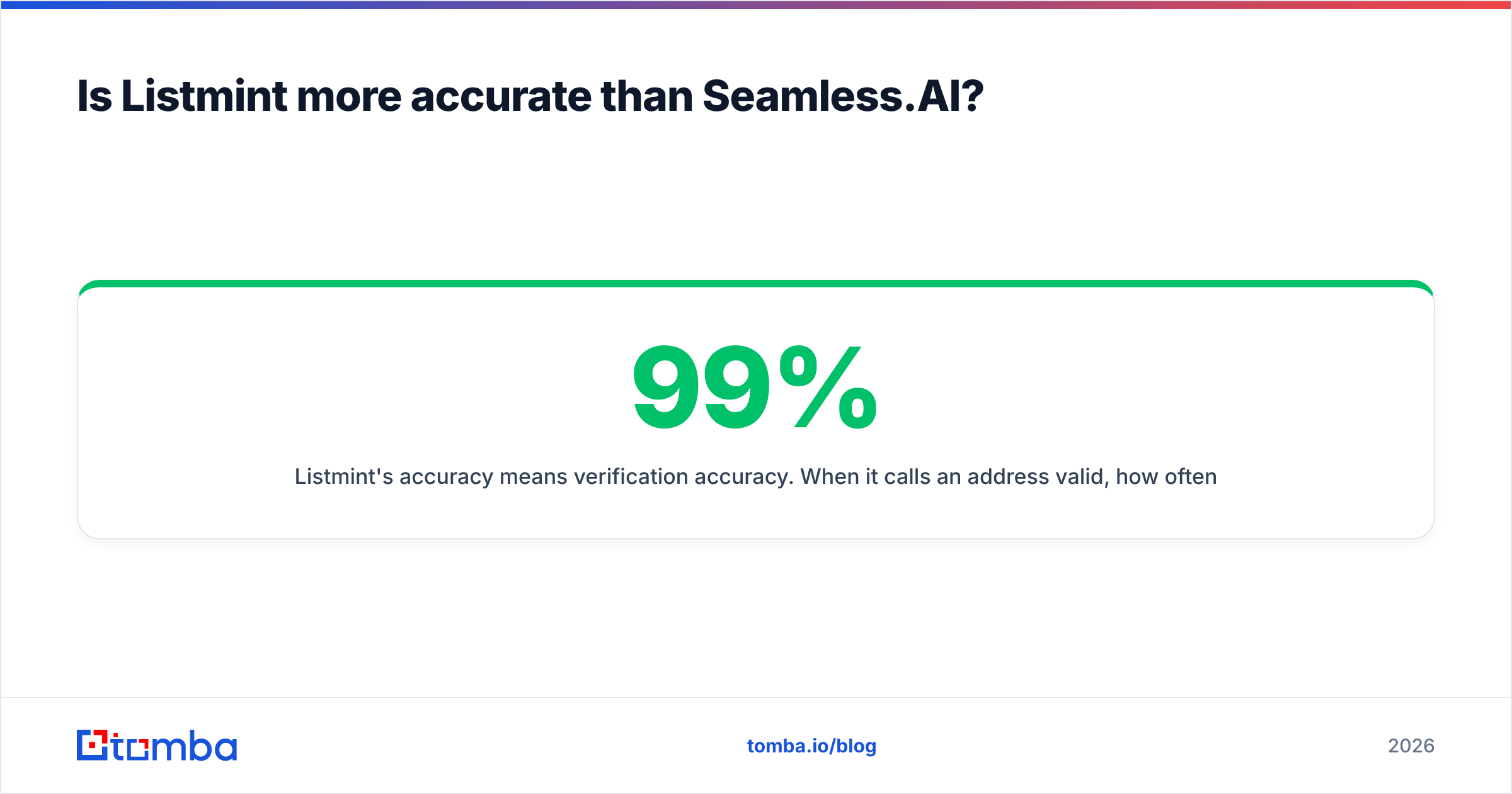
Listmint's accuracy means verification accuracy. When it calls an address valid, how often does the email really land? The vendor claims more than 99% SMTP and catch-all verification accuracy across over a billion verified emails. It also claims about 84% valid recovery on catch-all lists, compared with roughly 55% from typical verifiers. Those are Listmint's own numbers. Clay has run public catch-all verifier tests, and those are the closest thing to an independent benchmark in this category. Check the latest results before you commit.
Seamless.AI's accuracy means data accuracy. Is the contact still at that company, and is the email or phone current? User reviews on G2 and Capterra are mixed. Some users are happy with the email hit rates. Others report outdated contacts and bounces, especially on phone numbers and in fast-moving mid-market companies. That's normal for any large B2B database. Data decays, and no vendor fully escapes it.
In practice, even if you source contacts from Seamless.AI, you should still verify them before a cold campaign. Protecting your email deliverability is worth one extra step. That's also why these two tools can sit in the same stack instead of competing for the same budget.
Which tool fits which team?#
Use this as a quick routing guide.
- Cold email agencies running many client lists. Pick Listmint. High-volume verification with catch-all resolution is exactly what agencies struggle with, and monthly pricing matches client churn.
- Clay-heavy RevOps teams. Pick Listmint. The native Clay integration lets you add catch-all verification as a waterfall step after your enrichment providers.
- SDR teams starting from zero. Pick Seamless.AI, or another contact finder. You need a source of contacts before verification means anything.
- Teams that call as well as email. Pick Seamless.AI. Listmint doesn't do phone numbers at all.
- Budget-sensitive teams that want finding and verification in one place. Neither tool alone covers this. Look at a combined finder-plus-verifier with monthly billing.
What are the pros and cons of Listmint?#
Pros
- Catch-all verification is the core product, not an extra
- Clear monthly pricing with large credit allowances
- Tells you whether an address was valid or a catch-all deliverable
- Native Clay integration and a real-time API
- Support gets strong reviews on G2
Cons
- No contact discovery, so you have to bring your own list
- No phone data
- The review base is small, so reputation at scale is harder to judge
- Catch-all recovery figures are vendor-reported, so test them on your own data
What are the pros and cons of Seamless.AI?#
Pros
- A large searchable B2B database with emails and phone numbers
- A Chrome extension that fits naturally into a LinkedIn prospecting workflow
- Intent and job-change signals on the upper tiers
- Mature CRM and sequencer integrations
Cons
- Annual contracts and a reported 60-day cancellation notice window
- A small monthly credit allowance on Basic compared with the price
- Pro and Enterprise pricing is quote-only, which makes budgeting harder
- Data freshness varies by segment, so you still need to verify before sending
Can you use Listmint and Seamless.AI together?#
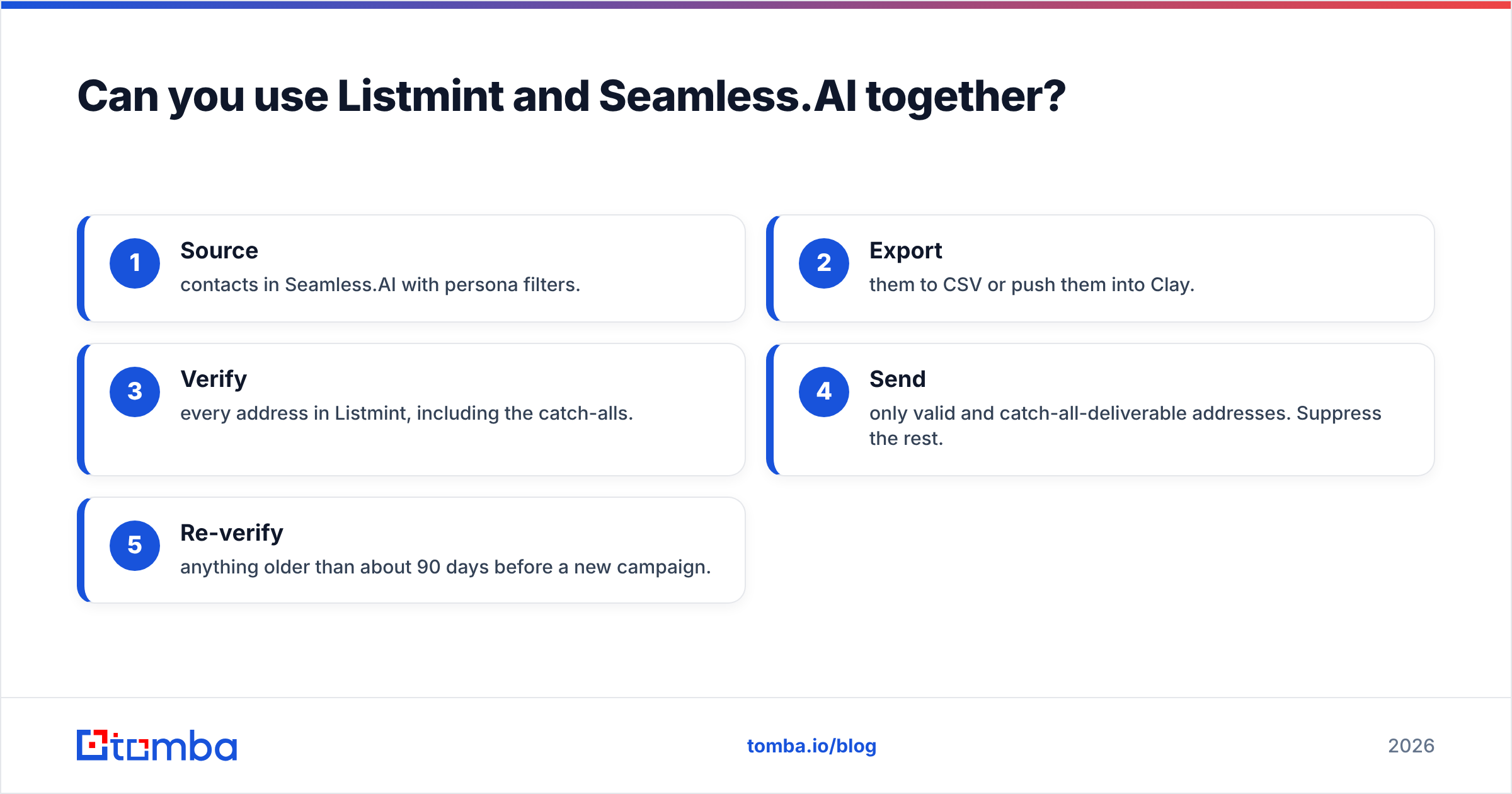
Yes. For some teams that's the most sensible setup. The workflow looks like this:
- Source contacts in Seamless.AI with persona filters.
- Export them to CSV or push them into Clay.
- Verify every address in Listmint, including the catch-alls.
- Send only valid and catch-all-deliverable addresses. Suppress the rest.
- Re-verify anything older than about 90 days before a new campaign.
The catch is cost and complexity. You pay for a per-seat annual contract plus a monthly verification plan. You also manage two credit pools and two integrations. For a well-funded team with a RevOps owner, that's fine. For a founder doing their own outbound or a three-person SDR pod, it's often more tooling than the pipeline justifies.
Where does Tomba fit in this comparison?#
Tomba comes at the problem from a third direction. It's an email finder first, with verification built into the same account instead of sold as a separate product.
- Finding. You can look up emails by name and company, pull every public address on a domain with domain search, or use the Chrome extension on LinkedIn.
- Verifying. Every found address can go through the email verifier. Tomba also has a dedicated catch-all verifier for the domains that trip up standard SMTP checks.
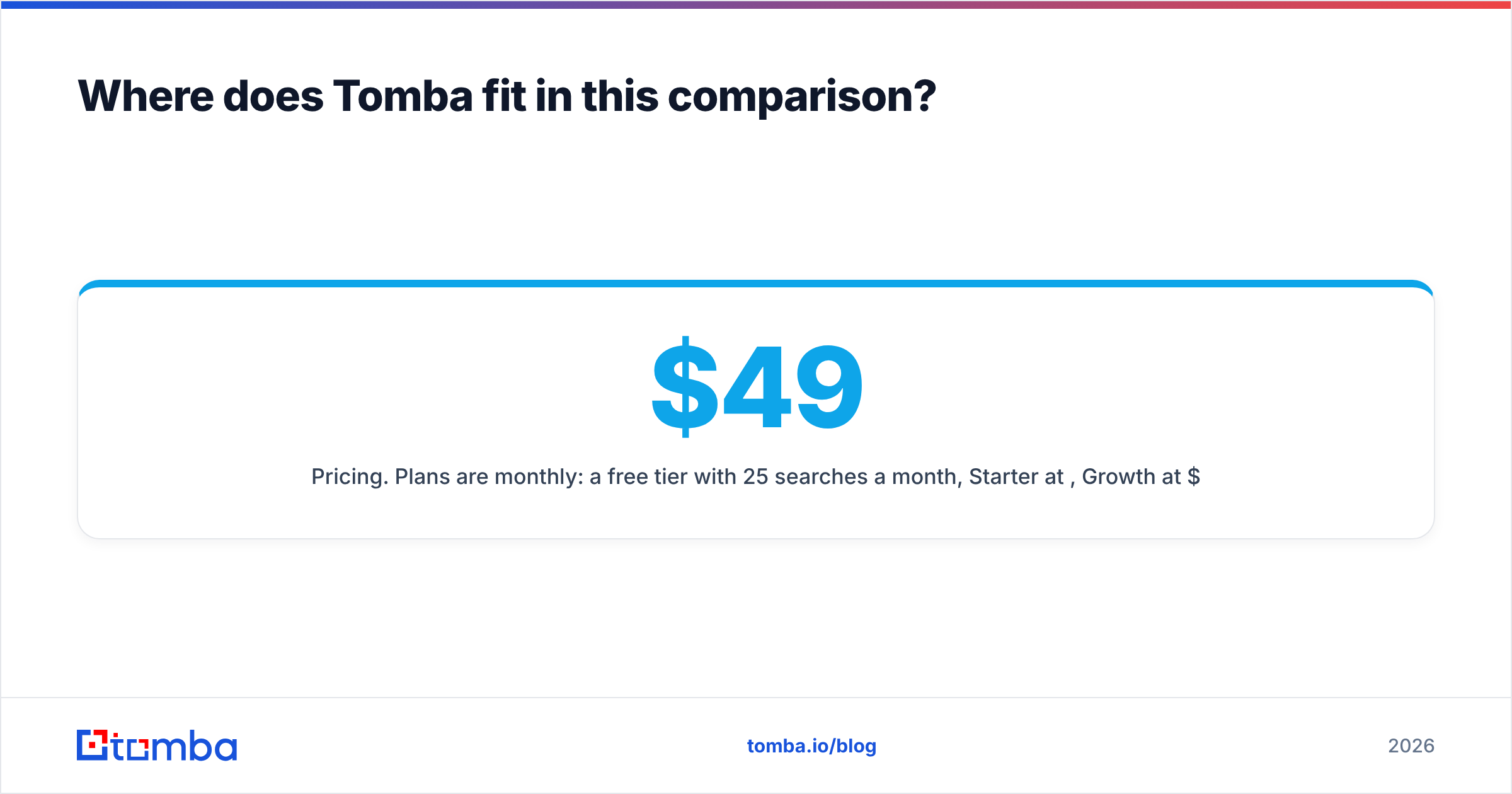
- Pricing. Plans are monthly: a free tier with 25 searches a month, Starter at $49/mo, Growth at $99/mo, Pro at $249/mo, and custom Enterprise. There's no annual lock-in to start. Full details are on the Tomba pricing page.
Be honest about where it doesn't fit. If you want a pure verification engine to clean six-figure purchased lists every week, a specialist like Listmint is designed for that job. If you need deep intent data and a huge dialer-ready phone database, Seamless.AI's upper tiers go further than a finder does. Tomba fits best in the middle: teams that want to find and verify professional emails in one place, pay monthly, and skip the annual contract.
Listmint vs Seamless.AI: which should you choose?#
Start with the problem you actually have.
- "Our bounce rate is killing us and half our list comes back 'unknown'." That's a verification problem, and Listmint is built for it.
- "We don't know who to email." That's a sourcing problem. Seamless.AI can solve it, as long as you're comfortable with an annual per-seat contract.
- "We need to find emails and trust them, without two contracts." That's a combined find-and-verify problem, and it's the one most small outbound teams really have.
Neither tool is the "winner" in general, because they don't do the same job. Listmint is a strong, focused verifier. Seamless.AI is an established contact database with the usual trade-offs of annual sales-intelligence contracts. Base the decision on the gap in your stack, not on the feature list.
If that gap is finding verified professional emails without an annual contract, try the Tomba Email Finder. Start on the free tier with 25 searches a month, run it on a real prospect list, and verify the results in the same dashboard. If the hit rate works for your market, Starter at $49/mo scales with you month to month.
Related guides#
// get started
Find, verify and enrich your first contacts today
Start on the free plan with 25 searches a month, then scale when your team is ready.
Free plan · No credit card required · GDPR & CCPA
Get the Tomba newsletter
Product and data updates
// about the author