AI SDR Agents in 2026: What They Are and How to Deploy Them
AI SDR agents now book meetings while your reps sleep. Here is what they actually do, where they break, and how to deploy one without torching your domain.
TL;DR
- An AI SDR agent is software that runs the top of the sales funnel end to end: it builds a target list, enriches contacts, writes outreach, sends it, and books qualified meetings with little human input.
- The category is real in 2026, but the marketing is ahead of the product. Most "autonomous" agents still need a human owning data quality, deliverability, and reply handling.
- The biggest failure point is not the AI copy — it is bad contact data and burned sending domains. Garbage in, garbage out, at machine speed.
- Pricing ranges from roughly $0 (DIY stacks) to $1,000+/seat/month for managed agents like Artisan or 11x. Cost per booked meeting is the metric that matters, not seat price.
- Pair any agent with a verified data source. A clean list from a tool like the Tomba Email Finder does more for reply rates than another prompt tweak.
What is an AI SDR agent?#
An AI SDR agent is an autonomous (or semi-autonomous) software worker that performs the job of a sales development representative: finding accounts, identifying the right people, researching them, writing personalized outreach, sending it across email and LinkedIn, and handling replies until a meeting is booked.
Think of it like a self-driving car for the top of your funnel. A cruise-control feature (a sequencer that just sends what you wrote) keeps you in your lane. A true AI SDR agent is supposed to decide where to go, when to change lanes, and when to brake — it chooses the accounts, drafts the message, and reacts to a reply. In practice, most products in 2026 sit somewhere between cruise control and full autonomy, and the honest vendors say so.
The category exploded after 2024 because three things matured at once: large language models good enough to write passable first-touch copy, accessible B2B data APIs, and orchestration frameworks that let an agent chain steps together. The result is a market with genuine utility and a lot of inflated claims.
What does an AI SDR agent actually do, step by step?#
Strip away the branding and almost every AI SDR agent runs the same pipeline. Understanding the stages tells you exactly where each tool is strong and where it quietly leans on you.
- Account targeting. It pulls companies matching your ICP — industry, headcount, tech stack, funding, hiring signals.
- Contact discovery. It finds the decision-makers at those companies and their work emails. This is the find email addresses step, and it is where accuracy lives or dies.
- Enrichment. It layers on title, seniority, location, recent news, and intent signals so the message can be personalized.
- Message generation. An LLM drafts a first touch plus follow-ups, ideally referencing something specific about the prospect.
- Sending and orchestration. It schedules sends across mailboxes, throttles volume, and runs multi-channel sequences (email + LinkedIn).
- Reply handling. It classifies replies (interested, not now, objection, out of office) and either drafts a response or routes a hot lead to a human.
- Booking. It offers times and drops the meeting on a calendar.
The fully autonomous pitch is that all seven run without you. The reality in 2026 is that steps 1–5 are largely automatable, while 6 and 7 still benefit from human judgment for anything above a low-intent reply.
Are AI SDR agents better than human SDRs?#
Short answer: they are better at volume and consistency, worse at judgment and trust. They are a complement, not a clean replacement — and anyone selling you "fire your SDR team" is selling, not advising.
A human SDR does maybe 40–60 thoughtful touches a day before fatigue sets in. An AI agent does thousands, never forgets a follow-up, and never has a bad Monday. But a human notices that a prospect just got promoted, references it naturally, and reads the room on a tricky reply. Agents fake this with data; they do not yet do it with instinct.
The smartest teams in 2026 run a hybrid: agents handle the wide, repeatable top of funnel, and humans take over the moment a conversation shows real intent. The agent is the prospector; the human closes the gap to a booked, qualified meeting.
How do the main AI SDR agents compare in 2026?#
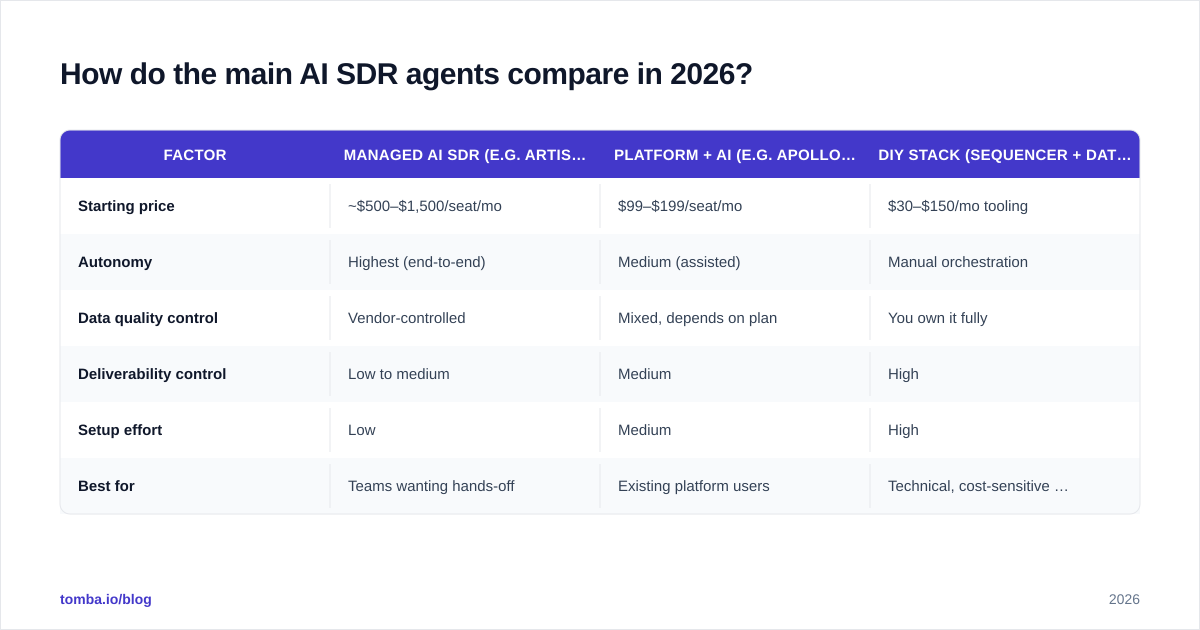
There is no single winner — the right pick depends on whether you want a fully managed agent, a flexible platform, or a DIY stack you control. Here is how the common options stack up.
| Factor | Managed AI SDR (e.g. Artisan, 11x) | Platform + AI (e.g. Apollo, Outreach) | DIY stack (sequencer + data API) |
|---|---|---|---|
| Starting price | ~$500–$1,500/seat/mo | $99–$199/seat/mo | $30–$150/mo tooling |
| Autonomy | Highest (end-to-end) | Medium (assisted) | Manual orchestration |
| Data quality control | Vendor-controlled | Mixed, depends on plan | You own it fully |
| Deliverability control | Low to medium | Medium | High |
| Setup effort | Low | Medium | High |
| Best for | Teams wanting hands-off | Existing platform users | Technical, cost-sensitive teams |
A few honest notes. Managed agents are convenient but you inherit their data and their sending reputation, and per-meeting cost can balloon if their list is weak. Platform add-ons like Apollo's AI features are fine if you already live there — see the Apollo alternative comparison if you are weighing the data side. The DIY stack is cheapest and most controllable, which is why so many operators pair a sequencer with a dedicated data API rather than trusting one black box.
Where do AI SDR agents fail most often?#
They fail at the data layer and the deliverability layer — almost never at the "the AI can't write" layer. If your agent is underperforming, look here before you touch the copy.
Bad contact data. An agent that emails wrong or outdated addresses does not just waste sends; it tanks your sender reputation. Every bounce is a vote against your domain. This is why email verification is non-negotiable before any send, and why catch-all domains need a real catch-all verifier rather than a hopeful guess.
Burned domains. Volume without warmup gets you filtered into spam, where even perfect copy converts at zero. Deliverability is a discipline, not a setting — review the fundamentals of email deliverability before scaling sends.
Generic personalization. "I saw your company is growing" is not personalization; it is a tell. Agents that only have a name and title produce this. Agents fed real enrichment data produce something a prospect actually reads.
No human escalation path. An agent that auto-replies to a CFO with a hallucinated answer costs you the deal. The fix is a clear handoff rule: low-intent replies stay automated, anything ambiguous goes to a person.
According to industry analysts at Gartner, the gap between AI sales tooling hype and realized productivity remains wide precisely because teams skip the data and process work. The tool is the easy part.
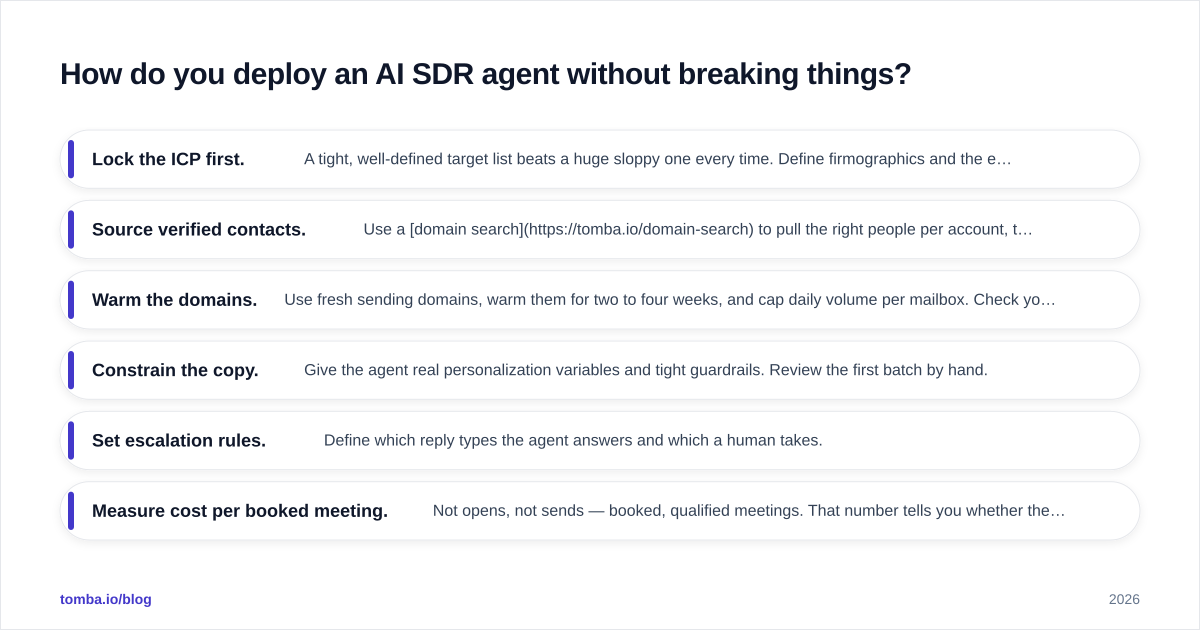
How do you deploy an AI SDR agent without breaking things?#
Start narrow, instrument everything, and treat the first month as a calibration exercise — not a launch. Speed comes after the data and deliverability are clean.
A practical rollout looks like this:
- Lock the ICP first. A tight, well-defined target list beats a huge sloppy one every time. Define firmographics and the exact titles you want.
- Source verified contacts. Use a domain search to pull the right people per account, then verify before the agent touches them. Clean data is the single highest-leverage input.
- Warm the domains. Use fresh sending domains, warm them for two to four weeks, and cap daily volume per mailbox. Check your sender reputation before scaling.
- Constrain the copy. Give the agent real personalization variables and tight guardrails. Review the first batch by hand.
- Set escalation rules. Define which reply types the agent answers and which a human takes.
- Measure cost per booked meeting. Not opens, not sends — booked, qualified meetings. That number tells you whether the agent earns its price.
The teams that win with AI SDR agents are not the ones with the cleverest prompts. They are the ones who feed the agent accurate, verified data and protect their sending reputation obsessively.
Frequently asked questions#
Will AI SDR agents replace human SDRs in 2026? No. They replace the repetitive, high-volume parts of the role. Humans still own judgment, trust-building, and complex reply handling. Expect hybrid teams, not empty desks.
What is the single biggest factor in AI SDR success? Data accuracy. A verified, well-targeted list outperforms any copy optimization. Bounces from bad data damage deliverability faster than anything else.
How much do AI SDR agents cost? Managed agents run roughly $500–$1,500 per seat per month; platform add-ons are $99–$199; a DIY stack can be under $150 in tooling. Judge by cost per booked meeting, not seat price.
Do I still need an email verifier if the agent finds emails? Yes. Finding and verifying are different steps. Always verify before sending, and use a catch-all finder for domains that accept everything.
The bottom line#
AI SDR agents are a genuine step forward for the top of the funnel, but they amplify whatever you feed them — including bad data and weak deliverability. Treat the agent as the engine and your data as the fuel. The engine is impressive; the fuel decides whether you go anywhere.
Before you wire up any agent, make the list right. The Tomba Email Finder gives your AI SDR agent verified, accurate work emails sourced from real data, so every send lands on a real person instead of a bounce. Start on the free tier with 25 searches a month, then scale to a plan that matches your outbound volume. Feed the agent clean data, and let it do what it is actually good at.
// get started
Find, verify and enrich your first contacts today
Start on the free plan with 25 searches a month, then scale when your team is ready.
Free plan · No credit card required · GDPR & CCPA
// about the author