AI Sales Forecasting for RevOps: The 2026 Playbook
Gut-feel forecasts miss by 20%+. Here's how RevOps teams use AI sales forecasting to predict revenue with less guesswork and cleaner pipeline data in 2026.
TL;DR
- AI sales forecasting predicts revenue by reading pipeline signals — deal age, engagement, buyer behavior — instead of relying on rep gut feel, which typically misses by 20% or more.
- It only works if your input data is clean. Garbage CRM records produce confident, wrong numbers. Data hygiene and enrichment come first.
- The best fit for most RevOps teams in 2026 is a hybrid: AI scoring layered on top of a disciplined manual forecast, not a black box that replaces the sales conversation.
- Tooling ranges from native CRM forecasting (Salesforce, HubSpot) to dedicated platforms (Clari, Gong, BoostUp). Pick based on data maturity, not feature count.
- Forecast accuracy compounds from the bottom up: better contact data, better activity capture, better stage definitions. Fix those before you buy a model.
What is AI sales forecasting?#
AI sales forecasting is the practice of predicting future revenue by training machine-learning models on your historical and live pipeline data, rather than asking each rep "how confident are you in this deal?"
Think of it like weather forecasting. A meteorologist doesn't walk outside, look at the sky, and guess. They feed temperature, pressure, and humidity readings into a model that has seen thousands of past storms. AI sales forecasting does the same thing with deal data: it has seen how thousands of similar deals behaved, and it tells you the probability this one closes — and when.
Technically, these systems ingest signals like deal stage, time-in-stage, email and meeting activity, contact seniority, and engagement velocity. They compare the live deal against patterns from won and lost deals, then output a weighted forecast with a confidence band. The output isn't "I feel good about Q3." It's "based on 14 comparable deals, this opportunity has a 62% close probability, likely landing the week of August 18."
The shift matters because traditional forecasting is notoriously unreliable. Reps are optimistic by nature, sandbagging and happy-ears cancel each other out unpredictably, and managers apply a "haircut" that's really just another guess. Research consistently shows that the majority of sales forecasts miss by a wide margin. AI doesn't make the uncertainty disappear — it just replaces opinion with math you can audit.
Why does RevOps own the forecast now?#
RevOps owns AI forecasting because the forecast is a data problem before it's a sales problem, and RevOps controls the data.
The forecast lives or dies on the quality of three inputs: pipeline structure, activity capture, and contact data. RevOps is the only function that touches all three. Sales leadership consumes the number; RevOps builds the machine that produces it. If you want a definition refresher, the revenue operations glossary entry covers how the role consolidated forecasting, enablement, and systems under one umbrella.
This is also why so many AI forecasting projects fail. Teams buy a sophisticated model and point it at a CRM full of stale contacts, half-logged calls, and deals stuck in "Stage 2" for ninety days. The model dutifully produces a confident forecast — and it's wrong, because the inputs were wrong. The model didn't fail. The data did.
That's the unglamorous truth of AI forecasting: 80% of the work is data hygiene. Clean stage definitions, enforced field requirements, automatic activity logging, and enriched, deduplicated contact records. Before you evaluate a single forecasting vendor, audit whether your pipeline data is even forecastable.
How does AI sales forecasting actually work?#
It works in four stages: ingest signals, score deals, roll up the forecast, and learn from outcomes.
1. Signal ingestion. The system pulls structured data (deal amount, stage, close date, owner) and unstructured data (email sentiment, call transcripts, meeting frequency) from your CRM and connected tools. Conversation-intelligence platforms add a rich layer here by analyzing what was actually said on calls.
2. Deal scoring. Each open opportunity gets a probability score. Unlike the static "Stage 4 = 60%" percentages baked into legacy CRMs, AI scores are dynamic. A deal that goes quiet for two weeks drops; a deal where the economic buyer just joined a call jumps.
3. Roll-up. Individual scores aggregate into a team, segment, and company forecast with a range — commit, best case, and worst case — rather than a single false-precision number.
4. Feedback loop. When deals close or die, the model records the outcome and recalibrates. Forecasts get more accurate the more cycles your team runs through the system.
The make-or-break ingredient across all four stages is the contact and account data underneath. If your records are missing decision-makers, attached to the wrong company, or full of bounced emails, every downstream score inherits that noise. This is where upstream data enrichment earns its keep — complete, verified contact records give the model cleaner features to learn from.
Build vs. buy vs. native: which AI forecasting approach fits?#
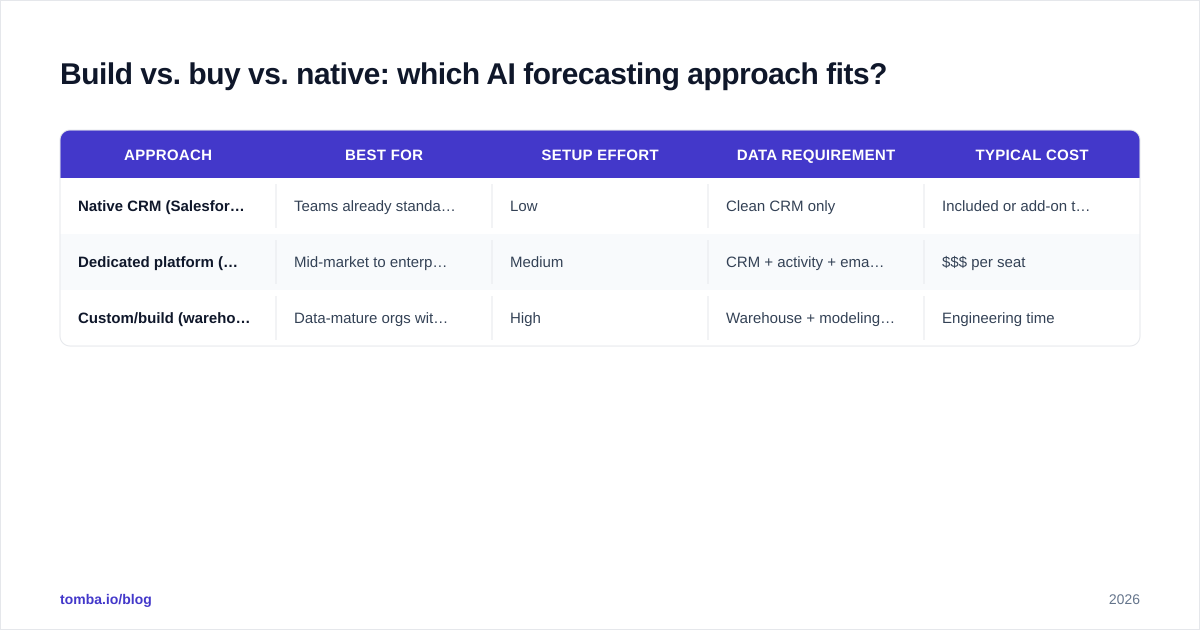
Most RevOps teams choose among three paths. Here's how they compare on the factors that actually drive the decision.
| Approach | Best for | Setup effort | Data requirement | Typical cost |
|---|---|---|---|---|
| Native CRM (Salesforce Einstein, HubSpot) | Teams already standardized on one CRM | Low | Clean CRM only | Included or add-on tier |
| Dedicated platform (Clari, Gong, BoostUp) | Mid-market to enterprise, complex pipelines | Medium | CRM + activity + email/calls | $$$ per seat |
| Custom/build (warehouse + ML) | Data-mature orgs with DS resources | High | Warehouse + modeling team | Engineering time |
A few honest guardrails:
- Native is underrated for SMB and early mid-market. If you run a tidy HubSpot or Salesforce instance, the built-in AI scoring will get you 80% of the value with zero integration overhead. Don't buy a $40k platform to forecast a 12-person sales team.
- Dedicated platforms earn their price at scale. Once you have multiple segments, long sales cycles, and a CRO who lives in the forecast call, tools like Clari and Gong add real rigor — especially the conversation-intelligence angle. Compare options on G2 before committing.
- Build only if data science is a core competency. A custom model gives you total control and zero per-seat fees, but you own maintenance forever. For most teams this is a trap dressed as savings.
What data do you need before AI forecasting works?#
You need three layers of clean data: pipeline structure, activity capture, and verified contacts. Skip any one and the forecast degrades.
Pipeline structure. Stages must mean something. "Discovery" should have exit criteria a model can rely on. If reps move deals to "Negotiation" inconsistently, the model can't learn what that stage predicts.
Activity capture. The model needs to see engagement — emails, meetings, calls. Manual logging is unreliable, so auto-capture is close to mandatory. No activity data means the model is forecasting blind, scoring only on stage and age.
Verified contact data. This is the layer most teams underinvest in. A deal with one stale contact looks very different to a model than a deal with three verified stakeholders across the buying committee. Bounced emails, missing roles, and duplicate accounts all corrupt the features the model trains on.
That last layer is where an email-finding and verification workflow pays off directly in forecast quality. Using a reliable email finder to complete the buying committee, then running an email verifier to strip dead addresses, means the model scores deals on real, reachable stakeholders — not ghosts. The same hygiene that lifts your outbound reply rates quietly lifts forecast accuracy too.
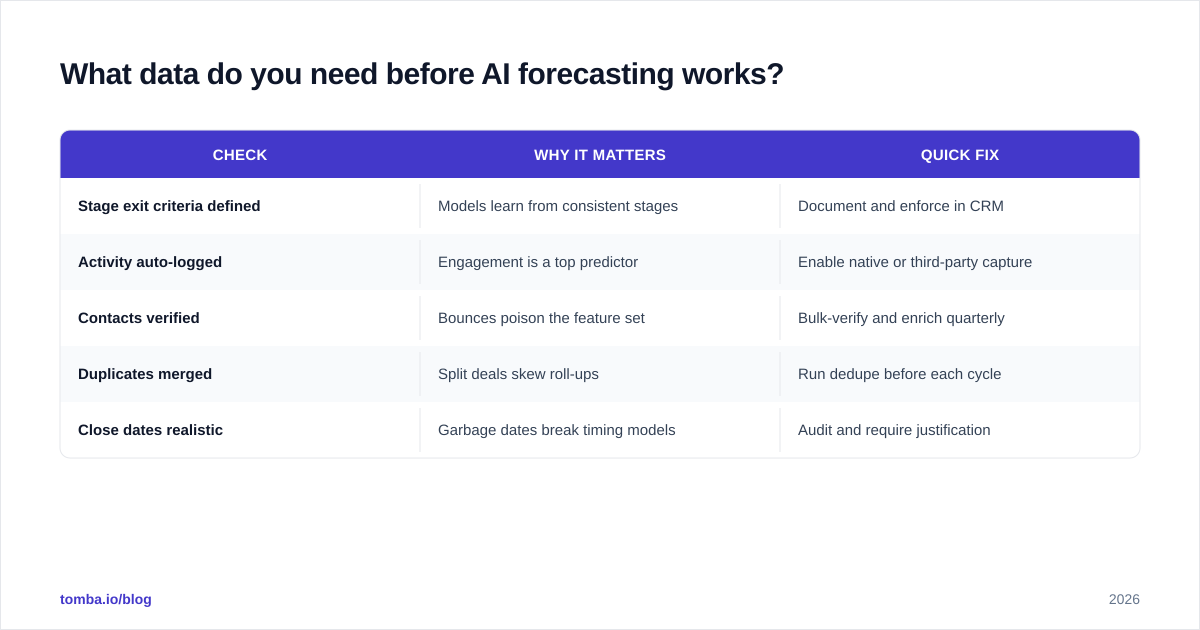
Here's a practical pre-flight checklist before you trust any AI forecast:
| Check | Why it matters | Quick fix |
|---|---|---|
| Stage exit criteria defined | Models learn from consistent stages | Document and enforce in CRM |
| Activity auto-logged | Engagement is a top predictor | Enable native or third-party capture |
| Contacts verified | Bounces poison the feature set | Bulk-verify and enrich quarterly |
| Duplicates merged | Split deals skew roll-ups | Run dedupe before each cycle |
| Close dates realistic | Garbage dates break timing models | Audit and require justification |
Is AI forecasting better than rep-driven forecasting?#
AI forecasting is more accurate at the roll-up level, but it doesn't replace the rep conversation — the best teams run both and reconcile the gap.
The strength of AI is consistency. It scores every deal by the same rules, every day, without optimism or fear. It catches the quietly dying deal the rep is still calling "commit." It flags the sleeper deal the rep forgot about. At the aggregate level, a well-fed model beats a spreadsheet of rep guesses almost every time.
The weakness of AI is context it can't see. It doesn't know the champion just got promoted, or that legal is the real blocker, or that the prospect's budget freeze lifts in two weeks. Reps know these things. A pure black-box forecast that ignores rep input feels alien and gets ignored — which kills adoption.
So the winning pattern in 2026 is the reconciled forecast: the AI produces a data-driven number, the rep produces a judgment-driven number, and the manager's job is the delta. Where they agree, confidence is high. Where they diverge, that's the deal to inspect on the forecast call. The AI isn't the judge — it's the analyst that tells you where to look.
This also improves your downstream metrics. When forecasting forces deal inspection, reps clean up their pipeline, which lifts both forecast accuracy and your real win rate by killing zombie deals earlier.
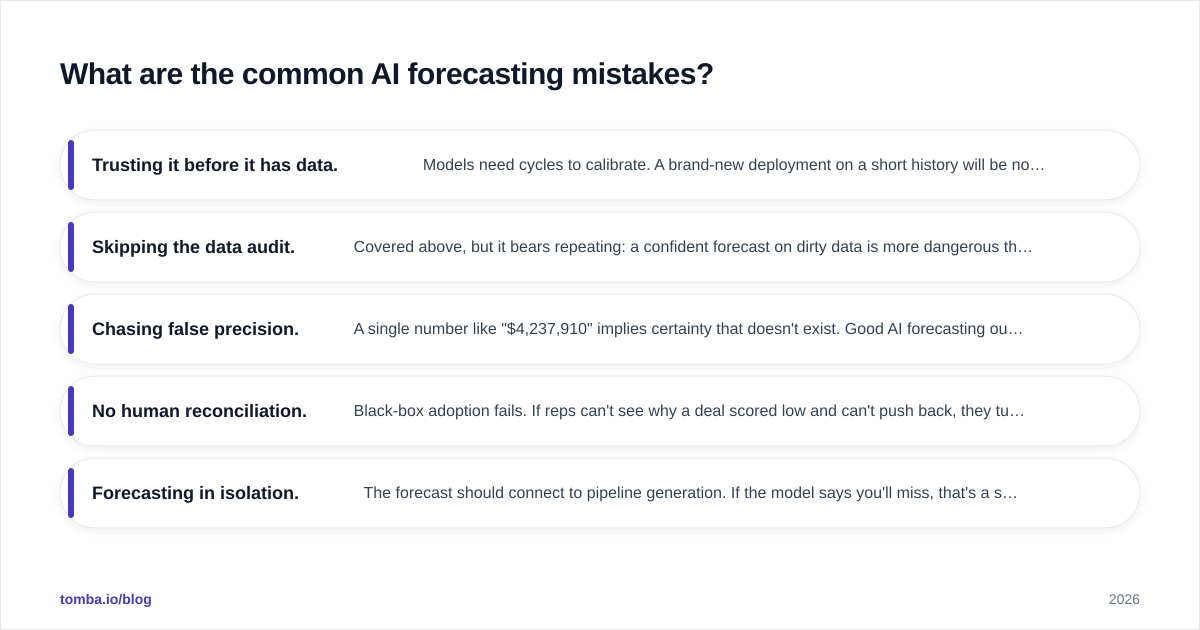
What are the common AI forecasting mistakes?#
The biggest mistakes are trusting the model too early, ignoring data hygiene, and treating the forecast as a number instead of a process.
- Trusting it before it has data. Models need cycles to calibrate. A brand-new deployment on a short history will be noisy. Run it in parallel with your existing process for a quarter or two before you bet the board meeting on it.
- Skipping the data audit. Covered above, but it bears repeating: a confident forecast on dirty data is more dangerous than an honest "we don't know." Fix inputs first.
- Chasing false precision. A single number like "$4,237,910" implies certainty that doesn't exist. Good AI forecasting outputs a range. Insist on it.
- No human reconciliation. Black-box adoption fails. If reps can't see why a deal scored low and can't push back, they tune out.
- Forecasting in isolation. The forecast should connect to pipeline generation. If the model says you'll miss, that's a signal to build more pipeline now — which loops back to prospecting and lead generation at the top of the funnel.
How do you roll out AI forecasting without disrupting the team?#
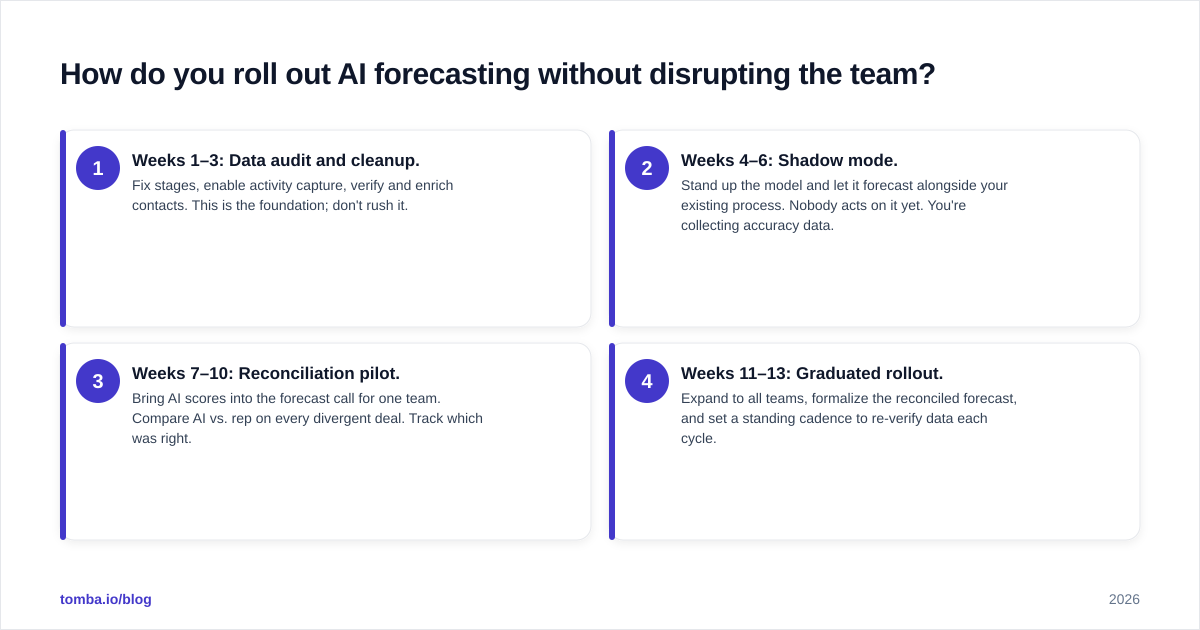
Roll it out in parallel, prove accuracy on real cycles, then graduate it into the official forecast — never flip a switch overnight.
A sane 90-day sequence:
- Weeks 1–3: Data audit and cleanup. Fix stages, enable activity capture, verify and enrich contacts. This is the foundation; don't rush it.
- Weeks 4–6: Shadow mode. Stand up the model and let it forecast alongside your existing process. Nobody acts on it yet. You're collecting accuracy data.
- Weeks 7–10: Reconciliation pilot. Bring AI scores into the forecast call for one team. Compare AI vs. rep on every divergent deal. Track which was right.
- Weeks 11–13: Graduated rollout. Expand to all teams, formalize the reconciled forecast, and set a standing cadence to re-verify data each cycle.
The quiet enabler through all of this is contact data freshness. B2B data decays fast — people change jobs, companies get acquired, emails go dead. A forecast model trained last quarter on contacts that are now 30% stale will drift. Schedule recurring enrichment and verification the same way you schedule pipeline reviews. Pricing for that hygiene layer is modest relative to the forecasting platform — see Tomba pricing to scope the contact-data side of the stack.
The bottom line#
AI sales forecasting is one of the highest-leverage moves a RevOps team can make in 2026 — but only after the data underneath it is clean. The model is the easy part. Verified contacts, complete buying committees, consistent stages, and captured activity are the hard part, and they're exactly what determines whether your forecast is a crystal ball or an expensive guess.
Start at the foundation. Complete and verify the contact data feeding your pipeline so every deal the model scores is built on real, reachable stakeholders. The Tomba Email Finder lets you fill in the missing decision-makers across each account by domain, name, or company — then verify them in bulk so your forecast learns from signal, not noise. Clean inputs first, smart models second. That's the order that actually moves the number.
// get started
Find, verify and enrich your first contacts today
Start on the free plan with 25 searches a month, then scale when your team is ready.
Free plan · No credit card required · GDPR & CCPA
// about the author