AI Sales Technology in 2026: An Overview & Evaluation Guide
A neutral, framework-driven guide to evaluating AI sales technology in 2026 — categories, scoring criteria, pricing traps, and how to run a pilot that proves ROI before you sign.
TL;DR
- AI sales technology is any tool that uses machine learning or generative models to find, score, contact, or close prospects — it spans data, engagement, conversation intelligence, forecasting, and agentic workflows.
- Most teams overspend because they buy by demo, not by job-to-be-done. Map the category first, then shortlist.
- Use a weighted scorecard (data quality, workflow fit, accuracy, integrations, security, total cost) instead of a feature checklist.
- Always run a 30-day pilot with a control group. If a vendor won't support a measurable trial, that's a signal.
- Clean contact data is the foundation every AI layer sits on. Garbage in, confident-sounding garbage out.
What is AI sales technology?#
AI sales technology is the set of tools that apply machine learning, large language models, and automation to the work of selling — sourcing accounts, enriching contact records, scoring intent, drafting outreach, summarizing calls, and forecasting pipeline. Think of it like power tools on a construction site: a nail gun doesn't make you an architect, but it makes a good builder dramatically faster. The same is true here. AI sales technology amplifies a sound process; it does not invent one.
The category exploded between 2023 and 2026 because two things matured at once: generative models that can write and summarize at near-human quality, and a data infrastructure layer good enough to feed those models real, current information. The result is a crowded market where a "conversation intelligence platform" and an "AI SDR" and a "revenue intelligence suite" can all claim to do overlapping things. That overlap is exactly why you need an evaluation framework before you talk to a single sales rep.
What are the main categories of AI sales tools?#
Before you can compare vendors, you have to know which shelf they belong on. Buying a forecasting tool to solve a prospecting problem is the most common and expensive mistake in this space.
- Data & enrichment — finds and verifies contact details, firmographics, and technographics. This is the foundation layer; everything downstream inherits its accuracy.
- Engagement & sequencing — automates multi-step outreach across email, phone, and social.
- Conversation intelligence — records, transcribes, and analyzes calls and meetings for coaching and deal risk.
- Revenue intelligence & forecasting — rolls up activity and pipeline signals into predictions.
- Agentic / AI SDR — autonomous agents that research, write, and send outreach with minimal human input — the newest and least proven category.
A quick way to see how these stack is below. Notice that the foundation layer feeds every other one, which is why teams that skip it tend to get fast, confident, wrong results.
How do you evaluate AI sales technology?#
Score vendors on weighted criteria, not feature counts. A 200-feature tool that nails the three things you actually need beats a 400-feature tool that does none of them well. Here is the scorecard we recommend teams adapt.
| Criterion | Weight | What "good" looks like | Common red flag |
|---|---|---|---|
| Data quality / accuracy | 25% | Verified, sourced, dated records with a published accuracy rate | "AI-powered" with no methodology |
| Workflow fit | 20% | Maps to how your reps already work | Forces a full process rewrite |
| Integrations | 15% | Native CRM sync, two-way, noZapier duct tape | Export-only or one-way push |
| Output accuracy | 15% | Drafts and scores you'd trust without heavy edits | Hallucinated names, stale titles |
| Security & compliance | 15% | SOC 2, GDPR/CCPA, clear data lineage | Vague on where data comes from |
| Total cost of ownership | 10% | Transparent per-seat + credit pricing | Hidden overage and onboarding fees |
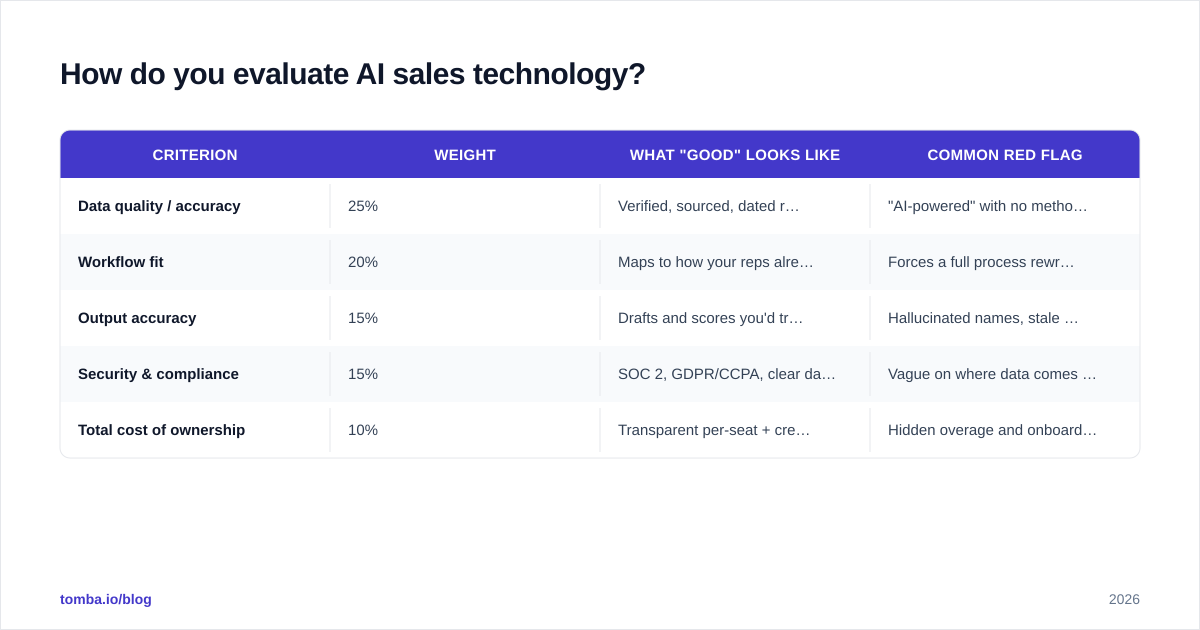
The weights matter more than the scores. If you're a 5-person team doing high-volume outbound, data quality and cost might jump to 30% each. If you're an enterprise with a compliance team breathing down your neck, security climbs. Set the weights before you see a single demo so the shiny features can't move them.
For the data-quality row specifically, ask vendors to show you their sourcing. Tools that publish where their data comes from — and let you audit it — are the ones worth trusting. Tomba's data sources page is an example of the transparency you should demand from any data layer, because the rest of your AI stack is only as honest as the records feeding it.
Why does data quality decide everything else?#
Because every AI layer downstream is a confidence multiplier, not a truth detector. Feed an AI SDR a list with 30% wrong email addresses and it will write 30% of its beautifully personalized messages to the void — and your sender reputation will pay for it. Feed a forecasting model activity data built on duplicate records and it will predict pipeline that doesn't exist.
This is the single most under-weighted criterion in AI sales technology evaluation. Buyers get dazzled by the generative layer — the email writing, the call summaries — and forget that those outputs are only as good as the contact and account data underneath. A study by Salesforce on the state of sales repeatedly finds that reps lose a large share of their week to manual data work and bad records; AI doesn't fix that automatically, it just hides it behind a polished interface.
Practically, that means your evaluation should start at the bottom of the stack. Before you score the AI SDR or the forecasting suite, verify the data layer:
- Run a sample of 100 known contacts through the tool and measure hit rate and accuracy yourself.
- Check whether records are dated and re-verified, or scraped once and left to rot.
- Confirm you can verify emails before sending — a good email verifier catches the bounces that wreck deliverability.
- Test catch-all handling, because a chunk of B2B domains are catch-all and naive tools mark them all "valid."
Is an all-in-one platform better than best-of-breed?#
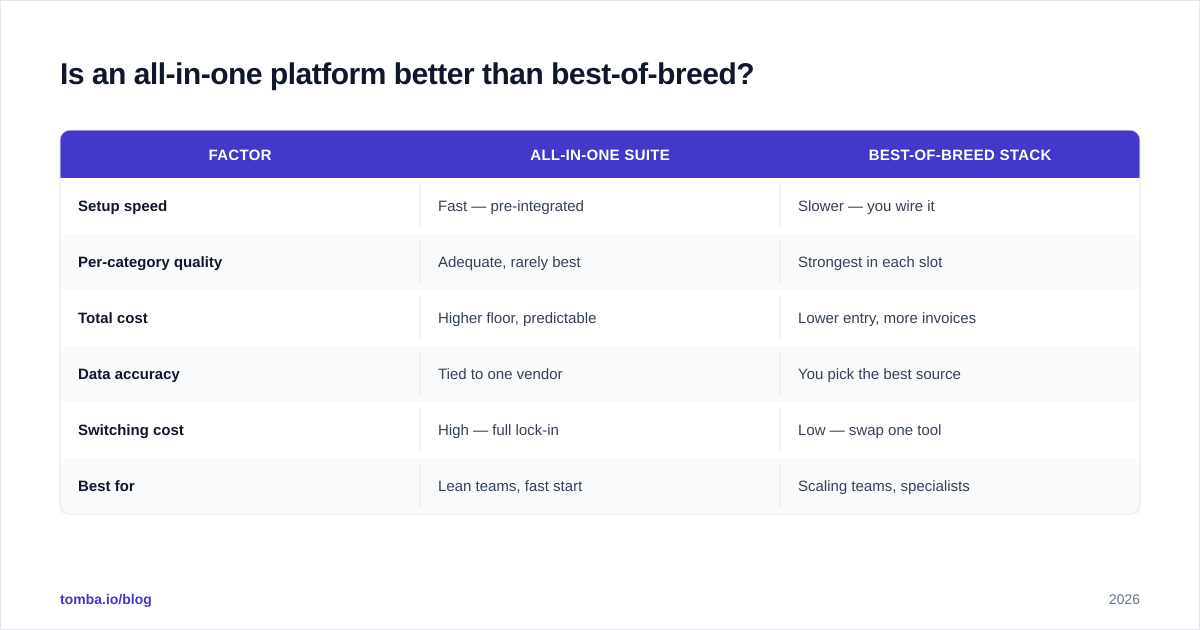
It depends on your team's size and how mature your process is — there's no universal winner. All-in-one suites promise one login, one invoice, and pre-wired integrations. Best-of-breed stacks promise the strongest tool in each category, wired together by you. Here's the honest trade-off.
| Factor | All-in-one suite | Best-of-breed stack |
|---|---|---|
| Setup speed | Fast — pre-integrated | Slower — you wire it |
| Per-category quality | Adequate, rarely best | Strongest in each slot |
| Total cost | Higher floor, predictable | Lower entry, more invoices |
| Data accuracy | Tied to one vendor | You pick the best source |
| Switching cost | High — full lock-in | Low — swap one tool |
| Best for | Lean teams, fast start | Scaling teams, specialists |
The pragmatic middle path most winning teams land on: buy best-of-breed for the foundation (data and verification, where accuracy compounds) and consolidate the convenience layers (sequencing, notes, summaries) into whatever your CRM already bundles. That keeps your most important inputs high-quality while avoiding a dozen logins for low-stakes features.

What does AI sales technology actually cost in 2026?#
The sticker price is rarely the real price. Most AI sales technology now uses a hybrid of per-seat licensing plus consumption credits for AI actions — enrichment lookups, generated messages, minutes transcribed. That second meter is where budgets blow up.
When you model total cost of ownership, account for:
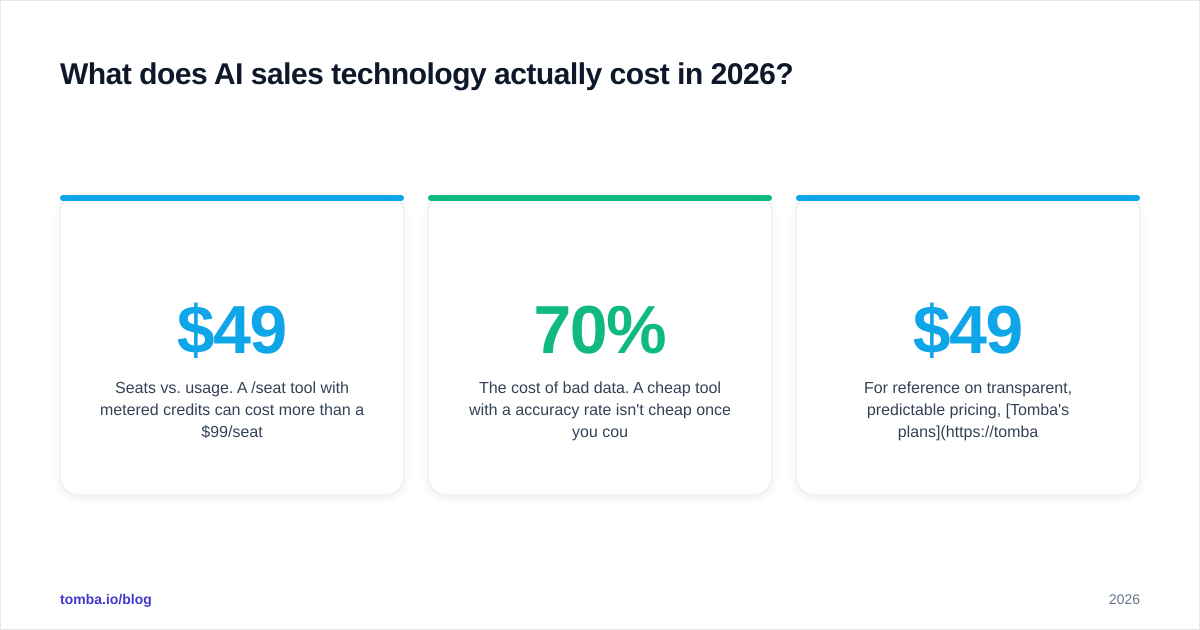
- Seats vs. usage. A $49/seat tool with metered credits can cost more than a $99/seat flat plan once your team ramps volume.
- Onboarding and migration fees. Enterprise suites frequently add a one-time implementation charge that's not on the pricing page.
- Overage rates. Find out what happens when you exceed credits mid-month — auto-upgrade, hard stop, or surprise invoice.
- The cost of bad data. A cheap tool with a 70% accuracy rate isn't cheap once you count wasted send volume and rep time chasing dead leads.
For reference on transparent, predictable pricing, Tomba's plans run from a Free tier with 25 searches a month, to Starter at $49/mo, Growth at $99/mo, Pro at $249/mo, and custom Enterprise — with no per-action surprise meter on top. Whatever vendor you choose, insist on that level of clarity before signing.
You can sanity-check any quote against public review data on G2 and Capterra, where real buyers flag hidden fees and renewal jumps that never make it into a sales call.
How do you run a pilot that proves ROI?#
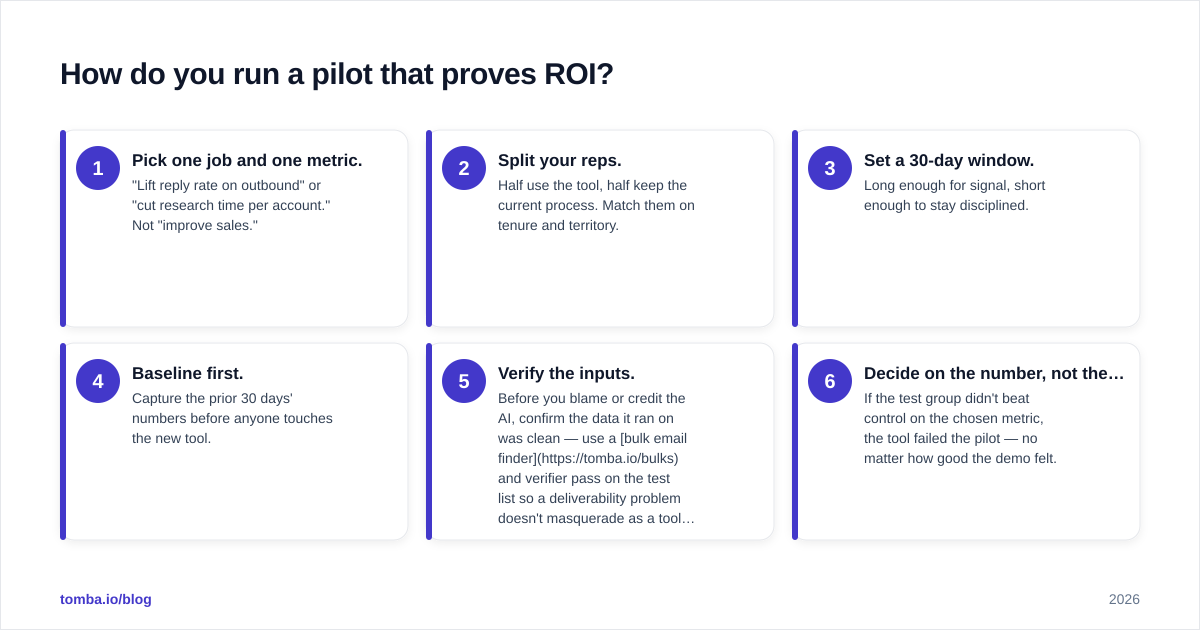
Run a time-boxed pilot with a control group and one metric that matters. Without a control, you can't separate the tool's impact from seasonality, a new comp plan, or a strong rep having a good month.
A pilot worth trusting looks like this:
- Pick one job and one metric. "Lift reply rate on outbound" or "cut research time per account." Not "improve sales."
- Split your reps. Half use the tool, half keep the current process. Match them on tenure and territory.
- Set a 30-day window. Long enough for signal, short enough to stay disciplined.
- Baseline first. Capture the prior 30 days' numbers before anyone touches the new tool.
- Verify the inputs. Before you blame or credit the AI, confirm the data it ran on was clean — use a bulk email finder and verifier pass on the test list so a deliverability problem doesn't masquerade as a tool failure.
- Decide on the number, not the vibe. If the test group didn't beat control on the chosen metric, the tool failed the pilot — no matter how good the demo felt.
If a vendor resists a structured pilot or can't instrument the metric you care about, treat that as data. The best AI sales technology providers are confident enough to be measured.
What mistakes should you avoid when buying AI sales tools?#
- Buying the demo, not the workflow. Demos run on perfect data and curated accounts. Your Tuesday afternoon does not.
- Skipping the data layer. Covered above, but it's the mistake that quietly poisons every other tool.
- Over-indexing on AI novelty. "Agentic AI SDR" is exciting and the least proven category in the table. Pilot it harder, not softer.
- Ignoring change management. A tool reps won't adopt has an ROI of zero regardless of its capabilities. Workflow fit is weighted at 20% for a reason.
- No exit plan. Before you sign, know how you'd export your data and switch. Lock-in is a cost even when the tool is good.
Sales automation and AI only compound the quality — or the mess — of what you already have. If your process is sound and your data is clean, AI sales technology can give a real, measurable lift. If it isn't, you're buying a faster way to do the wrong thing.
The bottom line on evaluating AI sales technology#
Map the category, weight your criteria before the demos, verify the data layer yourself, and let a controlled pilot make the final call. That sequence turns a crowded, hype-heavy market into a short list of tools that earn their seat.
And because every AI layer in your stack inherits the accuracy of the contacts beneath it, start where the leverage is highest: clean, verified, sourced data. The Tomba Email Finder gives you accurate professional emails by name, domain, or company — with verification built in — so the AI tools you layer on top are working from truth instead of guesses. Start free with 25 searches and feed your stack the foundation it actually needs.
// get started
Find, verify and enrich your first contacts today
Start on the free plan with 25 searches a month, then scale when your team is ready.
Free plan · No credit card required · GDPR & CCPA
// about the author