B2B Data Compliance in 2026: GDPR, CCPA & Best Practices
Buying lists and scraping data feels fast until a regulator calls. Here is how B2B data compliance actually works in 2026 — GDPR, CCPA, lawful sourcing, and the controls that keep your pipeline clean.
TL;DR
- B2B data compliance is the practice of collecting, storing, and using business contact data in a way that satisfies privacy laws like GDPR, CCPA/CPRA, and PECR — even when the contact is a "work" email.
- "It's just B2B" is not a legal exemption. GDPR covers personal data of employees; CCPA/CPRA covers California residents acting in a business context too.
- The biggest risk is not finding a contact — it's where the data came from. Lawful basis, sourcing transparency, and deletion-on-request are what auditors actually check.
- Scraped, bought, or "enriched-from-unknown-sources" lists are the fastest way to a complaint, a blocked domain, and a fine.
- The fix is process: source from compliant vendors, document lawful basis, honor opt-outs fast, and verify before you send.
What is B2B data compliance?#
B2B data compliance is the set of rules and internal controls that keep your prospecting data legal — from the moment you collect a contact to the day you delete them.
Think of it like food safety in a restaurant. Customers see the finished plate (a clean outreach email), but regulators care about the supply chain behind it: where the ingredients came from, how they were stored, and whether anything expired. Your CRM is the kitchen. A bought list of 100,000 emails with no provenance is the mystery meat nobody can trace.
Technically, compliance spans three things: lawful sourcing (you had a right to collect the data), lawful processing (you have a documented legal basis to use it), and data subject rights (people can see, correct, or delete what you hold). Miss any one and you are exposed, regardless of how accurate the data is.
The myth worth killing early: "B2B is exempt." It isn't. A name at a company email is still personal data under the GDPR. California's CCPA and its CPRA amendment explicitly cover residents acting in employment or B2B contexts. The exemptions that once softened B2B treatment have largely sunset.
Which laws actually apply to B2B prospecting data?#
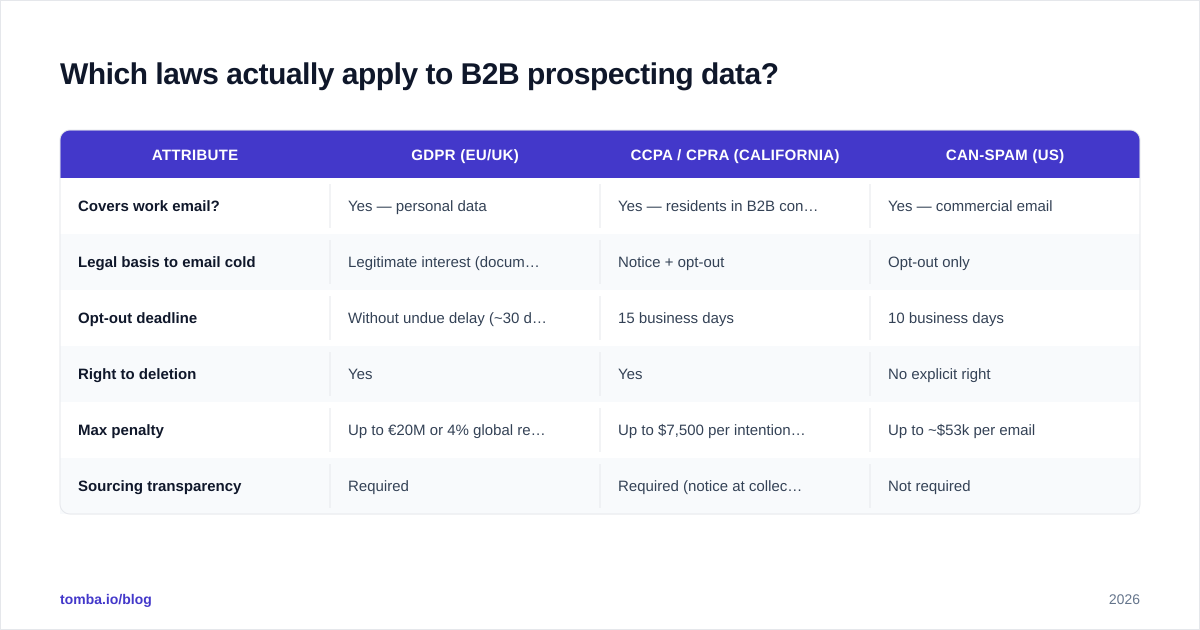
Conclusion first: assume GDPR if you touch anyone in the EU/UK, and assume CCPA/CPRA if you touch California residents — most outbound teams trigger both.
Here is how the major regimes compare for a typical B2B sender.
| Attribute | GDPR (EU/UK) | CCPA / CPRA (California) | CAN-SPAM (US) |
|---|---|---|---|
| Covers work email? | Yes — personal data | Yes — residents in B2B context | Yes — commercial email |
| Legal basis to email cold | Legitimate interest (documented) or consent | Notice + opt-out | Opt-out only |
| Opt-out deadline | Without undue delay (~30 days for requests) | 15 business days | 10 business days |
| Right to deletion | Yes | Yes | No explicit right |
| Max penalty | Up to €20M or 4% global revenue | Up to $7,500 per intentional violation | Up to ~$53k per email |
| Sourcing transparency | Required | Required (notice at collection) | Not required |
A few practical notes. GDPR's legitimate interest basis can support cold B2B outreach, but only if you document a balancing test and your message is relevant to the recipient's role. PECR (the EU/UK ePrivacy rules) layers on top for marketing email and is stricter for individuals than for corporate addresses. In the US, CAN-SPAM is weak on sourcing but unforgiving on opt-out handling — honor unsubscribes fast and keep the proof.
For the authoritative text, read the California Attorney General's CCPA overview and the official GDPR portal directly rather than a vendor's summary.
Where does compliant B2B data actually come from?#
The single most important compliance question is one most teams never ask their vendor: where did this record come from?
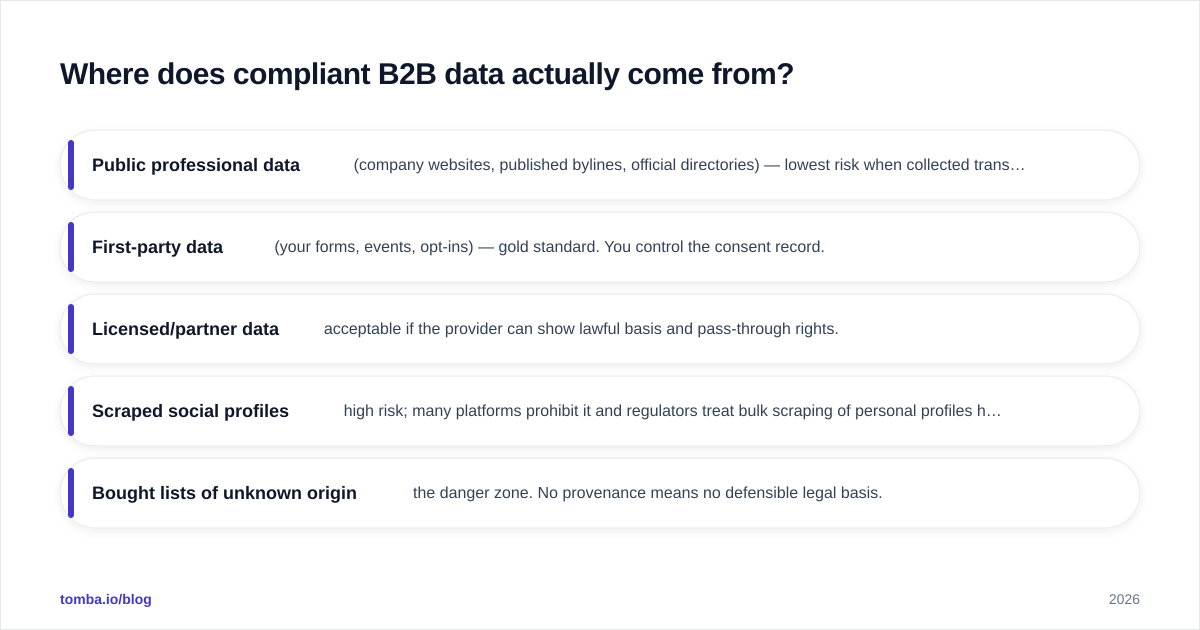
There is a spectrum of sourcing, and it maps almost perfectly to your risk.
- Public professional data (company websites, published bylines, official directories) — lowest risk when collected transparently. This is how a tool like Tomba's domain search assembles role-based company contacts from public footprints.
- First-party data (your forms, events, opt-ins) — gold standard. You control the consent record.
- Licensed/partner data — acceptable if the provider can show lawful basis and pass-through rights.
- Scraped social profiles — high risk; many platforms prohibit it and regulators treat bulk scraping of personal profiles harshly.
- Bought lists of unknown origin — the danger zone. No provenance means no defensible legal basis.
Before you trust any provider, read how they document sourcing. Tomba publishes its approach on its data sources page — that kind of transparency is exactly what a regulator (or a careful buyer) wants to see. If a vendor can't tell you where a record originated, you inherit a liability you can't measure.
The distinction matters in practice. Verified, public, role-based business data sits in a very different risk bucket than a $20 list of 500k "decision-makers" scraped from who-knows-where.
Is buying a B2B email list legal?#
Short answer: sometimes legal, usually risky, and rarely worth it.
Buying a list is not automatically illegal in the US under CAN-SPAM. But under GDPR, you become a data controller the moment you load those records — and you must have a lawful basis you can defend, plus the ability to honor access and deletion requests for people you've never met. If the seller can't transfer a documented lawful basis, you can't manufacture one after the fact.
There's also a deliverability tax that has nothing to do with law. Stale, unverified lists are full of spam traps and dead addresses. Hit enough of them and your sender reputation collapses, your domain lands on blocklists, and even your legitimate mail stops arriving. Compliance failure and deliverability failure usually arrive in the same week.

The safer pattern is to build, not buy: identify target accounts, then resolve specific role-based contacts on demand from public data, and verify each one before sending. It's slower per record and dramatically cheaper in risk.
How do you build a compliant B2B prospecting workflow?#
Here's a workflow that keeps legal, deliverability, and sales aligned.
- Define your lawful basis up front. For EU/UK, write a one-paragraph legitimate-interest assessment per campaign: who you're contacting, why it's relevant to their job, and how you'll let them opt out. Keep it on file.
- Source transparently. Pull role-based contacts from public/company data instead of scraping personal profiles. Tools like the email finder resolve professional addresses by name and domain without you handling a mystery list.
- Verify before contact. Run every address through an email verifier to drop invalids and traps. This protects deliverability and reduces the personal data you process unnecessarily.
- Minimize what you store. Keep only fields you use — name, role, company, business email. Don't hoard personal mobile numbers or scraped bios "just in case." Data minimization is a GDPR principle, not a nice-to-have.
- Make opt-out trivial and fast. One-click unsubscribe, suppression list updated immediately, deletion requests handled within the legal window.
- Set retention limits. Auto-purge contacts who never engage after a defined period. Old data is liability with no upside.
- Log consent and changes. If a regulator asks "why did you have this person's data and what did you do with it," you want an answer in minutes, not a panic.
This is the difference between a process you can defend and a spreadsheet you have to apologize for.
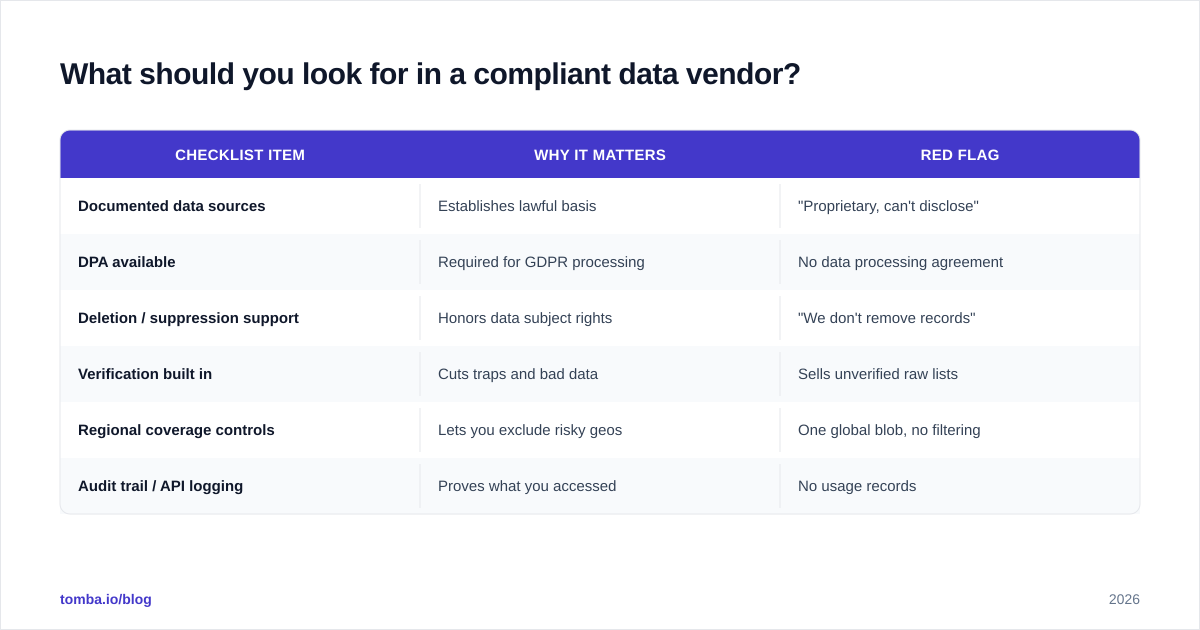
What should you look for in a compliant data vendor?#
Treat vendor selection as a compliance control, not a feature comparison. The right questions:
| Checklist item | Why it matters | Red flag |
|---|---|---|
| Documented data sources | Establishes lawful basis | "Proprietary, can't disclose" |
| DPA available | Required for GDPR processing | No data processing agreement |
| Deletion / suppression support | Honors data subject rights | "We don't remove records" |
| Verification built in | Cuts traps and bad data | Sells unverified raw lists |
| Regional coverage controls | Lets you exclude risky geos | One global blob, no filtering |
| Audit trail / API logging | Proves what you accessed | No usage records |
A vendor that verifies on the way in, documents where data comes from, and supports deletion is doing the heavy lifting for you. One that sells anonymous bulk dumps is selling you their risk. Tools that combine finding, verification, and data enrichment in one auditable pipeline are easier to defend than a stack of disconnected list buys.
For independent signal on any vendor's reliability and reviews, cross-check the G2 category for sales intelligence before you commit.
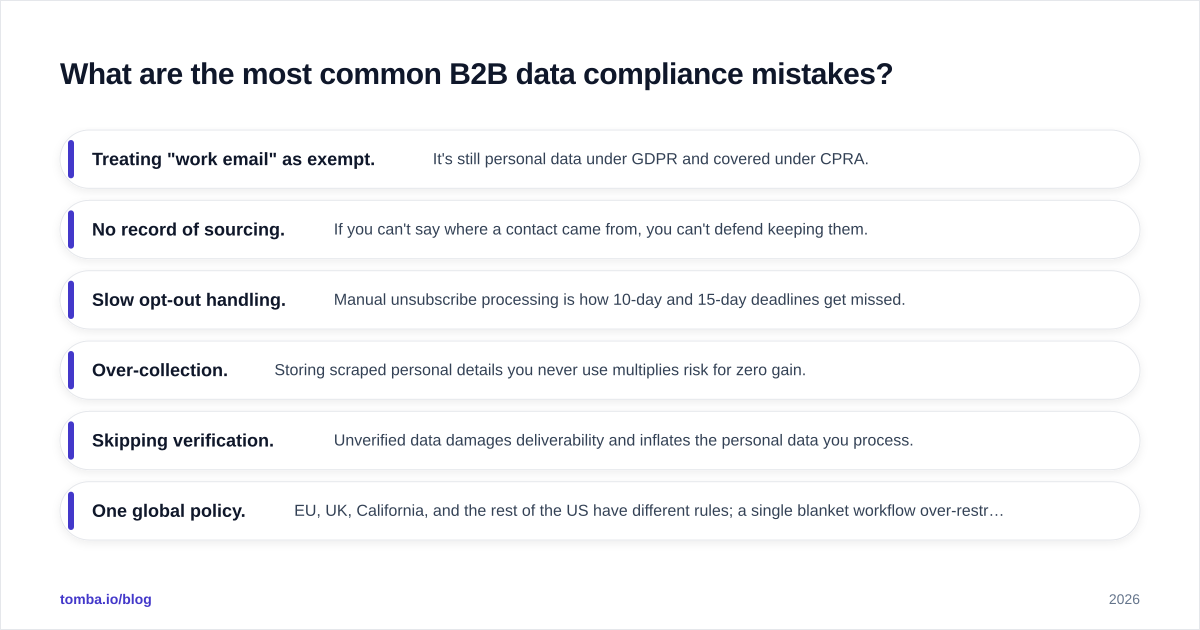
What are the most common B2B data compliance mistakes?#
- Treating "work email" as exempt. It's still personal data under GDPR and covered under CPRA.
- No record of sourcing. If you can't say where a contact came from, you can't defend keeping them.
- Slow opt-out handling. Manual unsubscribe processing is how 10-day and 15-day deadlines get missed.
- Over-collection. Storing scraped personal details you never use multiplies risk for zero gain.
- Skipping verification. Unverified data damages deliverability and inflates the personal data you process.
- One global policy. EU, UK, California, and the rest of the US have different rules; a single blanket workflow over-restricts some regions and under-protects others.
Most of these are process failures, not legal mysteries. Fix the process and the legal exposure shrinks on its own.
The bottom line#
Compliant B2B prospecting isn't about emailing fewer people — it's about being able to prove, at any moment, that every contact in your pipeline was sourced lawfully, verified, and is one click away from opting out. The teams that win in 2026 treat data hygiene and data compliance as the same discipline.
If you want a defensible alternative to bought lists, start with the Tomba Email Finder. It resolves professional, role-based email addresses from public company data, verifies them before you send, and documents its data sources — so your outreach stays accurate and auditable. Pair it with the built-in email verifier to keep deliverability high and the personal data you process to a minimum. Check current Tomba pricing — the free tier gives you 25 searches a month to test the workflow before you commit.
// get started
Find, verify and enrich your first contacts today
Start on the free plan with 25 searches a month, then scale when your team is ready.
Free plan · No credit card required · GDPR & CCPA
// about the author