B2B Data Quality in 2026: A Practical Framework Guide
Bad B2B data quietly drains pipeline, wastes rep hours, and tanks deliverability. Here's a practical 2026 framework to measure, fix, and maintain clean data.
TL;DR
- B2B data quality is how accurate, complete, consistent, and fresh your contact and account records are — and it decays roughly 2.5%–3% per month on its own.
- Bad data costs more than you think: wasted rep hours, bounced campaigns, blown deliverability, and forecasts built on phantom accounts.
- Measure it with six dimensions (accuracy, completeness, consistency, timeliness, uniqueness, validity) before you spend a cent on tooling.
- A clean pipeline beats a big one: verify at capture, enrich at the point of need, and re-validate on a schedule.
- The cheapest fix is preventing dirty data from entering — verification at the form and CRM level pays for itself fast.
What is B2B data quality?#
B2B data quality is the degree to which your sales and marketing records — contacts, companies, emails, phone numbers, job titles, firmographics — are accurate, complete, and usable for the decisions you make with them.
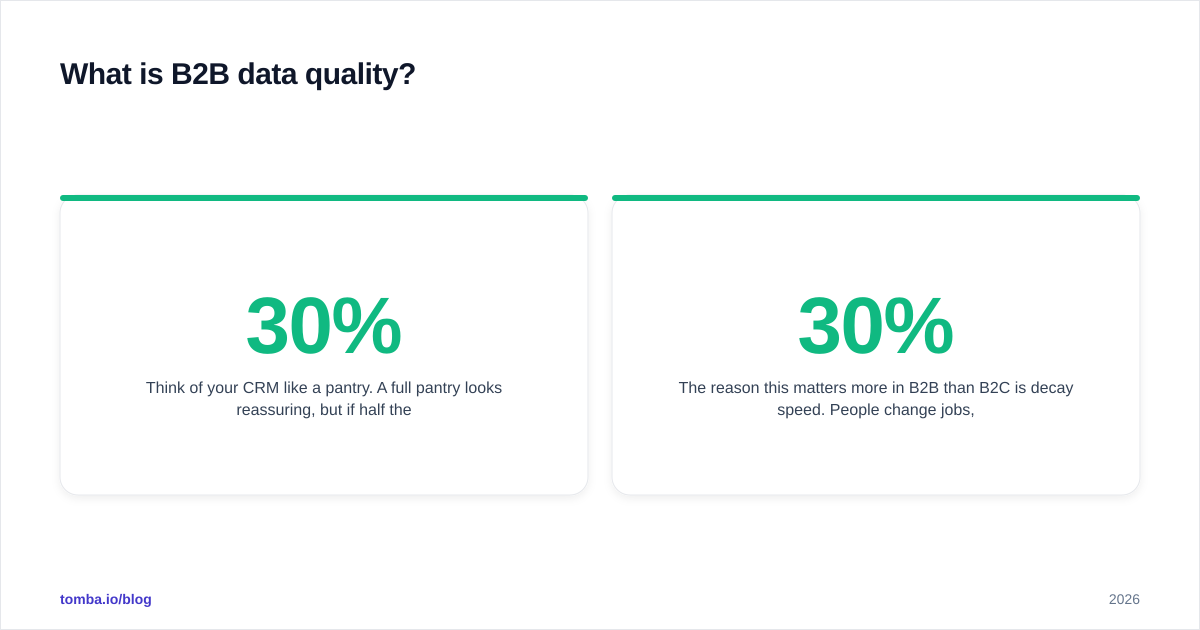
Think of your CRM like a pantry. A full pantry looks reassuring, but if half the cans are expired, mislabeled, or duplicated, you can't actually cook dinner from it. Volume isn't the same as usefulness. A database of 200,000 "leads" where 30% bounce and 40% have stale titles is worth less than 50,000 verified, current records.
The reason this matters more in B2B than B2C is decay speed. People change jobs, companies get acquired, domains get retired, and titles shift. Industry estimates put B2B contact decay at around 30% per year. That means a list you bought clean in January is meaningfully wrong by summer — without anyone touching it.
Why does poor B2B data quality cost so much?#
Poor data quality is expensive because the cost is hidden across every team instead of showing up as one line item.
Here's where the money leaks:
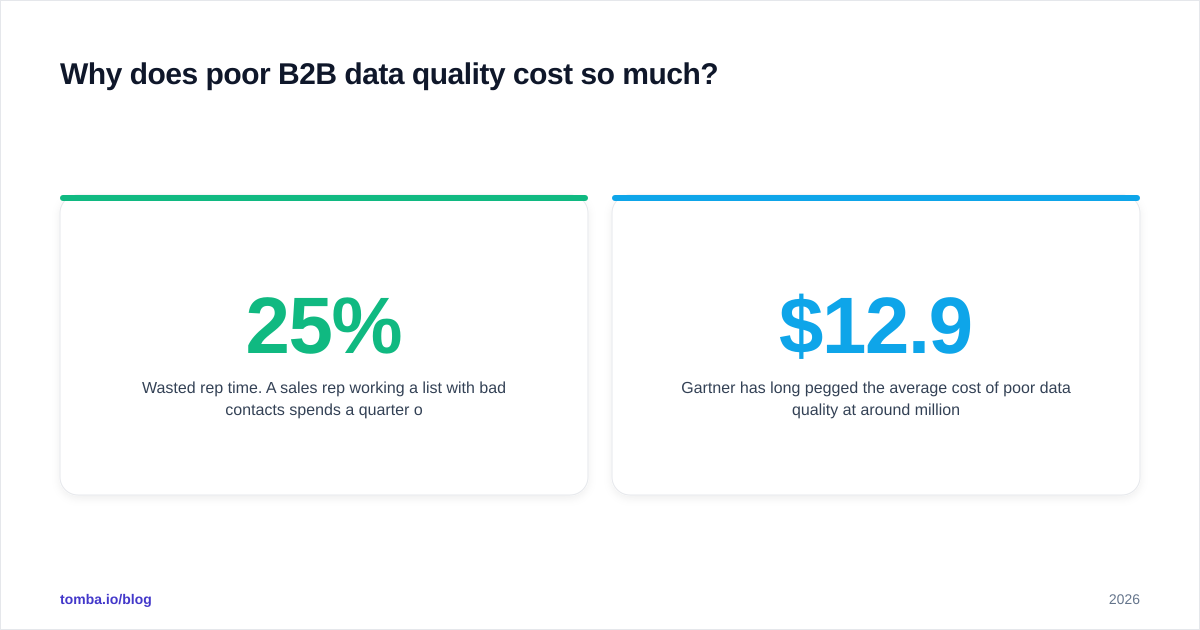
- Wasted rep time. A sales rep working a list with 25% bad contacts spends a quarter of their prospecting hours dialing dead numbers and emailing bounced addresses. At a loaded cost of $80k–$120k per rep, that's real burn.
- Deliverability damage. High bounce rates from unverified emails tank your sender reputation, which then hurts the deliverability of every campaign — including the ones to good addresses.
- Distorted forecasting. Duplicate accounts and phantom opportunities inflate pipeline. RevOps builds a forecast on numbers that were never real.
- Marketing spend waste. Retargeting and ABM budgets get spent against contacts who left the company a year ago.
- Compliance risk. Stale consent records and unverifiable contacts create GDPR and CAN-SPAM exposure.
Gartner has long pegged the average cost of poor data quality at around $12.9 million per year for enterprises. You don't need to be an enterprise to feel a scaled-down version of that.
What are the six dimensions of B2B data quality?#
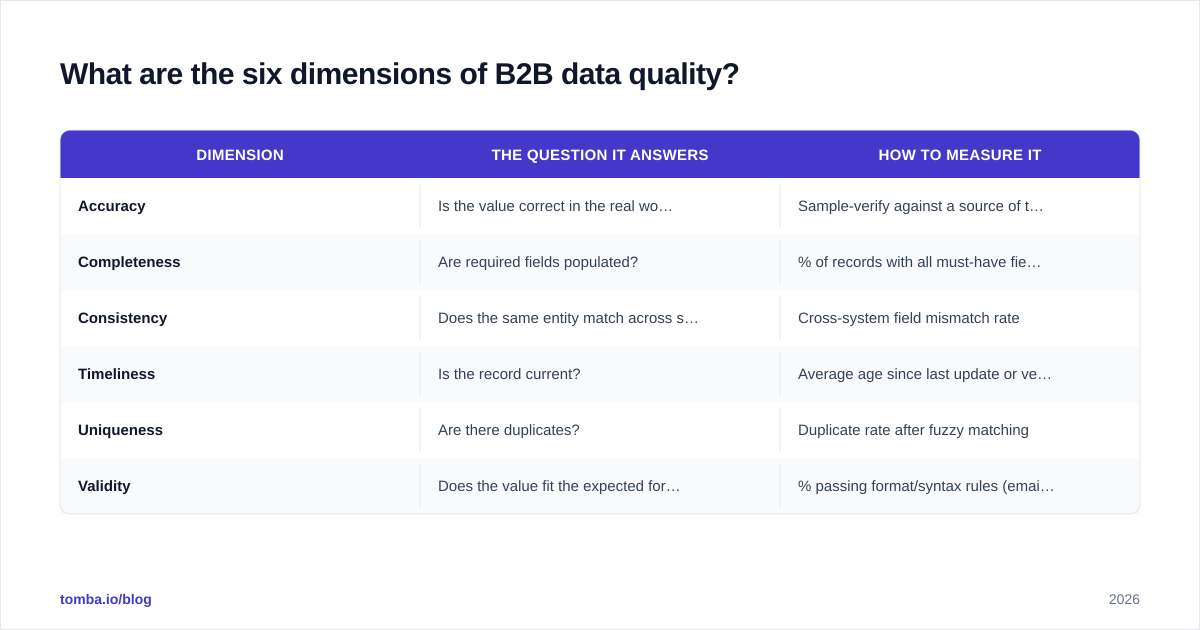
You can't fix what you don't measure, so start by scoring your data across six standard dimensions. Each one answers a different question.
| Dimension | The question it answers | How to measure it |
|---|---|---|
| Accuracy | Is the value correct in the real world? | Sample-verify against a source of truth (email verification, manual checks) |
| Completeness | Are required fields populated? | % of records with all must-have fields filled |
| Consistency | Does the same entity match across systems? | Cross-system field mismatch rate |
| Timeliness | Is the record current? | Average age since last update or verification |
| Uniqueness | Are there duplicates? | Duplicate rate after fuzzy matching |
| Validity | Does the value fit the expected format? | % passing format/syntax rules (email, phone, domain) |
The trick is to weight these by what your go-to-market motion actually needs. An outbound team living on email lives and dies by accuracy and validity. An ABM team cares more about completeness and consistency so account matching works. Score each dimension 0–100, weight them, and you get a single data-health number you can track over time.
How do you measure your current data health?#
Run a baseline audit before changing anything. The goal is an honest snapshot, not a perfect one.
- Pull a representative sample. Take 1,000–5,000 records at random rather than auditing everything by hand.
- Run validity checks. Format-check every email and phone number. An email verifier flags syntax errors, dead mailboxes, and risky catch-all domains in bulk.
- Measure completeness. Count records missing any field your playbook requires (company, title, verified email, region).
- Detect duplicates. Use fuzzy matching on name + company + domain — exact-match dedupe misses "Bob Smith" vs "Robert Smith." Tools like a remove duplicates utility handle the obvious passes.
- Spot-check accuracy. Manually verify 50–100 records against LinkedIn or company sites to estimate your true accuracy rate.
- Score and document. Record each dimension so you can prove improvement later.
The output is a number you'll be embarrassed by and a list of the worst offenders. Both are useful.
Verification, enrichment, or replacement — which approach fixes it?#
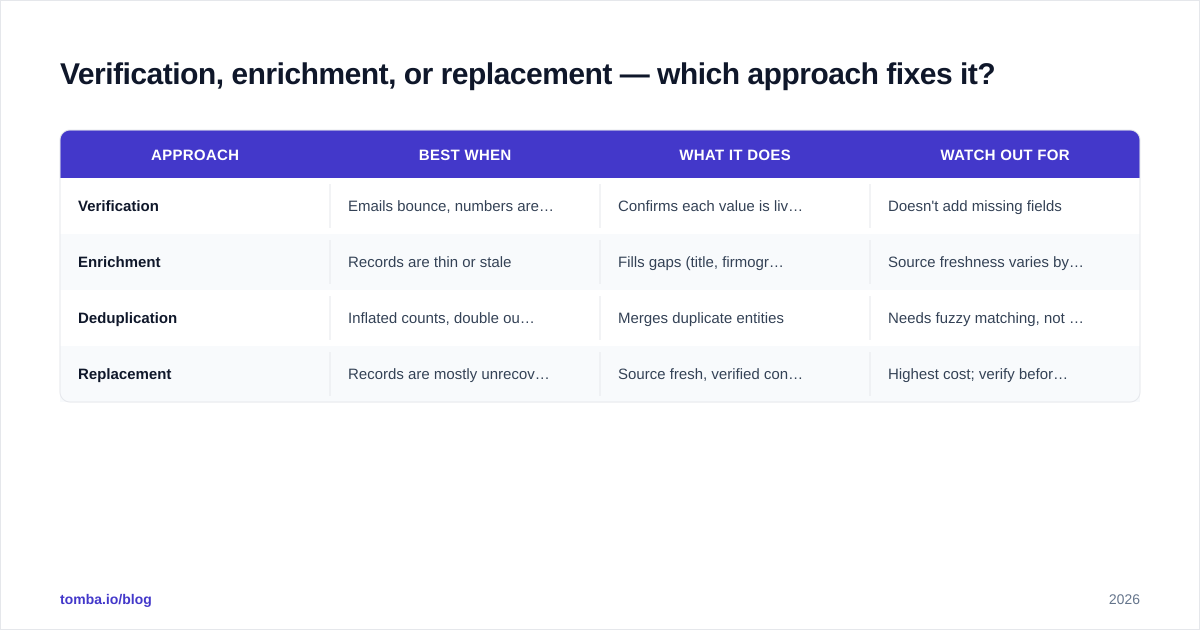
The right fix depends on what's actually broken. Most teams reach for "buy more data" when the cheaper move is to clean what they have.
| Approach | Best when | What it does | Watch out for |
|---|---|---|---|
| Verification | Emails bounce, numbers are dead | Confirms each value is live and deliverable | Doesn't add missing fields |
| Enrichment | Records are thin or stale | Fills gaps (title, firmographics, socials) | Source freshness varies by provider |
| Deduplication | Inflated counts, double outreach | Merges duplicate entities | Needs fuzzy matching, not exact |
| Replacement | Records are mostly unrecoverable | Source fresh, verified contacts | Highest cost; verify before importing |
In practice you'll combine them: dedupe first so you're not enriching the same record twice, verify to drop the dead weight, then enrich the survivors and source net-new only for the gaps. Data enrichment is most cost-effective when it runs against an already-deduplicated, already-verified base.

How do you prevent dirty data from entering in the first place?#
Prevention beats remediation every time, because cleaning is recurring labor while prevention is a one-time setup. The cleanest databases enforce quality at the point of entry.
- Verify at the form. Validate email syntax and deliverability before a lead record is created. A free email checker or an API call at submission keeps junk out.
- Standardize on write. Normalize job titles, company names, and country codes with picklists and formatting rules so "VP Sales," "V.P. of Sales," and "vp, sales" don't fragment your segments.
- Enrich at capture. When a contact comes in, append firmographics immediately via the Tomba API so reps never work a half-empty record.
- Block known bad patterns. Reject role-based addresses (info@, sales@) for individual outreach lists and flag free-mail domains where business emails are expected.
- Set a re-verification cadence. Re-check high-value segments quarterly and the full database twice a year. Decay is constant, so maintenance has to be too.
If you build records from scratch, finding the right contact is half the battle — an email finder that returns a confidence score lets you skip the verification round-trip for high-confidence results and only deep-verify the uncertain ones.
What does a sustainable data quality workflow look like?#
A sustainable workflow treats data quality as a pipeline stage, not a quarterly fire drill. Here's a workflow that holds up:
- Capture — validate and enrich at the moment of entry; reject malformed records.
- Standardize — apply formatting and normalization rules on write.
- Deduplicate — run fuzzy-match dedupe on a schedule, not just at import.
- Verify — re-check emails and phones on a decay-based cadence (high-value segments more often).
- Enrich — refresh stale firmographics and fill gaps before campaigns launch.
- Monitor — track your data-health score monthly and alert when any dimension drops.
For teams doing this at volume, batch processing matters. A bulk email finder and verifier lets you run thousands of records through verification and enrichment in one pass rather than one-by-one, and a documented B2B database with transparent sourcing reduces how often you have to source from scratch.
Assign an owner. Data quality without a named owner in RevOps or marketing ops becomes everyone's job, which means it's no one's job.
How does data quality connect to deliverability and revenue?#
Clean data is the foundation the rest of your go-to-market stack sits on. Verify your list and your bounce rate drops; your bounce rate drops and your sender reputation holds; your reputation holds and your good emails actually land in inboxes. The chain runs straight from data hygiene to revenue.
The same logic applies to forecasting. When duplicates are gone and accounts are accurate, your pipeline number means something, and RevOps can build a forecast leadership can trust. Garbage in, garbage forecast.
You don't need a six-figure data platform to start. You need a baseline score, a prevention layer at capture, and a maintenance cadence — in that order. The teams that win on data quality aren't the ones with the most records. They're the ones whose records they can actually believe.
Where should you start?#
Start by stopping the bleed. Before you buy more contacts, verify and dedupe the ones you have, then put a prevention layer at every point where records enter your system. If you're building lists or filling gaps, the Tomba Email Finder returns verified, confidence-scored professional emails by name, company, or domain — so the data going into your CRM is clean from the first day instead of something you have to fix six months later. Pair it with the email verifier for ongoing maintenance, and check the current Tomba pricing (free tier includes 25 searches/month, Starter at $49/mo) to find the plan that fits your volume. Clean data isn't a project you finish. It's a standard you keep.
// get started
Find, verify and enrich your first contacts today
Start on the free plan with 25 searches a month, then scale when your team is ready.
Free plan · No credit card required · GDPR & CCPA
// about the author