Website Visitor Identification in 2026: A B2B Playbook
Up to 98% of B2B website visitors leave without filling a form. Here's how website visitor identification turns that anonymous traffic into named, enrich-able pipeline in 2026.
TL;DR
- Website visitor identification reveals which companies — and sometimes which people — browse your site without ever filling out a form. Industry estimates put anonymous B2B traffic at 95–98% of all sessions.
- Two tiers exist: company-level (reverse-IP + firmographics) and person-level (cookie, account, or matched-identity resolution). They carry very different accuracy and legal profiles.
- Reveal data is only as useful as the enrichment behind it. An IP-to-company match means nothing until you attach a decision-maker, an email, and a reason to reach out.
- GDPR and ePrivacy make person-level identification a consent question, not just a tech question. Company-level reveal is far safer in the EU.
- The winning play in 2026 is a pipeline: identify → enrich → score → route → trigger outreach. Identification alone is a vanity metric.
What is website visitor identification?#
Website visitor identification matches anonymous web traffic to a real-world company or person. Your sales and marketing teams can then follow up with accounts that showed intent but never converted.
Think of it like a doorbell camera for your website. Most people who walk up to your door don't ring the bell — they look, hesitate, and leave. A doorbell camera doesn't force them to knock. It just tells you who stopped by, so you can decide whether to wave them back. Website visitor identification does the same for your pricing page, your product tour, and your comparison content.
Technically, it resolves the signals a browser leaves behind into a firmographic or contact record. Those signals include the IP address, reverse-DNS, cookies, a known logged-in identity, and third-party data graphs. The output is a feed that says, in effect: "Acme Corp, a 400-person logistics company, viewed your integrations page three times this week."
That's the promise. The reality depends heavily on which tier of identification you're buying, which we'll break down below.
How does website visitor identification work?#
At a high level, every reveal tool runs the same four-step loop, even when vendors dress it up differently.
- Capture — A lightweight JavaScript tag (or server-side event) records the session: IP, page path, referrer, time-on-page, UTM parameters, and any first-party identifiers you already hold.
- Resolve — The tool maps that session to an entity. Company-level resolution uses reverse-IP lookups against business ISP ranges and firmographic databases. Person-level resolution relies on cookies, an existing account login, or a match against a licensed identity graph.
- Enrich — A bare match ("IP belongs to Acme") is useless on its own. The record gets enriched with industry, headcount, revenue, tech stack, and — critically — contact data for the right buyer.
- Activate — The enriched record is scored, routed to a rep or a sequence, and (ideally) triggers a timely, relevant touch.
The first two steps get the marketing hype. Steps three and four are where revenue actually happens. A reveal feed without data enrichment behind it is a list of logos you can't act on.
Why do 98% of B2B visitors leave without converting?#
Because forms are friction, and most of your buying committee is researching long before anyone is willing to identify themselves.
Widely cited B2B benchmarks show the typical landing page converts in the low single digits. So the overwhelming majority of qualified traffic stays anonymous. In a complex deal, Gartner research has long noted that buyers spend most of their journey on independent research — comparison pages, docs, peer reviews. Only a sliver of that time goes to talking with vendors.
So the visitors who don't convert aren't junk. They include:
- Champions building a business case who aren't ready to "talk to sales."
- Procurement and finance scoping cost before a deal is greenlit.
- Competitors and analysts (noise you'll need to filter).
- Existing customers looking for support docs.
Website visitor identification exists to recover the first two groups: the high-intent, in-market accounts hiding inside that 98%.

What can you actually identify — person or company?#
This is the question that separates a realistic buyer from a disappointed one. There are two tiers, and conflating them is the most expensive mistake teams make.
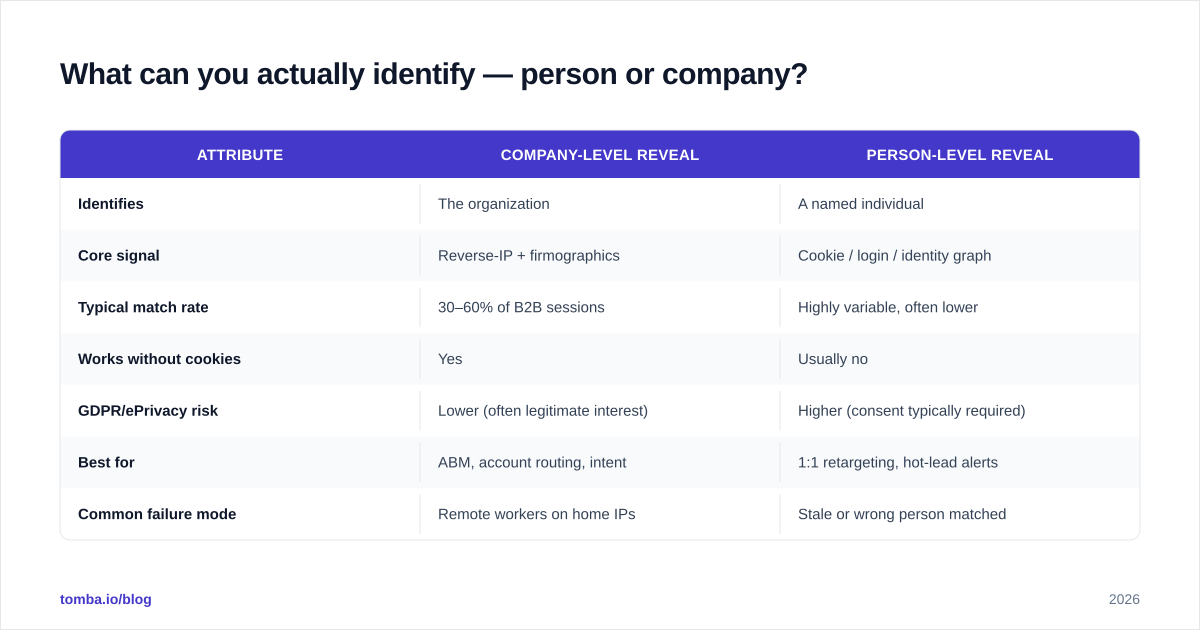
Company-level identification tells you the organization. It's based on reverse-IP and firmographics, it works without cookies, and it's the safer choice under EU privacy law. Match rates are decent for mid-market and enterprise traffic on static business IPs. They are poor for remote workers, mobile users, and consumer ISPs.
Person-level identification tries to name the individual. It depends on a cookie, a known logged-in user, or a probabilistic match against an identity graph. Accuracy varies wildly. In the EU it generally requires consent, because you're processing personal data.
Here's the honest tradeoff:
| Attribute | Company-level reveal | Person-level reveal |
|---|---|---|
| Identifies | The organization | A named individual |
| Core signal | Reverse-IP + firmographics | Cookie / login / identity graph |
| Typical match rate | 30–60% of B2B sessions | Highly variable, often lower |
| Works without cookies | Yes | Usually no |
| GDPR/ePrivacy risk | Lower (often legitimate interest) | Higher (consent typically required) |
| Best for | ABM, account routing, intent | 1:1 retargeting, hot-lead alerts |
| Common failure mode | Remote workers on home IPs | Stale or wrong person matched |
The practical answer for most B2B teams in 2026: start with company-level reveal. Then use enrichment and your own first-party data to resolve the right contact at that company. That beats buying a risky person-level match you can't legally use.
How do the main approaches compare?#
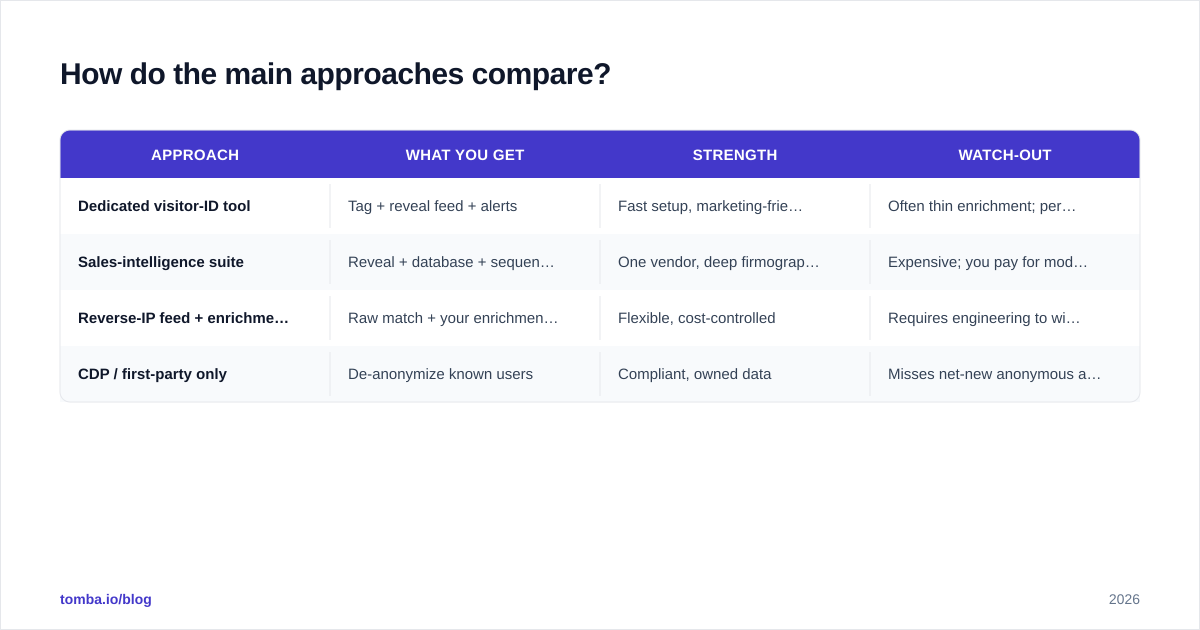
Website visitor identification ships in a few different packages. You can buy a dedicated visitor-ID tool, get it bundled inside a big sales-intelligence platform, or assemble it from a reverse-IP feed plus your own enrichment layer. Each has a different cost and accuracy profile.
| Approach | What you get | Strength | Watch-out |
|---|---|---|---|
| Dedicated visitor-ID tool | Tag + reveal feed + alerts | Fast setup, marketing-friendly | Often thin enrichment; per-match billing adds up |
| Sales-intelligence suite | Reveal + database + sequencing | One vendor, deep firmographics | Expensive; you pay for modules you won't use |
| Reverse-IP feed + enrichment | Raw match + your enrichment stack | Flexible, cost-controlled | Requires engineering to wire up |
| CDP / first-party only | De-anonymize known users | Compliant, owned data | Misses net-new anonymous accounts |
Notice what every row depends on: enrichment quality. A reveal product that hands you "Acme Corp" but no buyer, no email, and no phone number forces your reps to go hunting manually. That's exactly the work you were trying to automate. Pairing identification with an accurate email finder and reliable company email search is what closes the loop from logo to outreach.
How do you turn identified visitors into pipeline?#
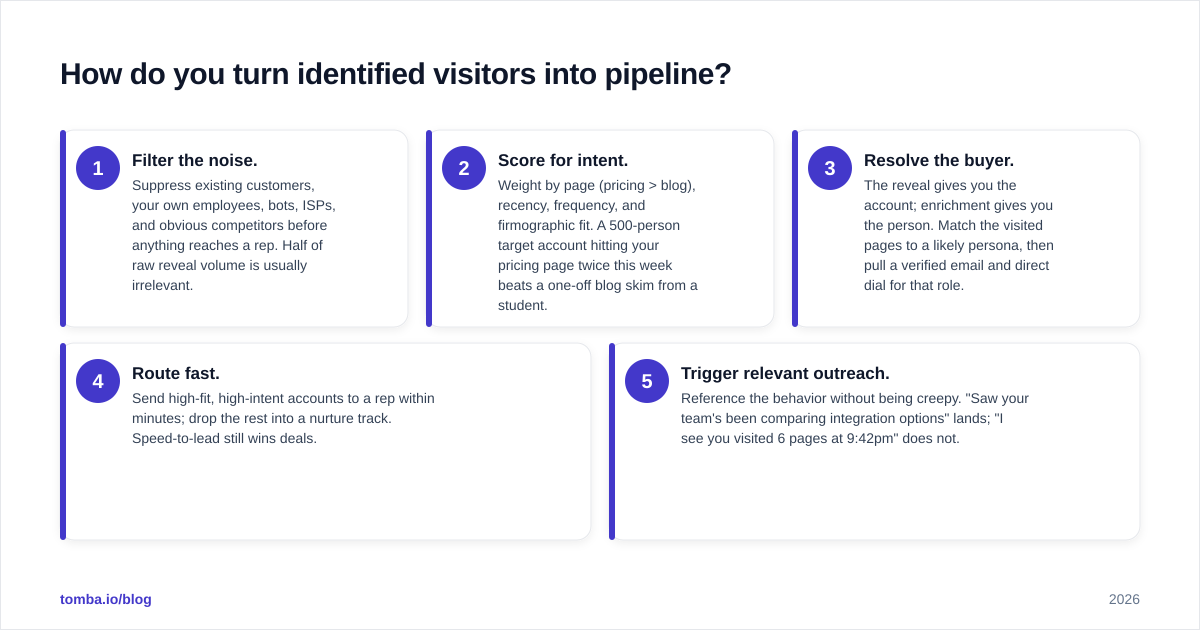
Website visitor identification is the start of the work, not the end. The teams that get ROI run a tight five-step operating model.
- Filter the noise. Suppress existing customers, your own employees, bots, ISPs, and obvious competitors before anything reaches a rep. Half of raw reveal volume is usually irrelevant.
- Score for intent. Weight by page (pricing > blog), recency, frequency, and firmographic fit. A 500-person target account hitting your pricing page twice this week beats a one-off blog skim from a student.
- Resolve the buyer. The reveal gives you the account; enrichment gives you the person. Match the visited pages to a likely persona, then pull a verified email and direct dial for that role.
- Route fast. Send high-fit, high-intent accounts to a rep within minutes; drop the rest into a nurture track. Speed-to-lead still wins deals.
- Trigger relevant outreach. Reference the behavior without being creepy. "Saw your team's been comparing integration options" lands; "I see you visited 6 pages at 9:42pm" does not.
This is also where contact enrichment earns its keep. It's the bridge between "an account is interested" and "here's the verified email of the person who can buy." For a primer on the broader discipline, our B2B data intelligence hub covers scoring and routing in more depth.
Is website visitor identification legal under GDPR?#
Short answer: company-level identification is generally defensible; person-level identification usually requires consent in the EU. Treat this as a design constraint, not an afterthought.
Under GDPR and the ePrivacy Directive, an individual's identity and behavior are personal data, and tracking cookies typically need consent. Company-level reverse-IP is murkier. Many vendors run it under legitimate interest, because a company is not, by itself, a natural person. But the moment you attach a named individual to that browsing behavior, you're firmly in personal-data territory.
Practical guardrails for 2026:
- Default to company-level reveal in the EU. It carries the lighter legal load and still powers ABM and routing.
- Honor consent for person-level. If your tool resolves individuals, it should respect your cookie banner and consent state.
- Keep a clear privacy notice. Disclose that you use analytics and reveal technology, and offer an opt-out.
- Mind regional rules. US states (CCPA/CPRA and successors) and other jurisdictions add their own requirements.
This isn't legal advice — loop in counsel — but the engineering principle is simple: the more precisely you name a human, the more consent you need. The Wikipedia overview of the General Data Protection Regulation is a reasonable starting point, and your DPO is the final word.
How do you choose a visitor identification tool?#
Evaluate website visitor identification tools on the parts that drive pipeline, not the demo dashboard. Use this checklist when you shortlist vendors on a marketplace like G2 or run your own trial.
- Match rate on your traffic. Run a real pilot. Vendor-quoted averages mean nothing against your specific visitor mix.
- Enrichment depth. Does a match come with verified contacts, or just a company name? Test the data, don't trust the brochure.
- Data accuracy. Bounce-tested emails and current job titles, not a stale database. Ask how often it refreshes and where the data comes from.
- Routing and integrations. Native sync to your CRM and outreach stack (HubSpot, Salesforce, Pipedrive) so reveals become tasks, not spreadsheets.
- Compliance posture. Consent handling, suppression lists, and a clear EU stance.
- Pricing model. Per-match, per-seat, or flat? Per-match pricing can spike with traffic; model your real volume.
On cost, watch how identification and enrichment are billed together. Some suites charge a premium for reveal and meter every enrichment credit. If you mostly need accurate contacts behind known accounts, a focused finder plus enrichment is often dramatically cheaper. For reference, transparent Tomba pricing starts with a free tier of 25 searches/month, Starter at $49/mo, Growth at $99/mo, and Pro at $249/mo — no per-match surprise billing.
Putting it together#
Website visitor identification is one of the highest-leverage plays in B2B because it acts on demand you've already paid to generate. You ran the ads, published the content, earned the rankings — and then watched 98% of that audience leave unnamed. Reveal recovers the in-market slice.
But identification is step one of four. The accounts only become revenue when you enrich them into real buyers, score for genuine intent, route fast, and reach out with relevance and consent. Get that pipeline right and your existing traffic quietly becomes your best lead source.
Ready to act on the accounts you identify? Once a reveal tool tells you which company is interested, Tomba's Email Finder gives you the verified email of the right person there — by domain, name, or company — so anonymous interest turns into a real, deliverable conversation. Start free with 25 searches a month and turn your warmest anonymous traffic into pipeline you can actually work.
// get started
Find, verify and enrich your first contacts today
Start on the free plan with 25 searches a month, then scale when your team is ready.
Free plan · No credit card required · GDPR & CCPA
// about the author