B2B Intent Signals in 2026: The Complete Buyer Guide
Intent signals tell you which accounts are in-market right now. Here is how B2B intent data works, where it comes from, and how to act on it before competitors do.
Most outbound still treats every account the same: same list, same sequence, same week. Intent signals break that pattern by telling you which accounts are actively researching a solution like yours — so you reach out while the buying committee is still forming an opinion, not after they've already shortlisted a competitor.
This guide explains what B2B intent signals are, where the data comes from, how to score it, and how to turn a spike in interest into a booked meeting.
TL;DR#
- Intent signals are behavioral data points (content consumption, search, site visits, review-site activity) that indicate an account is actively researching a purchase.
- There are three sources: first-party (your own site/CRM), second-party (review and community platforms), and third-party (publisher co-ops and bidstream).
- Intent data is probabilistic, not certain — treat a spike as a prioritization input, not proof of a deal.
- The winning play is signal + enrichment + fast outreach: detect the surge, find the right contacts, and reach the buying committee within days.
- Tools like Tomba turn an anonymous account-level signal into named, verified contacts you can actually email.
What are B2B intent signals?#
A B2B intent signal is any observable behavior that suggests an account is in-market for a product or service. Think of it like a smoke detector for buying interest: the alarm doesn't prove there's a fire, but it tells you exactly where to look first.
Concretely, a signal might be a director at a target company reading three articles about "email deliverability" in a week, a surge in branded search for a competitor, a spike in pricing-page visits, or a cluster of employees from one domain checking out your category on G2. None of these guarantee a purchase. Together, they shift the odds enough that your reps should prioritize that account today instead of next quarter.
Intent data sits inside the broader discipline of B2B data and intelligence — the practice of layering behavioral, firmographic, and contact data so go-to-market teams act on evidence rather than guesswork.
Why intent matters more in 2026#
Buying committees have grown. Gartner's research on B2B buying has long shown that a typical purchase now involves six to ten decision-makers, each arriving with their own pile of independently gathered information. By the time a buyer fills out a "contact sales" form, most of the research is already done. Intent signals are the only practical way to engage before that form — while you can still shape requirements instead of just responding to an RFP.
How does intent data actually work?#
Intent data is collected, anonymized, aggregated, and then matched back to accounts. The pipeline looks like this:
- Collection — a network of websites, publishers, review platforms, or your own properties logs content consumption.
- Topic mapping — raw page views are mapped to topics ("CRM migration," "cold email software," "SOC 2 compliance").
- Account resolution — IP addresses and other identifiers are resolved to a company (rarely to a named person, for privacy reasons).
- Baselining — the provider compares current activity to that account's normal baseline to detect a surge.
- Scoring & delivery — accounts crossing a threshold are surfaced in your CRM, ABM platform, or a CSV.
The key word is surge. A single page view is noise. A statistically abnormal jump in a topic, concentrated within one domain over a short window, is a signal.
The three types of intent data#
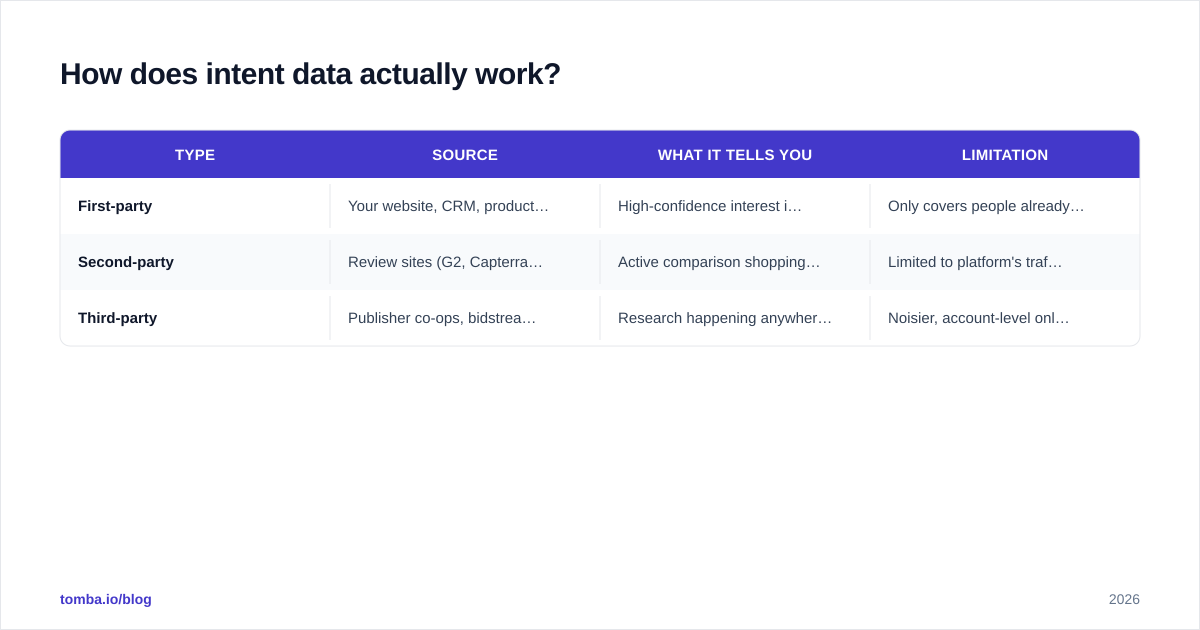
| Type | Source | What it tells you | Limitation |
|---|---|---|---|
| First-party | Your website, CRM, product, webinars | High-confidence interest in you | Only covers people already aware of you |
| Second-party | Review sites (G2, Capterra), communities | Active comparison shopping in your category | Limited to platform's traffic |
| Third-party | Publisher co-ops, bidstream networks | Research happening anywhere on the web | Noisier, account-level only, probabilistic |
First-party intent is the most accurate but the smallest pool — it only sees people who already found you. Third-party intent is the largest pool but the noisiest. Smart teams blend all three: third-party to find new in-market accounts, first-party to confirm and prioritize.
What are the most valuable intent signals to track?#
Not all signals carry equal weight. Here's a rough hierarchy, from strongest to weakest:
- Pricing-page and demo-page visits (first-party). Bottom-of-funnel intent. Reach out same day.
- Competitor comparison views on review sites (second-party). The buyer is shortlisting right now.
- Repeat content consumption on a specific topic (third-party). A research pattern, not a one-off.
- Job postings for roles that imply your product (e.g., hiring an "SDR Manager" signals outbound investment).
- Technographic changes — a company adopting or dropping a tool in your ecosystem.
- Funding announcements and headcount growth — budget and scaling pressure.
A practical rule: weight signals by proximity to a purchase decision and concentration within the account. Three people from the same domain reading buyer-stage content beats thirty scattered views across unrelated companies.

First-party vs third-party intent: which should you start with?#
Start with first-party — it's free, it's yours, and it's the most accurate. You already have it sitting in web analytics, form fills, email engagement, and product usage logs. Most teams under-use it because the data is scattered across tools and never resolved to accounts.
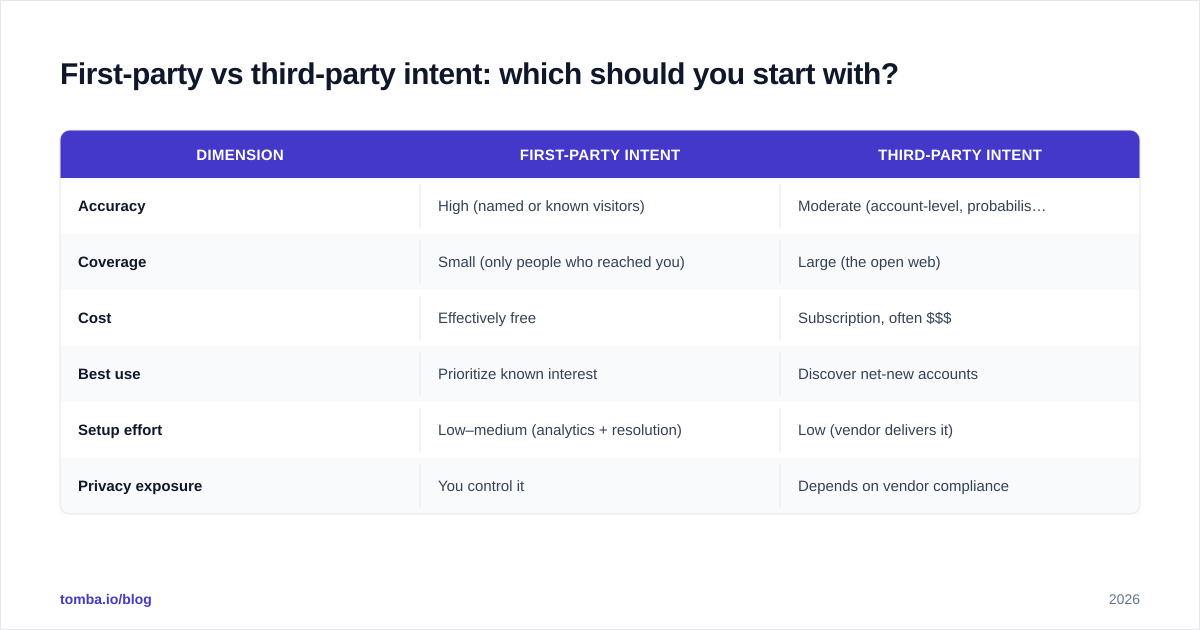
Once first-party is wired up, layer in second- and third-party data to widen the funnel. Here's how the trade-offs compare:
| Dimension | First-party intent | Third-party intent |
|---|---|---|
| Accuracy | High (named or known visitors) | Moderate (account-level, probabilistic) |
| Coverage | Small (only people who reached you) | Large (the open web) |
| Cost | Effectively free | Subscription, often $$$ |
| Best use | Prioritize known interest | Discover net-new accounts |
| Setup effort | Low–medium (analytics + resolution) | Low (vendor delivers it) |
| Privacy exposure | You control it | Depends on vendor compliance |
If budget is tight, a website visitor reveal tool that de-anonymizes the companies already hitting your site is usually a higher-ROI first move than buying a broad third-party feed.
How do you turn an intent signal into pipeline?#
A signal is worthless until someone acts on it fast. The chain has four links, and a break anywhere kills the play.
1. Detect the surge. Set thresholds so reps only see meaningful spikes, not every flicker. Alert fatigue is the number-one reason intent programs die.
2. Resolve the account to people. This is where most intent programs stall. The signal says "someone at acme.com is researching cold email tools." It doesn't say who. You need to identify the buying committee — the VP who owns the budget, the manager who'll run the trial, the ops person who'll integrate it.
3. Enrich and verify contacts. Once you know the roles to target, you need accurate, current email addresses and phone numbers. This is exactly where an email finder and data enrichment layer convert an anonymous account signal into an outreach-ready contact. Run a domain search on the surging account to pull every relevant role, then push the results through an email verifier so your first touch doesn't bounce and burn sender reputation.
4. Reach out on a timed, relevant sequence. Reference the topic they researched, not a generic pitch. "Saw your team's been digging into deliverability" lands far better than "Hope this finds you well." Speed matters: intent decays fast — a surge is usually actionable for one to three weeks before the window closes.
A worked example#
Say your third-party feed flags a 4x surge in "lead generation software" research at a 200-person SaaS company. Here's the play:
- Confirm against first-party: did anyone from that domain visit your pricing page? If yes, escalate priority.
- Run a domain search to list the marketing and RevOps team.
- Enrich the three most relevant contacts (VP Marketing, Demand Gen Manager, RevOps Lead) and verify their emails.
- Launch a three-touch sequence — email, LinkedIn, call — all referencing the lead-gen topic, within 48 hours.
- Log outcomes and feed them back into your scoring model so it learns which signals actually convert.
That feedback loop in step five is what separates a mature intent program from a one-time data purchase.
What are the common mistakes with intent data?#
Most failed intent programs fail the same handful of ways:
- Treating probability as certainty. A surge is a tilt in the odds, not a buying confirmation. Reps who pitch hard on a weak signal torch trust.
- No contact resolution layer. Account-level intent with no way to reach the people is a dashboard nobody acts on.
- Acting too slowly. Intent decays. A signal you action three weeks late is a cold lead with extra steps.
- Ignoring first-party. Teams buy expensive third-party feeds while their own pricing-page visitor data rots in analytics.
- One giant threshold for every topic. Buyer-stage and awareness-stage topics deserve different scores and different plays.
- No feedback loop. If you never measure which signals converted, your scoring never improves.
Avoid these and intent becomes a prioritization engine. Ignore them and it becomes shelfware your CFO questions at renewal.
How does intent data fit with your existing stack?#
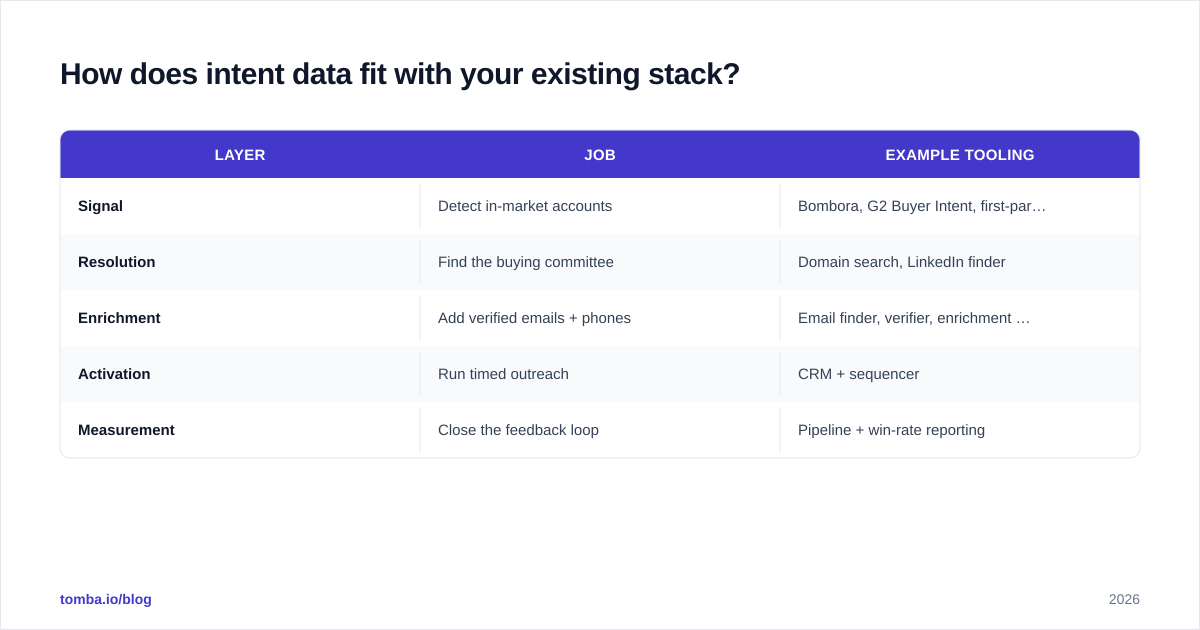
Intent data is a prioritization layer, not a replacement for your CRM, sequencer, or sales automation tooling. It tells your existing motion who to focus on this week. The cleanest architecture looks like this:
| Layer | Job | Example tooling |
|---|---|---|
| Signal | Detect in-market accounts | Bombora, G2 Buyer Intent, first-party reveal |
| Resolution | Find the buying committee | Domain search, LinkedIn finder |
| Enrichment | Add verified emails + phones | Email finder, verifier, enrichment API |
| Activation | Run timed outreach | CRM + sequencer |
| Measurement | Close the feedback loop | Pipeline + win-rate reporting |
The middle two layers — resolution and enrichment — are where intent programs most often have a gap, because the signal vendors stop at the account and the CRM expects named contacts. Filling that gap is the difference between a pretty dashboard and booked meetings. You can compare what enrichment and lookup actually cost on the Tomba pricing page; the free tier (25 searches a month) is enough to test the resolution-to-contact step before you commit budget.
For wider context on where intent fits in a modern go-to-market motion, G2's research on buyer intent data and HubSpot's sales statistics are both solid, vendor-neutral starting points.
Is intent data worth it for small teams?#
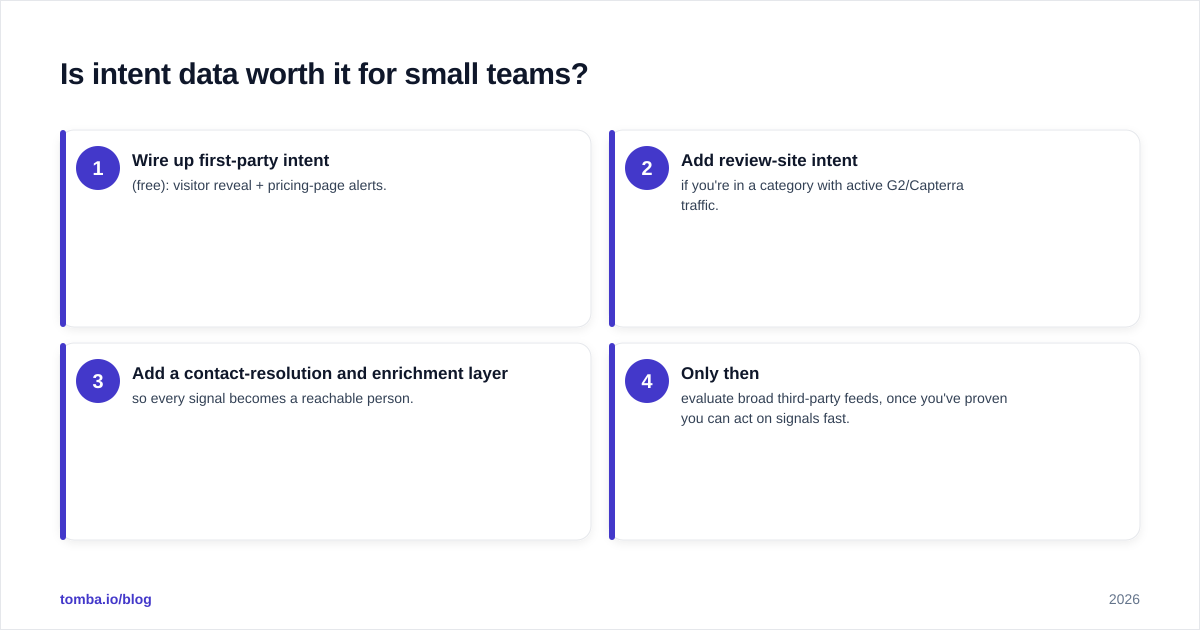
Yes — but start lean. You don't need a six-figure third-party contract on day one. A small team's highest-ROI sequence is:
- Wire up first-party intent (free): visitor reveal + pricing-page alerts.
- Add review-site intent if you're in a category with active G2/Capterra traffic.
- Add a contact-resolution and enrichment layer so every signal becomes a reachable person.
- Only then evaluate broad third-party feeds, once you've proven you can act on signals fast.
The bottleneck for small teams is almost never more signal — it's the capacity to act on the signal they already have. Fix activation first.
The bottom line#
Intent signals are the closest thing B2B sales has to knowing who's raising their hand before they do. They won't tell you a deal is certain, but they will tell you where to spend your limited outreach hours — and in outbound, attention is the scarcest resource you have.
The catch is that intent data is only as useful as your ability to act on it. A surge at acme.com means nothing until you know who to email and that the email is valid. That's the resolution-and-enrichment gap, and it's exactly what Tomba is built to close. Use the Tomba Email Finder to turn any in-market account into named, verified contacts in seconds — then run a domain search to map the full buying committee and reach them while the window is still open. Start free, prove the play on a handful of high-intent accounts, and scale from there.
// get started
Find, verify and enrich your first contacts today
Start on the free plan with 25 searches a month, then scale when your team is ready.
Free plan · No credit card required · GDPR & CCPA
// about the author