Account-Based Marketing in 2026: The Complete ABM Guide
Account-based marketing flips the funnel: pick the accounts that matter, then orchestrate sales and marketing to win them. Here's the 2026 ABM playbook, tooling, and metrics that actually move revenue.
TL;DR
- Account-based marketing (ABM) treats individual accounts as markets of one: you pick the companies worth winning first, then coordinate marketing and sales to land them.
- It works best for high-ACV, multi-stakeholder B2B deals — not low-ticket, high-volume motions.
- A working ABM program needs three things: a clean target account list, intent and enrichment data, and tight sales-marketing orchestration.
- The 2026 stack splits into account selection (intent/ICP), data (enrichment + contact discovery), and activation (ads, email, SDR plays).
- Measure pipeline and account engagement, not MQL volume. ABM's whole point is fewer, better accounts.
What is account-based marketing?#
Account-based marketing is a go-to-market strategy where you choose a defined set of target accounts and run coordinated, personalized campaigns against them — instead of casting a wide net and hoping the right buyers self-select.
Think of traditional lead gen like fishing with a net: you drag it through the water and sort the catch afterward. ABM is spearfishing. You identify the specific fish you want, learn where it swims, and aim. Technically, ABM inverts the funnel — rather than generating volume at the top and filtering down to accounts, you start with the accounts and work outward to the people inside them.
That inversion matters because modern B2B deals are committee decisions. Gartner research puts the typical buying group at six to ten stakeholders, each arriving with their own information. A single marketing-qualified lead from one of those people tells you almost nothing about whether the account is in-market. ABM optimizes for the account, not the contact.
How is ABM different from traditional demand generation?#
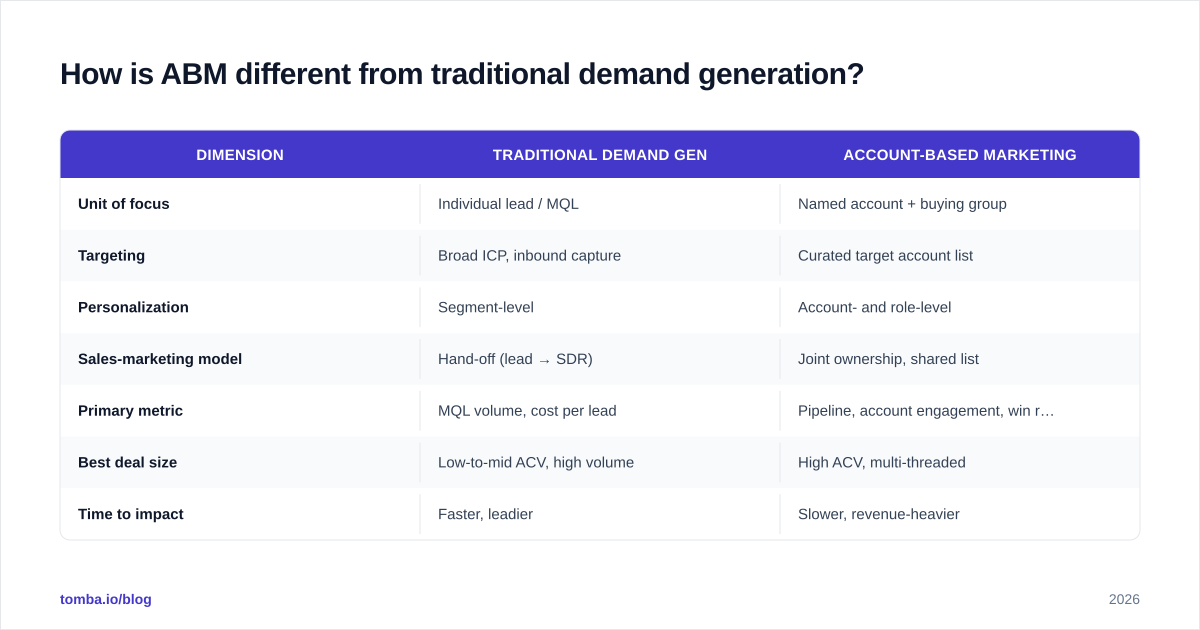
The clearest way to see the difference is side by side. Demand gen and ABM are not enemies — most teams run both — but they answer different questions and they're measured differently.
| Dimension | Traditional demand gen | Account-based marketing |
|---|---|---|
| Unit of focus | Individual lead / MQL | Named account + buying group |
| Targeting | Broad ICP, inbound capture | Curated target account list |
| Personalization | Segment-level | Account- and role-level |
| Sales-marketing model | Hand-off (lead → SDR) | Joint ownership, shared list |
| Primary metric | MQL volume, cost per lead | Pipeline, account engagement, win rate |
| Best deal size | Low-to-mid ACV, high volume | High ACV, multi-threaded |
| Time to impact | Faster, leadier | Slower, revenue-heavier |
The strategic takeaway: if your average contract value is small and you win on volume, ABM overhead probably isn't worth it. If you sell five- or six-figure deals to a knowable list of companies, ABM is almost always the higher-leverage motion. Many teams blend the two — using inbound demand gen to surface interest and ABM to convert the accounts that matter.
Why does ABM work for B2B in 2026?#
Three shifts make ABM the default enterprise motion now rather than a niche tactic.
Buyers are anonymous longer. Most of the buying journey happens before anyone fills out a form. If you wait for the form, you've already lost the early-research window. Account-level signals — like surging research activity or website visitor reveal — let you act before the lead exists.
Data is good enough to personalize at scale. A decade ago, account-level personalization meant a human manually researching each company. Now data enrichment and intent feeds make it possible to tailor messaging to hundreds of accounts without hand-building each one.
Budgets reward efficiency. RevOps leaders are under pressure to show pipeline per dollar, not leads per dollar. ABM's concentration on fewer, higher-fit accounts maps directly to that mandate. HubSpot's research on ABM consistently shows higher deal velocity and contract values when sales and marketing align around a shared account list.
What does an ABM framework look like?#
A repeatable ABM program runs in five stages. The diagram below maps the full loop; the stages are explained underneath.
- Define the ICP and tier the list. Not all target accounts deserve equal effort. Most teams split into three tiers (see the next section).
- Build the account and contact data. For each account, you need the buying group: names, roles, verified emails, and phone numbers. This is where contact discovery lives.
- Orchestrate plays. Coordinate ads, email, SDR outreach, and content so a target account sees a consistent, role-relevant story across channels.
- Engage and route. When an account shows engagement, route it to the right rep with full context — no cold hand-offs.
- Measure and recycle. Track account progression, feed learnings back into tiering, and re-target accounts that stalled.
The process is a loop, not a line. Accounts move up and down tiers as signals change, and the measurement stage feeds directly back into selection.
How should you tier ABM accounts?#
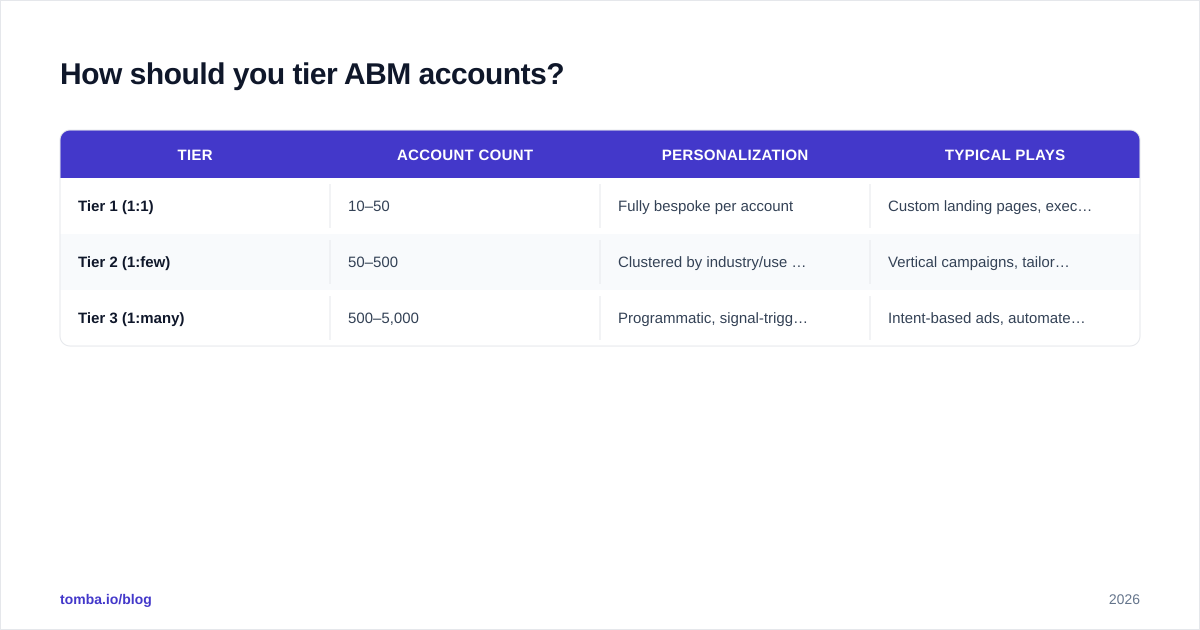
Tiering is how you spend effort proportional to opportunity. The standard three-tier model:
| Tier | Account count | Personalization | Typical plays |
|---|---|---|---|
| Tier 1 (1:1) | 10–50 | Fully bespoke per account | Custom landing pages, exec gifting, dedicated SDR + AE |
| Tier 2 (1:few) | 50–500 | Clustered by industry/use case | Vertical campaigns, tailored content, targeted ads |
| Tier 3 (1:many) | 500–5,000 | Programmatic, signal-triggered | Intent-based ads, automated sequences, retargeting |
The mistake most first-time ABM teams make is treating every account like Tier 1. You don't have the resources, and most accounts don't warrant it. Start with a tight Tier 1, prove the motion, then layer in Tier 2 and 3 as your data and automation mature.
What does the 2026 ABM tech stack look like?#
A functional ABM stack has three layers. You don't need a single all-in-one suite — most teams assemble best-of-breed tools that share data.
Layer 1 — Account selection & intent. Platforms like 6sense and Demandbase score accounts on fit and surface buying signals. This tells you which accounts to work and when.
Layer 2 — Data & contact discovery. Once you know the account, you need the people inside it: verified emails, direct phone numbers, and enriched firmographics. This is the layer that turns "we should target Acme Corp" into "here are the seven stakeholders and how to reach them." A B2B database plus a domain-level lookup does the heavy lifting here.
Layer 3 — Activation. Ads (LinkedIn, programmatic), email sequencing, SDR cadences, and a CRM to tie it together. This is where the orchestration happens.
The layer teams most often under-invest in is Layer 2. You can buy the fanciest intent platform on the market, but if you can't reliably reach the buying group with accurate contact data, the signals die on the vine. Pair your intent tool with a domain search workflow so that the moment an account surges, you already have verified contacts ready to action.
How do you find and reach the buying group?#
This is the operational core of ABM, and it's where most programs quietly leak. Knowing you want to win Acme Corp is useless until you have verified ways to reach the CFO, the VP of Ops, and the three managers who'll actually use your product.
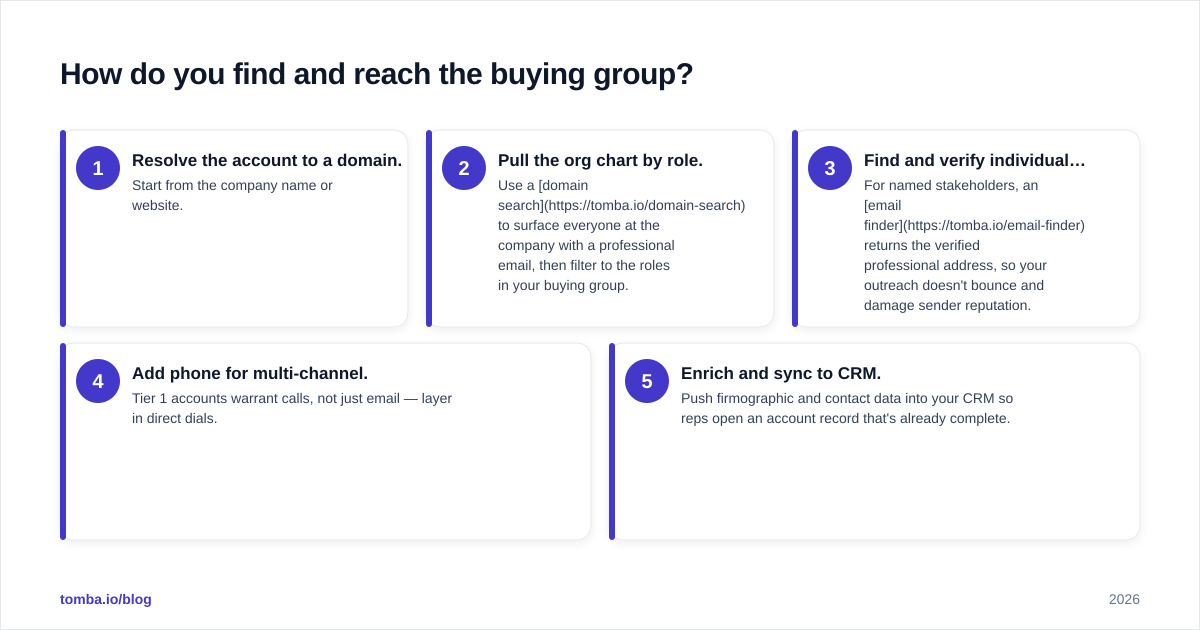
A practical workflow:
- Resolve the account to a domain. Start from the company name or website.
- Pull the org chart by role. Use a domain search to surface everyone at the company with a professional email, then filter to the roles in your buying group.
- Find and verify individual contacts. For named stakeholders, an email finder returns the verified professional address, so your outreach doesn't bounce and damage sender reputation.
- Add phone for multi-channel. Tier 1 accounts warrant calls, not just email — layer in direct dials.
- Enrich and sync to CRM. Push firmographic and contact data into your CRM so reps open an account record that's already complete.
Accuracy matters more in ABM than in volume plays. When you only have 50 Tier 1 accounts, a 30% bounce rate isn't a deliverability nuisance — it's a third of your strategy gone. That's why verified-first contact data is non-negotiable for account-based work.
How do you measure ABM success?#
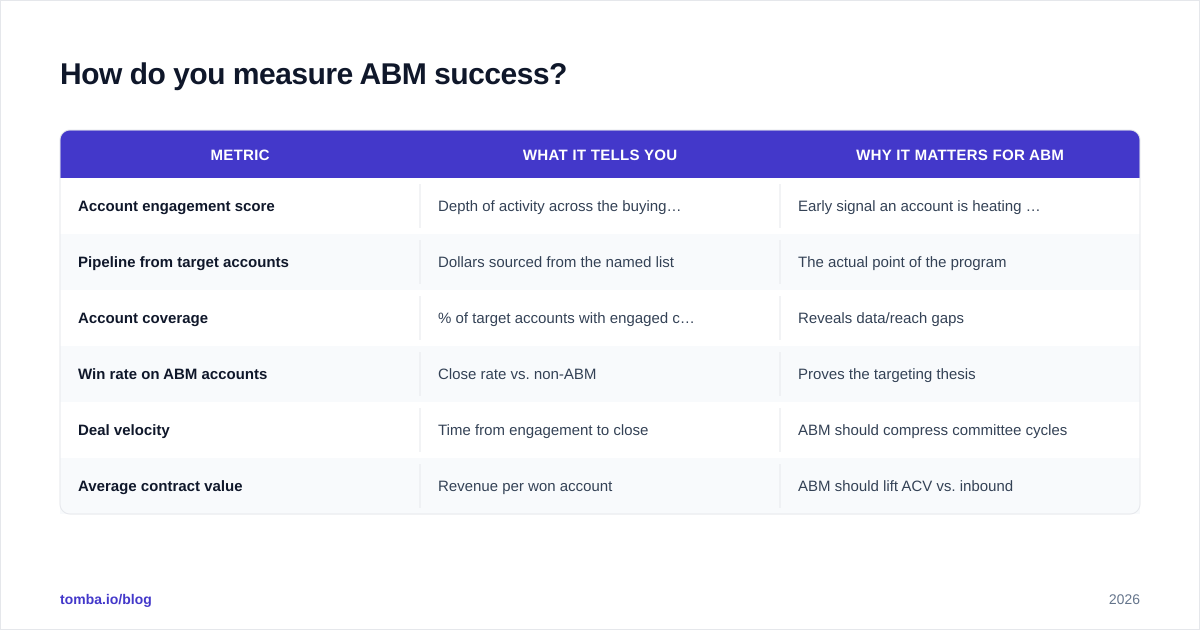
ABM breaks traditional marketing dashboards, because the whole strategy is built on fewer leads. If you grade an ABM program on MQL volume, it will look like a failure even when it's printing pipeline. Measure these instead:
| Metric | What it tells you | Why it matters for ABM |
|---|---|---|
| Account engagement score | Depth of activity across the buying group | Early signal an account is heating up |
| Pipeline from target accounts | Dollars sourced from the named list | The actual point of the program |
| Account coverage | % of target accounts with engaged contacts | Reveals data/reach gaps |
| Win rate on ABM accounts | Close rate vs. non-ABM | Proves the targeting thesis |
| Deal velocity | Time from engagement to close | ABM should compress committee cycles |
| Average contract value | Revenue per won account | ABM should lift ACV vs. inbound |
Run these against a control group of non-ABM accounts wherever you can. The comparison is what convinces a CFO. According to peer reviews on G2's ABM category, the teams that report the strongest ROI are the ones tracking pipeline and influenced revenue from day one — not the ones counting clicks.
What are common ABM mistakes to avoid?#
- Boiling the ocean. Picking 2,000 "target" accounts is just demand gen with extra steps. Start narrow.
- Sales and marketing running separate lists. If the two teams aren't working the same account list with shared definitions, it isn't ABM. Co-own the list.
- Personalization theater. Dropping
{FirstName}into a generic email isn't account personalization. Reference the account's actual situation or don't bother. - Ignoring data hygiene. Stale, unverified contacts quietly kill ABM. Re-verify before every major push.
- Measuring on lead volume. Already covered, but it's the most common reason good ABM programs get killed by leadership before they mature.
Is ABM worth it for smaller teams?#
Yes — arguably more so, because small teams can't afford to waste motion. You don't need an enterprise suite to start. A lean ABM stack can be as simple as a spreadsheet of 30 Tier 1 accounts, an intent signal you already have (website visitors, demo requests), reliable contact data, and a disciplined SDR cadence. The strategy scales down to a single founder doing 1:1 outreach to a hand-picked list just as well as it scales up to a 50-person GTM org.
The constraint that actually limits small teams isn't tooling budget — it's contact accuracy and time. Both are solved by feeding your account list through a verified contact source rather than guessing email formats by hand.
Where does Tomba fit in your ABM stack?#
ABM lives or dies on Layer 2: turning a target account into reachable, verified people. That's exactly what the Tomba Email Finder is built for. Drop in a company domain and get the verified professional emails of the buying group, run a domain search to map an entire org by role, and enrich those records straight into your CRM — so the moment an account surges, your reps open a complete, accurate contact record instead of a name and a guess.
You can start free with 25 searches a month and scale into Starter at $49/mo or Growth at $99/mo as your target list grows; see full Tomba pricing for team plans. Pick the accounts that matter, find the people who decide, and reach them with data you can trust. That's ABM that actually closes.
Ready to find emails that actually work?
Join 150,000+ professionals who stopped guessing and started sending. Free credits on signup — no credit card required.
Get the Tomba newsletter
Practical outbound tactics and product updates — once every two weeks.
About the author