AI SDR in 2026: What It Is and the Best Tools to Use
AI SDRs promise to automate prospecting, research, and outreach end to end. Here's what they actually do in 2026, where they break, and how to deploy one without torching your domain.
TL;DR
- An AI SDR is software that runs the top-of-funnel sales development job — list building, research, personalization, and multi-step outreach — with little human input. It is not a person, and it is not magic.
- The category split into two camps in 2026: fully autonomous "AI rep" platforms (Artisan, 11x, AiSDR) and AI-assisted human workflows (Apollo, Outreach, Clay). Most teams get more value from the second.
- The bottleneck is almost never the AI copy. It's data quality and deliverability — bad emails and burned domains kill an AI SDR faster than any prompt.
- Expect to pay $0.50–$2.00 per researched, contactable lead once you stack data, verification, and sending costs. "Unlimited" plans hide those costs downstream.
- Feed any AI SDR verified contact data from a dedicated source like the Tomba Email Finder, keep bounce rates under 2%, and treat the AI as a force multiplier — not a replacement for judgment.
What is an AI SDR?#
An AI SDR is a tool that automates the work a sales development representative normally does by hand: finding accounts that fit your profile, identifying the right contacts, researching each one, writing a personalized first touch, and managing the follow-up sequence until someone replies or books a meeting.
Think of it like a self-driving car for the top of your funnel. A human still sets the destination — your ideal customer profile, your offer, your guardrails — and a human still has to grab the wheel when something unexpected happens. But the routine driving between waypoints runs on its own. The marketing claims you a "digital employee"; the reality is closer to a very fast junior rep that never gets bored of research but also never uses common sense unless you build it in.
Technically, an AI SDR chains together several capabilities that used to live in separate tools: account selection (firmographic and intent signals), contact discovery (name → email → phone), enrichment, an LLM for personalization, and a sending engine with sequencing logic. The whole point is that these run as one loop instead of five disconnected steps.
What does an AI SDR actually do?#
Break the job into stages, because no tool does all of them equally well:
- Targeting — pulls accounts matching your ICP from a database or intent provider, then picks contacts by title and seniority.
- Research — scrapes the company site, LinkedIn, recent news, and tech stack to find an angle worth opening with.
- Contact discovery — resolves a verified work email and, increasingly, a mobile number. This is where most AI SDRs quietly fail; see the accuracy section below.
- Personalization — an LLM writes the opener and the body, ideally tied to a real signal rather than "I saw you work at {{company}}."
- Sending and sequencing — schedules the email, spaces follow-ups, rotates inboxes, and pauses on reply.
- Triage — classifies replies (interested, not now, unsubscribe, out of office) and routes hot ones to a human.
The gap between a demo and production almost always sits in stages 3 and 5. A polished AI opener sent to a guessed, unverified address that lands in spam is worse than no email at all — it costs you domain reputation.
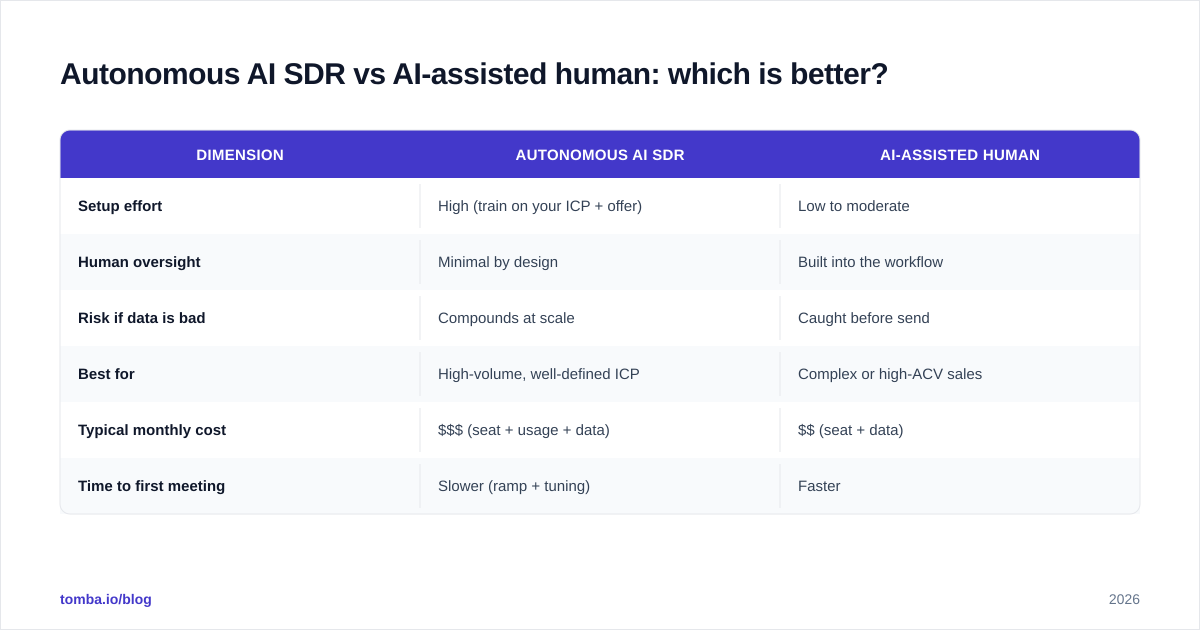
Autonomous AI SDR vs AI-assisted human: which is better?#
Short answer: for most B2B teams in 2026, AI-assisted beats fully autonomous — until your data and deliverability are airtight.
A fully autonomous AI SDR is attractive because it promises to remove headcount. But it also removes the human checks that catch a tortured personalization line, a misfired sequence, or a list full of catch-all domains. When the loop runs end to end without supervision, a single bad input compounds across thousands of sends.
AI-assisted tools keep a person in the loop at the highest-leverage step — usually list approval and message review — while automating the grind. You lose a little speed and gain a lot of control. As your process matures, you hand more of the loop to the machine.
| Dimension | Autonomous AI SDR | AI-assisted human |
|---|---|---|
| Setup effort | High (train on your ICP + offer) | Low to moderate |
| Human oversight | Minimal by design | Built into the workflow |
| Risk if data is bad | Compounds at scale | Caught before send |
| Best for | High-volume, well-defined ICP | Complex or high-ACV sales |
| Typical monthly cost | $$$ (seat + usage + data) | $$ (seat + data) |
| Time to first meeting | Slower (ramp + tuning) | Faster |
If you sell a six-figure product to a narrow list of accounts, full autonomy is the wrong tool — the personalization and timing matter too much. If you run high-volume outbound into a broad, well-understood market, autonomy can pay off once you've proven the data pipeline.
What are the best AI SDR tools in 2026?#
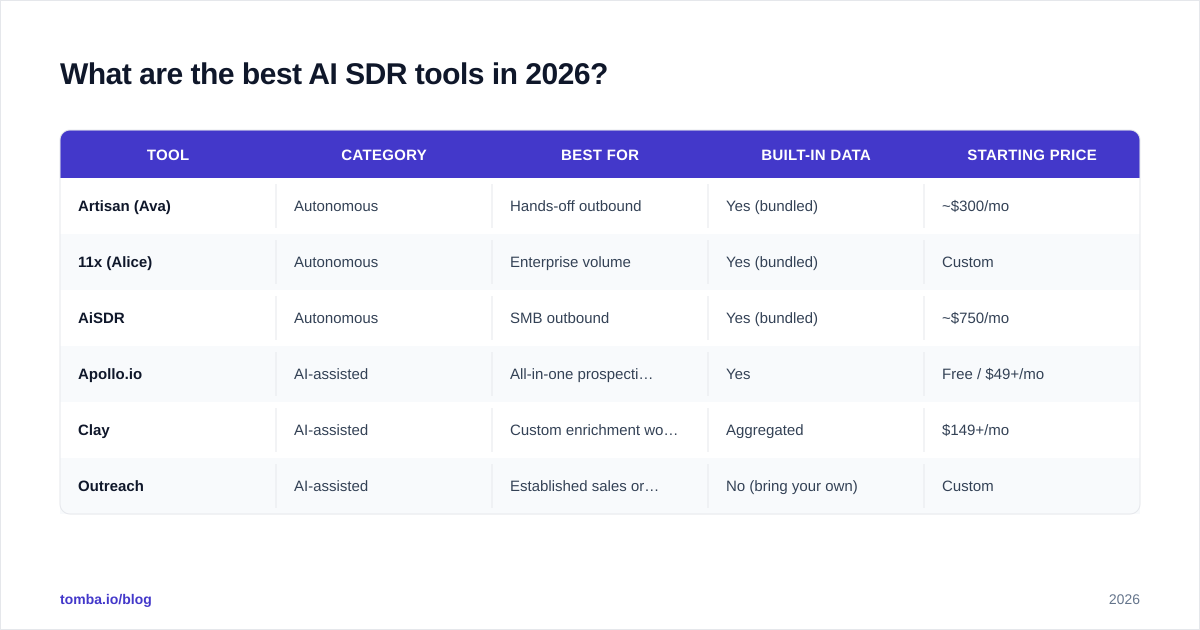
There's no single winner — the right pick depends on whether you want a full digital rep or an AI layer on top of a workflow you already trust. Here's how the main options compare on the attributes that actually decide outcomes.
| Tool | Category | Best for | Built-in data | Starting price |
|---|---|---|---|---|
| Artisan (Ava) | Autonomous | Hands-off outbound | Yes (bundled) | ~$300/mo |
| 11x (Alice) | Autonomous | Enterprise volume | Yes (bundled) | Custom |
| AiSDR | Autonomous | SMB outbound | Yes (bundled) | ~$750/mo |
| Apollo.io | AI-assisted | All-in-one prospecting | Yes | Free / $49+/mo |
| Clay | AI-assisted | Custom enrichment workflows | Aggregated | $149+/mo |
| Outreach | AI-assisted | Established sales orgs | No (bring your own) | Custom |
A pattern worth noting: the autonomous platforms bundle their own contact data, which is convenient but opaque — you rarely know the verification standard, and accuracy varies by region and seniority. The assisted tools let you bring your own verified data, which is why teams that care about bounce rates often pair them with a dedicated email verifier and a bulk email finder rather than trusting a single bundled source.
For a deeper look at where these tools sit against pure prospecting platforms, see how the major Apollo alternatives stack up — the data layer is usually the real differentiator, not the AI.
How accurate is the data behind an AI SDR?#
This is the question that decides whether your AI SDR earns its cost. The best-written email in the world bounces if the address is wrong.
Most autonomous AI SDRs source contact data from a bundled database and "verify" it with a quick SMTP ping. That catches obvious failures but misses two big categories: catch-all domains (which accept everything and tell you nothing) and stale records (a real address for someone who left 14 months ago). Both inflate your bounce rate and quietly degrade sender reputation.
A practical standard for 2026: keep your hard-bounce rate under 2%. To hit that, treat verification as a separate, deliberate step rather than a checkbox inside the AI SDR:
- Resolve emails from a source that publishes its data sources and confidence scoring.
- Run every address through a real email verification pass, not just a syntax check.
- Handle catch-all domains explicitly with a catch-all verifier instead of guessing.
- Re-verify any list older than 90 days before a fresh campaign.
Independent reviews on G2 consistently show that bundled-data accuracy is the most common complaint about autonomous AI SDR platforms — not the AI copy. Fix the data and most "the AI SDR didn't work" stories disappear.
Will an AI SDR hurt my email deliverability?#
It can, badly, if you let it run unmanaged — and this is the failure mode nobody puts in the sales deck.
An AI SDR can generate thousands of personalized emails a day. That volume is exactly what spam filters watch for. Without controls, you'll see your domain reputation slide within weeks. The fix is the same discipline good human teams already use, just enforced at machine speed:
- Warm up every sending inbox before volume ramps, and keep dedicated sending domains separate from your primary domain.
- Authenticate properly — a valid SPF record, DKIM, and DMARC are non-negotiable. Google and Yahoo enforce them.
- Cap daily volume per inbox (40–50 cold sends is a safe ceiling) and let the AI SDR rotate across inboxes rather than blasting from one.
- Verify before you send. Bounces are the single fastest way to get filtered.
For the underlying mechanics, the HubSpot guide to email deliverability is a solid primer, and our own breakdown of email deliverability covers the metrics to watch. The headline: an AI SDR amplifies whatever your sending hygiene already is. Good hygiene scales into more meetings; bad hygiene scales into a blocked domain.
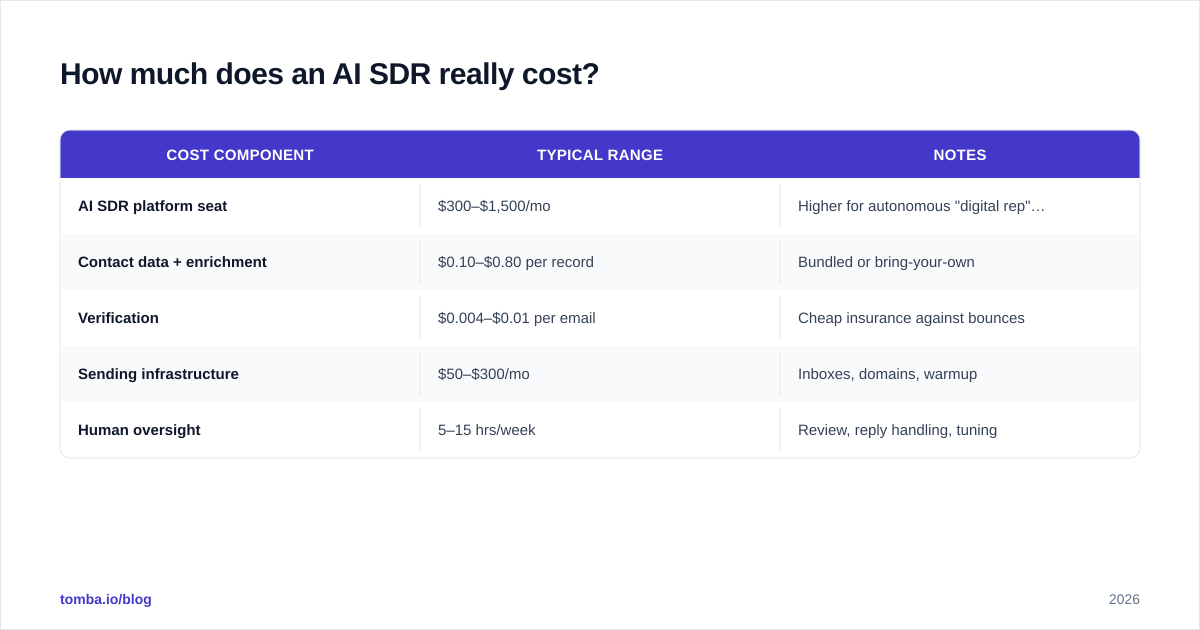
How much does an AI SDR really cost?#
The sticker price is the smallest part. Budget for the full stack, because "unlimited sending" plans push the real costs downstream onto your data and domains.
| Cost component | Typical range | Notes |
|---|---|---|
| AI SDR platform seat | $300–$1,500/mo | Higher for autonomous "digital rep" tools |
| Contact data + enrichment | $0.10–$0.80 per record | Bundled or bring-your-own |
| Verification | $0.004–$0.01 per email | Cheap insurance against bounces |
| Sending infrastructure | $50–$300/mo | Inboxes, domains, warmup |
| Human oversight | 5–15 hrs/week | Review, reply handling, tuning |
All in, a realistic blended cost lands around $0.50 to $2.00 per researched, contactable, sent-to lead. When a vendor quotes a flat per-month number with "unlimited" anything, find out where the data comes from and what the verification standard is — that's where the hidden cost lives. You can sanity-check the data side against transparent Tomba pricing: a Starter plan is $49/mo and the free tier gives you 25 searches to test accuracy before committing.
How do I deploy an AI SDR without it backfiring?#
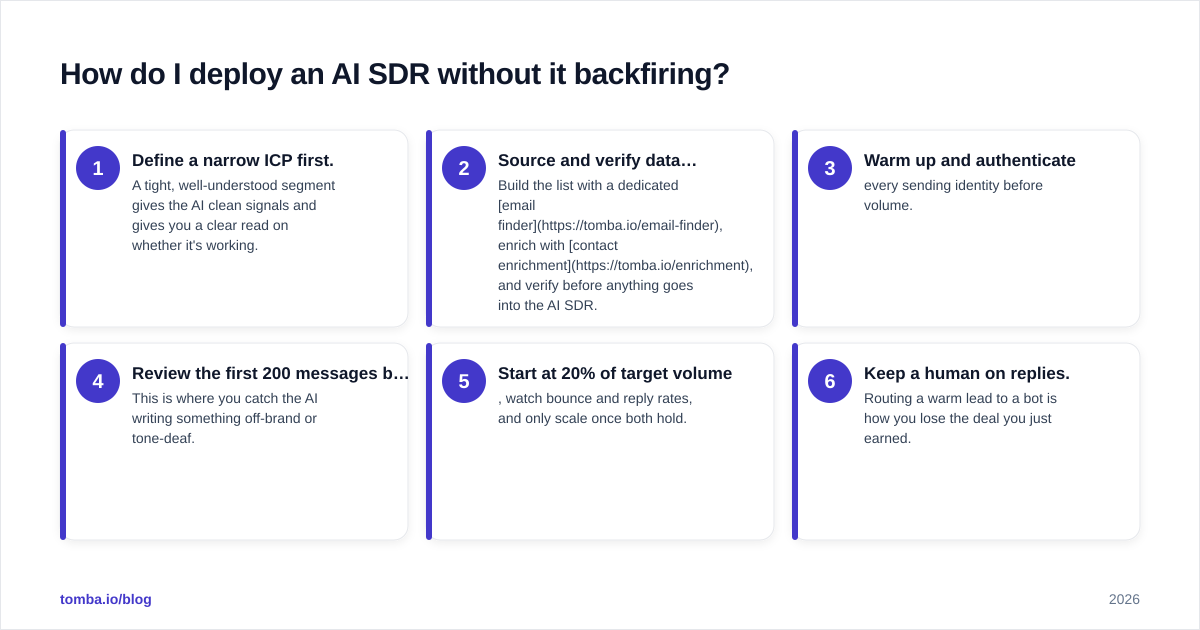
Run it like a pilot, not a switch you flip. A staged rollout catches the data and deliverability problems while they're cheap to fix.
- Define a narrow ICP first. A tight, well-understood segment gives the AI clean signals and gives you a clear read on whether it's working.
- Source and verify data separately. Build the list with a dedicated email finder, enrich with contact enrichment, and verify before anything goes into the AI SDR.
- Warm up and authenticate every sending identity before volume.
- Review the first 200 messages by hand. This is where you catch the AI writing something off-brand or tone-deaf.
- Start at 20% of target volume, watch bounce and reply rates, and only scale once both hold.
- Keep a human on replies. Routing a warm lead to a bot is how you lose the deal you just earned.
The teams that win with AI SDRs in 2026 aren't the ones who removed humans fastest. They're the ones who automated the grind, kept judgment in the loop, and obsessed over data quality.
The bottom line#
An AI SDR is a genuine productivity unlock — but only on top of clean, verified data and a healthy sending setup. The AI writes the email; your data decides whether it lands. Get the foundation right and an AI SDR turns one rep's output into a team's. Get it wrong and you've automated your way into a blocked domain.
Start with the part every AI SDR depends on and most get wrong: accurate, verified contact data. Use the Tomba Email Finder to source emails by name, domain, or company, verify them before they ever reach your sequencer, and feed your AI SDR a list that actually converts. Try it free with 25 searches, then scale on a plan that fits your volume — and let the AI do the grinding while your data does the winning.
// get started
Find, verify and enrich your first contacts today
Start on the free plan with 25 searches a month, then scale when your team is ready.
Free plan · No credit card required · GDPR & CCPA
// about the author