B2B Data Enrichment in 2026: The Complete Strategy Guide
What B2B data enrichment is, how it works, the metrics that matter, and how to build an enrichment stack that actually lifts pipeline in 2026.
B2B data enrichment is the process of taking a thin record — an email, a domain, a LinkedIn URL — and filling in the missing fields that make it sellable: job title, company size, tech stack, phone number, funding, and intent. Done right, it is the difference between a list and a pipeline. Done wrong, it is an expensive way to email the wrong people.
This guide breaks down how enrichment actually works in 2026, what to measure, when to build versus buy, and how to assemble a stack that keeps your CRM clean without burning your budget.
TL;DR#
- B2B data enrichment appends missing firmographic, contact, and behavioral fields to records you already have, so reps spend time selling instead of researching.
- Accuracy and freshness matter more than database size — a 200M-contact database that is 30% stale is worse than a smaller, recently verified one.
- The three enrichment types — firmographic, contact, and intent — solve different problems; most teams need a blend.
- Build-vs-buy comes down to volume and engineering bandwidth: APIs win for scale and automation, manual tools win for low volume.
- A good enrichment workflow is continuous, not a one-time scrub: enrich on entry, re-verify on a schedule, and suppress what bounces.
What is B2B data enrichment?#
Think of a lead record like a job application with most of the boxes left blank. You know the candidate's name and email, but not their title, their company, how big it is, or whether they are even still employed there. Enrichment is the background check that fills those boxes in — automatically, at scale, and ideally before a rep ever opens the record.
Technically, B2B data enrichment matches an input identifier (email, domain, name + company, or LinkedIn URL) against one or more data sources, then appends verified attributes back onto the record. Those attributes usually fall into three buckets:
- Firmographic — company name, domain, industry, employee count, revenue, HQ location, funding stage.
- Contact / demographic — verified email, direct-dial phone, job title, seniority, department, social profiles.
- Behavioral / intent — technologies in use, hiring signals, recent funding, and topic-level buying intent.
The goal is not to collect data for its own sake. It is to give every go-to-market motion — routing, scoring, personalization, territory planning — the fields it needs to run automatically.
Why does data enrichment matter for revenue?#
Conclusion first: bad data quietly taxes every downstream metric, and enrichment is the cheapest place to fix it.
Industry research has long pegged B2B data decay at roughly 25–30% per year — people change jobs, companies rebrand, domains get acquired. Gartner and other analysts have repeatedly tied poor data quality to material losses in productivity and revenue. The mechanics are simple:
- Routing breaks when company size or industry is missing, so leads sit unassigned.
- Scoring lies when seniority and department fields are blank, so reps chase low-fit accounts.
- Personalization dies when you do not know a prospect's role or tech stack, so emails read as spam.
- Deliverability suffers when you mail unverified addresses, dragging down your sender reputation and inbox placement.
Enrichment attacks all four at once. When a record enters your CRM already carrying a verified email, a confirmed title, and firmographics, automation can route it, score it, and sequence it without human cleanup. That is why enrichment sits upstream of nearly every revenue operations workflow.
What are the types of B2B data enrichment?#
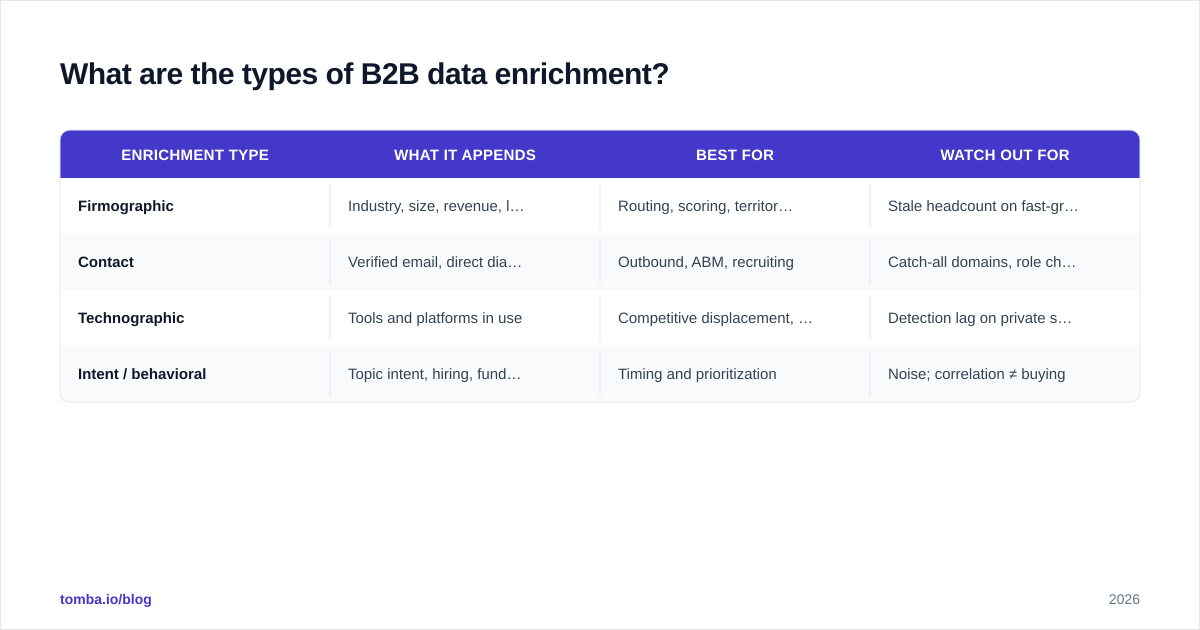
Not all enrichment solves the same problem. Match the type to the job.
| Enrichment type | What it appends | Best for | Watch out for |
|---|---|---|---|
| Firmographic | Industry, size, revenue, location, funding | Routing, scoring, territory design | Stale headcount on fast-growing firms |
| Contact | Verified email, direct dial, title, seniority | Outbound, ABM, recruiting | Catch-all domains, role changes |
| Technographic | Tools and platforms in use | Competitive displacement, fit scoring | Detection lag on private stacks |
| Intent / behavioral | Topic intent, hiring, funding signals | Timing and prioritization | Noise; correlation ≠ buying |
Most teams over-invest in one bucket and ignore the rest. A common failure mode: buying expensive intent data while half your contact records still bounce. Fix the foundation — verified contact and firmographic data — before layering signals on top.
How accurate is B2B data enrichment, really?#
Accuracy is the only enrichment metric that compounds. A field that is wrong is worse than a field that is empty, because automation trusts it.
Three numbers to demand from any provider:
- Match rate — of the records you submit, how many get enriched at all. Higher is not automatically better; a vendor that "matches" everything is probably guessing.
- Accuracy rate — of the fields returned, how many are correct. This is what protects deliverability and rep trust.
- Freshness — how recently the data was verified. A correct title from 2023 may be wrong today.
The honest way to evaluate this is a blind sample: take 200 records you can independently verify, run them through each vendor, and score the output yourself. Vendor-published accuracy claims are marketing until you reproduce them on your own data. For contact data specifically, pair enrichment with an email verifier so every appended address is SMTP-checked before it reaches a sequence, and use a catch-all verifier for domains that accept everything.
Should you build or buy your enrichment stack?#
Conclusion first: buy the data, build the orchestration. Almost no B2B team should be assembling raw data sources from scratch in 2026 — but you absolutely should own the workflow that decides when and how enrichment fires.
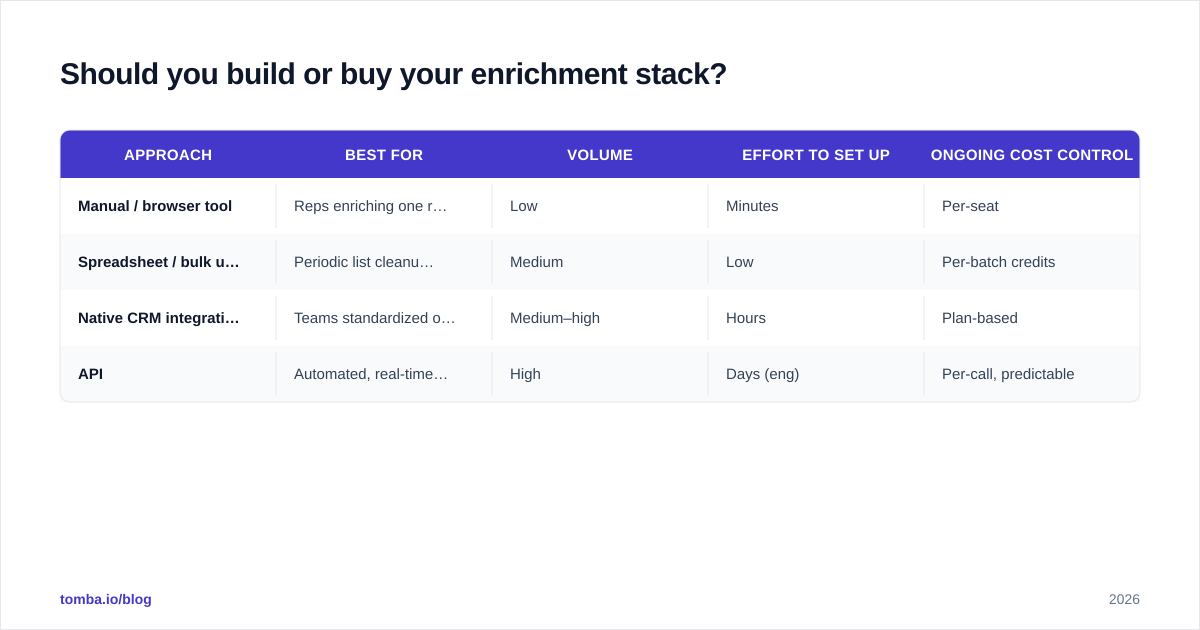
The real decision is how you consume vendor data: manual tools, native CRM integrations, or API.
| Approach | Best for | Volume | Effort to set up | Ongoing cost control |
|---|---|---|---|---|
| Manual / browser tool | Reps enriching one record at a time | Low | Minutes | Per-seat |
| Spreadsheet / bulk upload | Periodic list cleanups | Medium | Low | Per-batch credits |
| Native CRM integration | Teams standardized on one CRM | Medium–high | Hours | Plan-based |
| API | Automated, real-time enrichment at scale | High | Days (eng) | Per-call, predictable |
If your volume is low and sporadic, a Chrome extension or a Google Sheets add-on is plenty. As volume grows, push enrichment to the boundary — enrich the moment a record is created — which means an email finder API firing inside your signup flow, form handler, or CRM automation. The API path costs engineering time once and saves manual effort forever.
A middle ground that works for most mid-market teams: native integrations with HubSpot, Salesforce, or Pipedrive for day-to-day records, plus a bulk email finder for periodic backfills of historical data.
How do you choose a B2B data enrichment vendor?#
Score vendors on the dimensions that survive contact with real data, not the dimensions on their pricing page.
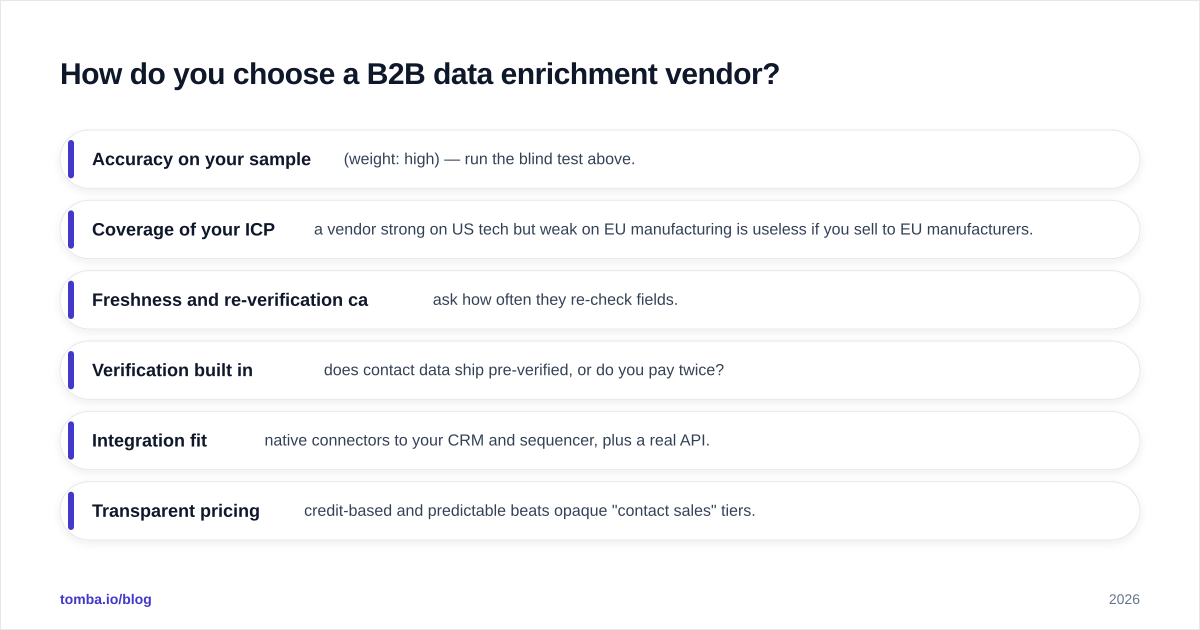
A practical scorecard:
- Accuracy on your sample (weight: high) — run the blind test above.
- Coverage of your ICP — a vendor strong on US tech but weak on EU manufacturing is useless if you sell to EU manufacturers.
- Freshness and re-verification cadence — ask how often they re-check fields.
- Verification built in — does contact data ship pre-verified, or do you pay twice?
- Integration fit — native connectors to your CRM and sequencer, plus a real API.
- Transparent pricing — credit-based and predictable beats opaque "contact sales" tiers.
- Compliance — GDPR/CCPA posture and clear data sourcing.
When you compare named tools, weigh them against this list rather than database headcount. Public review platforms like G2 and Capterra are useful for spotting recurring complaints — especially around match-rate inflation and surprise billing — but treat star ratings as a starting point, not a verdict.
Where Tomba fits: it pairs an email finder and verifier with domain search, phone finder, and data enrichment under one credit pool, with transparent plans starting at a Free tier (25 searches/month) and a $49/month Starter — so contact data arrives already verified instead of needing a second tool.
What does a good enrichment workflow look like?#
The biggest mistake teams make is treating enrichment as a one-time project — a quarterly "data scrub" — instead of a continuous system. Data decays daily; your enrichment should run daily too.
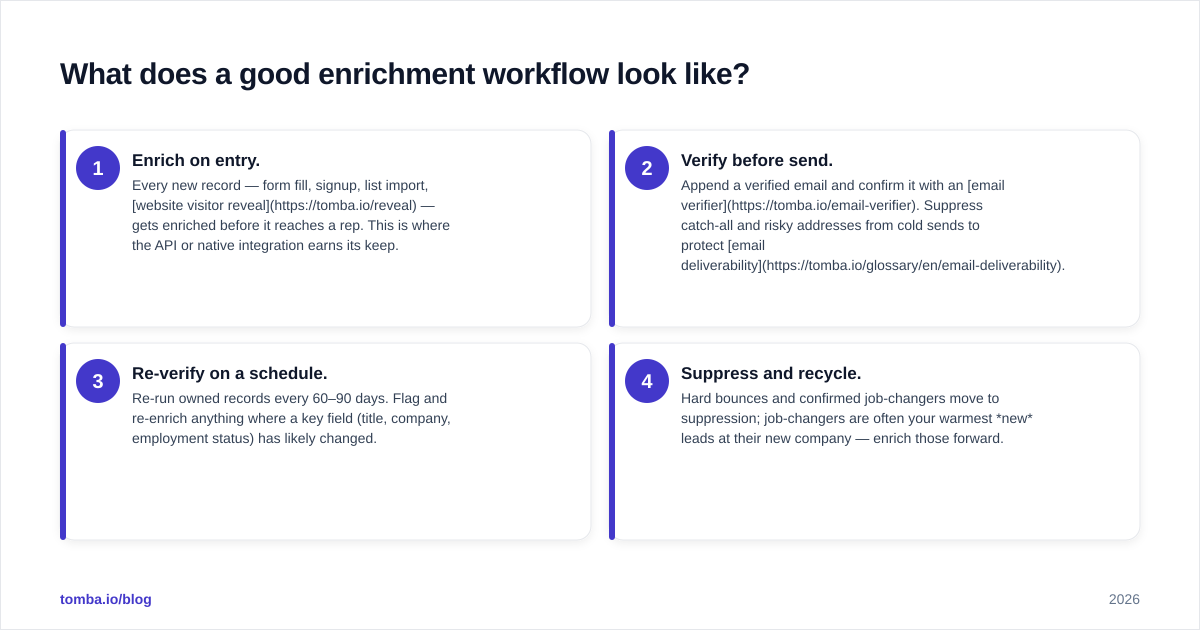
A durable workflow has four stages:
- Enrich on entry. Every new record — form fill, signup, list import, website visitor reveal — gets enriched before it reaches a rep. This is where the API or native integration earns its keep.
- Verify before send. Append a verified email and confirm it with an email verifier. Suppress catch-all and risky addresses from cold sends to protect email deliverability.
- Re-verify on a schedule. Re-run owned records every 60–90 days. Flag and re-enrich anything where a key field (title, company, employment status) has likely changed.
- Suppress and recycle. Hard bounces and confirmed job-changers move to suppression; job-changers are often your warmest new leads at their new company — enrich those forward.
This loop turns enrichment from a cost center into a compounding asset: your database gets cleaner and more valuable over time instead of decaying toward noise. Tie it to your lead scoring model so freshly enriched, high-fit records jump the queue.
How do you measure enrichment ROI?#
Conclusion first: measure enrichment by what it unlocks downstream, not by fields appended.
Track these before-and-after:
- Bounce rate on cold sends — should drop sharply once contact data is verified at entry.
- Connect / reply rate — better titles and direct dials lift conversation rates.
- Time-to-first-touch — automated routing on enriched firmographics shortens it.
- Coverage of required fields — percentage of records with a complete, sellable profile.
- Cost per qualified record — total enrichment spend divided by records that became sales-accepted.
If enrichment is not moving at least one of the first three, you are enriching the wrong fields or trusting the wrong vendor. A quick gut check: if reps still spend the first five minutes of every call Googling the prospect, your enrichment is not doing its job.
Common enrichment pitfalls to avoid#
- Chasing database size. A bigger raw database does not mean better matches for your ICP. Coverage of your segment is what matters.
- Skipping verification. Enriched-but-unverified email is a deliverability landmine. Always verify contact data before it sequences.
- One-and-done scrubs. Without continuous re-verification, a clean database is dirty again within a year.
- Over-buying intent. Intent data is powerful only once your contact and firmographic foundation is solid. Fix the base first.
- Ignoring compliance. Know where your vendor sources data and whether it holds up under GDPR/CCPA. Cheap data with murky provenance is a liability, not a bargain.
- No suppression loop. If bounces and job-changers do not flow back into suppression, you keep paying to email dead addresses.
Frequently asked questions#
What is the difference between data enrichment and data cleansing? Cleansing fixes what is already there — deduping, standardizing formats, correcting typos. Enrichment adds what is missing — new fields from external sources. Most teams need both: cleanse first so matching works, then enrich.
How often should I re-enrich my CRM? Owned, actively worked records every 60–90 days; the broader database at least twice a year. High-velocity segments (startups, fast-hiring teams) decay faster and warrant tighter cadence.
Can I enrich data for free? For low volume, yes — Tomba's Free tier covers 25 searches a month, and free utilities like an email checker or company email pattern tool handle one-off lookups. At scale, a paid plan or API is more economical than the manual time spent.
Does enrichment hurt email deliverability? The opposite — unverified data hurts deliverability. Enrichment that includes SMTP verification reduces bounces and protects your sender reputation, provided you suppress catch-all and risky addresses from cold campaigns.
Build a cleaner pipeline with Tomba#
If your reps are still copy-pasting from LinkedIn and your sequences are bouncing, the fix is upstream. Start with the Tomba Email Finder: find verified professional emails by domain, name, or company, then enrich and verify in the same workflow so every record reaches your CRM sales-ready. Spin up the Free tier (25 searches/month), test it against your own ICP sample, and scale into a paid plan or the API once the accuracy proves out on your data — not on a vendor's slide.
Clean data is not a project you finish. It is a system you run. Build the loop once, and every downstream metric thanks you.
Ready to find emails that actually work?
Join 150,000+ professionals who stopped guessing and started sending. Free credits on signup — no credit card required.
Get the Tomba newsletter
Practical outbound tactics and product updates — once every two weeks.
About the author