B2B Intent Data in 2026: How to Find Buyers Ready to Buy
Intent data tells you which accounts are researching solutions like yours right now. Here's how B2B intent data works, what it costs, and how to act on it in 2026.
B2B Intent Data in 2026: How to Find Buyers Ready to Buy
Most of your total addressable market is not in-market today. Intent data is how you find the small slice that is — the accounts quietly reading review sites, comparing competitors, and building a shortlist before they ever fill out a form. Get this right and your reps stop dialing cold lists and start calling people who are already shopping.
TL;DR#
- Intent data identifies accounts (and sometimes individuals) actively researching products like yours, based on content consumption and behavioral signals.
- There are three core flavors: first-party (your own site/CRM), second-party (a partner's data, e.g. a review site), and third-party (aggregated publisher networks).
- The real value isn't the signal — it's the workflow: scoring, routing, enriching with contact data, and reaching out within the buying window.
- Pricing ranges from "free with your existing stack" (first-party) to $25k–$100k+/year for enterprise third-party platforms.
- Intent without accurate contact data and deliverability is just a list of company names. Pair signals with a reliable email finder to actually reach the buyer.
What is B2B intent data?#
B2B intent data is behavioral evidence that an account is researching a solution. Think of it like a bookstore that could see which customers keep returning to the same shelf, flipping through competing titles. You wouldn't wait for them to reach the register — you'd walk over and help. Intent data is that visibility, applied to the buying journey.
Technically, intent data is collected by tracking the topics and keywords that people at a given company consume across the web — articles, product pages, comparison guides, review sites — and surfacing a "surge" when consumption spikes above an account's baseline. The output is usually an account, a set of trending topics, and a score.
The reason it matters in 2026: buyers complete most of their research before talking to sales. Gartner's research on the B2B buying journey has long shown that buyers spend only a sliver of their time with any single sales rep. Intent data is how you get into the deal while the shortlist is still forming, not after it's locked.
What are the types of intent data?#
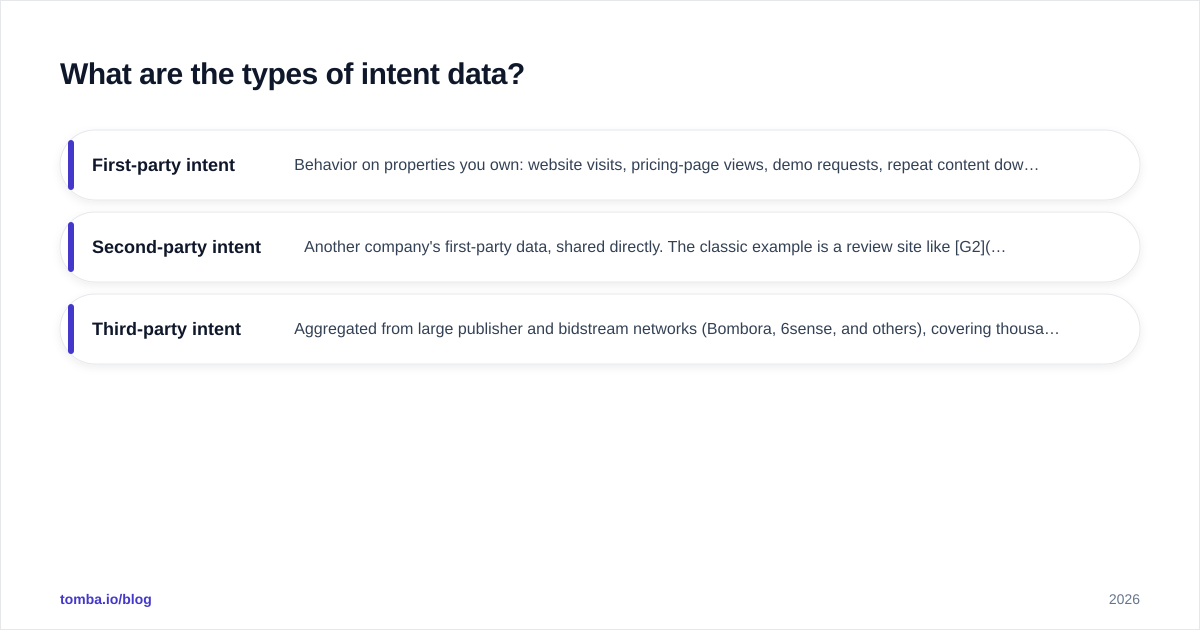
Not all signals are created equal. The closer the data is to your own domain, the more reliable — and the cheaper — it tends to be.
- First-party intent — Behavior on properties you own: website visits, pricing-page views, demo requests, repeat content downloads, and CRM activity. It's the highest-quality signal because it's about your product, and you already own it. The catch: most of this traffic is anonymous until you de-anonymize it.
- Second-party intent — Another company's first-party data, shared directly. The classic example is a review site like G2 telling you that someone from Acme Corp viewed your category page and your competitor's profile. High intent, narrow scope.
- Third-party intent — Aggregated from large publisher and bidstream networks (Bombora, 6sense, and others), covering thousands of B2B topics across millions of accounts. Broad reach, but noisier and account-level rather than person-level.
A serious program blends all three. First-party tells you who's already engaging; second-party tells you who's comparing you head-to-head; third-party widens the funnel to accounts you haven't touched yet.
How does intent data actually work?#
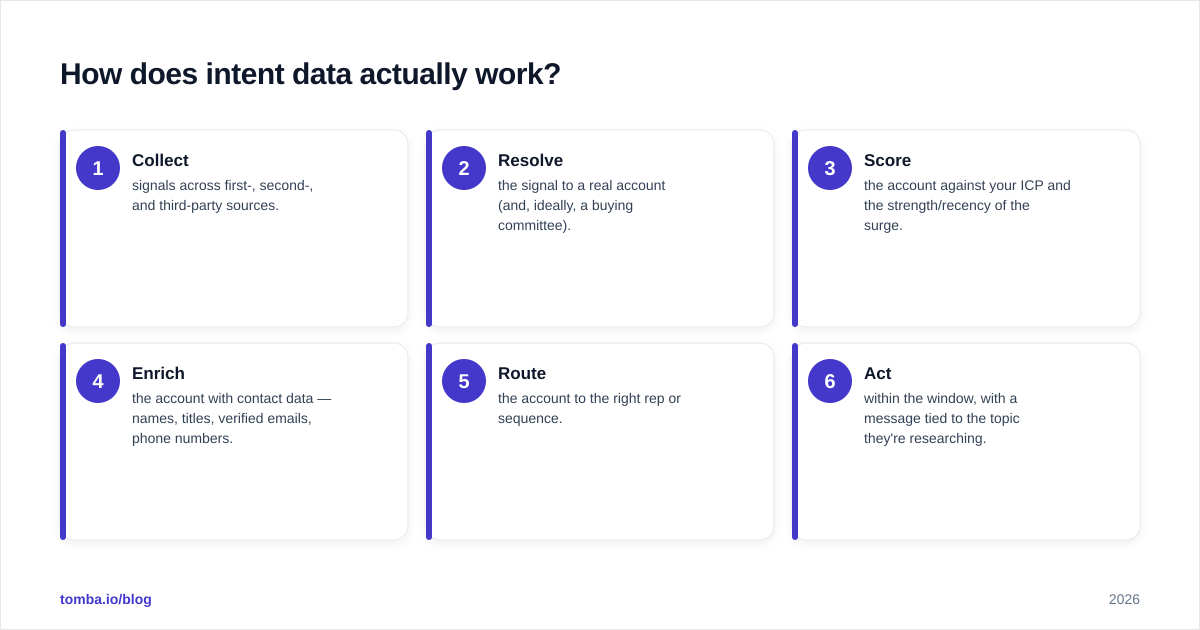
The signal is only the first step. The value is created downstream, in a repeatable loop:
- Collect signals across first-, second-, and third-party sources.
- Resolve the signal to a real account (and, ideally, a buying committee).
- Score the account against your ICP and the strength/recency of the surge.
- Enrich the account with contact data — names, titles, verified emails, phone numbers.
- Route the account to the right rep or sequence.
- Act within the window, with a message tied to the topic they're researching.
Steps 4 and 6 are where most programs leak. You can know that "Acme Corp is surging on email deliverability" and still do nothing useful if you can't identify the VP of Demand Gen and reach her inbox. That's why intent and contact data are two halves of the same machine — covered more below.
Which intent data platforms should you compare in 2026?#
The market splits into pure-play intent networks, ABM platforms with intent baked in, and sales-intelligence tools that bundle intent with contact data. Here's a concrete comparison of the categories you'll evaluate.
| Platform / category | Primary signal type | Best for | Contact data included | Typical pricing |
|---|---|---|---|---|
| Bombora | Third-party (topic surge) | Feeding intent into your existing stack | No | $25k–$40k/yr |
| 6sense | Third-party + predictive AI | Enterprise ABM orchestration | Add-on | $60k–$120k+/yr |
| G2 Buyer Intent | Second-party (review site) | Bottom-funnel, in-category buyers | No | $10k–$30k/yr |
| ZoomInfo / Apollo | Third-party + contact DB | All-in-one sales intelligence | Yes | $15k–$50k+/yr |
| First-party + Tomba | Your site + de-anon + enrichment | Lean teams acting on owned signals | Yes | From $49/mo |
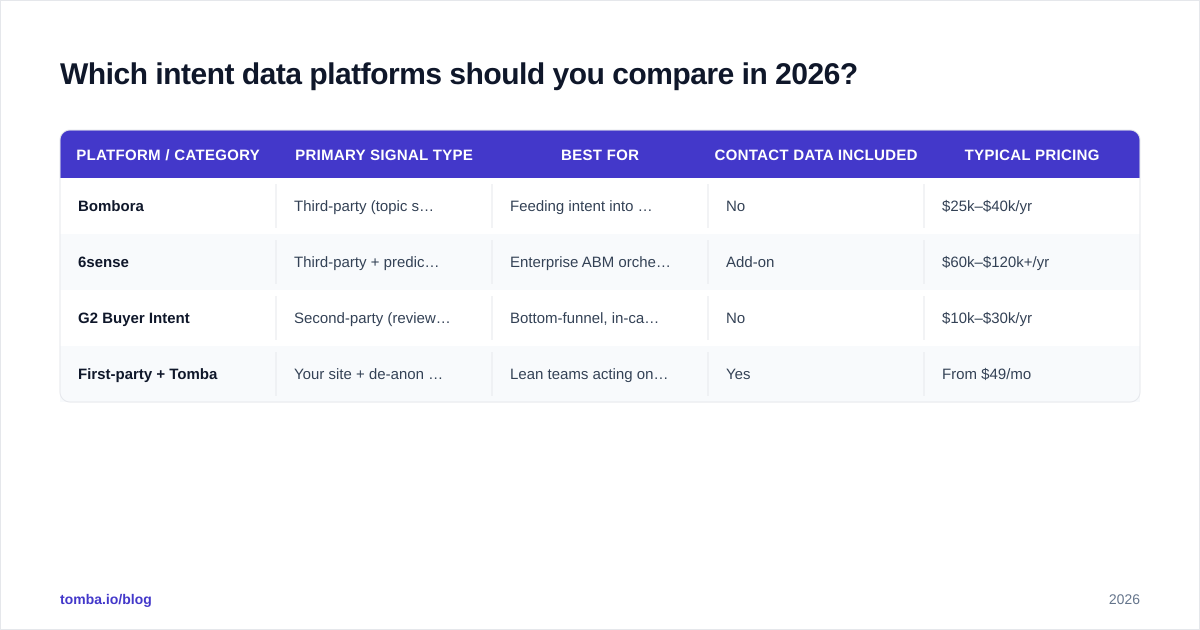
The takeaway: enterprise third-party platforms are powerful but expensive and account-level. If you're a lean team, the highest-ROI starting point is squeezing your first-party signals — your own traffic — and layering affordable enrichment on top instead of buying a six-figure network on day one.
Is intent data worth it for small and mid-size teams?#
Yes — but only if you start where the ROI is highest, not where the marketing spend is loudest.
For a 5–20 person sales org, a six-figure predictive ABM platform is overkill. You'll get more pipeline by de-anonymizing the buyers already on your site and reaching them fast. Tools like website visitor identification turn anonymous, high-intent traffic into named accounts, and a data enrichment layer fills in the buying committee. That's a first-party intent program you can run for a fraction of an enterprise contract.
The mistake teams make is buying broad third-party intent before they can even act on the warm signals they already generate. If your pricing page got 400 anonymous visits last month and you contacted zero of them, you don't have an intent-data problem — you have an activation problem. Fix that first.
How do you turn intent signals into pipeline?#
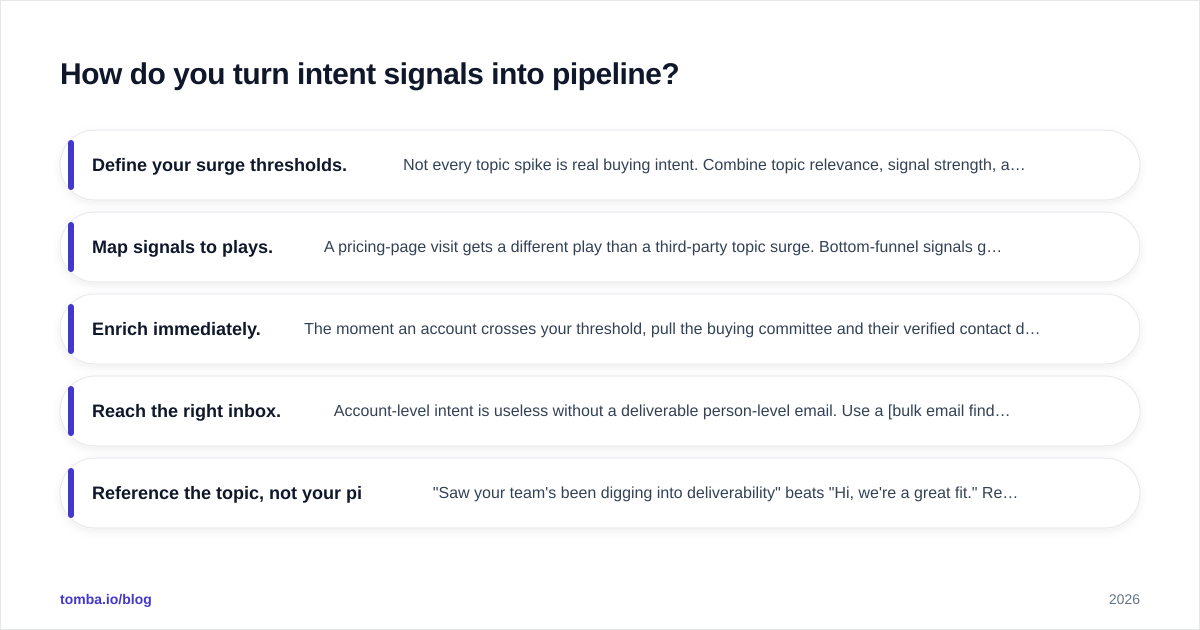
A signal that doesn't trigger an action is a vanity metric. Build the activation path before you buy the data.
- Define your surge thresholds. Not every topic spike is real buying intent. Combine topic relevance, signal strength, and recency. A two-week-old surge on a tangential topic isn't worth a rep's time.
- Map signals to plays. A pricing-page visit gets a different play than a third-party topic surge. Bottom-funnel signals go to AEs; top-funnel surges go to nurture or SDR sequencing.
- Enrich immediately. The moment an account crosses your threshold, pull the buying committee and their verified contact details so the rep isn't doing manual research mid-window.
- Reach the right inbox. Account-level intent is useless without a deliverable person-level email. Use a bulk email finder to resolve the committee, then verify so you protect email deliverability.
- Reference the topic, not your pitch. "Saw your team's been digging into deliverability" beats "Hi, we're a great fit." Relevance to the research is the whole point.
The accounts that convert from intent are the ones you reach inside the buying window with a message tied to what they were actually researching. Speed and relevance, in that order.
What are the biggest intent-data mistakes to avoid?#
- Treating account-level intent as person-level. "Acme is in-market" doesn't tell you who to call. You still need to resolve the buying committee — that's a marketing qualified lead gap most teams ignore.
- Ignoring first-party data. Teams chase expensive third-party networks while letting their own high-intent website traffic go anonymous and uncontacted.
- Acting too slowly. Intent decays. A surge you action three weeks late is a competitor's closed deal.
- No contact-data hygiene. Blasting unverified emails at intent accounts torches your sender reputation and the deal. Verify before you send.
- Over-automating the message. Intent earns you relevance; generic automation throws it away. Personalize to the topic.
HubSpot's research on buyer behavior and sales trends consistently underlines the same thing: relevance and timing beat volume. Intent data gives you both — if you act on it.
How does contact data complete the intent picture?#
Intent tells you which account and when. Contact data tells you who and how to reach them. You need both, and the second is where most "intent stacks" quietly fail.
When an account surges, you typically get a company name and a topic. To run a play, you need the VP, the director, and the manager on that buying committee — with verified emails and direct phone numbers. That's the enrichment-and-finder layer sitting underneath every effective intent program.
This is where pairing intent with a focused finder pays off. Tomba's domain search maps an entire company's email patterns and people in one pass, the email verifier confirms each address is deliverable before you send, and the phone finder adds a second channel for high-priority surges. The signal gets you to the door; accurate contact data gets you through it. See full Tomba pricing — it starts at $49/mo on the Starter plan, with a free tier of 25 searches to test the workflow.
Build the activation layer, not just the signal#
Intent data is having a moment, and the temptation is to buy the biggest network you can afford. Resist it. The teams winning with intent in 2026 aren't the ones with the most signals — they're the ones who act fastest on the right ones, with the right person's verified contact details in hand.
Start with your first-party traffic. De-anonymize it, score it, enrich the buying committee, and reach out inside the window. When you're ready to layer in second- and third-party sources, you'll already have the activation machine that turns signals into pipeline.
Ready to turn account-level signals into real conversations? Use the Tomba Email Finder to resolve every in-market account into a verified buying committee — by domain, name, or company — so your reps spend their time selling to buyers who are already shopping, not chasing cold lists. Start free with 25 searches and see how fast an intent signal becomes a booked meeting.
// get started
Find, verify and enrich your first contacts today
Start on the free plan with 25 searches a month, then scale when your team is ready.
Free plan · No credit card required · GDPR & CCPA
// about the author