Revenue Operations in 2026: The B2B RevOps Tool Stack Guide
Revenue operations aligns sales, marketing, and customer success around one pipeline. Here's the 2026 RevOps framework, tool stack, and metrics that matter.
Revenue operations stopped being a buzzword somewhere around the time finance started asking sales, marketing, and customer success why their numbers never matched. If three teams report three different pipeline figures for the same quarter, you don't have a data problem — you have an operations problem. That's the gap revenue operations (RevOps) exists to close.
This guide breaks down what revenue operations actually is in 2026, the framework that holds it together, the tool stack that powers it, and the metrics that tell you whether it's working.
TL;DR#
- Revenue operations (RevOps) unifies sales ops, marketing ops, and customer success ops under one team accountable for the full revenue lifecycle.
- The core job is removing friction: clean data, connected tools, shared metrics, and one definition of "pipeline" everyone trusts.
- A modern RevOps stack has five layers — CRM, data/enrichment, engagement, analytics, and automation — that must talk to each other.
- The metrics that matter are win rate, pipeline velocity, CAC payback, net revenue retention, and data accuracy.
- Start small: fix your data foundation before buying another platform. Garbage in, garbage out applies to every tool downstream.
What is revenue operations?#
Revenue operations is the function that aligns sales, marketing, and customer success around a single, shared revenue process and one source of truth for data. Think of it like the operations crew backstage at a theatre. The actors (sales reps) get the applause, but if the lighting, sound, and stage cues aren't synchronized, the show falls apart. RevOps is the crew that makes the cues line up.
Historically these three teams each ran their own ops function in isolation. Marketing ops optimized for lead volume, sales ops optimized for quota attainment, and customer success ops optimized for retention — three scoreboards, three tool stacks, three versions of the truth. The result was predictable: leads leaked between handoffs, attribution fights at every QBR, and a forecast nobody believed.
RevOps consolidates those functions. According to Gartner, the discipline emerged precisely because go-to-market complexity outgrew the siloed ops model. One team owns the systems, the data, and the process end to end, so the handoffs stop leaking.
If you want the textbook definition for your internal wiki, the Tomba revenue operations glossary entry keeps it short.
Why does RevOps matter for B2B in 2026?#
Three forces made RevOps non-optional this year.
Buying committees got bigger. A typical B2B deal now involves six to ten stakeholders. No single rep can manually track that, so the system has to. RevOps owns the system.
Tool sprawl got expensive. The average revenue team runs more than ten tools. Without someone owning integration and data hygiene, you pay for overlapping seats and still get conflicting reports.
Boards started asking about efficiency, not just growth. "Grow at any cost" is over. CAC payback and net revenue retention are board-level metrics now, and you can't improve a number you can't measure consistently. That measurement is RevOps work.
The teams that win aren't the ones with the most tools. They're the ones whose tools agree with each other.
What does a revenue operations team own?#
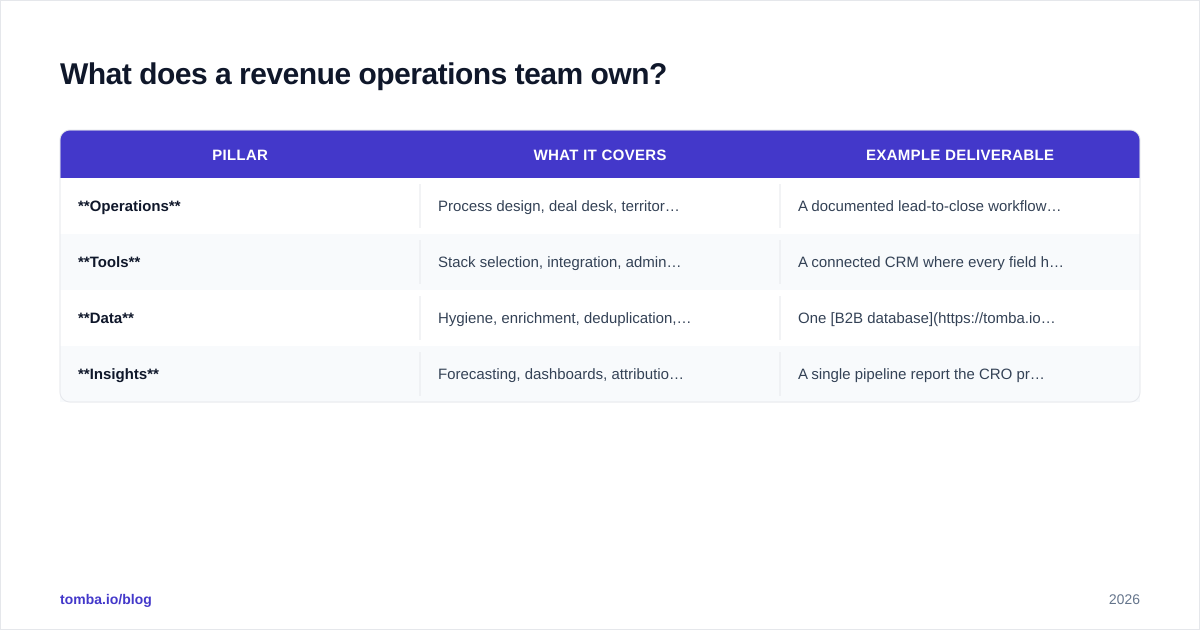
A RevOps charter usually covers four pillars. Keep them visible — scope creep is the fastest way to turn RevOps into a ticket queue.
| Pillar | What it covers | Example deliverable |
|---|---|---|
| Operations | Process design, deal desk, territory and quota planning | A documented lead-to-close workflow with stage definitions |
| Tools | Stack selection, integration, admin, governance | A connected CRM where every field has an owner |
| Data | Hygiene, enrichment, deduplication, segmentation | One B2B database everyone trusts |
| Insights | Forecasting, dashboards, attribution, win/loss | A single pipeline report the CRO presents to the board |
The non-negotiable across all four is the data pillar. Every dashboard, forecast, and automation inherits the quality of the records underneath it. If your contact data is 30% stale, no amount of dashboard polish fixes the forecast — you're just visualizing wrong numbers more attractively.
What is the modern RevOps tool stack?#
A functional stack has five layers. The mistake teams make is buying a shiny platform in one layer while ignoring whether it connects to the others. Connection is the whole point.
1. CRM — the system of record#
Everything orbits the CRM. Salesforce and HubSpot dominate B2B, and your choice here constrains every other decision. If you're on HubSpot, the Tomba HubSpot integration pushes enriched contacts straight into the right properties; Salesforce shops can use the Salesforce integration the same way.
2. Data and enrichment — the fuel#
This is where most pipelines quietly fail. Reps can't sell to contacts they can't reach, and a CRM full of bounced emails poisons every downstream metric. The enrichment layer keeps records current: it finds missing emails, appends firmographic data, and verifies what you already have.
A practical setup uses an email finder to source missing contacts, an email verifier to scrub the list before it touches your sequencer, and ongoing data enrichment to fill gaps as records age. Stale data isn't a one-time cleanup — contacts change jobs constantly, so enrichment is a standing process, not a project.
3. Engagement — the outreach engine#
Sequencers and dialers (Outreach, Salesloft, Instantly, and similar) run the actual touches. RevOps owns the rules: cadence governance, sending limits, and the connection back to the CRM so activity logs automatically.
4. Analytics — the scoreboard#
BI and forecasting tools turn raw CRM data into the numbers leadership acts on. This layer is only as honest as layer 2. Beautiful dashboards on dirty data are how forecasts miss by 40%.
5. Automation — the connective tissue#
Zapier, Make, and native workflows move data between systems without humans copy-pasting. The Tomba Zapier integration is a common pattern: a new CRM lead triggers an enrichment lookup, the verified result writes back, and a sequence enrolls — no manual step.
How do you compare RevOps platforms and approaches?#
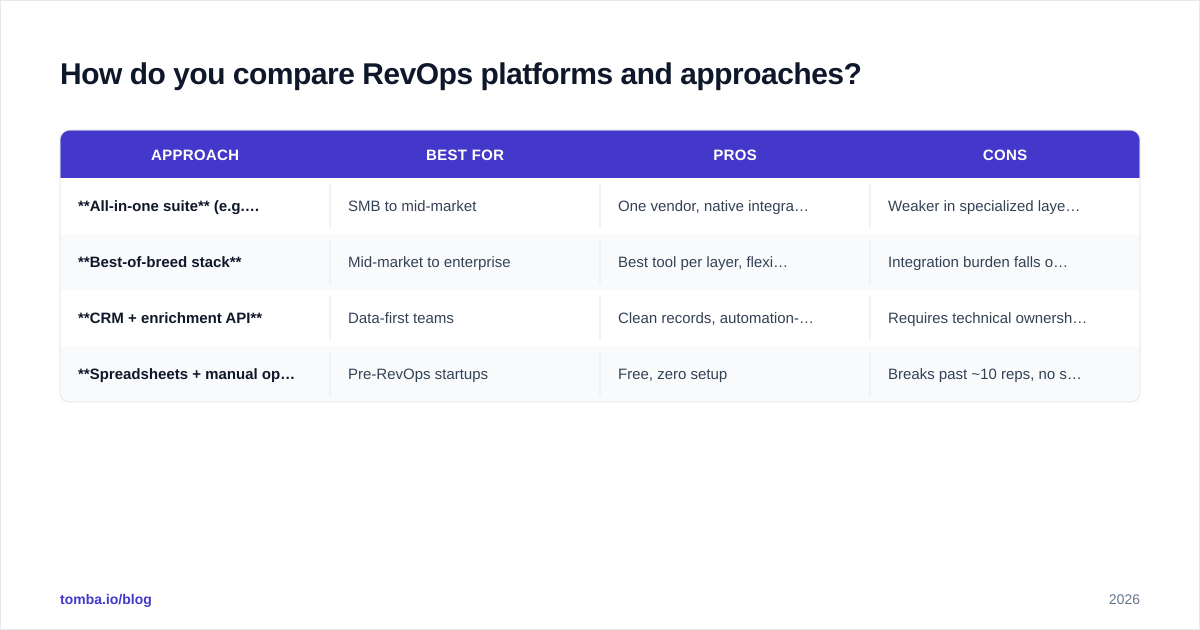
There's no single "RevOps tool." You're really choosing how much to consolidate versus how much to best-of-breed. Here's how the common approaches stack up.
| Approach | Best for | Pros | Cons |
|---|---|---|---|
| All-in-one suite (e.g. HubSpot) | SMB to mid-market | One vendor, native integration, fast setup | Weaker in specialized layers, lock-in |
| Best-of-breed stack | Mid-market to enterprise | Best tool per layer, flexible | Integration burden falls on RevOps |
| CRM + enrichment API | Data-first teams | Clean records, automation-friendly | Requires technical ownership |
| Spreadsheets + manual ops | Pre-RevOps startups | Free, zero setup | Breaks past ~10 reps, no single source of truth |
Most growing B2B teams end up at "best-of-breed stack" with a strong enrichment layer wired in via API. The Tomba API and bulk email finder exist for exactly this — programmatic enrichment that keeps the CRM clean without a human in the loop. For the full breakdown of plan limits, the Tomba pricing page lists credits per tier.
What metrics should a RevOps team track?#
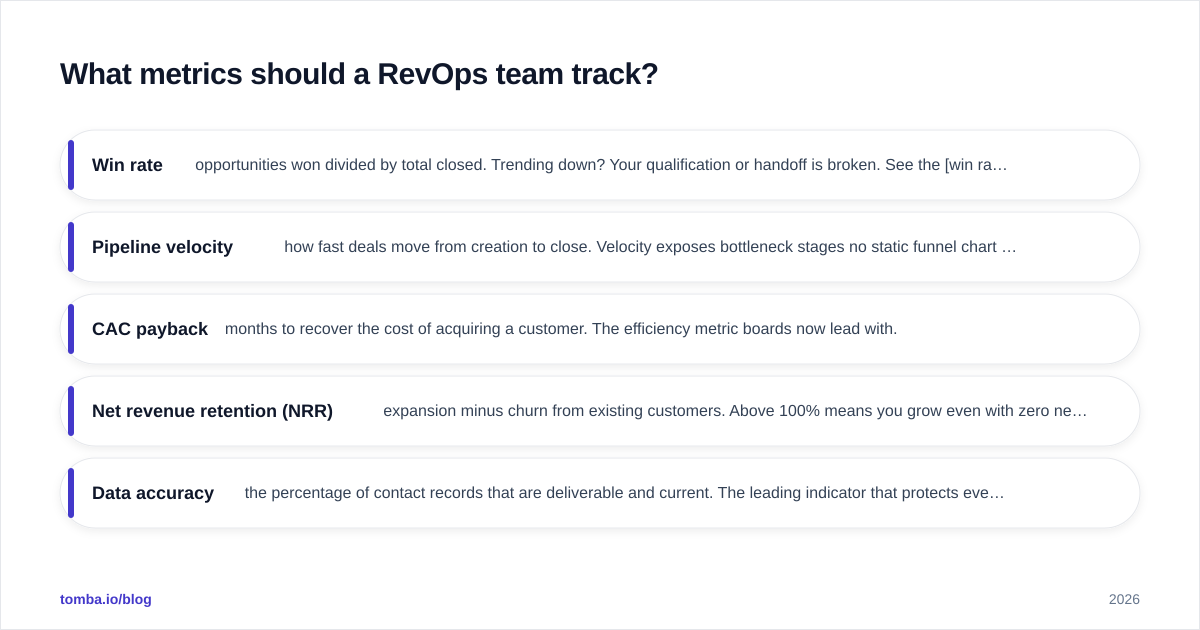
Track outcomes, not vanity. These five tell you whether the operation is actually working.
- Win rate — opportunities won divided by total closed. Trending down? Your qualification or handoff is broken. See the win rate definition for how to slice it by segment.
- Pipeline velocity — how fast deals move from creation to close. Velocity exposes bottleneck stages no static funnel chart will.
- CAC payback — months to recover the cost of acquiring a customer. The efficiency metric boards now lead with.
- Net revenue retention (NRR) — expansion minus churn from existing customers. Above 100% means you grow even with zero new logos.
- Data accuracy — the percentage of contact records that are deliverable and current. The leading indicator that protects every metric above it.
That last one is the canary. When data accuracy slips, win rate and forecast accuracy follow a quarter later — by then the damage is already booked.
How do you build a RevOps function from scratch?#
You don't need a ten-person team or a six-figure platform to start. You need sequence.
1. Audit the data first. Before buying anything, measure how much of your CRM is stale or unreachable. Run a sample through an email verifier and a catch-all verifier. The bounce rate is your baseline, and it's usually worse than anyone guesses.
2. Define one shared process. Agree on stage definitions, lead handoff criteria, and a single pipeline report. Write it down. Ambiguity is where the three-versions-of-truth problem regrows.
3. Consolidate the source of truth. Pick the CRM as the system of record and make every tool write back to it. No more shadow spreadsheets.
4. Wire in enrichment. Connect an enrichment source so new records arrive complete and old ones stay current. Use domain search to map whole accounts and the bulk email finder to backfill gaps at scale.
5. Instrument the metrics. Build the five-metric dashboard once and present from it everywhere. When everyone reads the same scoreboard, the QBR attribution fights stop.
6. Automate the repetitive. Only after the foundation is solid, automate the handoffs — enrichment on lead creation, alerts on stage stalls, write-backs on verification.
Do these in order. Teams that buy automation before fixing data just automate the production of bad records faster.
Is RevOps the same as sales operations?#
No — and conflating them is a common hiring mistake. Sales ops is a subset. Sales operations optimizes the sales team: territories, quotas, comp, forecasting for one department. Revenue operations sits above all three go-to-market functions and optimizes the entire revenue lifecycle, from first marketing touch to renewal.
Practically, if your "RevOps" leader only ever talks to sales and never to marketing or CS, you have sales ops with a fancier title. Real RevOps lives in the seams between teams — and the seams are exactly where revenue leaks. For related context on how automation fits in, the sales automation entry pairs well with this.
What's next for revenue operations?#
Two shifts are defining 2026. First, AI moved from forecasting novelty to operational default — enrichment, lead scoring, and next-best-action are increasingly automated, which raises the stakes on data quality, because AI on dirty data scales the error. Second, RevOps is getting a board seat. As CAC payback and NRR became board metrics, the function that owns those numbers earned a voice in strategy, not just a queue of admin tickets.
The throughline hasn't changed since the discipline began: clean data, one process, shared metrics. The tools get smarter every year. The fundamentals don't.
Where Tomba fits in your RevOps stack#
Every layer of a RevOps stack inherits the quality of the data layer underneath it — so that's the layer to get right first. The Tomba Email Finder sources verified professional emails by name, company, or domain, then feeds them straight into your CRM through native integrations or the API. Pair it with the email verifier and ongoing enrichment and your forecast, dashboards, and automations finally run on records that are actually deliverable. Start on the free tier — 25 searches a month — and scale to a paid plan when your pipeline does. Fix the data foundation, and the rest of the stack stops lying to you.
// get started
Find, verify and enrich your first contacts today
Start on the free plan with 25 searches a month, then scale when your team is ready.
Free plan · No credit card required · GDPR & CCPA
// about the author