Sales Engagement Platforms in 2026: A Buyer's Guide
A sales engagement platform turns scattered outreach into measurable cadences. Here's how the category works in 2026, what to compare, and where it fits your stack.
TL;DR
- A sales engagement platform (SEP) sequences and tracks every touch — email, call, LinkedIn, SMS — so reps run consistent, measurable outreach instead of one-off guesses.
- The category in 2026 is defined by multichannel cadences, signal-based triggers, native dialers, and AI that drafts and prioritizes — not just "email automation."
- Salesloft, Outreach, Apollo, Instantly, and Reply.io anchor the market, but they differ sharply on price, data, and who they fit.
- A SEP is only as good as the contact data feeding it. Bad emails sink deliverability and waste cadence slots before a single reply lands.
- Pair an accurate email finder with your SEP of choice; the platform handles workflow, the data layer handles reachability.
What is a sales engagement platform?#
A sales engagement platform is the system reps live in all day to plan, execute, and measure outbound and follow-up activity across channels. Think of it as the difference between a musician busking from memory and an orchestra reading from a shared score: the SEP is the score. Everyone plays the same sequence of notes — email on day one, call on day three, LinkedIn touch on day five — and the conductor (your sales manager) can see exactly who is on beat.
Technically, a SEP layers four things on top of your CRM: cadences (multi-step, multi-channel sequences), execution tools (email sending, a dialer, social touchpoints, task queues), tracking (opens, clicks, replies, call dispositions), and increasingly AI assistance (draft generation, reply classification, next-best-action). Gartner groups these under "sales engagement" as a distinct layer from the CRM of record, and that separation matters: the CRM stores the truth, the SEP drives the activity.
It is not the same as marketing automation. Marketing automation nurtures large lists with branded campaigns; a sales engagement platform powers 1:1 rep-driven outreach that should read like a human wrote it. If you want a precise definition of the surrounding workflow, the sales automation glossary entry breaks down where automation helps and where it backfires.
Why do B2B teams need one in 2026?#
The short answer: consistency compounds, and memory does not. Reps who freestyle their follow-up forget the fourth and fifth touches — which is exactly where most replies happen. A SEP guarantees the sequence runs whether the rep is having a great week or a terrible one.
Three forces made the category non-optional this year:
- Channel fragmentation. Buyers ignore single-channel outreach. A 2026-grade cadence mixes email, phone, LinkedIn, and sometimes SMS — coordinating that by hand is impossible past a handful of accounts.
- Signal overload. Intent data, website visits, job changes, and funding events now trigger outreach. A SEP ingests those signals and routes them into the right cadence automatically instead of dying in a spreadsheet.
- AI drafting and triage. Reply classification and AI-written first drafts cut admin time, but they only pay off when bolted to a system that tracks outcomes. AI without a cadence is just faster spray-and-pray.
The measurable payoff shows up in response rate and pipeline created per rep. Teams that move from ad-hoc follow-up to enforced cadences routinely see reply rates climb, mostly because touches that used to vanish now actually happen.
What features separate a real SEP from "email automation"?#
Plenty of cheap tools call themselves engagement platforms. Use this checklist to tell a genuine SEP from a glorified mail merge:
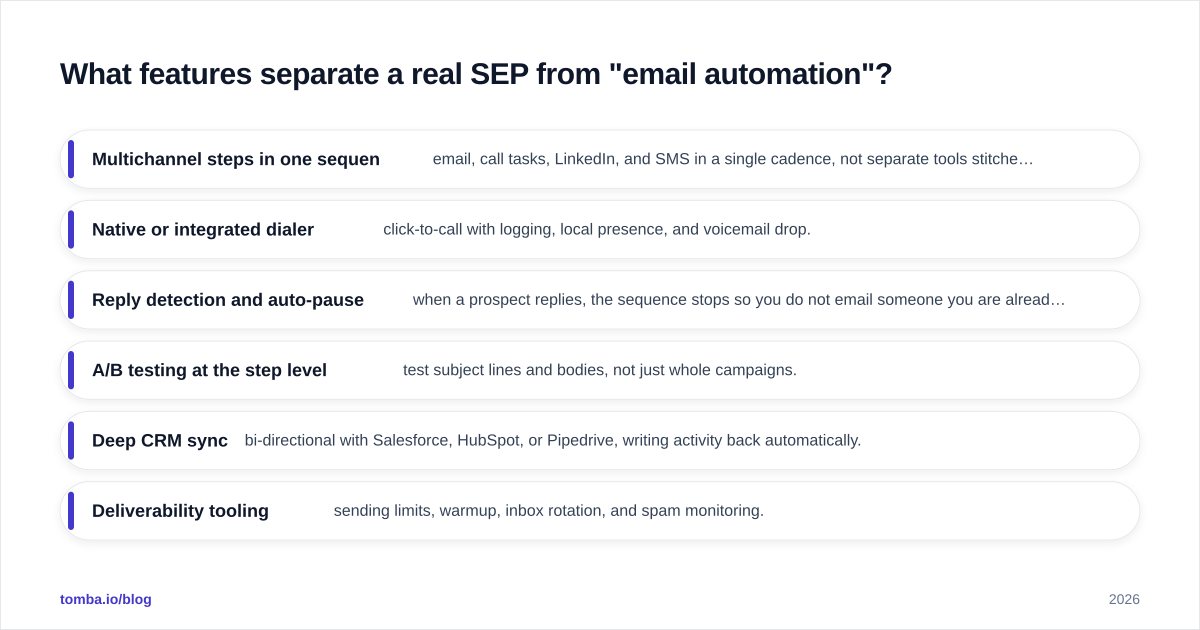
- Multichannel steps in one sequence — email, call tasks, LinkedIn, and SMS in a single cadence, not separate tools stitched together.
- Native or integrated dialer — click-to-call with logging, local presence, and voicemail drop.
- Reply detection and auto-pause — when a prospect replies, the sequence stops so you do not email someone you are already talking to.
- A/B testing at the step level — test subject lines and bodies, not just whole campaigns.
- Deep CRM sync — bi-directional with Salesforce, HubSpot, or Pipedrive, writing activity back automatically.
- Deliverability tooling — sending limits, warmup, inbox rotation, and spam monitoring.
- Analytics by rep, cadence, and step — so managers coach the specific step that leaks.
That last cluster — deliverability — is where most cheap tools quietly fail. If your SEP blasts from a cold domain with no throttling, you will land in spam regardless of copy quality. Connecting a HubSpot integration or Salesforce sync keeps activity visible, but it does nothing for inbox placement; that is a separate discipline.
How do the top sales engagement platforms compare?#
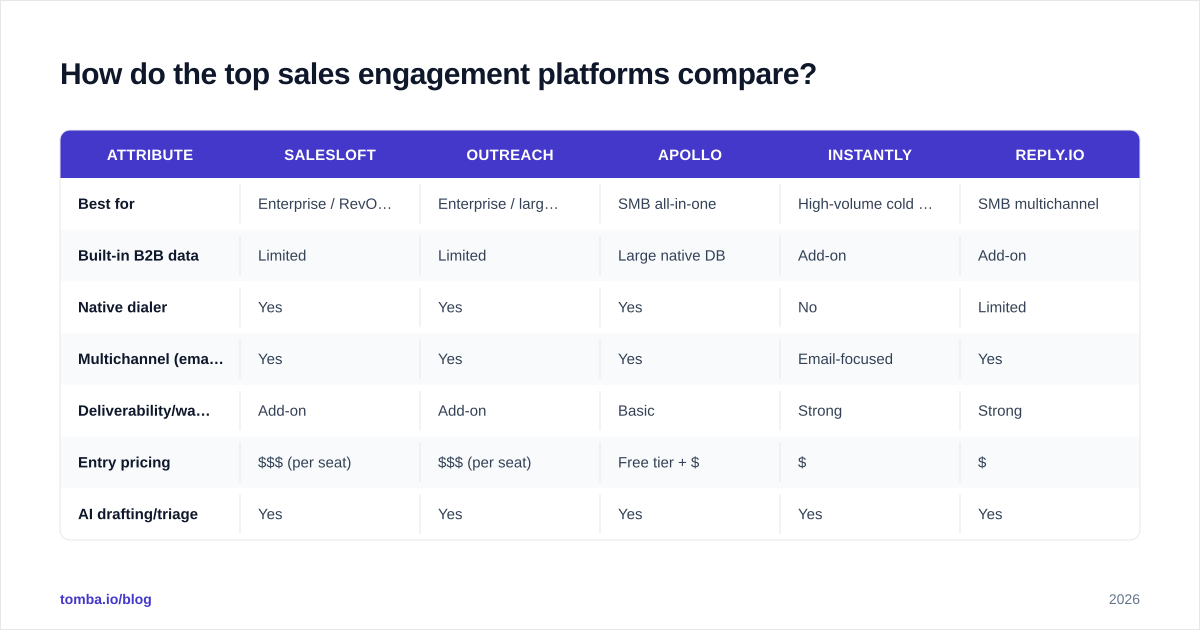
No single platform wins for everyone. Enterprise revenue teams optimize for governance and forecasting; founder-led startups optimize for cost and speed. Here is how the leading options line up in 2026 on the attributes that actually drive a decision.
| Attribute | Salesloft | Outreach | Apollo | Instantly | Reply.io |
|---|---|---|---|---|---|
| Best for | Enterprise / RevOps | Enterprise / large SDR teams | SMB all-in-one | High-volume cold email | SMB multichannel |
| Built-in B2B data | Limited | Limited | Large native DB | Add-on | Add-on |
| Native dialer | Yes | Yes | Yes | No | Limited |
| Multichannel (email/call/social) | Yes | Yes | Yes | Email-focused | Yes |
| Deliverability/warmup | Add-on | Add-on | Basic | Strong | Strong |
| Entry pricing | $$$ (per seat) | $$$ (per seat) | Free tier + $ | $ | $ |
| AI drafting/triage | Yes | Yes | Yes | Yes | Yes |
A few honest takeaways. Salesloft and Outreach are the heavyweight choices — rich governance, forecasting, and analytics, but priced per seat at a level that only makes sense once you have a real SDR org. Compare them directly on G2 before committing; the feature gap between them narrows every year. Apollo bundles a contact database with the cadence engine, which is attractive for SMB teams that want one bill — though the bundled data quality varies by region. Instantly and Reply.io lead on cold-email deliverability and price, making them the practical pick for lean outbound teams who bring their own data.
If you are weighing specific swaps, Tomba maintains side-by-side breakdowns like the Instantly alternative, Outreach alternative, and Salesloft alternative pages that go deeper than this overview.
What does a sales engagement platform cost?#
Pricing splits cleanly into two camps, and knowing which camp you are buying into prevents sticker shock.
Enterprise SEPs (Salesloft, Outreach) charge per seat per month, typically billed annually, and the real number lands well into the hundreds per rep once you add the dialer, analytics, and AI tiers. Implementation and admin overhead are real line items too. These platforms assume a dedicated RevOps owner.
SMB and cold-email SEPs (Apollo, Instantly, Reply.io) start with free or low double-digit monthly tiers and scale by sending volume, contacts, or seats. You can be live the same afternoon. The trade-off is lighter forecasting and governance.
A critical hidden cost sits underneath all of them: data. Most SEPs either charge extra for contact credits or assume you already have verified emails. If you are paying per seat for an engagement platform and then feeding it stale lists, you are paying twice for half a result.
How does data quality make or break a SEP?#
A sales engagement platform executes whatever you feed it — including bad addresses. Here is the chain reaction when your data is weak: invalid emails bounce, bounces hurt your sender reputation, a damaged reputation pushes even your good emails to spam, and your carefully built cadence quietly stops reaching anyone. The platform reports "sent." The prospect never sees it.
That is why the highest-leverage upgrade for most teams is not switching SEPs — it is fixing the data layer in front of the one they have. Two moves matter most:
- Verify before you send. Run every address through an email verifier so bounces never enter your cadence. Catch-all domains need a catch-all verifier to avoid false confidence.
- Source accurate contacts. Use a precise email finder to build lists by name, role, or domain instead of scraping unreliable exports.
The platforms above treat data as an add-on or a bundled afterthought. Decoupling your data layer — accurate finding and verification — from your engagement layer gives you better reachability and lets you switch SEPs later without re-buying your contact database. Salesforce's own State of Sales research keeps flagging data quality as the top blocker to rep productivity, and it lines up with what bounce logs show in practice.
How do you choose the right one?#
Match the platform to your team's stage and motion, not to the longest feature list.
| Your situation | Recommended fit |
|---|---|
| Enterprise SDR org, heavy forecasting | Salesloft or Outreach |
| SMB wanting data + cadence in one bill | Apollo |
| Lean team running high-volume cold email | Instantly |
| SMB needing affordable multichannel | Reply.io |
| Any of the above with weak contact data | Add a dedicated finder + verifier layer |
Run a real pilot before signing. Load one segment, build one honest cadence, and measure replies and meetings booked over two to three weeks. Watch deliverability metrics as closely as reply rate — a platform that books meetings while burning your domain is a short-term win and a long-term loss. Check the Tomba pricing page if you want to model the data-layer cost alongside whichever SEP you shortlist; a verified list often costs less than the bounces it prevents.
The bottom line#
A sales engagement platform is the operating system for modern outbound — it enforces the cadences your reps would otherwise forget and gives managers the visibility to coach the exact step that leaks. But every platform on this list shares one dependency: the contact data you pour into it. Pick the SEP that fits your stage, then protect that investment with a data layer that actually reaches inboxes.
Start there. Build clean, verified lists with the Tomba Email Finder — find professional emails by domain, name, or company, verify them before they hit your cadence, and let your sales engagement platform do what it does best: turn consistent, deliverable touches into booked meetings. Spin up the free tier (25 searches a month), feed your SEP addresses that land, and stop paying per seat to email the void.
// get started
Find, verify and enrich your first contacts today
Start on the free plan with 25 searches a month, then scale when your team is ready.
Free plan · No credit card required · GDPR & CCPA
// about the author