Cold Calling Compliance in 2026: Rules, Risks & Checklist
TCPA fines now top $1,500 per call. Here's a plain-English guide to cold calling compliance in 2026 — DNC rules, consent, recording laws, and a pre-dial checklist.
TL;DR
- Cold calling is still legal in 2026, but the rules tightened: TCPA statutory damages run $500–$1,500 per violating call, and class actions routinely settle in the millions.
- The two pillars are consent (when you need it, when you don't) and suppression (scrubbing against the National DNC Registry, state lists, and your own internal opt-outs).
- B2B-to-business-line calls have more leeway than B2C, but "B2B" is not a blanket exemption — wireless numbers, recording laws, and GDPR/PECR still apply.
- Compliance is a process, not a one-time check: verify the number, log consent, scrub before every campaign, honor opt-outs within 30 days, and keep records for at least 5 years.
- Clean, accurate contact data is the cheapest insurance you can buy — bad numbers are how reps accidentally dial DNC-listed cells and wrong parties.
What is cold calling compliance?#
Cold calling compliance is the set of laws and internal controls that govern who you can call, when, how, and what you must record. Think of it like driving: you're allowed on the road, but there are speed limits, no-go zones, and a logbook you'd better be able to produce if you're pulled over.
In the United States the core statute is the Telephone Consumer Protection Act (TCPA), enforced by the FCC and backed by a private right of action — meaning the person you called can sue you directly. On top of that sit the FTC's Telemarketing Sales Rule, the National Do Not Call (DNC) Registry, dozens of state-level mini-TCPA laws, and call-recording consent rules that vary state by state. Sell into the EU or UK and you add GDPR and PECR to the stack.
The penalties are not theoretical. TCPA damages start at $500 per call and triple to $1,500 for willful violations, with no cap. A modest 2,000-call campaign to the wrong list can manufacture a seven-figure exposure overnight.
Is cold calling still legal in 2026?#
Yes — cold calling is legal, but the margin for sloppiness has shrunk. Three shifts define the current landscape:
- The FCC closed the "lead generator loophole." One-to-one consent is now the standard for many automated calls and texts — a single checkbox can no longer authorize a parade of unrelated sellers to dial a consumer.
- State laws stack on top of federal. Florida, Oklahoma, Washington, and others passed mini-TCPA statutes with their own consent definitions, calling-hour windows, and damages. You must comply with the strictest law that applies to the contact.
- Wireless enforcement is aggressive. Most adults' "phone number" is a cell. Auto-dialing or pre-recording to a wireless number without prior express consent is the single most common way companies get sued.
The takeaway: legality depends entirely on your process. A manually dialed, properly scrubbed B2B call to a business landline is low-risk. The same pitch auto-dialed to a personal cell on the DNC list is a lawsuit.
What laws govern cold calling? (TCPA, DNC, GDPR)#
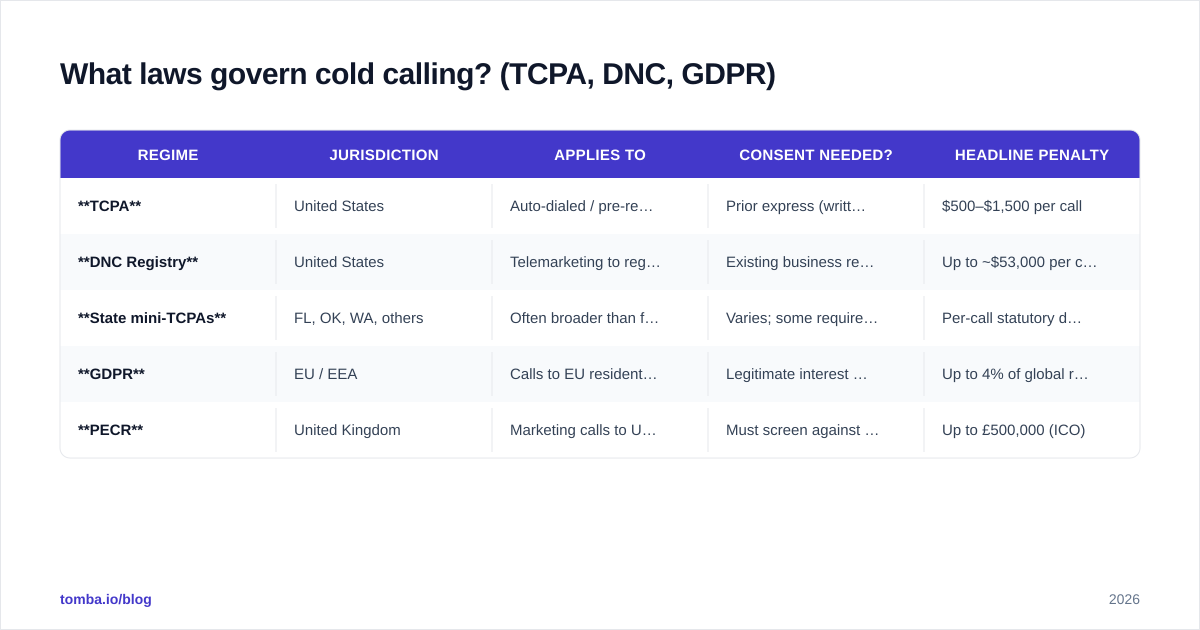
Here's how the major regimes compare. Use it to figure out which rules bind a given call before you dial.
| Regime | Jurisdiction | Applies to | Consent needed? | Headline penalty |
|---|---|---|---|---|
| TCPA | United States | Auto-dialed / pre-recorded calls, texts, especially to cell phones | Prior express (written) consent for automated calls to cells | $500–$1,500 per call |
| DNC Registry | United States | Telemarketing to registered consumers | Existing business relationship or written consent exempts you | Up to ~$53,000 per call (FTC) |
| State mini-TCPAs | FL, OK, WA, others | Often broader than federal; tighter calling hours | Varies; some require consent for any auto-dial | Per-call statutory damages |
| GDPR | EU / EEA | Calls to EU residents, personal data processing | Legitimate interest or consent; must honor objection | Up to 4% of global revenue |
| PECR | United Kingdom | Marketing calls to UK numbers | Must screen against TPS/CTPS | Up to £500,000 (ICO) |
A few clarifications that trip teams up:
- DNC has a B2B carve-out, but it's narrow. Calls to a business for business purposes are generally exempt from the consumer DNC registry — but the moment you dial a sole proprietor's personal cell, or pitch a personal product, the exemption evaporates.
- "Existing Business Relationship" (EBR) is time-boxed. A prior purchase typically buys you 18 months; an inquiry buys you 3. After that, the relationship is stale.
- GDPR is about data, not just the call. Storing a prospect's number is processing personal data. You need a lawful basis and a way to honor erasure requests — see our primer on what counts as personal data in the B2B glossary.
For the authoritative text, go to the source rather than a blog summary: the FCC's TCPA rules, the FTC's National Do Not Call Registry, and the official GDPR portal all publish current guidance.
Do you need consent before a B2B cold call?#
Short answer: not always for the call itself, but almost always for automation, recording, and data storage. Break it into three questions:
1. Are you auto-dialing or using a pre-recorded message? If yes, and the number could be a cell, you need prior express written consent under the TCPA. Manual dialing of a business line to a live rep is the safest mode and sidesteps most auto-dialer exposure.
2. Are you recording the call? Recording consent is governed by state wiretap law. Eleven-plus states (California, Florida, Pennsylvania, Illinois, and others) are all-party consent — every person on the line must agree before you hit record. The rest are one-party. When in doubt, disclose and get verbal agreement at the top of the call; it costs you four seconds and removes the question entirely.
3. Are you calling or storing data on an EU/UK resident? GDPR and PECR require a documented lawful basis (usually legitimate interest for B2B) plus an easy path to object. You must be able to show why you believed your interest outweighed theirs.
The practical rule: document everything. When a prospect opts in, log the timestamp, source, and exact language they agreed to. When they opt out, suppress them everywhere within 30 days. A consent log you can export is your best defense in any dispute.
How do you build a compliant cold calling process?#
Compliance lives in the workflow, not in a policy PDF nobody reads. Here's the loop that keeps reps dialing and legal happy.
Step 1 — Source data you can stand behind. Most violations start with a bad list. Purchased "verified" lists are riddled with recycled numbers, personal cells mislabeled as business lines, and contacts who opted out years ago. Pull contacts from transparent, traceable sources and confirm where each number came from. Tomba publishes its data sources precisely so you can audit provenance.
Step 2 — Validate the number before it enters the dialer. A surprising share of compliance trouble is just dialing the wrong person. Run numbers through a phone validator to confirm line type (mobile vs. landline vs. VoIP), carrier, and active status. Knowing a number is a cell before you dial tells you whether TCPA auto-dialer rules apply.
Step 3 — Scrub against every suppression list. Before each campaign, wash your list against the National DNC Registry, applicable state registries, the UK's TPS/CTPS if relevant, and — critically — your own internal opt-out list. Scrubbing is not a one-time task; numbers get added daily, so re-scrub every campaign.
Step 4 — Respect calling hours. Federal rules limit telemarketing to 8 a.m.–9 p.m. in the recipient's time zone. Several states are stricter. Always sort by the prospect's local time, not yours.
Step 5 — Disclose, then pitch. Identify yourself and your company at the start. If recording, say so. If they ask to be removed, confirm it on the spot.
Step 6 — Log and suppress opt-outs fast. The FTC requires honoring do-not-call requests within a reasonable period; treat 24–48 hours as your internal SLA and 30 days as the legal hard ceiling.
Step 7 — Keep records for five years. Consent logs, scrub timestamps, call recordings (where lawful), and opt-out confirmations. If you can't produce them, you can't defend yourself.
For teams running outbound at volume, store all of this beside your contact records — a clean B2B database with provenance and validation status baked in is far easier to audit than a spreadsheet of mystery numbers.
What are the biggest cold calling compliance mistakes?#
These are the patterns that turn a routine campaign into a legal incident:
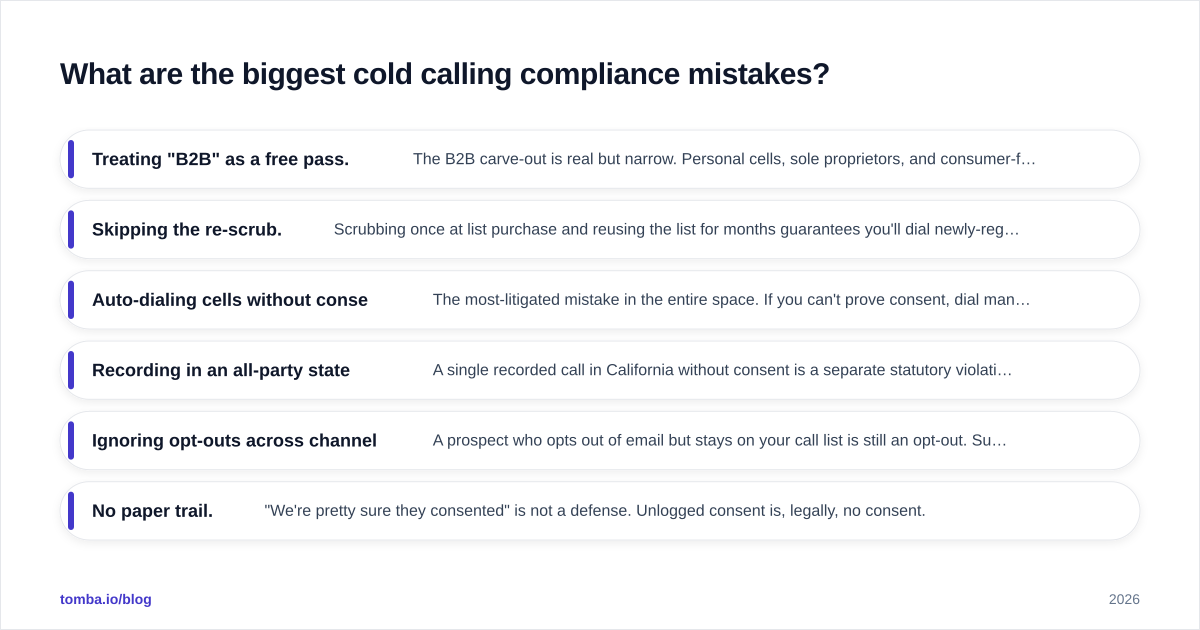
- Treating "B2B" as a free pass. The B2B carve-out is real but narrow. Personal cells, sole proprietors, and consumer-flavored pitches fall outside it.
- Skipping the re-scrub. Scrubbing once at list purchase and reusing the list for months guarantees you'll dial newly-registered DNC numbers.
- Auto-dialing cells without consent. The most-litigated mistake in the entire space. If you can't prove consent, dial manually.
- Recording in an all-party state without disclosure. A single recorded call in California without consent is a separate statutory violation, stacked on top of TCPA.
- Ignoring opt-outs across channels. A prospect who opts out of email but stays on your call list is still an opt-out. Suppression must be unified.
- No paper trail. "We're pretty sure they consented" is not a defense. Unlogged consent is, legally, no consent.
A useful gut check: if a regulator asked you to produce the consent record and scrub timestamp for any single call you made last quarter, could you — in under five minutes? If not, fix the recordkeeping before you scale the dialing.
How does data quality reduce compliance risk?#
Better data is the cheapest compliance control you have. Most TCPA and DNC violations are not malice — they're a rep dialing a number that should never have been in the list. Three data practices cut that risk dramatically:
- Verify line type and ownership up front. Knowing whether a number is a business landline or a personal mobile changes which rules apply. This is exactly what a phone validator and phone finder are for — they return carrier and line-type metadata so you classify risk before the dial.
- Prefer enrichment over purchased lists. Instead of buying a static, decaying list, enrich your existing CRM accounts on demand so every contact is fresh and traceable. Tomba's data enrichment and domain search pull current contact details tied to a known company — far less likely to surface recycled personal cells.
- Keep one source of truth for opt-outs. When suppression data lives in five tools, someone always dials a removed contact. Consolidate.
Clean data won't write your compliance policy, but it removes the single largest category of accidental violations — and it makes your reps faster, because they stop burning hours on dead and dangerous numbers.
Cold calling compliance checklist (copy this)#
Run this before every campaign:
- List sourced from a traceable provider, provenance logged
- Every number validated for line type and active status
- Scrubbed against National DNC + applicable state registries
- Scrubbed against internal opt-out / suppression list
- Calling window set to recipient's local time (8 a.m.–9 p.m. min.)
- Recording disclosure ready (all-party states)
- Consent records on file for any automated dialing to cells
- Opt-out capture and 24–48h suppression SLA in place
- Records retention set to 5+ years
Start with data you can trust#
Compliance failures almost always trace back to one root cause: dialing contacts you couldn't vouch for. Fix the data and you remove most of the risk before a rep ever picks up the phone.
Build your call lists from accurate, traceable contacts with Tomba Email Finder and its companion tools — pair it with the phone finder and phone validator to confirm line type before you dial, and enrich records on demand instead of buying stale lists. Start free with 25 searches a month, then scale on the Starter plan at $49/mo — see full Tomba pricing for the Growth ($99/mo) and Pro ($249/mo) tiers. Clean data is the foundation every compliant calling program is built on; give your reps numbers they can dial with confidence.
This article is general information, not legal advice. Consult counsel for your specific jurisdiction and use case.
// get started
Find, verify and enrich your first contacts today
Start on the free plan with 25 searches a month, then scale when your team is ready.
Free plan · No credit card required · GDPR & CCPA
Get the Tomba newsletter
Product and data updates
// about the author