Cold Email Verticals and Personas: A 2026 Playbook
One template can't sell to a CFO, a RevOps lead, and a clinic owner. Here's how to segment cold email by vertical and persona so every send lands as relevant.

TL;DR
- Cold email verticals and personas are two halves of one target. The vertical is the industry you sell into. The persona is the role inside it who feels the pain. Cold email works when you write to the intersection of both, not to a generic "decision maker."
- One template per campaign fails. A hospital COO, a Series B RevOps lead, and an agency founder buy for different reasons, on different timelines, in different language.
- The fastest lift in 2026 isn't a cleverer subject line — it's a tighter segment. A mediocre email to the right vertical-persona pair beats a brilliant email to the wrong one.
- Build a vertical × persona matrix, assign one core pain and one proof point per cell, then personalize the top two lines. Everything else can be templated.
- You need clean, role-accurate contact data to do this. Bad role mapping kills relevance before your copy gets a chance.
What do cold email verticals and personas actually mean?#
Conclusion first: a vertical is who the company is, a persona is who the human is, and your cold email has to satisfy both at once.
Think of it like a tailor. The vertical is the occasion — a wedding, a job interview, a hike. The persona is the body being measured. A great suit for the wrong occasion is still wrong. A great fit for the wrong body still doesn't work. Cold email is the same: you tailor the argument to the vertical and the angle to the persona.
- Vertical examples: B2B SaaS, fintech, healthcare providers, e-commerce brands, marketing agencies, logistics, manufacturing.
- Persona examples: CEO/founder, VP of Sales, RevOps manager, Head of Marketing, IT/security lead, Office/Operations manager.
The mistake most teams make is optimizing one axis and ignoring the other. They nail "VP of Sales" messaging and blast it across ten industries. Or they pick "fintech" and send the same email to the CFO and the junior analyst. Relevance lives in the cell where a specific role meets a specific industry.
Why does one cold email template fail across verticals?#
Because the pain changes even when the role stays the same.
Take a Head of Marketing. In e-commerce, their nightmare is rising CAC and a Meta ads account that keeps getting throttled. In healthcare, it's compliance-safe patient communication and a brand that can't make wild claims. In SaaS, it's pipeline contribution and proving marketing-sourced revenue. Same title, three different 6 a.m. anxieties. A single "Hey {{firstName}}, struggling with lead gen?" line is generic enough to insult all three.
There's also a vocabulary problem. Each vertical has its own jargon, rules, and status games. Say "PHI" to a clinic operator and you sound native. Say it to a DTC founder and you sound like a bot. Cold email is a trust transaction, and the fastest trust signal is talking like an insider. That only happens when you've segmented down to the vertical.
How do you map verticals to personas?#
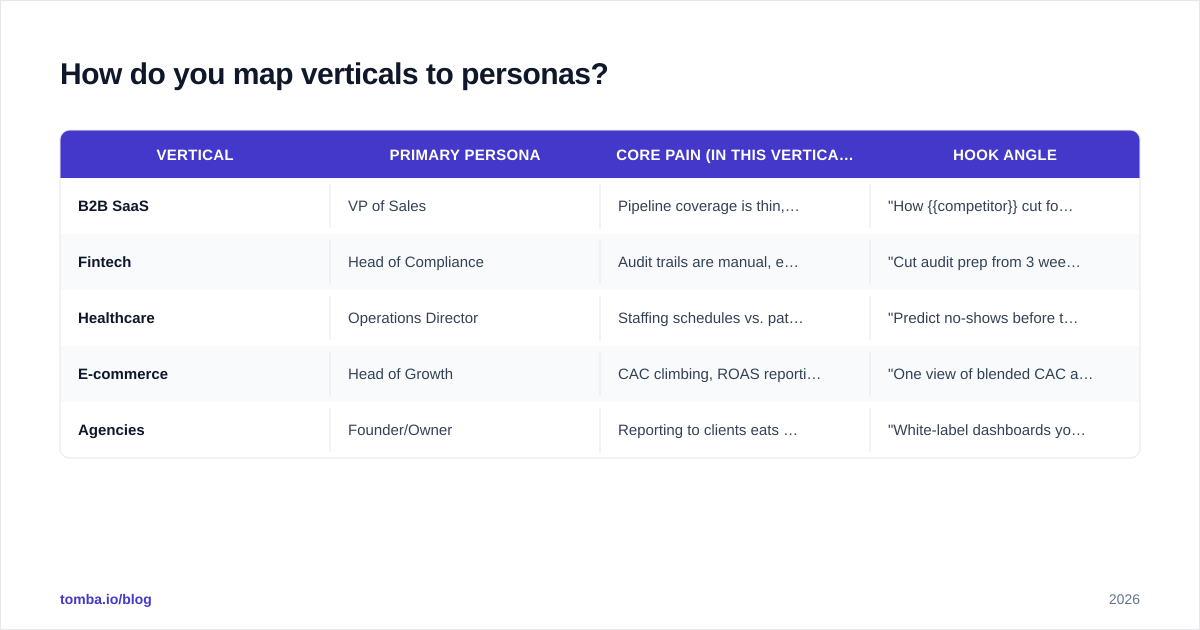
Use a matrix. List your target verticals down the side, your buying personas across the top, and fill each cell with the one pain that role feels in that industry. This single artifact does more for reply rates than any copywriting course.
Here's a worked example for a fictional analytics product:
| Vertical | Primary persona | Core pain (in this vertical) | Hook angle |
|---|---|---|---|
| B2B SaaS | VP of Sales | Pipeline coverage is thin, forecast slips every quarter | "How {{competitor}} cut forecast error to single digits" |
| Fintech | Head of Compliance | Audit trails are manual, every report is a fire drill | "Cut audit prep from 3 weeks to 3 days" |
| Healthcare | Operations Director | Staffing schedules vs. patient demand never align | "Predict no-shows before they cost a shift" |
| E-commerce | Head of Growth | CAC climbing, ROAS reporting fragmented across channels | "One view of blended CAC across Meta + Google" |
| Agencies | Founder/Owner | Reporting to clients eats billable hours | "White-label dashboards your clients actually open" |
Notice the persona changes per vertical. The decision-maker for analytics in a 20-person agency is the founder. In a fintech it's compliance, not sales. Forcing the same persona across every row is the second-most-common segmentation error after using none at all.
To build this matrix accurately, you need to know which roles actually exist and who holds them at each account. That's a data problem before it's a copy problem — and where a precise email finder and data enrichment layer earns its keep by attaching real titles, seniority, and departments to each contact.

How do you personalize at scale without sounding like a bot?#
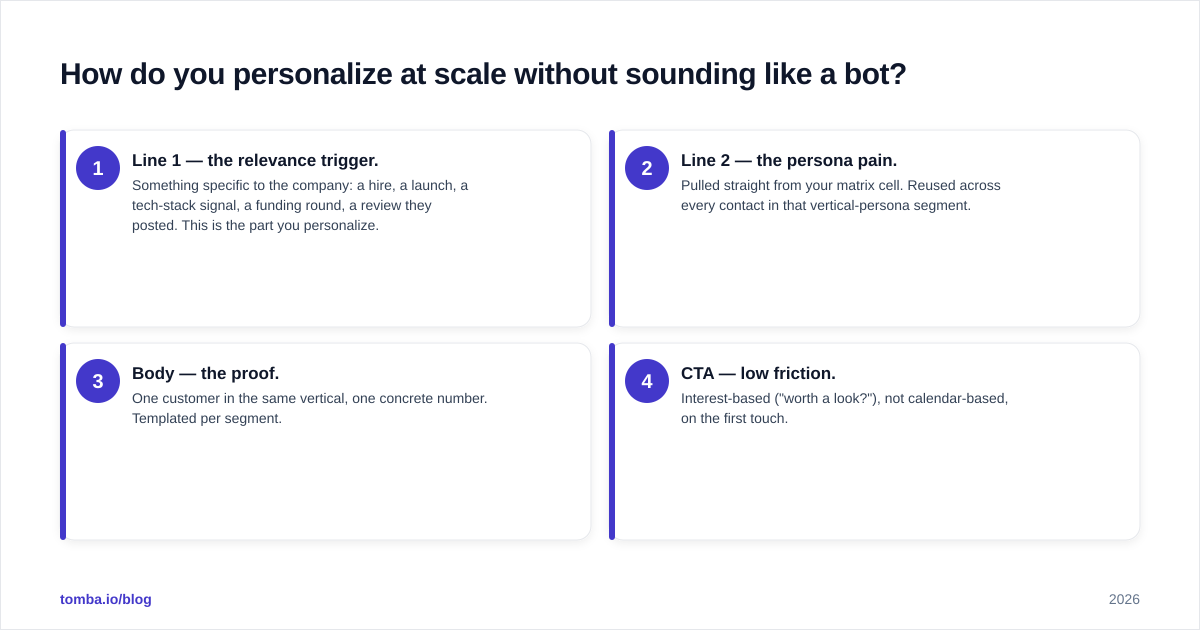
The trick is to separate what must be bespoke from what can be templated. You do not need to hand-write every email. You need to hand-write the first two lines and let a strong, vertical-specific frame carry the rest.
A reliable structure per email:
- Line 1 — the relevance trigger. Something specific to the company: a hire, a launch, a tech-stack signal, a funding round, a review they posted. This is the part you personalize.
- Line 2 — the persona pain. Pulled straight from your matrix cell. Reused across every contact in that vertical-persona segment.
- Body — the proof. One customer in the same vertical, one concrete number. Templated per segment.
- CTA — low friction. Interest-based ("worth a look?"), not calendar-based, on the first touch.
This means your "personalization" workload scales with segments, not with contacts. Ten verticals × four personas = forty message frames. You write forty good frames once, then your only per-prospect work is line 1. That's the difference between a campaign you can run at 2,000 prospects and one that dies at 50.
Mailbox providers in 2026 reward this too. Tightly segmented sends with high engagement protect your sender reputation. Broad, low-relevance blasts that get marked as spam degrade it for every future campaign. Segmentation is a deliverability strategy, not just a copy strategy. For more on the mechanics, HubSpot's cold email guidance is a solid neutral primer, and G2's sales engagement category helps you benchmark tools.
What does message angle look like per persona?#
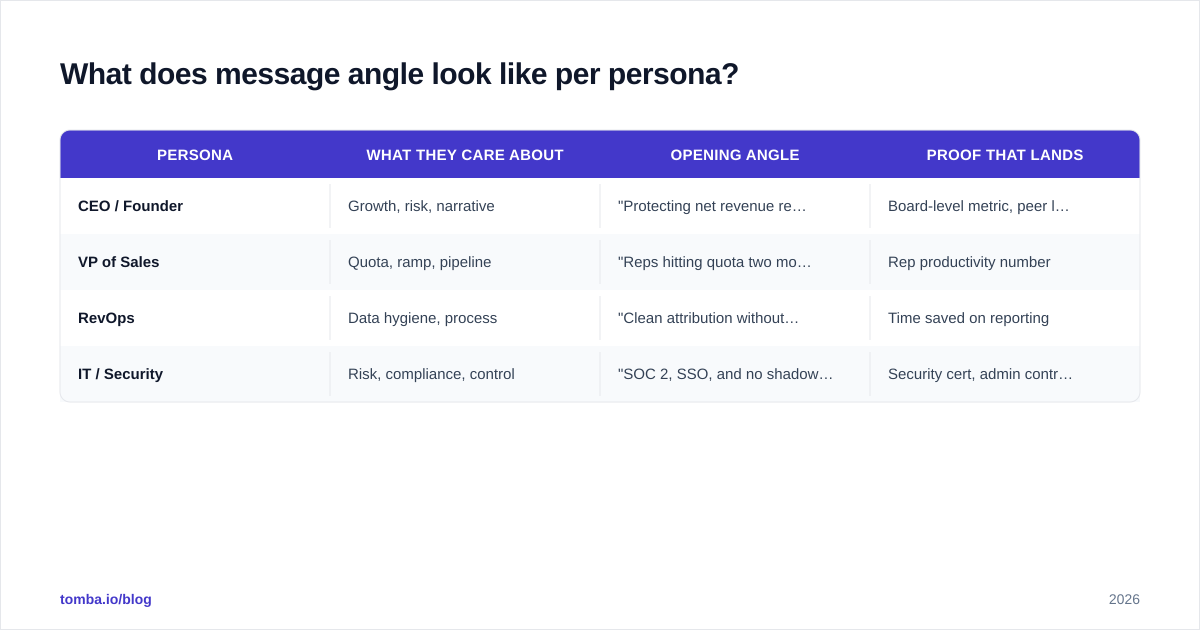
Same product, same vertical — change only the persona and watch the argument shift. Here's a SaaS deal where the buying committee has four members:
| Persona | What they care about | Opening angle | Proof that lands |
|---|---|---|---|
| CEO / Founder | Growth, risk, narrative | "Protecting net revenue retention as you scale" | Board-level metric, peer logo |
| VP of Sales | Quota, ramp, pipeline | "Reps hitting quota two months faster" | Rep productivity number |
| RevOps | Data hygiene, process | "Clean attribution without a data team" | Time saved on reporting |
| IT / Security | Risk, compliance, control | "SOC 2, SSO, and no shadow data" | Security cert, admin controls |
A CEO does not want to read about SSO. An IT lead does not want a growth narrative. Send the wrong angle to the right person and you read as someone who didn't do their homework — exactly the impression cold email can't afford.
How do you build the contact list for a vertical-persona campaign?#
Conclusion first: start from the persona definition, then source contacts that match it exactly — not "anyone at the company."
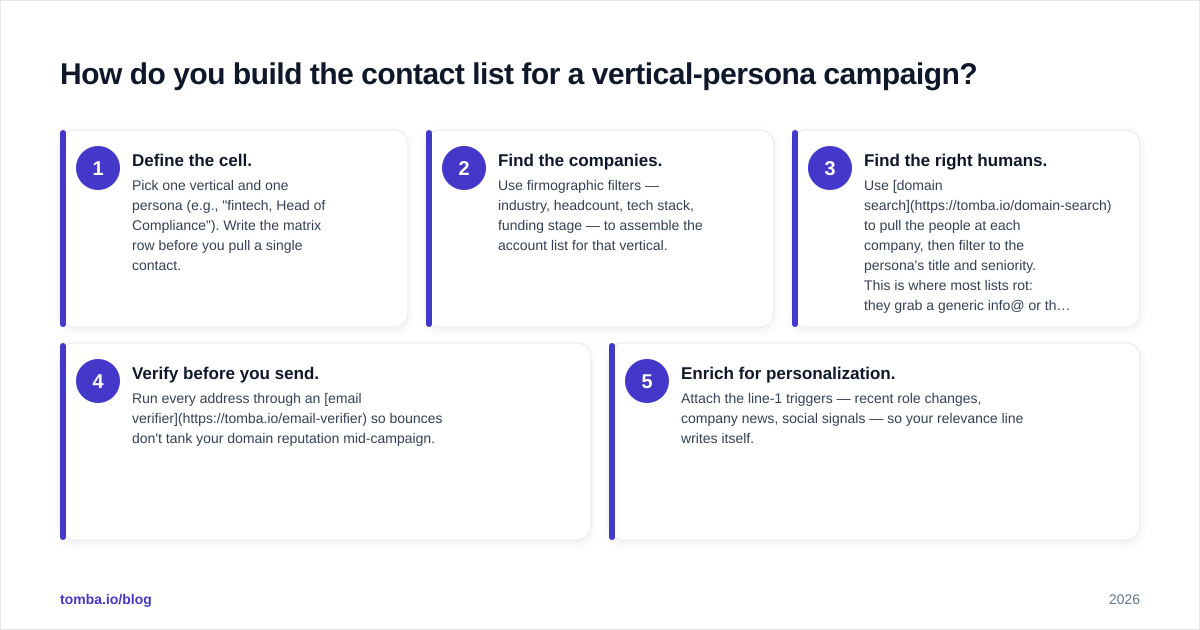
A repeatable workflow:
- Define the cell. Pick one vertical and one persona (e.g., "fintech, Head of Compliance"). Write the matrix row before you pull a single contact.
- Find the companies. Use firmographic filters — industry, headcount, tech stack, funding stage — to assemble the account list for that vertical.
- Find the right humans. Use domain search to pull the people at each company, then filter to the persona's title and seniority. This is where most lists rot: they grab a generic info@ or the wrong department.
- Verify before you send. Run every address through an email verifier so bounces don't tank your domain reputation mid-campaign.
- Enrich for personalization. Attach the line-1 triggers — recent role changes, company news, social signals — so your relevance line writes itself.
The cost of skipping step 3 is invisible but brutal. You'll send a perfectly written "Head of Compliance" email to a software engineer because the data said "works at a fintech." Role accuracy is the hinge the whole strategy turns on.
How do you measure whether segmentation is working?#
Track metrics per segment, not per campaign. The whole point of a vertical × persona matrix is that it shows you which cells are hot and which are dead. A blended campaign average hides that completely.
Watch these by segment:
- Reply rate — the clearest relevance signal. Below 3–5% in a segment usually means the pain hook is off, not the copy.
- Positive reply rate — separate "interested" from "not now" and "unsubscribe." A high reply rate that's all rejections means you found the right person with the wrong message.
- Meeting-booked rate — the only number that pays rent.
- Bounce rate — keep it under ~2–3%; spikes mean your data or verification slipped.
When one cell over-performs, double down. Build more accounts in that vertical-persona pair before you expand to new ones. Most teams spread too wide too early. Gartner's research on B2B buying behavior reinforces why: buying groups are large and role-specific, so concentration beats breadth.

What are the most common mistakes?#
- Treating "decision maker" as a persona. It isn't one. A CFO and a VP of Eng are both decision-makers and share zero motivations.
- Personalizing the wrong layer. Spending an hour on a clever line 1 while line 2 (the pain) is generic. Line 2 does the heavy lifting; get the matrix right first.
- One vertical, many personas, same email. You picked an industry but blasted every title with identical copy. Half your sends are off-angle by design.
- Skipping verification to "save time." A 12% bounce rate doesn't just waste sends — it flags your domain to providers and suppresses your good emails too.
- Never retiring dead cells. If a vertical-persona pair has sent 300 emails at a 0.5% reply rate, stop. Move that budget to a cell that's converting.
- Over-templating the trigger. "I saw your company is in {{industry}}" is not personalization; it's a mail-merge confession. The trigger has to be specific enough that it couldn't apply to anyone else.
How many segments should you actually run?#
Start narrow. Pick your two strongest verticals and the single persona who signs off in each — four cells at most. Prove the message, hit a reply rate you're happy with, then expand one cell at a time. A focused operator running four sharp segments will beat a team running twenty blurry ones every quarter, because each new cell compounds your library of proven frames and proof points.
The mature version of this is a living matrix. Every won deal feeds a new proof point into its cell. Every dead cell gets cut. Every new vertical you enter starts from the closest existing frame. Over a year, that library becomes a genuine moat — the kind competitors can't copy, because it's built from your actual results.
Where Tomba fits#
Your cold email verticals and personas are only as good as the contact data behind them, so start there. Use the Tomba Email Finder to source role-accurate contacts for each vertical-persona cell. Pair it with the email verifier to protect deliverability, and enrich each prospect with the signals that make line 1 write itself. Plans start free with 25 searches a month, with paid tiers from $49/mo on the Tomba pricing page when you're ready to scale a full matrix. Build the segment first, send the email second — that order is the whole game.
Ready to find emails that actually work?
Join 150,000+ professionals who stopped guessing and started sending. Free credits on signup — no credit card required.
Get the Tomba newsletter
Practical outbound tactics and product updates — once every two weeks.
About the author