Sales Campaign Copy in 2026: Frameworks, Templates & Examples
A practical playbook for writing sales campaign copy that books meetings in 2026 — frameworks, real templates, a sequence map, and the metrics that prove it works.
TL;DR
- Sales campaign copy is the connected set of messages — emails, LinkedIn touches, call scripts — that move one segment of buyers toward a single action, not a pile of one-off blasts.
- Win on relevance before cleverness: tight segmentation and a clear trigger beat any subject-line trick.
- Use a repeatable framework (PAS, BAB, or the 4-line cold email) so every rep ships consistent copy instead of reinventing it per send.
- A campaign is a sequence: 4–6 touches across channels, each adding a new angle — never the same pitch louder.
- Measure reply rate and positive-reply rate, not opens. Clean data and a verified list do more for conversions than word choice.
What is sales campaign copy?#
Sales campaign copy is the messaging that powers a coordinated, multi-touch outreach push aimed at one audience and one outcome. Think of it like a film script versus a single line of dialogue. A one-off cold email is a line. A campaign is the whole script — every scene (touch) builds on the last, the tension rises, and there's a clear closing shot (your call to action).
The distinction matters because buyers rarely convert on touch one. They convert when a sequence has earned enough relevance and credibility that replying feels low-risk. Campaign copy is engineered for that arc: the first email opens a loop, the follow-ups close it with proof, urgency, or a softer ask.
Three properties separate campaign copy from generic outreach:
- One segment, one promise. You write to "VP of RevOps at 50–200 person SaaS companies who just hired SDRs," not "decision-makers."
- A through-line. Every touch references the same core problem so the prospect recognizes you by touch three.
- A measurable action. Book a call, reply "yes," claim an audit — singular and unambiguous.
Why does most sales campaign copy fail?#
Most campaigns fail before a single word is written — they fail at targeting and data. You can have flawless copy, but if it lands in the wrong inbox or an invalid address, conversion is mathematically capped near zero. Before optimizing sentences, make sure you're emailing real, relevant people: pull contacts with an email finder, then run the list through an email verifier so bounces don't wreck your sender reputation.
When the data is solid, copy still fails for predictable reasons:
- It's about you. "We're a leading platform that empowers teams to..." Nobody replies to a brochure.
- No trigger. There's no reason you're reaching out now, so it reads as random.
- One angle, repeated. The follow-ups just say "bumping this" — adding volume, not value.
- A heavy first ask. "Can we hop on a 30-minute call this week?" to a stranger is a marriage proposal on a first date.
The fix is rarely "be more creative." It's "be more relevant." That's the difference between a batch blast and a campaign.
What frameworks make writing sales campaign copy faster?#
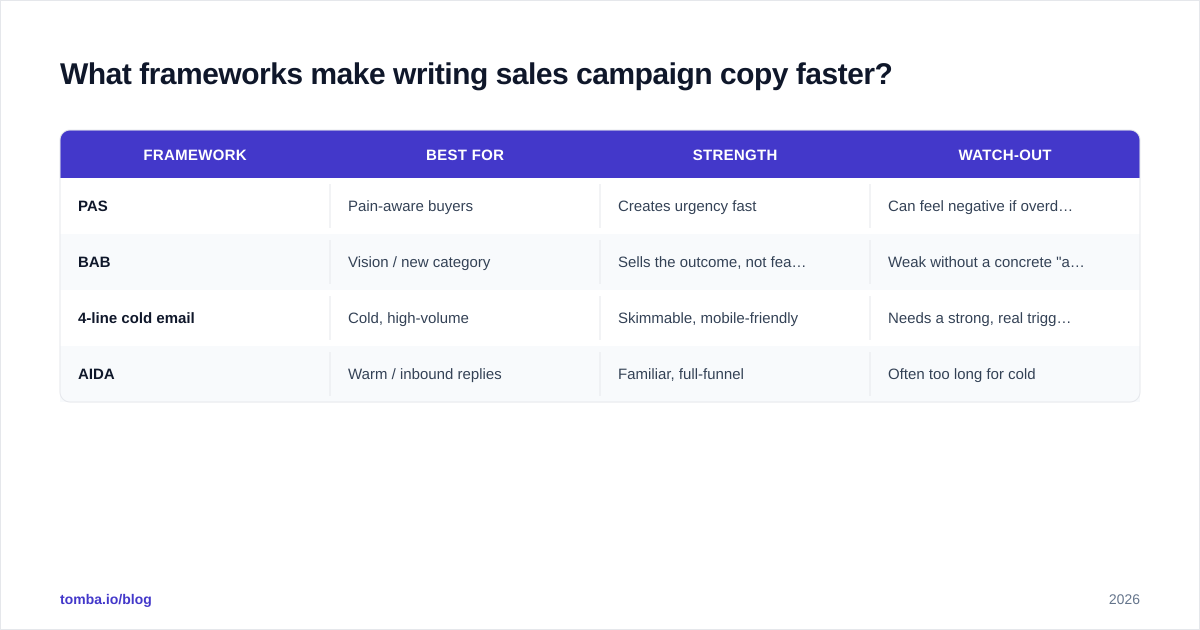
Frameworks turn copywriting from a blank-page problem into fill-in-the-blanks. They're like recipe cards: you still cook, but you're not guessing the steps. Here are the three that carry most B2B campaigns.
PAS — Problem, Agitate, Solution. Name the prospect's problem, twist the knife on its cost, then position your offer as relief. Best for pain-aware buyers.
BAB — Before, After, Bridge. Paint their current state, paint the better future state, then show your product as the bridge. Best for vision-led or category-creation sells.
The 4-line cold email. Observation (a specific trigger) → problem it implies → one-line proof → soft CTA. Best for cold, high-volume top-of-funnel.
Here's how they compare in practice:
| Framework | Best for | Strength | Watch-out |
|---|---|---|---|
| PAS | Pain-aware buyers | Creates urgency fast | Can feel negative if overdone |
| BAB | Vision / new category | Sells the outcome, not features | Weak without a concrete "after" |
| 4-line cold email | Cold, high-volume | Skimmable, mobile-friendly | Needs a strong, real trigger |
| AIDA | Warm / inbound replies | Familiar, full-funnel | Often too long for cold |
You don't need to memorize all of them. Pick one per campaign, write every touch in that voice, and you'll ship faster with more consistency. If you want a head start, the cold email templates library gives you framework-shaped skeletons you can adapt per segment.
How do you structure a multi-touch campaign sequence?#
A campaign is a sequence, and the copy's job changes at each touch. The mistake is writing five versions of the same email. Instead, each touch should introduce a new reason to care.
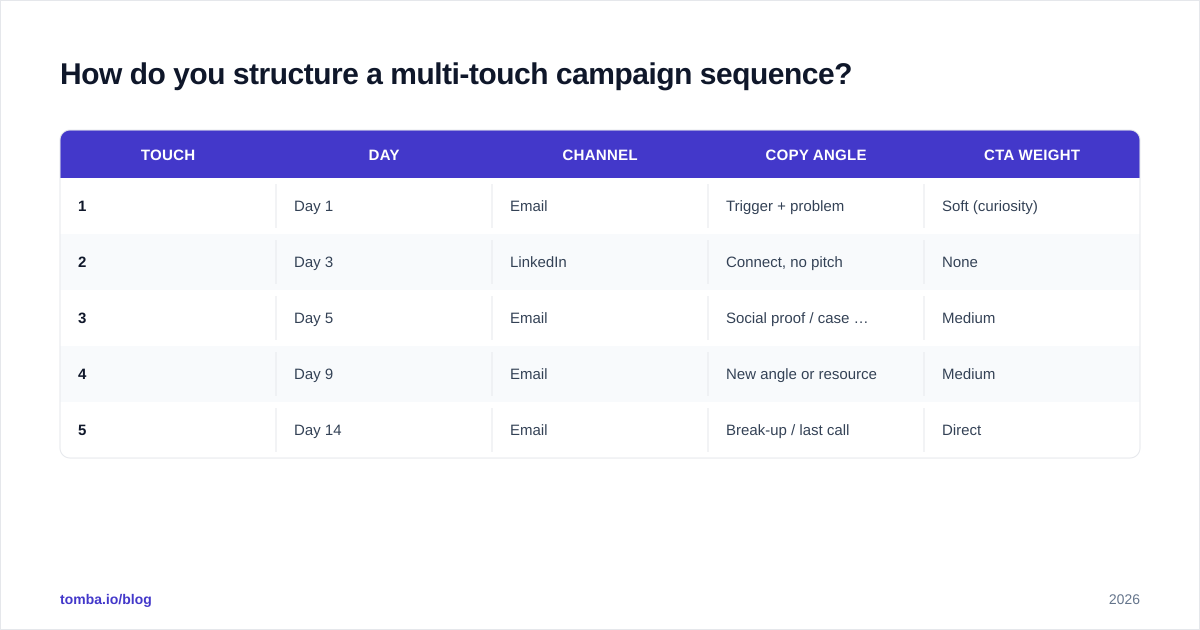
Here's a proven 5-touch structure across email and LinkedIn:
| Touch | Day | Channel | Copy angle | CTA weight |
|---|---|---|---|---|
| 1 | Day 1 | Trigger + problem | Soft (curiosity) | |
| 2 | Day 3 | Connect, no pitch | None | |
| 3 | Day 5 | Social proof / case study | Medium | |
| 4 | Day 9 | New angle or resource | Medium | |
| 5 | Day 14 | Break-up / last call | Direct |
The break-up email is the quiet workhorse — telling someone you'll stop reaching out often surfaces the "wait, actually..." reply. Keep the whole sequence to 4–6 touches; past that, reply rates fall and spam complaints climb. If you're building LinkedIn into the mix, pair your sends with verified contact data using the LinkedIn finder so your connection requests and emails point to the same real person.
For deeper context on what counts as a healthy response rate across a sequence, benchmark against your own segments rather than vanity averages — a niche enterprise list will convert differently than SMB.
What does good sales campaign copy actually look like?#
Templates beat theory. Here are two touches you can adapt today. Replace the brackets with real, specific details — the specificity is the whole point.
Touch 1 — 4-line cold email (PAS-flavored)
Subject: {{first_name}}, your new SDRs + ramp time
Hi {{first_name}} — saw {{company}} added three SDRs last month.
Most teams that scale headcount fast hit the same wall: reps burn their first 60 days on bad-fit lists instead of selling.
We helped {{similar_company}} cut list-building time 70% and book 22% more meetings in a quarter.
Worth a quick look? Happy to send the 2-minute breakdown — no call needed.
Touch 5 — break-up email
Subject: closing the loop
Hi {{first_name}} — I've reached out a couple of times about {{problem}}, and haven't heard back, which usually means it's not a priority right now. Totally fair.
I'll stop here. If ramping your new reps faster becomes urgent, just reply "later" and I'll circle back next quarter.
Notice what both do: concrete trigger, one idea per touch, an ask that's lighter than "book a call," and zero adjectives about how great the seller is. If writing from scratch still stalls you, a cold email AI assistant can draft the first version against your framework — then you edit for voice and truth.
How do you personalize at scale without sounding like a robot?#
Personalization at scale is a data problem disguised as a writing problem. The trick isn't writing 500 unique emails — it's building copy that slots in a few high-signal variables, then making sure those variables are accurate.
Three tiers of personalization, cheapest to most expensive:
- Tier 1 — Segment-level. One message per tightly defined segment. Cheap, scales infinitely, and 80% of the lift comes from here.
- Tier 2 — Trigger-level. Insert a recent event: funding, a new hire, a product launch, a tech-stack change. This is where data enrichment earns its keep — it appends the firmographic and signal data that makes a line feel hand-written.
- Tier 3 — Manual. A genuinely researched first line for high-value accounts only. Reserve this for your top 10%.
The failure mode is fake personalization: "I loved your recent post!" with no specifics. Buyers spot it instantly, and it's worse than no personalization at all. If you can't say something specific and true, stay at the segment tier and let relevance — not flattery — carry the message.
To keep your variables clean, pull contacts and company fields straight from domain search, and verify before merge so a wrong name or dead address never auto-fills into a send.
How do you measure and improve sales campaign copy?#
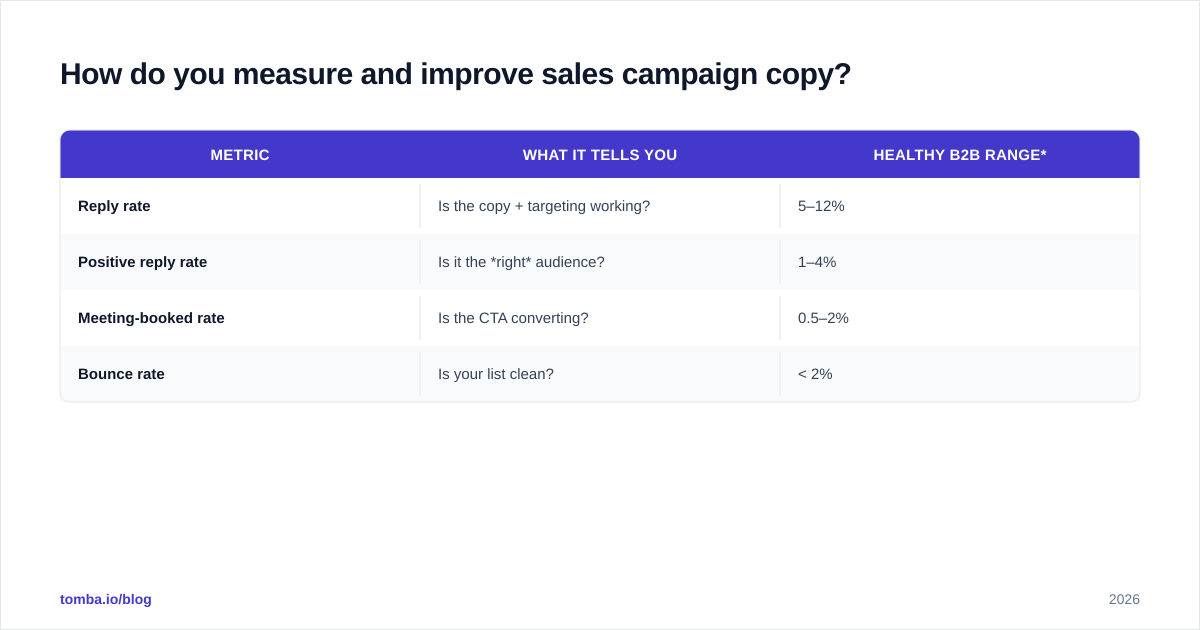
Measure replies and meetings, not opens — Apple Mail Privacy Protection inflated open rates into noise years ago. The metrics that actually map to revenue are simple.
| Metric | What it tells you | Healthy B2B range* |
|---|---|---|
| Reply rate | Is the copy + targeting working? | 5–12% |
| Positive reply rate | Is it the right audience? | 1–4% |
| Meeting-booked rate | Is the CTA converting? | 0.5–2% |
| Bounce rate | Is your list clean? | < 2% |
*Ranges vary by industry, segment, and list quality — treat them as directional, not gospel.
Improve copy with one disciplined habit: change one variable per test. New subject line or new opener or new CTA — never all three, or you'll never know what moved the number. Run each test until you have a meaningful sample (a few hundred sends per variant minimum) before declaring a winner.
And remember the unglamorous lever: a bounce rate above 2% can throttle your whole domain's sender reputation, which silently caps every campaign's reach regardless of copy quality. Verifying your list with a bulk email finder and verifier before launch protects the deliverability that all your clever sentences depend on.
For broader benchmarking on outbound performance and tooling, industry resources like G2's sales software category and HubSpot's sales statistics are useful neutral references to sanity-check your numbers.
What tools support a sales campaign copy workflow?#
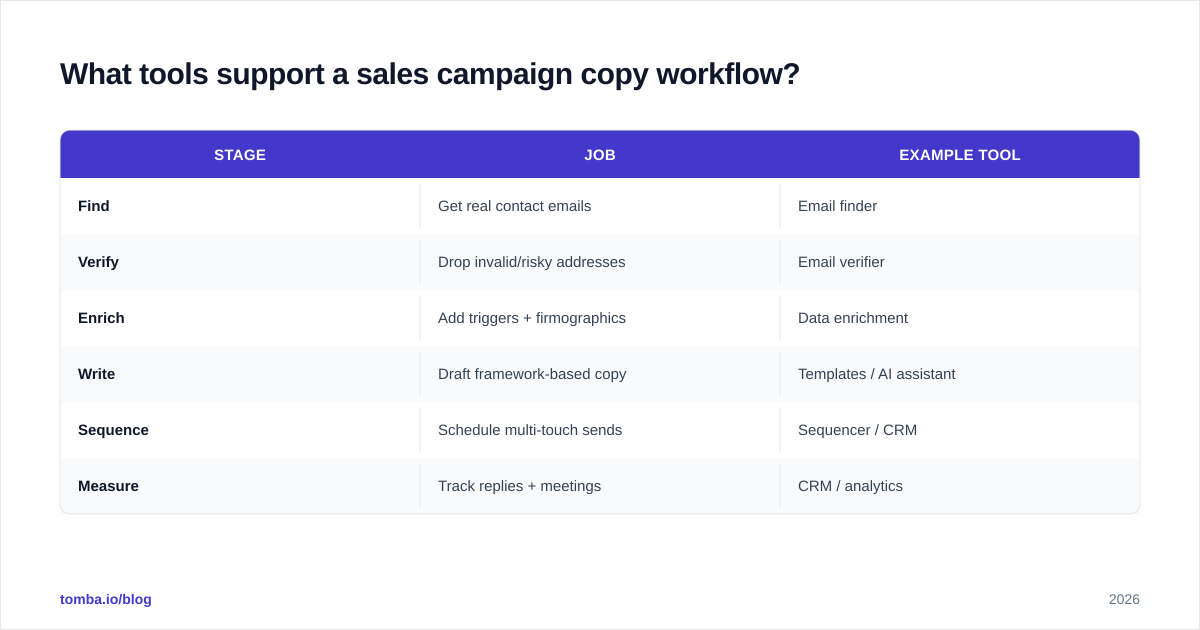
Copy is one stage in a pipeline: find contacts → verify → enrich → write → sequence → measure. The copy stage gets all the attention, but the stages around it determine whether the copy ever reaches a real human. A quick map of how the pieces fit, and where Tomba slots in:
| Stage | Job | Example tool |
|---|---|---|
| Find | Get real contact emails | Email finder |
| Verify | Drop invalid/risky addresses | Email verifier |
| Enrich | Add triggers + firmographics | Data enrichment |
| Write | Draft framework-based copy | Templates / AI assistant |
| Sequence | Schedule multi-touch sends | Sequencer / CRM |
| Measure | Track replies + meetings | CRM / analytics |
You can compare the data-side tooling against alternatives like Apollo or RocketReach if you're consolidating your stack — but the principle holds regardless of vendor: copy quality is necessary, never sufficient. Pricing for the data layer is transparent on the Tomba pricing page, with a free tier to test before you commit.
Bringing it together#
Great sales campaign copy is relevance, structured. Pick one segment, anchor every touch to a real trigger, write in a single framework, sequence 4–6 touches across channels, and measure replies over opens. Do that on a clean, verified list and you'll out-convert teams sending ten times the volume with "creative" one-offs.
The fastest fix most teams ignore is the foundation: who you're emailing and whether the address is real. Start there. Use the Tomba Email Finder to build accurate, segmented contact lists by domain, name, or company — then point your best copy at people who can actually say yes. Spin up a free account, pull your first segment, and let your campaign copy do what it was written to do.
// get started
Find, verify and enrich your first contacts today
Start on the free plan with 25 searches a month, then scale when your team is ready.
Free plan · No credit card required · GDPR & CCPA
// about the author