B2B Lead Generation in 2026: The Complete Sales Hub Playbook
A practical, no-fluff playbook for building a B2B lead generation engine in 2026 — sourcing, enrichment, scoring, and the tools that actually move pipeline.
Lead generation is the part of B2B sales everyone says they're good at and almost nobody measures honestly. You can buy a million contacts in an afternoon, and your reply rate will still tell the truth: most of those records are noise. This playbook is about building the opposite — a lead generation engine that produces fewer, cleaner, better-fit leads on a schedule you can forecast against.
TL;DR#
- B2B lead generation in 2026 is a data problem first, a creative problem second. Targeting and data quality decide 80% of your outcome before a single email is sent.
- Define a sharp ICP, source contacts against it, then enrich and verify — skipping the verify step is the single most common reason outbound underperforms.
- Score leads on fit + intent, not vanity signals, so reps spend time on the 20% of records that convert.
- Inbound and outbound are one funnel, not two teams — the lead from a webinar and the lead from a cold sequence both need the same enrichment and routing.
- Tooling matters, but accuracy and deliverability matter more than feature lists. A cheap list that bounces costs more than a precise one that lands.
What is B2B lead generation, really?#
B2B lead generation is the process of identifying companies and people who match your ideal customer, capturing a way to reach them, and qualifying them enough to hand to sales. That's it. Everything else — ads, content, cold email, events, intent data — is just a different doorway into that same hallway.
Think of it like fishing. Buying a giant generic list is casting a net into the open ocean and hoping. A real lead gen engine is knowing which lake holds the fish you want, what they bite on, and showing up at the right hour. The net feels productive because you pull in volume. The targeted approach feels slow until you count what's actually in the bucket.
The reason this distinction matters more in 2026 than five years ago: inbox providers and buyers have both gotten ruthless. Spam filters punish low-quality sending, and prospects ignore anything that smells like a blast. Volume without precision now actively hurts you — it burns your sending domain and your reputation at the same time.
What are the main B2B lead generation channels?#
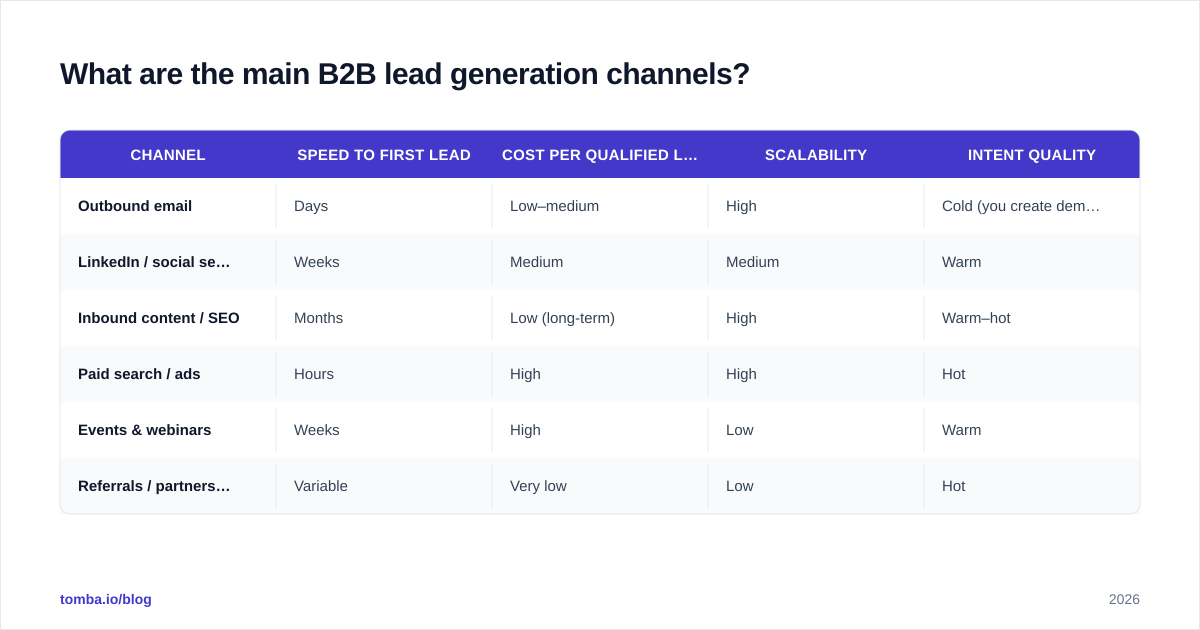
There's no single best channel — there's the best mix for your motion. Here's how the major channels actually compare on the metrics that decide where to put budget.
| Channel | Speed to first lead | Cost per qualified lead | Scalability | Intent quality |
|---|---|---|---|---|
| Outbound email | Days | Low–medium | High | Cold (you create demand) |
| LinkedIn / social selling | Weeks | Medium | Medium | Warm |
| Inbound content / SEO | Months | Low (long-term) | High | Warm–hot |
| Paid search / ads | Hours | High | High | Hot |
| Events & webinars | Weeks | High | Low | Warm |
| Referrals / partnerships | Variable | Very low | Low | Hot |
Most teams over-index on whichever channel their founder happens to like. The disciplined move is to run two channels well rather than five channels badly. For a new outbound motion, cold email plus LinkedIn is the highest-leverage pair: email gives you scale and measurable reply data, LinkedIn gives you a warmer touch and a face to the name.
If you want a deeper breakdown of where these channels sit in a modern pipeline, the HubSpot research on lead generation benchmarks is a reasonable industry baseline, and G2's category data is useful for seeing which tools real buyers rate per channel.
How do you build an ideal customer profile (ICP)?#
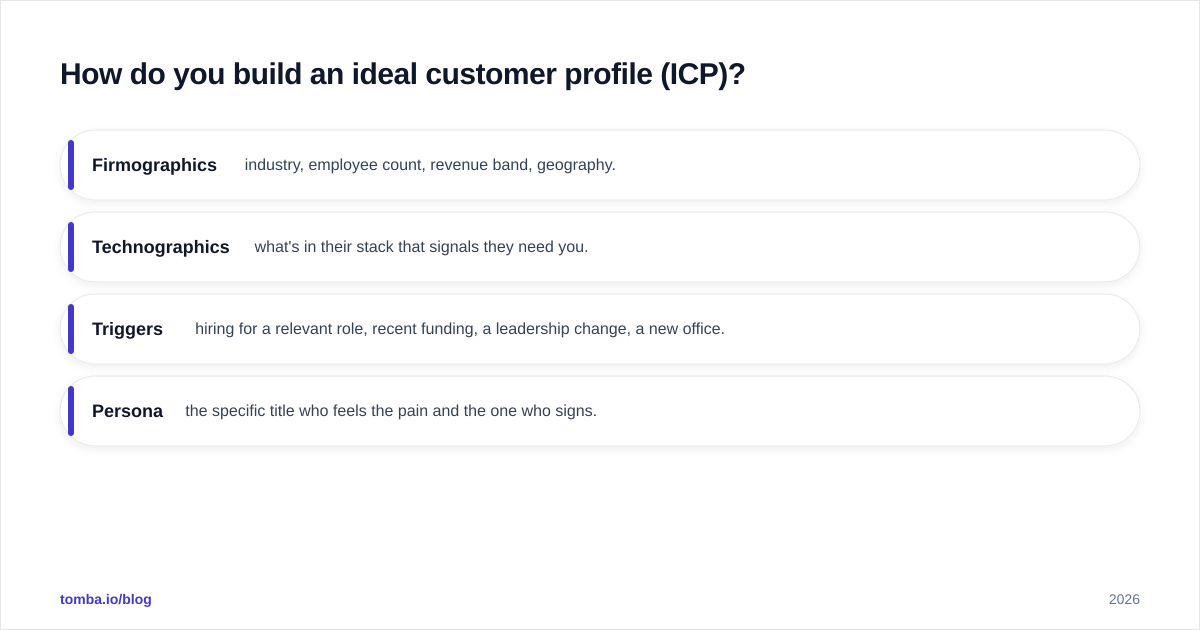
Start with your best existing customers and reverse-engineer them. Not your biggest logos — your best ones: high retention, fast sales cycle, low support burden, ones who'd genuinely be upset if you disappeared. Those accounts encode the pattern you want to clone.
Pull together the shared attributes:
- Firmographics — industry, employee count, revenue band, geography.
- Technographics — what's in their stack that signals they need you.
- Triggers — hiring for a relevant role, recent funding, a leadership change, a new office.
- Persona — the specific title who feels the pain and the one who signs.
The output isn't a vague paragraph. It's a filter precise enough that someone on your team could look at a company and say "yes, that's us" or "no" in ten seconds. A blurry ICP is why so much lead gen spend evaporates — you can't source against a target you can't describe.
How do sourcing, enrichment, and verification fit together?#
These three steps are the actual machinery of lead generation, and the order matters.
Sourcing is finding the right people inside your ICP accounts. This is where a tool like an email finder earns its keep — you give it a company domain and a name, it returns the professional address. If you're targeting whole organizations, domain search returns every reachable contact at a company so you can pick the right personas instead of guessing.
Enrichment fills in the gaps. A name and email aren't enough to personalize or route a lead. You want title, seniority, location, company size, and ideally a LinkedIn profile. Good data enrichment turns a thin record into one your reps can act on and your CRM can score.
Verification is the step everyone skips and everyone regrets. Even fresh data decays — people change jobs constantly, and catch-all domains hide invalid addresses. Running every address through an email verifier before you send protects your sending reputation and your numbers. A 3% bounce rate is the rough line where mailbox providers start throttling you; clean data keeps you under it.
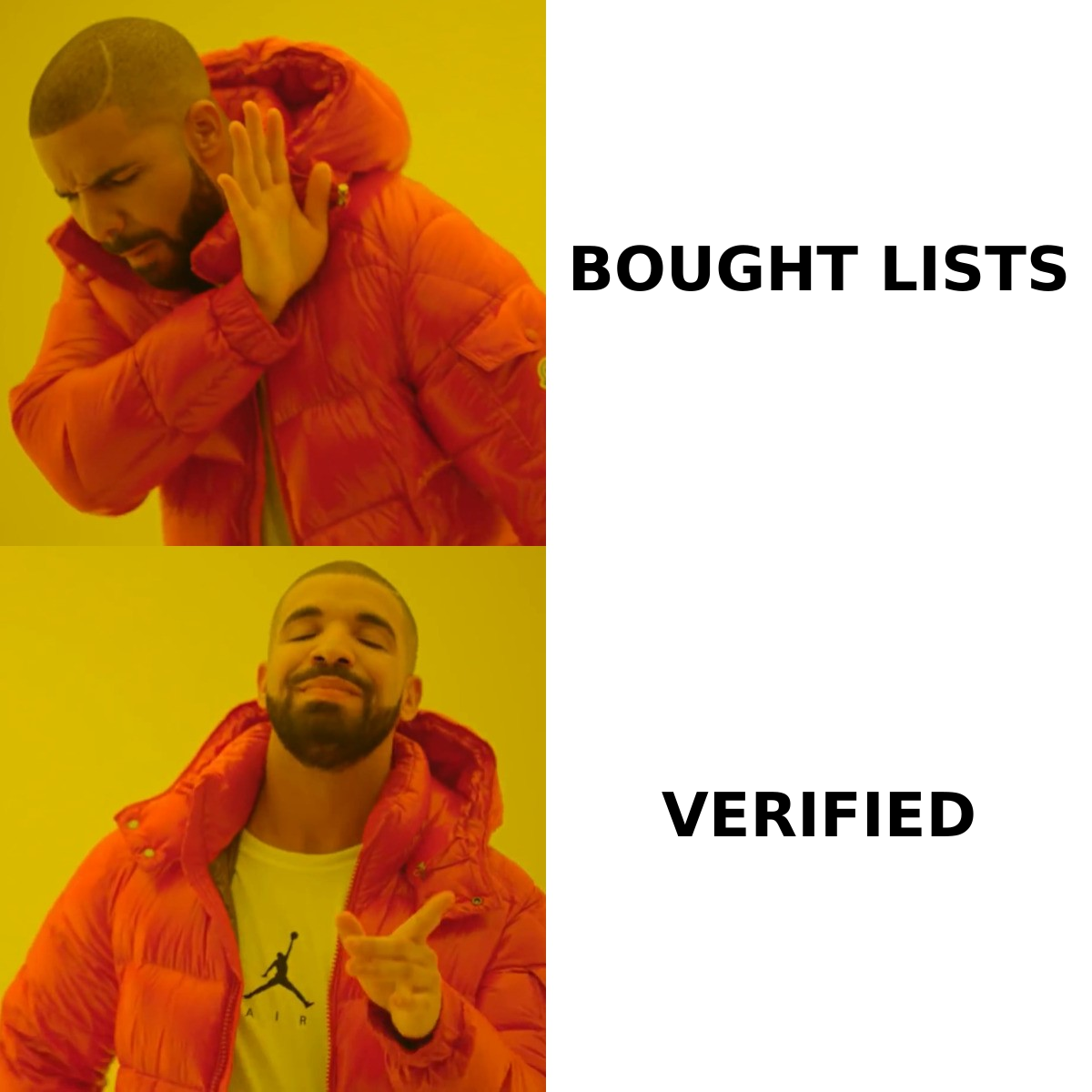
Here's the trap to avoid: buying a pre-built "verified" list and trusting the label. Lists are sold to many buyers, age the moment they're exported, and "verified" rarely means recently verified. Sourcing against your own ICP and verifying at send time beats any off-the-shelf database for accuracy.
How should you score and qualify B2B leads?#
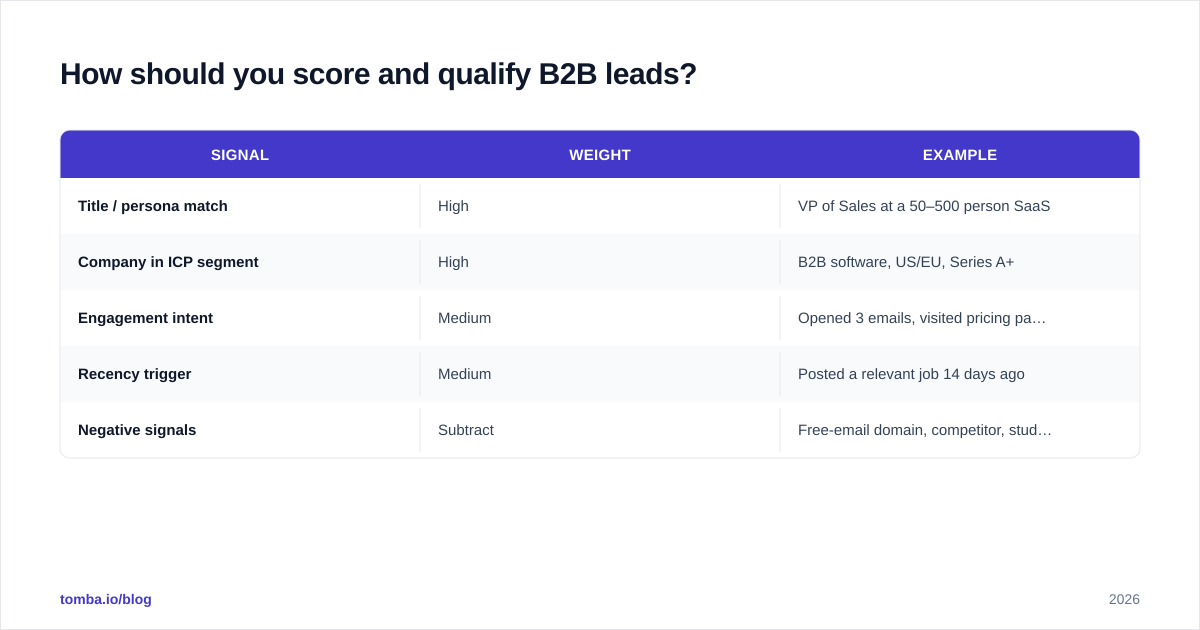
Score on two axes: fit (how well they match your ICP) and intent (how much they're acting like a buyer). A lead that's high on both goes to a rep today. High fit, low intent goes to nurture. High intent, low fit usually goes nowhere — resist the temptation, it's a time sink dressed as opportunity.
A simple, defensible model:
| Signal | Weight | Example |
|---|---|---|
| Title / persona match | High | VP of Sales at a 50–500 person SaaS |
| Company in ICP segment | High | B2B software, US/EU, Series A+ |
| Engagement intent | Medium | Opened 3 emails, visited pricing page |
| Recency trigger | Medium | Posted a relevant job 14 days ago |
| Negative signals | Subtract | Free-email domain, competitor, student |
Keep it transparent. A scoring model nobody on the team understands gets ignored, and an ignored model is worse than no model because it creates false confidence. Start with five rules you can explain in a sentence each, watch which scores actually predict closed deals, and tune from there.
The qualification framework you layer on top — BANT, MEDDIC, whatever your team uses — is downstream of this. Scoring decides who gets a conversation; qualification decides how serious that conversation is.
Inbound vs outbound: which should you prioritize?#
Wrong question. The right framing is: inbound and outbound feed the same pipeline and should share the same data layer.
The lead who downloads your ebook and the lead you found cold both need the same treatment — enrich them, verify the address, score them, route them. Teams that run inbound and outbound as separate silos end up with two CRMs' worth of duplicated, inconsistent records and reps who don't know which leads are already in motion.
That said, sequencing matters for early-stage teams:
- No brand yet, need pipeline this quarter? Outbound first. You control the volume and the timing.
- Have traffic and content but slow conversion? Fix inbound capture and routing before scaling spend.
- Both working? Build the shared enrichment and dedup layer so they stop stepping on each other.
The unifying principle is that every lead, regardless of door, hits the same enrichment and verification pipeline before a human touches it. That's what keeps your B2B database clean enough to forecast against.
What does a 2026 lead generation tech stack look like?#
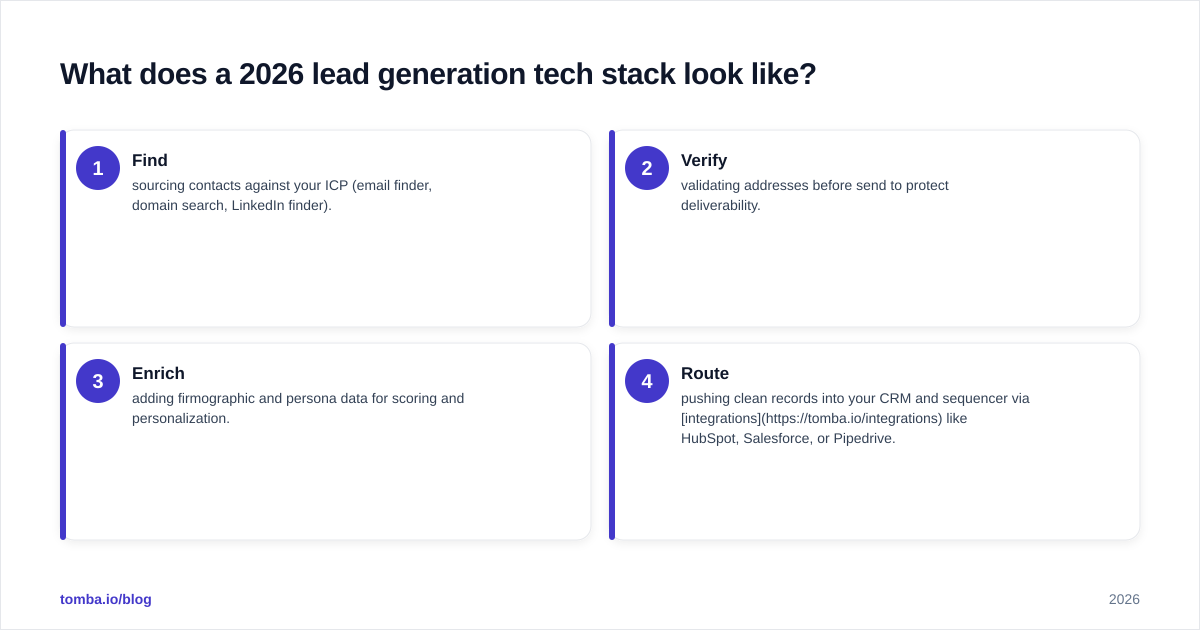
You need four capabilities, and you can get them from one platform or several. The capabilities, not the logos, are what matter:
- Find — sourcing contacts against your ICP (email finder, domain search, LinkedIn finder).
- Verify — validating addresses before send to protect deliverability.
- Enrich — adding firmographic and persona data for scoring and personalization.
- Route — pushing clean records into your CRM and sequencer via integrations like HubSpot, Salesforce, or Pipedrive.
Where teams waste money is buying five point tools that each do one of these, then paying engineers to glue them together. Consolidating find + verify + enrich into one source — with one Tomba API call or a bulk email finder run — removes the integration tax and keeps your data consistent. Check the Tomba pricing tiers against your monthly lead volume rather than your feature wishlist; most teams need far fewer credits than they think once they stop blasting.
A quick reality check on tool selection, because the market is loud: the two things that actually move your numbers are match accuracy (does the tool find a correct, current address) and deliverability impact (does verification keep your bounce rate low). Everything else — UI polish, integration count, AI features — is secondary. When you evaluate vendors, the analyst coverage from firms like Gartner is useful for understanding the category, but your own bounce-rate and reply-rate test on 500 real contacts tells you more than any quadrant.
What metrics actually tell you lead generation is working?#
Track the funnel, not the activity. Activity metrics (emails sent, calls made) feel like progress but reward motion over outcomes. Watch these instead:
- Lead-to-MQL rate — are the leads you generate good enough to qualify?
- MQL-to-SQL rate — does sales agree they're real?
- Bounce rate — your data-quality canary; over 3% means fix sourcing now.
- Reply and positive-reply rate — the honest verdict on targeting and message.
- Cost per SQL — the number that lets you compare channels apples-to-apples.
If only one of these can be your north star, make it cost per SQL. It forces every upstream decision — channel, data source, scoring threshold — to justify itself against pipeline that sales actually accepts.
Putting the engine together#
A working 2026 lead generation engine is unglamorous: a sharp ICP, contacts sourced against it, every address verified, records enriched and scored, clean data routed to reps, and a weekly look at funnel conversion to find the leak. No single trick, no growth hack. Just a loop you run consistently while competitors chase the next channel.
The teams that win aren't the ones with the most leads. They're the ones whose leads are real, current, and well-matched — so every downstream dollar of sales effort lands on someone who might actually buy.
Ready to build the sourcing layer? Start with the Tomba Email Finder — find professional email addresses by domain, name, or company, verify them in the same workflow, and push clean, enriched leads straight into your CRM. The free tier gives you 25 searches a month to test accuracy on your own ICP before you commit. Generate leads you can actually forecast against, instead of a list you'll apologize to your sending domain for.
Ready to find emails that actually work?
Join 150,000+ professionals who stopped guessing and started sending. Free credits on signup — no credit card required.
Get the Tomba newsletter
Practical outbound tactics and product updates — once every two weeks.
About the author