Vertical Lead Generation in 2026: A B2B Playbook by Industry
Spray-and-pray lists are dead. Here's how to build vertical lead generation engines that win SaaS, fintech, healthcare, and manufacturing pipelines in 2026 — with a repeatable framework and tooling.
TL;DR
- Vertical lead generation means building a separate prospecting motion for each industry you sell into — distinct ICP, messaging, data sources, and channels — instead of one generic list for everyone.
- Verticalized campaigns consistently out-convert horizontal blasts because the pain, vocabulary, and buying committee differ wildly between, say, a fintech CFO and a manufacturing plant manager.
- The framework below has four steps: pick winnable verticals, define the vertical ICP, source vertical-specific data, then build a per-vertical outreach engine.
- Data quality is the bottleneck. You need accurate, role-targeted contacts per industry — which is where a domain search plus email verifier workflow earns its keep.
- Start narrow. Two verticals done well beat eight done lazily.
What is vertical lead generation?#
Vertical lead generation is the practice of running a dedicated demand-gen and prospecting motion for each industry vertical you serve, rather than treating your total addressable market as one undifferentiated list.
Think of it like a restaurant deciding between a 200-item menu and three tasting menus built for specific diners. The giant menu looks like more opportunity, but the kitchen does everything poorly. The tasting menus feel narrow, yet every dish lands because it was designed for who's actually at the table. Horizontal lead generation is the 200-item menu. Vertical lead generation is the tasting menu — fewer targets, far higher conversion.
Technically, a "vertical" is a group of companies that share an industry, a regulatory environment, a tech stack, and a buying pattern: SaaS, fintech, healthcare, logistics, professional services, manufacturing, and so on. Each one has its own language. A line that makes a fintech compliance lead lean in ("SOC 2-ready audit trails") means nothing to a manufacturing ops director who cares about machine uptime.
If you want the textbook definition of the downstream goal, a qualified contact who fits the vertical and shows intent becomes a marketing qualified lead — but the path to that MQL is completely different per industry.
Why does verticalized outreach beat broad lists?#
Because relevance compounds at every step of the funnel. A broad list might get a 1% reply rate; a tight vertical list with industry-specific copy routinely doubles or triples that. The reason is mechanical, not magical:
- Messaging resonance. You can name the exact workflow, tool, or regulation the prospect lives with daily. Specificity is the cheapest credibility you can buy.
- Referenceability. "We helped three other regional credit unions cut onboarding time 40%" only works if you're emailing credit unions. Social proof has to match the vertical to land.
- Channel fit. Manufacturing buyers still answer the phone; developer-tools buyers live in Slack and GitHub. Verticalizing lets you put effort where that audience actually responds.
- Tighter feedback loops. When everyone on a campaign shares a context, your A/B results are clean. Mixed-vertical lists produce muddy data you can't learn from.
According to HubSpot's research on personalization, targeted, segmented outreach reliably outperforms generic sends — and a vertical is the most durable segment you can build, because an industry doesn't churn out of your ICP next quarter.

How do you choose which verticals to target?#
Conclusion first: pick verticals where you already have proof, a repeatable use case, and reachable contacts — then rank by winnability, not by size.
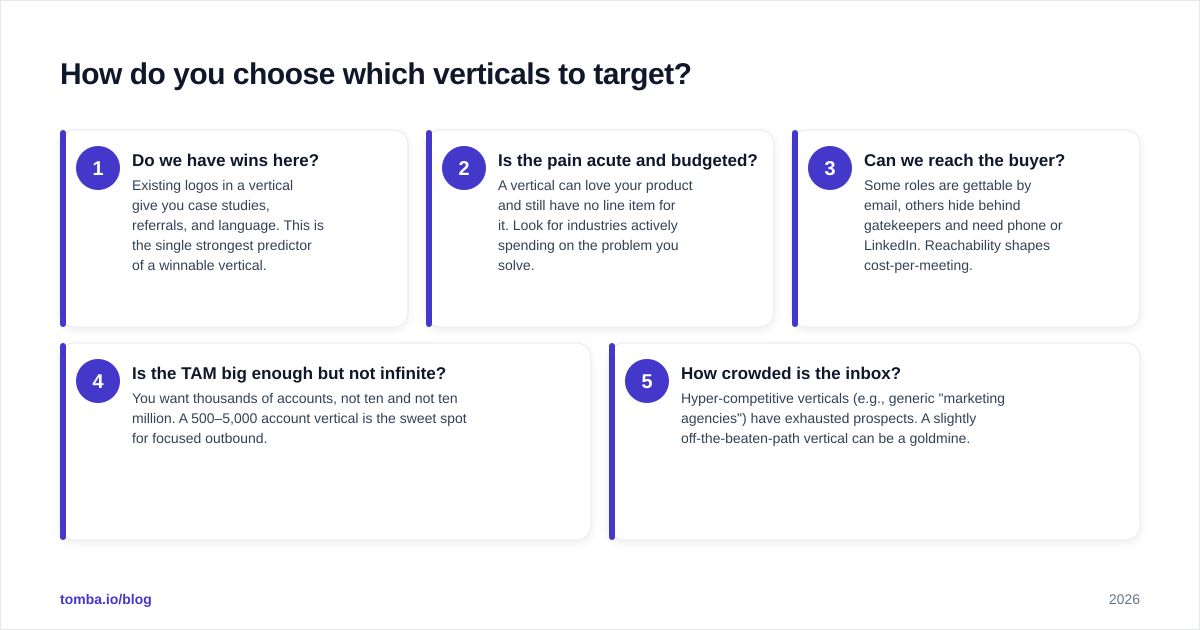
Run every candidate vertical through five questions:
- Do we have wins here? Existing logos in a vertical give you case studies, referrals, and language. This is the single strongest predictor of a winnable vertical.
- Is the pain acute and budgeted? A vertical can love your product and still have no line item for it. Look for industries actively spending on the problem you solve.
- Can we reach the buyer? Some roles are gettable by email, others hide behind gatekeepers and need phone or LinkedIn. Reachability shapes cost-per-meeting.
- Is the TAM big enough but not infinite? You want thousands of accounts, not ten and not ten million. A 500–5,000 account vertical is the sweet spot for focused outbound.
- How crowded is the inbox? Hyper-competitive verticals (e.g., generic "marketing agencies") have exhausted prospects. A slightly off-the-beaten-path vertical can be a goldmine.
Gartner's go-to-market guidance consistently points the same direction: concentration beats coverage for emerging and mid-market sellers. Score each vertical 1–5 on those five questions, and start with the top two.
What does a vertical-specific ICP look like?#
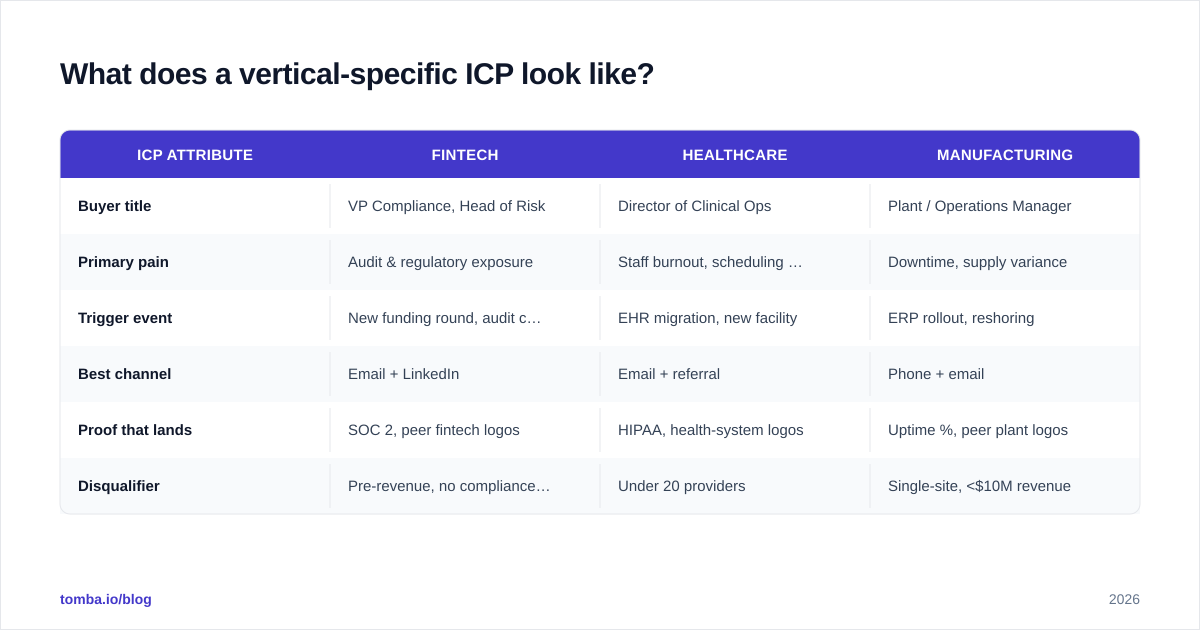
A horizontal ICP says "B2B companies, 50–500 employees, in North America." A vertical ICP is sharper on every axis because you've committed to one industry. Here's how the same product produces three different ICPs across three verticals.
| ICP attribute | Fintech | Healthcare | Manufacturing |
|---|---|---|---|
| Buyer title | VP Compliance, Head of Risk | Director of Clinical Ops | Plant / Operations Manager |
| Primary pain | Audit & regulatory exposure | Staff burnout, scheduling chaos | Downtime, supply variance |
| Trigger event | New funding round, audit cycle | EHR migration, new facility | ERP rollout, reshoring |
| Best channel | Email + LinkedIn | Email + referral | Phone + email |
| Proof that lands | SOC 2, peer fintech logos | HIPAA, health-system logos | Uptime %, peer plant logos |
| Disqualifier | Pre-revenue, no compliance team | Under 20 providers | Single-site, <$10M revenue |
Notice that the title, trigger, and channel all move. That's why one list can't serve all three — the shape of a good lead is different in each column. Build this table for every vertical before you write a single email.
Where do you source vertical lead data?#
You source it by layering three inputs: a firmographic filter to find the right companies, a role filter to find the right people, and a verification pass so you don't burn your domain on bad addresses.
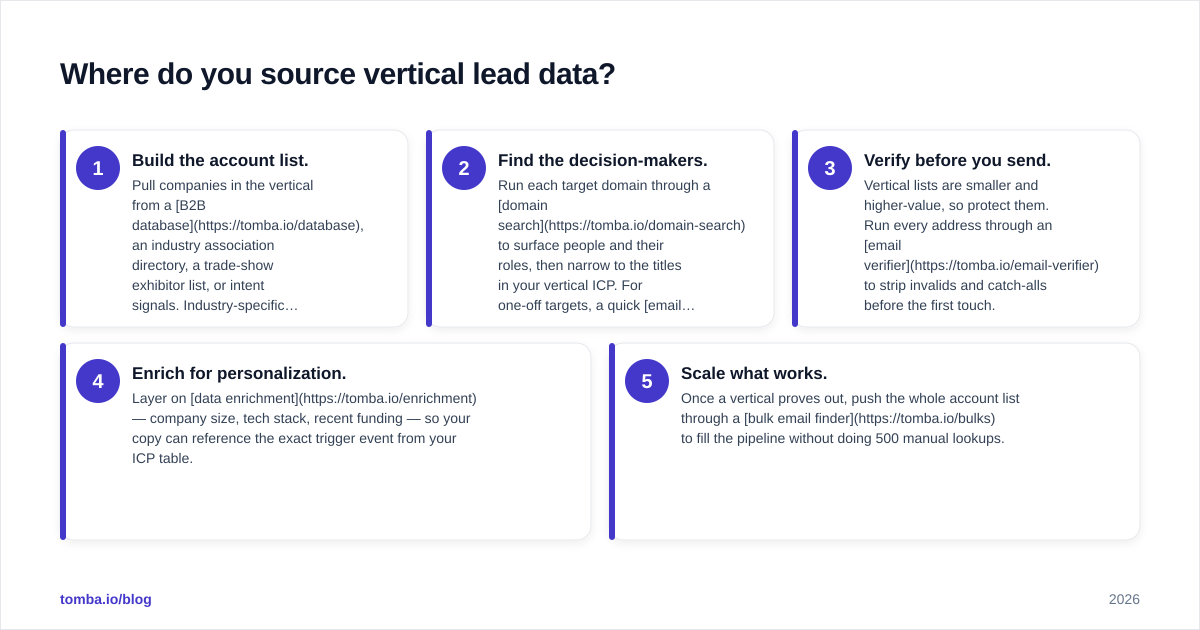
The practical workflow looks like this:
- Build the account list. Pull companies in the vertical from a B2B database, an industry association directory, a trade-show exhibitor list, or intent signals. Industry-specific sources (a fintech accelerator cohort, a hospital system directory) beat generic exports every time.
- Find the decision-makers. Run each target domain through a domain search to surface people and their roles, then narrow to the titles in your vertical ICP. For one-off targets, a quick email finder lookup by name and company works.
- Verify before you send. Vertical lists are smaller and higher-value, so protect them. Run every address through an email verifier to strip invalids and catch-alls before the first touch.
- Enrich for personalization. Layer on data enrichment — company size, tech stack, recent funding — so your copy can reference the exact trigger event from your ICP table.
- Scale what works. Once a vertical proves out, push the whole account list through a bulk email finder to fill the pipeline without doing 500 manual lookups.
The mistake teams make here is treating data sourcing as one universal step. In reality, the source changes per vertical — manufacturing lives in trade directories and ERP communities, while SaaS lives on GitHub, Product Hunt, and LinkedIn. Match the source to the industry.

How do you build the per-vertical outreach engine?#
Build one sequence per vertical, sharing structure but never sharing copy. The skeleton stays constant — touch one is a relevant problem, touch two is proof, touch three is a soft ask — but every sentence gets re-written in the vertical's vocabulary.
A few rules that hold across industries:
- Lead with their world, not your product. Open with the trigger event or pain from your ICP table. "Saw you just opened a second facility" beats "We're an AI platform."
- One proof point, matched to the vertical. Drop the most relevant peer logo or metric. Mismatched proof is worse than none.
- Pick the channel the vertical actually uses. For phone-heavy industries, pair email with a phone finder so reps can follow an email with a call the same day.
- Cap the verticals per rep. A rep juggling six verticals masters none. Two is plenty; three is the ceiling.
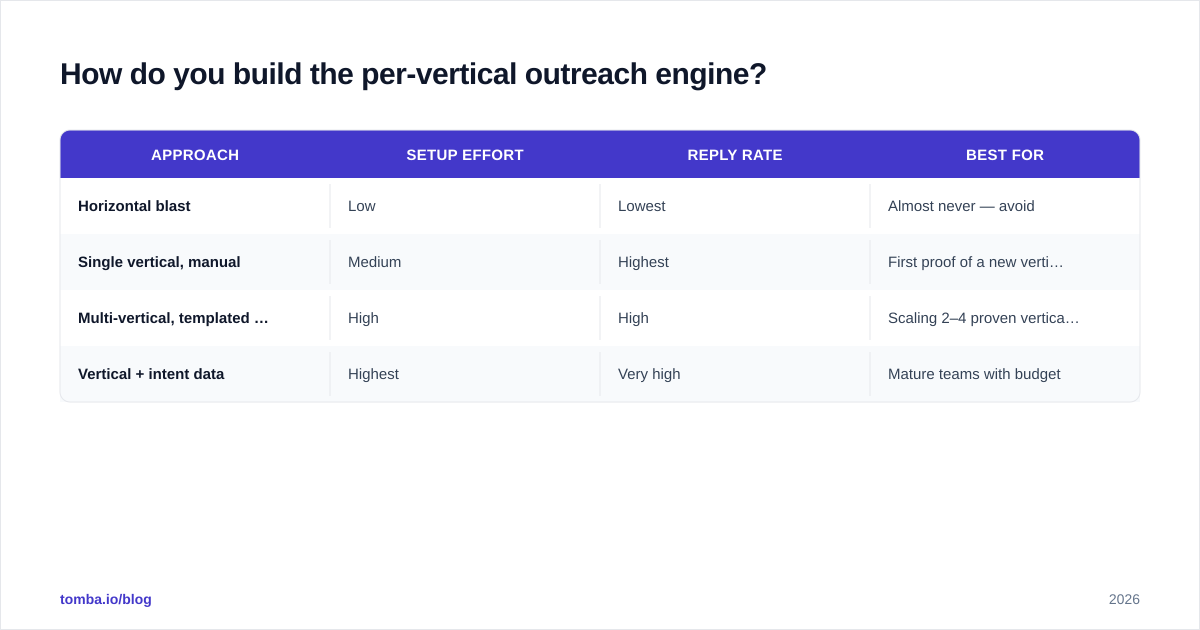
Here's how three common outbound approaches stack up once you commit to verticalization:
| Approach | Setup effort | Reply rate | Best for |
|---|---|---|---|
| Horizontal blast | Low | Lowest | Almost never — avoid |
| Single vertical, manual | Medium | Highest | First proof of a new vertical |
| Multi-vertical, templated + verified | High | High | Scaling 2–4 proven verticals |
| Vertical + intent data | Highest | Very high | Mature teams with budget |
The progression is the point: start in row two to prove a vertical by hand, then graduate to row three to scale it. Skipping straight to scale before you've proven the message is how teams burn good data on bad copy.
How do you measure and expand verticals?#
Measure each vertical as its own P&L: cost per qualified meeting, reply-to-meeting rate, and pipeline created. Average numbers across verticals will lie to you — a great fintech motion can hide a dead healthcare one, and vice versa.
Track these per vertical, weekly:
- Reply rate — your message-market fit signal. Below 3%? The copy or the list is wrong.
- Meeting rate — your targeting signal. Replies but no meetings means you're reaching the wrong title.
- Win rate — your fit signal. Meetings but no wins means the vertical may not actually need you. Compare against your overall win rate to spot weak verticals fast.
- Data decay — verticals rot at different speeds. Re-verify high-value lists quarterly.
Expand only after a vertical clears your benchmarks two months running. When you add the next one, clone the process, not the copy — fresh ICP table, fresh data source, fresh sequence. Sites like G2's category data are useful for sanity-checking which adjacent verticals are actively shopping for tools like yours before you commit reps to them.
A reasonable cadence: prove vertical one in Q1, add vertical two in Q2 while automating one, and so on. Steady compounding beats launching six at once and watching all six underperform.
What are the most common vertical lead-gen mistakes?#
- Calling a segment a vertical. "Companies that use Salesforce" is a segment, not an industry. Real verticals share regulation and buying patterns, not just a tool.
- Reusing horizontal copy. If you can swap the industry name in your email and it still reads fine, it wasn't verticalized.
- Skipping verification. Small, high-value lists make bounces expensive — one bad send to a 40-person target list can dent your sender reputation. Always run the email verifier first.
- Too many verticals, too soon. Focus is the entire advantage. Diluting it defeats the strategy.
- No vertical-level reporting. If you can't see each vertical's numbers separately, you can't kill the losers or double down on the winners.
Build your first vertical engine#
Vertical lead generation rewards focus and accurate data above everything else. Pick one winnable industry, write a sharp vertical ICP, and source contacts that actually fit — then verify before you ever hit send. The teams that win in 2026 aren't the ones with the biggest lists; they're the ones whose every touch reads like it was written for exactly one industry, because it was.
That accuracy starts at the data layer. Use the Tomba Email Finder to find the right decision-makers at every account in your target vertical — by name, company, or domain — then verify and enrich them before outreach. Start free with 25 searches, and scale to a paid plan (Starter at $49/mo) once your first vertical proves out. Build the engine for one industry, get it humming, then clone it for the next.
// get started
Find, verify and enrich your first contacts today
Start on the free plan with 25 searches a month, then scale when your team is ready.
Free plan · No credit card required · GDPR & CCPA
// about the author