Lead Management and Scoring: The Complete 2026 Playbook
Most sales teams lose deals not from a lack of leads, but from chasing the wrong ones. Here's how lead management and lead scoring fix that in 2026.
Lead Management and Scoring: The Complete 2026 Playbook
Your pipeline isn't empty. It's clogged. Reps spend hours on leads that were never going to buy while the one prospect ready to sign sits in a queue, untouched, until a competitor calls first. Lead management and lead scoring exist to solve exactly that problem: get the right lead to the right rep at the right moment, and let the rest cool off without burning anyone's time.
This guide walks through what lead scoring actually is, how to build a model that works, and how to wire it into a lead management process your team will follow.
TL;DR#
- Lead management is the end-to-end system for capturing, tracking, routing, and nurturing leads. Lead scoring is the ranking engine inside it that decides who gets attention first.
- A good score blends fit (does this person match your ICP?) and intent (are they showing buying signals?). Score them separately, then combine.
- Manual point-based models are easy to start; AI/predictive scoring wins at scale once you have clean historical data.
- Scoring is worthless without clean contact data. Enrich and verify before you score, or you'll route garbage fast.
- Review your model quarterly. Win-rate by score band is the only metric that proves it works.
What is lead management, and how does scoring fit in?#
Lead management is the closing routine of a restaurant kitchen: orders come in (leads captured), they get sorted by table and priority (routing and scoring), the kitchen preps the urgent ones first (sales follow-up), and slow tables get a check-in later (nurture). Skip the sorting step and every order gets cooked in the order it arrived — which is how the table ready to pay waits 40 minutes and walks out.
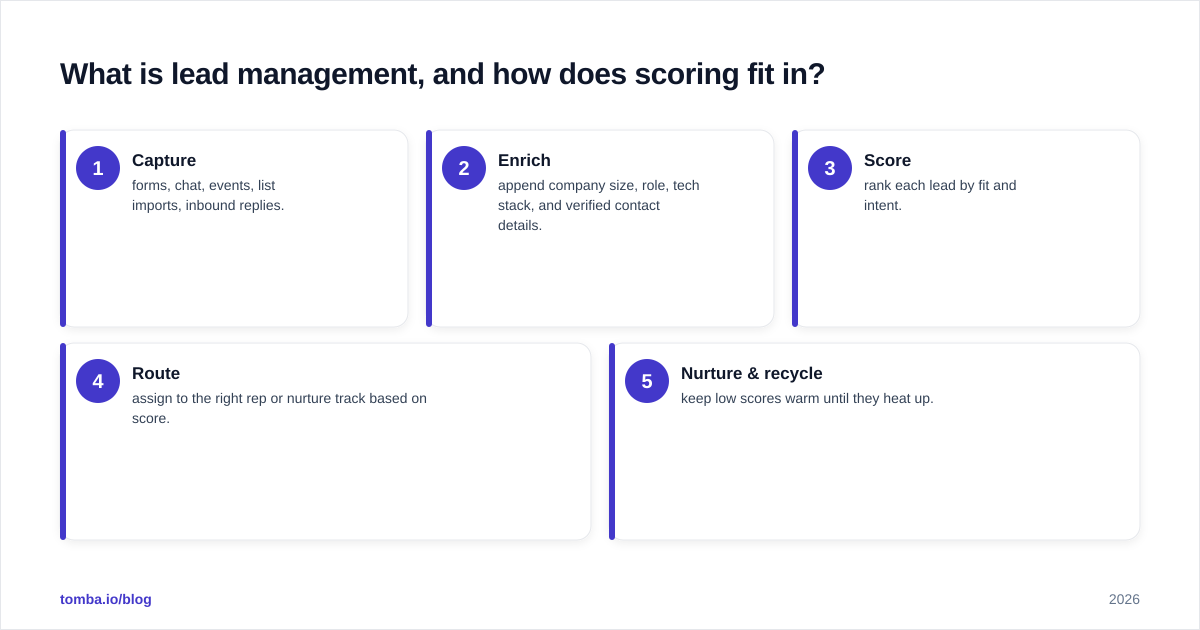
Technically, lead management covers five stages:
- Capture — forms, chat, events, list imports, inbound replies.
- Enrich — append company size, role, tech stack, and verified contact details.
- Score — rank each lead by fit and intent.
- Route — assign to the right rep or nurture track based on score.
- Nurture & recycle — keep low scores warm until they heat up.
Lead scoring is step three, but it quietly governs steps four and five. Get scoring right and routing becomes automatic. Get it wrong and your best reps drown in noise.
What is lead scoring?#
Lead scoring assigns a numeric value to each lead so your team can prioritize objectively instead of by gut feel. Instead of a rep guessing whether a downloaded ebook means buying intent, the model says "VP of Sales, 200-person SaaS company, visited pricing twice this week = 87/100. Call now."
There are two ingredients in almost every model:
- Fit (demographic/firmographic): Does this lead match your ideal customer profile? Job title, seniority, company size, industry, geography, revenue.
- Intent (behavioral): Is this lead acting like a buyer? Pricing-page views, demo requests, email replies, repeat visits, content downloads, free-trial signups.
A lead can score high on one axis and low on the other. A perfect-fit CFO who has never opened an email is a marketing problem. A scrappy intern hammering your pricing page is an intent signal attached to no budget. Scoring both axes separately — then combining — keeps you from confusing the two.
How do you build a lead scoring model?#
Start simple. A spreadsheet beats a stalled "AI project" every time. Here's a four-step build.
Step 1: Define your ICP from closed-won data#
Pull your last 50–100 won deals. What do they have in common? Company size, industry, title of the champion, region. Those shared traits become your positive fit signals. Look at closed-lost too — recurring traits there become negative signals (e.g., "student email domain" or "company size < 5").
Step 2: Assign points to fit attributes#
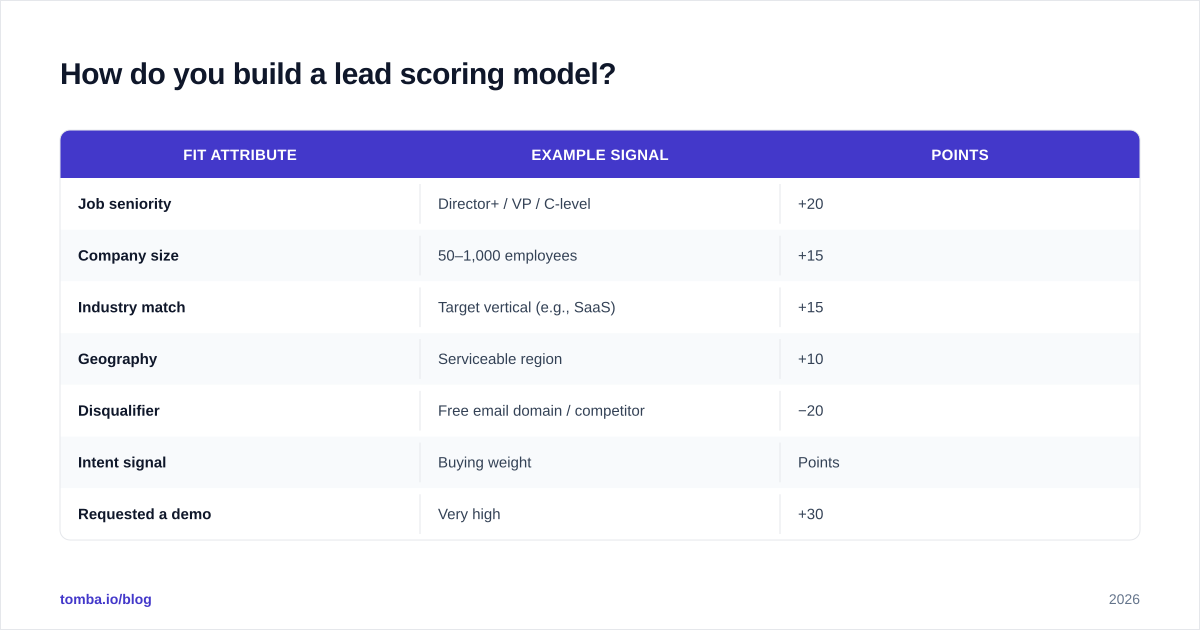
| Fit attribute | Example signal | Points |
|---|---|---|
| Job seniority | Director+ / VP / C-level | +20 |
| Company size | 50–1,000 employees | +15 |
| Industry match | Target vertical (e.g., SaaS) | +15 |
| Geography | Serviceable region | +10 |
| Disqualifier | Free email domain / competitor | −20 |
Step 3: Layer intent points on top#
| Intent signal | Buying weight | Points |
|---|---|---|
| Requested a demo | Very high | +30 |
| Viewed pricing 2+ times | High | +20 |
| Replied to a sales email | High | +18 |
| Opened 3+ emails in a week | Medium | +8 |
| No activity in 30 days | Decay | −15 |
Step 4: Set thresholds and route#
Define bands and what happens at each:
- 80–100 (Hot / MQL): route to a rep within minutes for same-day follow-up.
- 50–79 (Warm): add to a nurture sequence; rep touch within a few days.
- Below 50 (Cold): automated nurture only, revisit monthly.
For the formal definition of when a scored lead becomes sales-ready, see Tomba's breakdown of the marketing qualified lead and how it hands off into your CRM.
Manual scoring vs. predictive (AI) scoring: which should you use?#
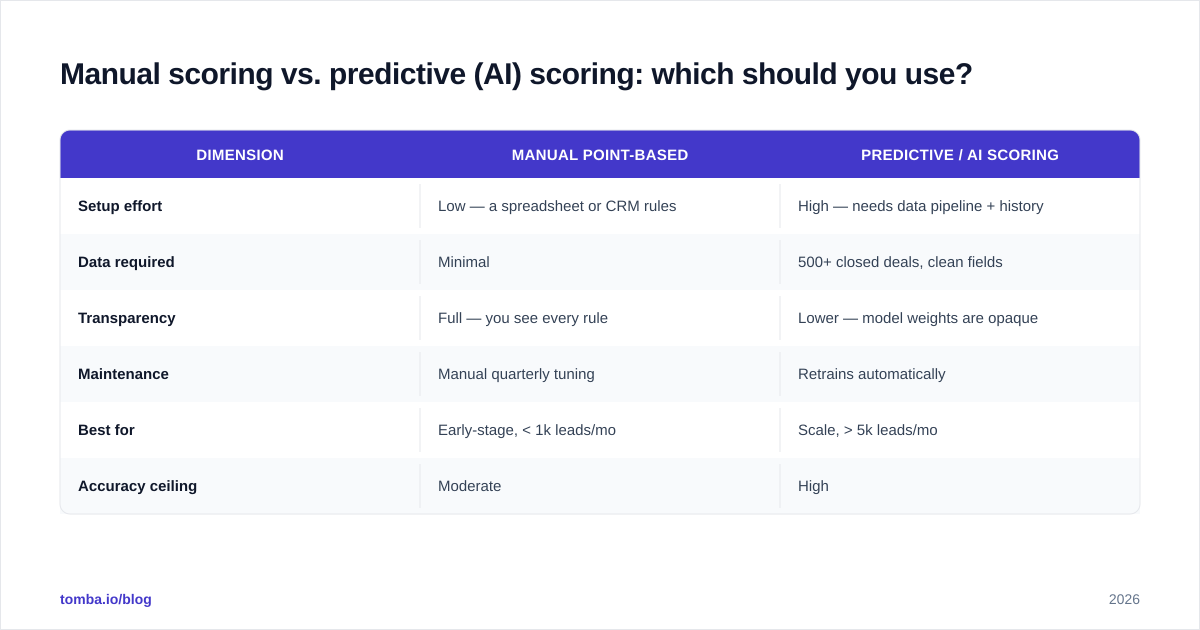
Manual point-based models are transparent and fast to launch. Predictive models — which learn the patterns in your historical conversions automatically — are more accurate at scale but need clean data and volume to train on. Most teams start manual and graduate to predictive once they have 500+ scored, closed deals to learn from.
| Dimension | Manual point-based | Predictive / AI scoring |
|---|---|---|
| Setup effort | Low — a spreadsheet or CRM rules | High — needs data pipeline + history |
| Data required | Minimal | 500+ closed deals, clean fields |
| Transparency | Full — you see every rule | Lower — model weights are opaque |
| Maintenance | Manual quarterly tuning | Retrains automatically |
| Best for | Early-stage, < 1k leads/mo | Scale, > 5k leads/mo |
| Accuracy ceiling | Moderate | High |
Vendors like HubSpot and Salesforce ship both flavors — rules-based scoring on lower tiers and predictive scoring on higher ones. Gartner's research on lead management consistently finds the deciding factor isn't the algorithm; it's data hygiene feeding it.
Why does data quality make or break lead scoring?#
Garbage in, garbage scored — fast. A predictive model trained on records where 30% of job titles are blank and half the emails bounce will confidently route bad leads to your best reps. Scoring amplifies whatever data you feed it, good or bad.

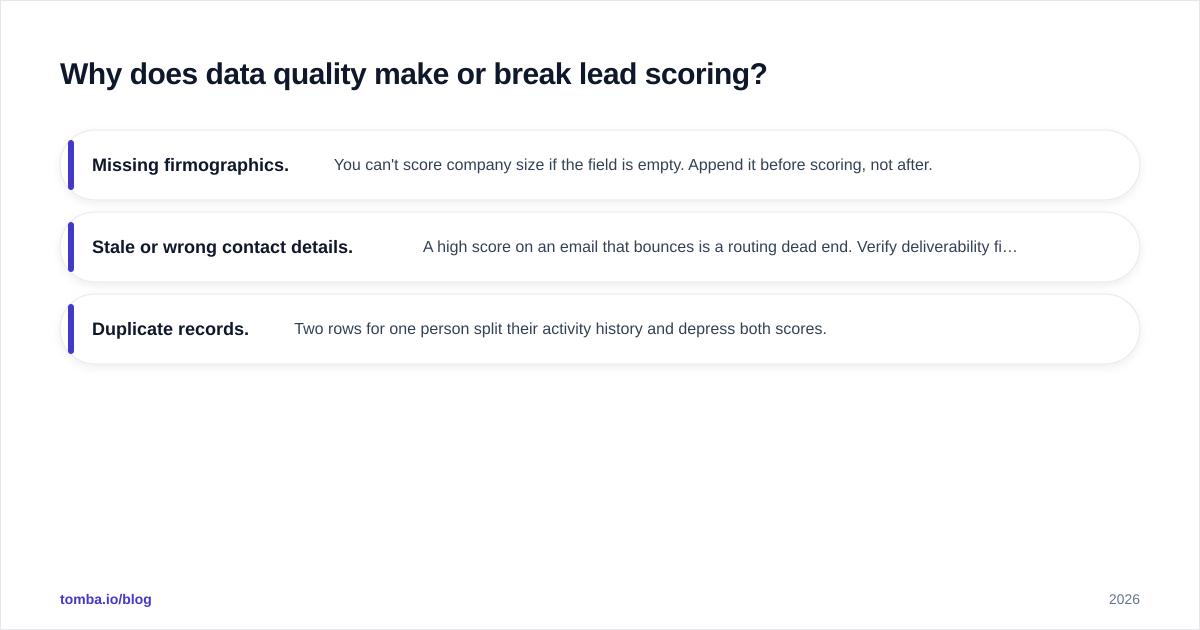
Three data problems quietly wreck most scoring models:
- Missing firmographics. You can't score company size if the field is empty. Append it before scoring, not after.
- Stale or wrong contact details. A high score on an email that bounces is a routing dead end. Verify deliverability first.
- Duplicate records. Two rows for one person split their activity history and depress both scores.
The fix is an enrichment-and-verify step before the score is calculated. Tomba's data enrichment appends firmographic and role data to thin lead records, while the email finder and verifier confirm you actually have a reachable contact. Clean inputs are the cheapest accuracy upgrade you'll ever make.
How do you route and nurture scored leads?#
Scoring without routing is a leaderboard nobody acts on. Tie each band to a concrete, automated action:
- Hot leads trigger an instant alert (Slack, CRM task, round-robin assignment). Speed-to-lead matters more here than anything: replying within five minutes versus an hour can multiply your connect rate.
- Warm leads enter a tailored nurture track — case studies, comparison content, a soft demo offer — and re-score as they engage.
- Cold leads go to long-cycle nurture and get re-evaluated monthly. Don't delete them; markets and budgets change.
Build a feedback loop: when a rep disqualifies a "hot" lead, that's a signal your fit model is over-weighting something. When a "cold" lead converts, your intent model missed a signal. Feed both back into the next tuning cycle.
How often should you review your scoring model?#
Quarterly, at minimum — and the metric that matters is win rate by score band. If your 80–100 band doesn't convert meaningfully better than your 50–79 band, your model isn't separating good leads from bad, and the scores are just decoration.
Run this simple audit every quarter:
- Pull closed deals from the period and group by the score they had at handoff.
- Calculate win rate per band.
- If the bands aren't cleanly separated, find the over- or under-weighted signal.
- Adjust point values, re-test against the next batch.
A model that isn't reviewed decays. Buyer behavior shifts, your ICP evolves as you move upmarket, and last year's strong intent signal becomes this year's noise.
Common lead scoring mistakes to avoid#
- Scoring only on intent. A flood of clicks from a non-buyer still scores high. Always anchor with fit.
- Never decaying scores. A lead hot in January is cold by June if nothing happened. Subtract points for inactivity.
- Too many signals. Twenty weak signals add noise. Start with the five that actually predicted past wins.
- Set-and-forget. The biggest mistake. An untuned model is worse than no model because people trust it.
- Scoring dirty data. Covered above, but worth repeating: enrich and verify first.
Putting it all together#
Lead management and lead scoring aren't two projects — they're one system. Capture cleanly, enrich and verify the data, score on fit and intent, route by band, nurture the rest, and review quarterly against win rate. Do that and your reps stop guessing. They wake up to a queue already sorted by who's most likely to buy.
The hard part isn't the math. It's the data underneath it. A scoring model is only as accurate as the contact and company records feeding it — which is exactly where most teams quietly lose.
Start with clean, complete lead data#
Before you tune a single point value, make sure every lead you score is a real, reachable, enriched contact. Use the Tomba Email Finder to find verified professional emails by name or domain, then layer on data enrichment to fill in the firmographics your fit score depends on. Clean inputs turn a decent scoring model into one your reps actually trust — and act on. Check the Tomba pricing plans, starting free at 25 searches a month and scaling to Starter at $49/mo when you're ready to enrich at volume.
// get started
Find, verify and enrich your first contacts today
Start on the free plan with 25 searches a month, then scale when your team is ready.
Free plan · No credit card required · GDPR & CCPA
// about the author