Lead Follow-Up and Nurture: The 2026 Conversion Playbook
Most deals die in the gap between first touch and close. Here is a data-backed system for lead follow-up and nurture that turns slow leads into booked revenue.
Lead Follow-Up and Nurture: The 2026 Conversion Playbook
Most of your revenue is not lost on the first call. It leaks out of the silent stretch between "interested" and "signed" — the weeks where a lead goes quiet and your reps quietly move on. Lead follow-up and nurture is the system that closes that gap.
TL;DR#
- Roughly 80% of conversions need five or more follow-ups, yet most reps stop after one or two. The math alone is a growth lever.
- Follow-up and nurture are different jobs. Follow-up chases a specific next step; nurture keeps a not-yet-ready lead warm until the timing is right.
- Lead scoring decides the cadence. Hot leads get a tight human sequence; cold leads get a slower automated drip. One cadence for everyone wastes both.
- Channel mix beats channel volume. Email + phone + LinkedIn together convert far better than hammering a single channel.
- Clean contact data is the hidden multiplier. A perfect sequence sent to a bounced or wrong address converts nobody.
What is the difference between lead follow-up and nurture?#
Follow-up and nurture are two gears in the same machine, and confusing them is why pipelines stall.
Follow-up is short-range and goal-specific. A lead downloaded your pricing sheet, booked a demo, or replied "send me more info." Follow-up moves them to one concrete next action — book the call, return the proposal, sign the order. Think of it like a waiter clearing your plate and asking about dessert: there is a clear next step on the table, and the job is to land it.
Nurture is long-range. The lead is a real fit but not buying this quarter — wrong budget cycle, mid-contract with a competitor, or just early in research. Nurture keeps you top of mind without pestering, so when the timing flips you are the first call. It is the slow simmer, not the sear.
Get the assignment wrong and you either burn a hot lead with too-soft drip content or annoy a long-horizon prospect with "just checking in" emails every three days. The fix is to let lead score and intent — not a one-size cadence — decide which gear you are in.
Why do so many leads die in follow-up?#
Because follow-up is boring, uncomfortable, and easy to skip — and the data shows reps skip it constantly. Industry research compiled by HubSpot consistently finds that the majority of sales require five or more touches after the initial contact, while a large share of reps give up after one or two. The leads did not say no. Nobody asked them again.
Three failure patterns cause most of the leakage:
- No system, just memory. Reps "follow up when they remember," which means high-status leads get chased and everyone else evaporates. A documented cadence removes the willpower tax.
- Single-channel monotony. Five identical emails to an inbox that already ignored the first one. Switching channels — a call, a LinkedIn note, a different angle — resets attention.
- Generic, value-free pings. "Just bumping this to the top of your inbox" gives the lead no reason to re-engage. Every touch should carry a new hook: a case study, a relevant trigger event, a specific question.
The distraction problem is structural, too. The moment a fresh batch of leads lands, reps chase the new shiny names and let the half-warm ones go cold.
What does a high-converting follow-up cadence look like?#
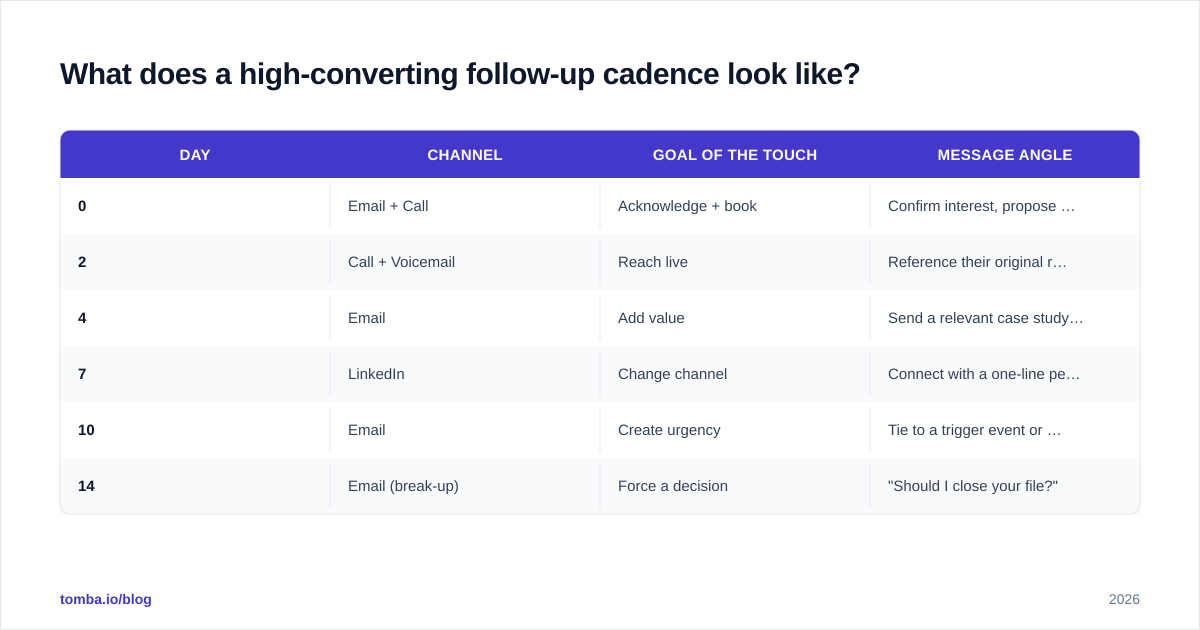
A good cadence is specific about timing, channel, and message — not just "follow up a few times." Below is a battle-tested 14-day cadence for a hot inbound lead (someone who requested a demo or pricing). Slow it down and stretch it out for colder leads.
| Day | Channel | Goal of the touch | Message angle |
|---|---|---|---|
| 0 | Email + Call | Acknowledge + book | Confirm interest, propose 2 specific times |
| 2 | Call + Voicemail | Reach live | Reference their original request, leave a 20-sec VM |
| 4 | Add value | Send a relevant case study or ROI number | |
| 7 | Change channel | Connect with a one-line personalized note | |
| 10 | Create urgency | Tie to a trigger event or limited window | |
| 14 | Email (break-up) | Force a decision | "Should I close your file?" |
A few rules that make this work:
- Multi-channel from day zero. Email and a call on the same day roughly doubles your reach versus either alone.
- Every touch carries new value. No empty bumps. If you have nothing new to say, you have not earned the touch.
- The break-up email is non-negotiable. A clean "should I close your file?" routinely revives 5–10% of dead threads because loss aversion is a stronger motivator than interest.
- Speed on the first touch is everything. Responding within five minutes of an inbound versus an hour later can swing connect rates by an order of magnitude. Build the day-0 step to fire fast.
If you are still writing each message from scratch, start from a library of proven cold email templates and personalize the top two lines. Personalization belongs in the hook, not the boilerplate.
How does lead scoring decide follow-up vs nurture?#
Lead scoring is the dispatcher that routes each lead to the right cadence. Without it, your best reps spend equal effort on a CFO who booked a demo and a student who grabbed a free ebook.
A simple score blends two dimensions:
- Fit — does this lead match your ideal customer profile? (industry, company size, role, region)
- Engagement — what have they actually done? (opened, clicked, replied, visited pricing, booked)
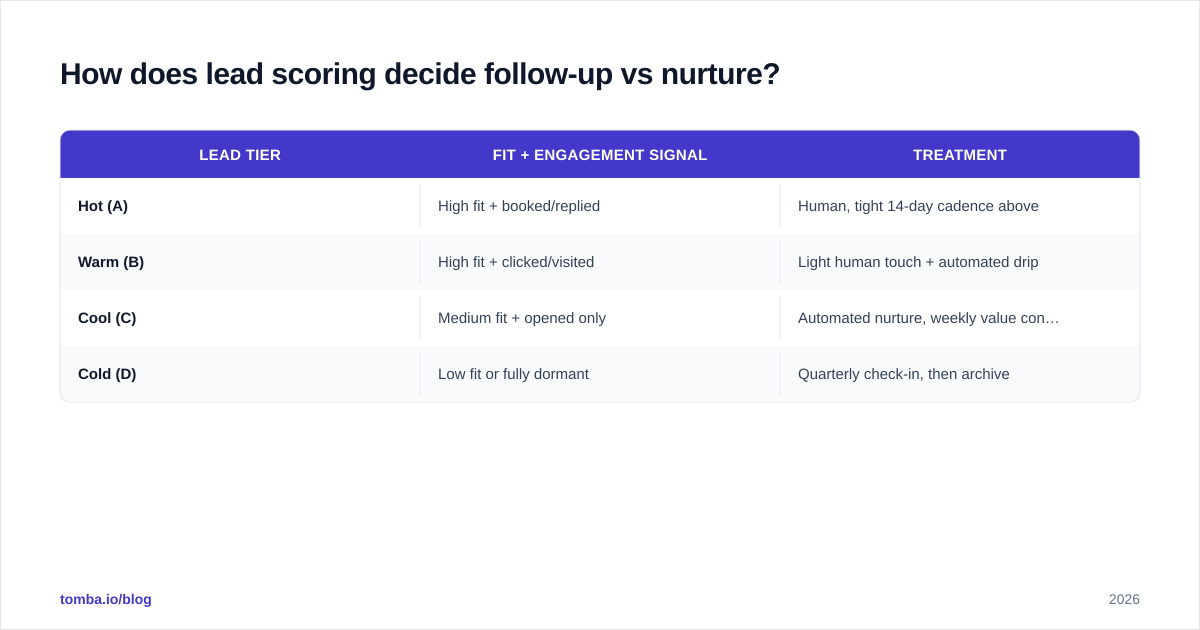
Combine them into a tiered routing rule:
| Lead tier | Fit + engagement signal | Treatment |
|---|---|---|
| Hot (A) | High fit + booked/replied | Human, tight 14-day cadence above |
| Warm (B) | High fit + clicked/visited | Light human touch + automated drip |
| Cool (C) | Medium fit + opened only | Automated nurture, weekly value content |
| Cold (D) | Low fit or fully dormant | Quarterly check-in, then archive |
The point is that a hot, sales-ready lead — effectively a marketing qualified lead that has crossed the engagement threshold — should never sit in the same slow drip as a curious browser. Score first, then choose the gear. Re-score on every meaningful action so a cool lead that suddenly visits your pricing page three times gets promoted to a human cadence within minutes.
Which channels convert best in a nurture sequence?#
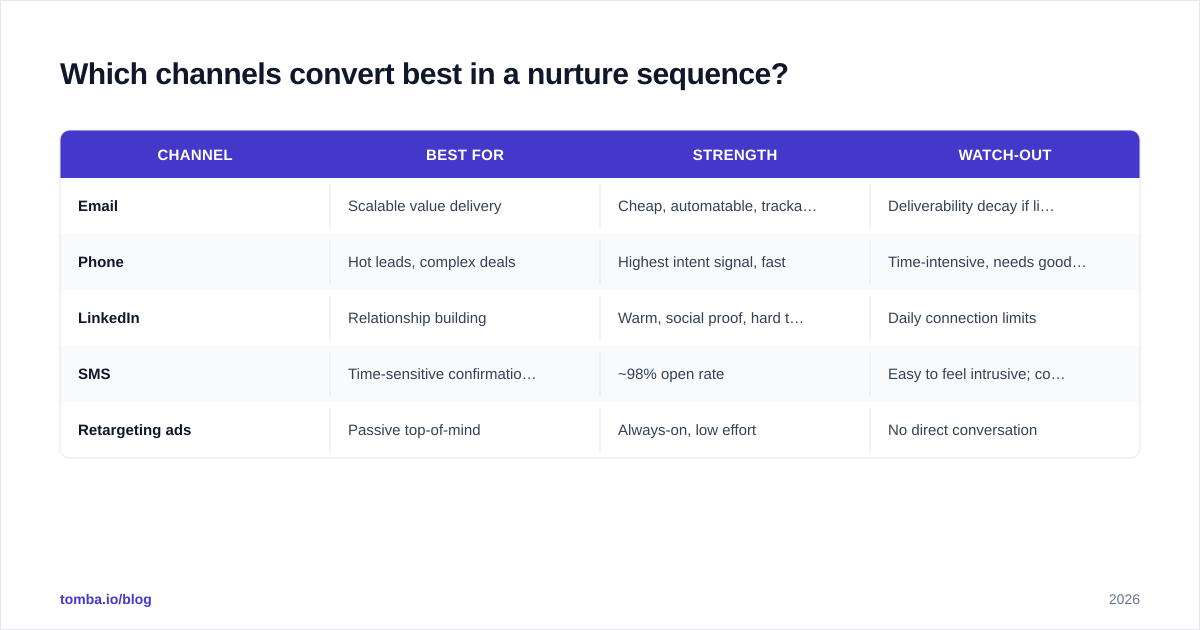
The winning answer in 2026 is "more than one." Single-channel sequences are easy to ignore; orchestrated multi-channel sequences are not. Here is how the main channels stack up for nurture work.
| Channel | Best for | Strength | Watch-out |
|---|---|---|---|
| Scalable value delivery | Cheap, automatable, trackable | Deliverability decay if list is dirty | |
| Phone | Hot leads, complex deals | Highest intent signal, fast | Time-intensive, needs good numbers |
| Relationship building | Warm, social proof, hard to ignore | Daily connection limits | |
| SMS | Time-sensitive confirmations | ~98% open rate | Easy to feel intrusive; consent matters |
| Retargeting ads | Passive top-of-mind | Always-on, low effort | No direct conversation |
The practical recipe: email carries the weight, phone closes the gap, LinkedIn warms the relationship, and SMS handles confirmations. A nurture lead might get a value email on Monday, see a retargeting ad midweek, and accept a LinkedIn connection on Friday — three impressions, three formats, one coherent story.
None of this works without accurate contact data underneath it. A multi-channel sequence multiplies the cost of a wrong email or a dead phone number across every step. Before a lead enters a cadence, verify the address with an email verifier and enrich missing fields with data enrichment so phone, role, and company are correct. The cleanest cadence in the world converts nobody if it is aimed at the wrong inbox — and your email response rate is only as honest as the list it is measured against.
How do you write nurture content that does not get ignored?#
Stop "checking in." Start being useful. The leads ignoring you are not waiting for a reminder that you exist — they are waiting for a reason to care.
Build your nurture content around the lead's stage, not your sales calendar:
- Early stage: educational. Frameworks, benchmarks, "how teams like yours solve X." No pitch.
- Mid stage: proof. Case studies, before/after numbers, a customer in their exact industry.
- Late stage: de-risk. Pricing clarity, implementation timelines, a small no-commitment trial.
Three writing rules keep nurture from sliding into spam:
- One idea per message. A nurture email with five links converts worse than one with a single clear takeaway.
- Lead with the recipient, not the product. "I noticed your team just expanded into the EU — here is how three similar companies handled localized onboarding" beats any feature list.
- Always end with a low-friction next step. A single question that is easy to answer outperforms "let me know if you'd like to chat."
Independent review sites like G2 are also worth weaving into late-stage nurture — pointing a hesitant lead to third-party proof removes the "you would say that" objection better than another pitch from you.
What does the full system look like end to end?#
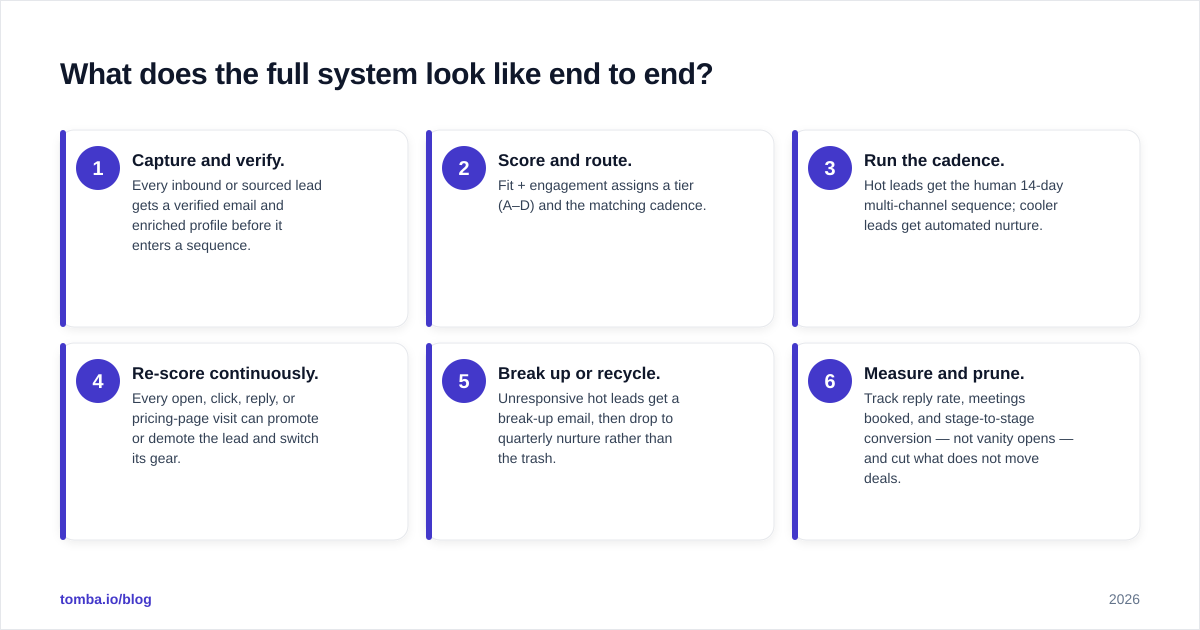
Put the pieces together and the playbook is straightforward to operate:
- Capture and verify. Every inbound or sourced lead gets a verified email and enriched profile before it enters a sequence.
- Score and route. Fit + engagement assigns a tier (A–D) and the matching cadence.
- Run the cadence. Hot leads get the human 14-day multi-channel sequence; cooler leads get automated nurture.
- Re-score continuously. Every open, click, reply, or pricing-page visit can promote or demote the lead and switch its gear.
- Break up or recycle. Unresponsive hot leads get a break-up email, then drop to quarterly nurture rather than the trash.
- Measure and prune. Track reply rate, meetings booked, and stage-to-stage conversion — not vanity opens — and cut what does not move deals.
The teams that win in 2026 are not the ones sending the most emails. They are the ones who matched the right cadence to the right lead, kept their data clean, and simply followed up more times than their competitors had the discipline to.
Where does Tomba fit?#
Every step above assumes you can actually reach the lead — and that is exactly where pipelines quietly break. If your sequence is firing at outdated, guessed, or bounced addresses, no amount of clever copy or cadence design saves it.
Tomba's Email Finder gives you verified, professional email addresses by name, company, or domain, so every follow-up and nurture touch lands in a real inbox. Pair it with the built-in verifier and enrichment, start free with 25 searches a month, and scale up on the Starter plan at $49/mo when you are ready to run cadences at volume. Build the sequence once; aim it at data you can trust. Start finding verified leads with Tomba today.
// get started
Find, verify and enrich your first contacts today
Start on the free plan with 25 searches a month, then scale when your team is ready.
Free plan · No credit card required · GDPR & CCPA
// about the author