Lead Management in 2026: The Core Process, Stages & Tools
Leads leak out of every pipeline that lacks a defined process. Here's the core lead management framework — capture, enrich, score, route, nurture — that turns raw contacts into closed revenue in 2026.
Most pipelines do not have a lead problem. They have a lead management problem. You generate contacts, drop them into a CRM, and watch a depressing share of them go cold because nobody decided who owns them, when they get worked, or what makes one lead more urgent than the next.
This guide breaks down the core lead management process — the repeatable system that moves a raw contact from "we have an email" to "we have a customer" without leaking qualified buyers along the way.
TL;DR#
- Lead management is a five-stage process: capture, enrich, score, route, and nurture. Skip any stage and the pipeline leaks.
- Scoring is the spine. Without a shared definition of a "good" lead, reps chase the loudest contact instead of the best one.
- Routing speed decides win rates. Responding in under five minutes can lift contact rates dramatically versus an hour-plus delay.
- Enrichment is the cheapest leverage point. A complete, verified record makes scoring, routing, and personalization all work better at once.
- Tooling should serve the process, not replace it. A CRM, an enrichment/email source, and a scoring model cover 90% of teams.
What is lead management, exactly?#
Lead management is the end-to-end process of tracking and working inbound and outbound leads from first touch to a sales-ready handoff (and beyond). Think of it like an airport baggage system: bags (leads) arrive from many gates (sources), get tagged and sorted (enriched and scored), routed to the right carousel (rep or sequence), and tracked until they reach the right owner. Lose a bag at any belt and the traveler — your revenue — never arrives.
Technically, lead management spans four systems working together: your CRM as the system of record, a data layer that fills in missing fields, a scoring engine that ranks intent and fit, and an outreach layer that nurtures until the lead converts. When people say their "CRM is a mess," they almost always mean the process feeding the CRM is undefined.
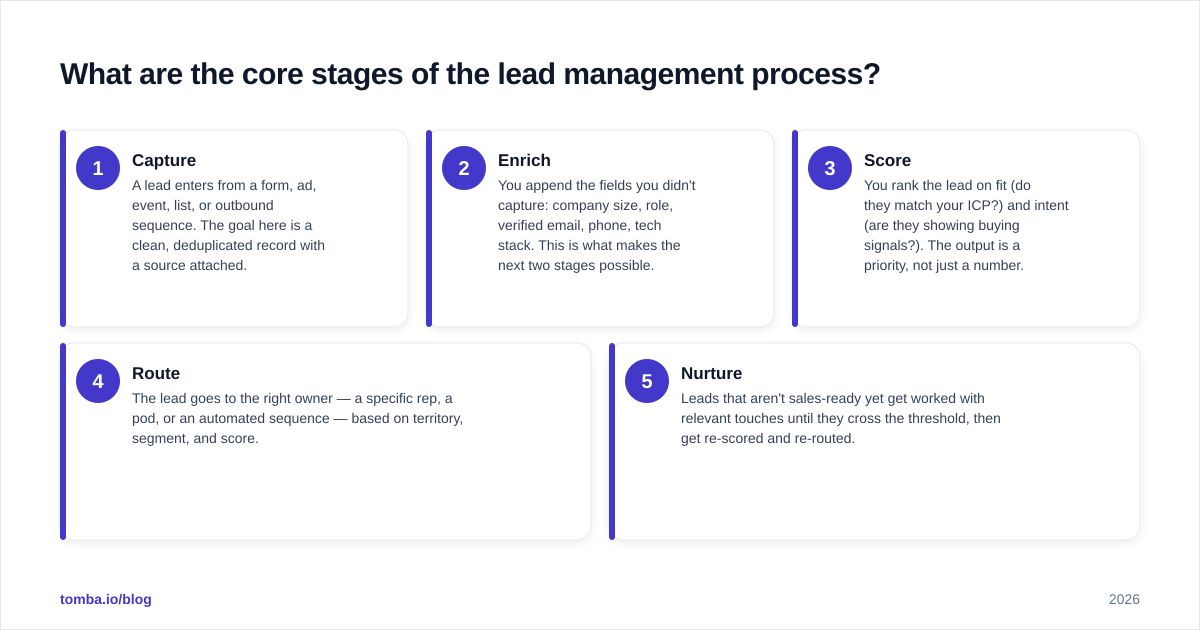
What are the core stages of the lead management process?#
Every durable system runs the same five stages in order. The names vary by vendor; the sequence does not.
- Capture — A lead enters from a form, ad, event, list, or outbound sequence. The goal here is a clean, deduplicated record with a source attached.
- Enrich — You append the fields you didn't capture: company size, role, verified email, phone, tech stack. This is what makes the next two stages possible.
- Score — You rank the lead on fit (do they match your ICP?) and intent (are they showing buying signals?). The output is a priority, not just a number.
- Route — The lead goes to the right owner — a specific rep, a pod, or an automated sequence — based on territory, segment, and score.
- Nurture — Leads that aren't sales-ready yet get worked with relevant touches until they cross the threshold, then get re-scored and re-routed.
The mistake most teams make is treating these as separate departments instead of one conveyor belt. Marketing "does" capture and nurture, sales "does" routing, and nobody owns the handoff in the middle — which is exactly where leads die.
How does lead scoring actually work?#
Lead scoring assigns a value to each lead based on two axes: fit (how closely they match your ideal customer) and intent (how strongly they're signaling readiness to buy). A VP of Engineering at a 500-person SaaS company who just requested a demo scores high on both. A student downloading a free template scores low on fit, regardless of activity.
There are three practical scoring approaches:
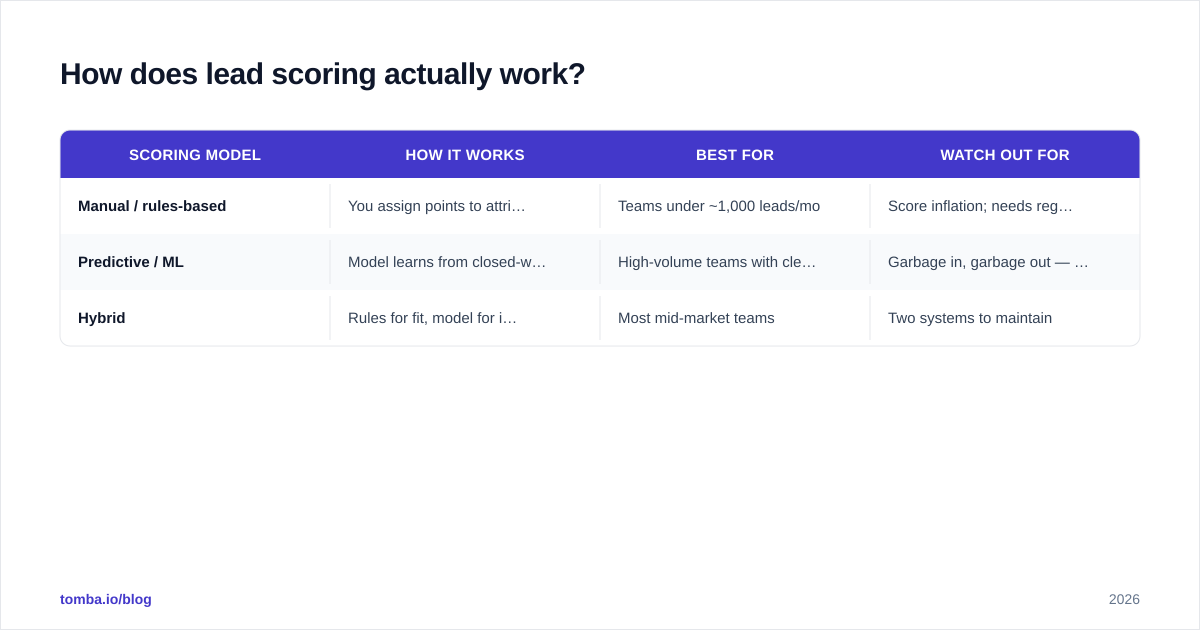
| Scoring model | How it works | Best for | Watch out for |
|---|---|---|---|
| Manual / rules-based | You assign points to attributes and actions | Teams under ~1,000 leads/mo | Score inflation; needs regular tuning |
| Predictive / ML | Model learns from closed-won history | High-volume teams with clean data | Garbage in, garbage out — needs enriched data |
| Hybrid | Rules for fit, model for intent | Most mid-market teams | Two systems to maintain |
Whichever you choose, the score is only as good as the data underneath it. If half your records are missing job title or company size, your "fit" score is a coin flip. That's why enrichment comes before scoring in the process — and why teams that score on thin data end up chasing the wrong leads with great confidence.
A working definition matters more than a sophisticated model. Agree on what a marketing qualified lead (MQL) is, what a sales-qualified lead is, and the score threshold between them. Write it down. Re-score the whole database against it.
Why does enrichment make or break the whole system?#
Enrichment is the cheapest high-leverage move in lead management because it improves every downstream stage at once. A complete record scores more accurately, routes to the correct territory, and lets reps personalize outreach — all from one investment.
Consider what a raw form fill usually gives you: a name, an email, maybe a company. That's not enough to score fit or route by segment. After enrichment, the same record carries role, seniority, company size, industry, verified contact details, and social profiles. Now your rules engine has something to work with.
The two enrichment failures that quietly wreck pipelines:
- Stale data. People change jobs every ~2–3 years. A record enriched 18 months ago is partly fiction.
- Unverified emails. Routing a lead to a rep who emails a dead address burns the rep's time and their sender reputation.
This is where a reliable data source earns its keep. Tools like Tomba's data enrichment append and verify contact fields so your scoring and routing operate on facts, not guesses. If you're working from a list with names and companies but no contact details, an email finder closes that gap before the lead ever hits your scoring model. For broad coverage, a maintained B2B database gives you fields you never captured in the first place.
How fast should you route and respond to a lead?#
Fast. The single most cited finding in lead management research is that response speed dominates win rate. Lead-response studies popularized by HubSpot and the original Harvard Business Review "Short Life of Online Sales Leads" analysis found that contacting a web lead within five minutes versus thirty minutes can change qualification odds by an order of magnitude. The lead is comparing you to competitors in real time; the first credible response often wins.
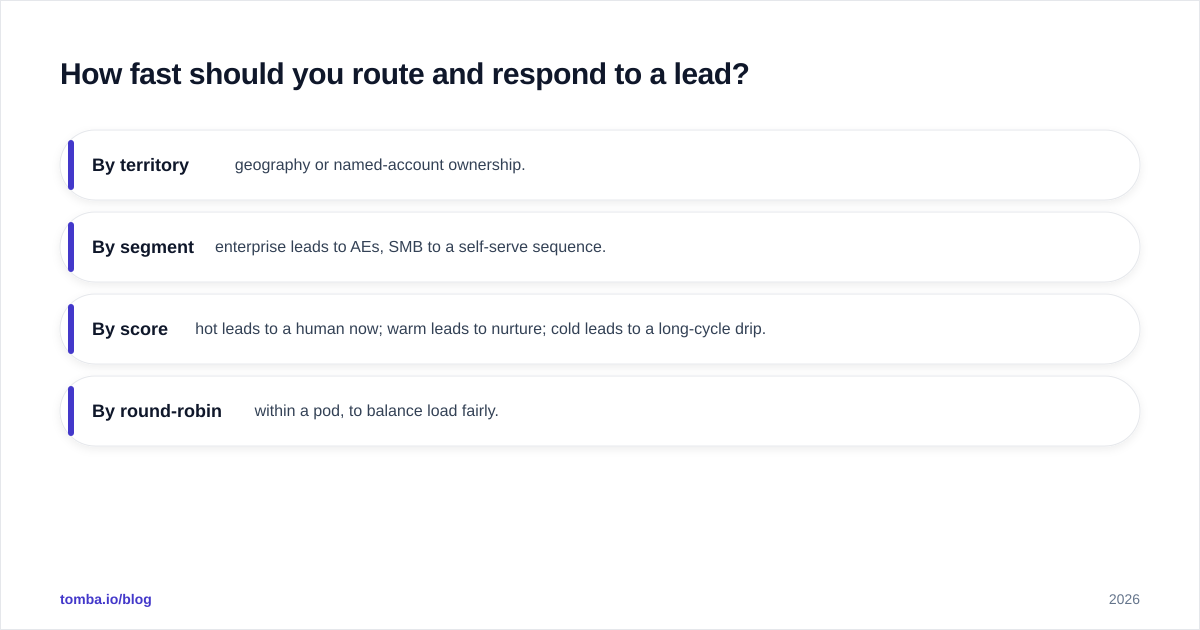
Routing is what makes speed possible. If a high-score lead lands in a generic queue and waits for someone to notice, you've lost the advantage your scoring just created. Good routing rules are boring and explicit:
- By territory — geography or named-account ownership.
- By segment — enterprise leads to AEs, SMB to a self-serve sequence.
- By score — hot leads to a human now; warm leads to nurture; cold leads to a long-cycle drip.
- By round-robin — within a pod, to balance load fairly.
The test of a routing system: a brand-new high-fit lead arriving at 2 p.m. on a Tuesday should have an owner and a first touch within minutes, with zero human deciding "who takes this one."

What does a nurture track look like for leads that aren't ready?#
Most leads — often the majority — are not ready to buy when they enter your system. Nurturing keeps them warm without burning rep time, then re-injects them into the active pipeline when their score crosses the line.
A functional nurture track has three properties:
- Segmented, not blasted. A lead's industry and role determine which track they enter. The same five emails for everyone is a newsletter, not a nurture.
- Signal-aware. When a nurtured lead visits pricing, opens three emails in a week, or hits a key page, that's an intent spike — re-score and route to a human.
- Time-bounded. Define an exit. A lead that shows no engagement after N touches moves to a low-priority recycle list, not an infinite loop.
The handoff back from nurture to sales is the most underbuilt part of most pipelines. Marketing nurtures a lead to "hot," but there's no trigger that tells a rep to call. Wire the score threshold to a routing action and you close that gap.
Which tools do you actually need to manage leads?#
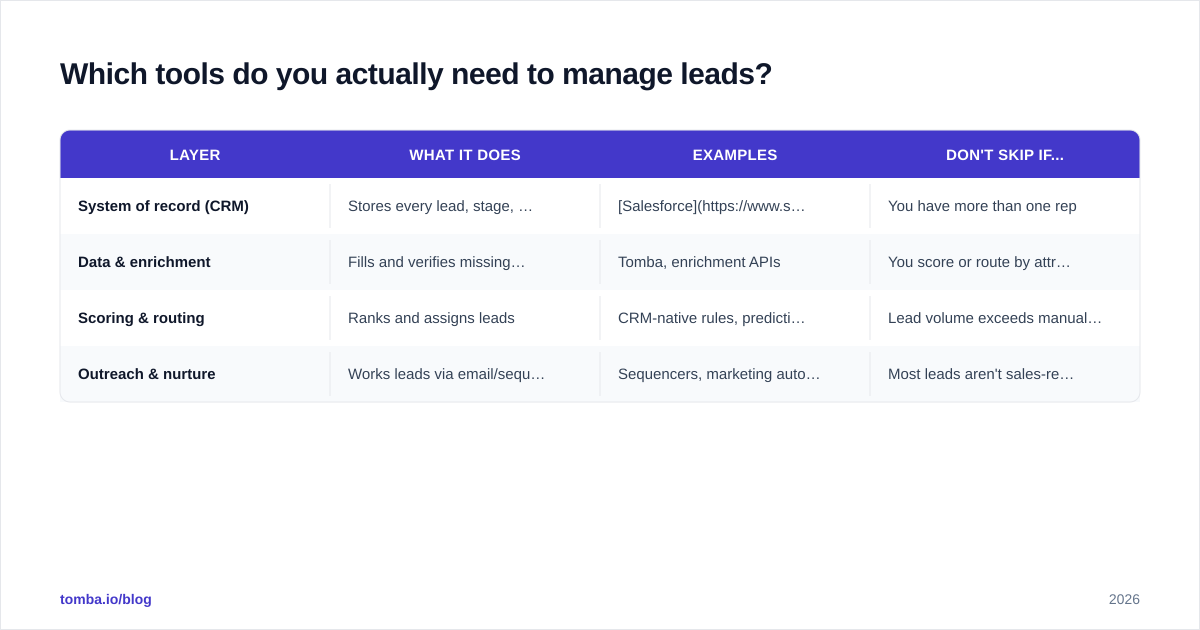
You need three categories of tool, and most teams over-buy in some and under-buy in others.
| Layer | What it does | Examples | Don't skip if... |
|---|---|---|---|
| System of record (CRM) | Stores every lead, stage, and activity | Salesforce, HubSpot, Pipedrive | You have more than one rep |
| Data & enrichment | Fills and verifies missing fields | Tomba, enrichment APIs | You score or route by attributes |
| Scoring & routing | Ranks and assigns leads | CRM-native rules, predictive add-ons | Lead volume exceeds manual triage |
| Outreach & nurture | Works leads via email/sequences | Sequencers, marketing automation | Most leads aren't sales-ready (they aren't) |
The integration between these layers matters more than any single tool's feature list. A best-in-class CRM fed by stale, unverified data produces confident, wrong decisions. That's why teams increasingly start with the data layer — a verified contact source feeding a simple CRM beats a fancy CRM full of garbage. If you're evaluating where to spend, compare the pricing of your data layer against what one missed enterprise deal costs you; the math is rarely close.
For sourcing and verifying the contact data underneath all of this, Tomba's free tier covers 25 searches a month, with Starter at $49/mo, Growth at $99/mo, and Pro at $249/mo — enough to keep a mid-market pipeline enriched without a six-figure data contract.
How do you measure whether your lead management is working?#
Track the conversion rate between stages, not just totals. A healthy system shows you exactly where leads leak. The metrics that matter:
- Lead-to-MQL rate — Is capture bringing in the right people?
- MQL-to-SQL rate — Is your scoring threshold calibrated, or are you passing junk to sales?
- Speed-to-first-touch — Median time from capture to first human/automated contact.
- SQL-to-opportunity rate — Is routing sending leads to the right owner?
- Stage aging — How long do leads sit in each stage before moving or dying?
If your MQL-to-SQL rate is low, your scoring is too loose — sales rejects what marketing passes. If speed-to-first-touch is high, routing is broken. Each metric points at a specific stage to fix, which is the entire point of running a defined process instead of a vibe. Industry analysts at Gartner consistently tie revenue predictability to exactly this kind of stage-by-stage instrumentation.
Common lead management mistakes (and quick fixes)#
- No single owner per lead. Fix: every lead has exactly one accountable owner at every moment.
- Scoring on incomplete data. Fix: enrich before you score, always.
- One nurture track for everyone. Fix: segment by role and industry minimum.
- Slow or manual routing. Fix: automate assignment by score and segment.
- Never recycling. Fix: closed-lost and stale leads go to a timed recycle track, not the trash.
The bottom line#
Lead management is not a tool you buy; it's a five-stage process — capture, enrich, score, route, nurture — that you instrument and tune. The teams that win aren't the ones with the most leads. They're the ones who never let a qualified lead leak between stages, because every stage has an owner, a rule, and a metric.
Start where the leverage is highest: clean, verified, enriched data feeding an honest scoring model. Get that right and routing, nurturing, and reporting all get easier. Get it wrong and no CRM on earth will save you.
Ready to fix the data layer first? Start with the Tomba Email Finder to source and verify the contact details that power accurate scoring and instant routing — find professional emails by domain, name, or company, then push verified records straight into your pipeline. Spin up the free tier, enrich your next 25 leads, and watch your MQL-to-SQL rate respond.
// get started
Find, verify and enrich your first contacts today
Start on the free plan with 25 searches a month, then scale when your team is ready.
Free plan · No credit card required · GDPR & CCPA
// about the author