Lead Segmentation and Enrichment: The 2026 Sales Playbook
Raw lead lists don't close deals. Learn how lead segmentation and enrichment work together in 2026 to route, score, and personalize at scale — with a framework, comparison table, and tooling guide.
TL;DR
- Segmentation groups leads by who they are and how they behave; enrichment fills in the missing data that makes those groups accurate. You need both.
- A clean enrich-then-segment pipeline raises routing accuracy, lifts reply rates, and stops reps wasting time on bad-fit accounts.
- The 2026 shift: enrichment happens continuously (on form-fill, on CRM write, on intent signal) instead of in quarterly batch jobs.
- Most "personalization" fails because the underlying data is stale or thin — fix the data layer first.
- You can stand up a working segmentation-and-enrichment loop with a verifier, a domain/email finder, and a CRM sync — no six-figure platform required.
What is the difference between lead segmentation and enrichment?#
Segmentation is sorting; enrichment is filling in the blanks. Think of a library: segmentation is shelving books by genre so readers find them fast, and enrichment is making sure every book actually has its title, author, and ISBN printed on the spine. Shelve books with blank spines and your categories collapse into guesswork.
In sales terms, lead segmentation is the practice of dividing your leads into groups that share traits — company size, industry, region, job role, buying stage, or behavior — so you can treat each group differently. Lead enrichment is the practice of appending missing or outdated attributes to a lead record: a verified work email, a direct phone number, company headcount, tech stack, funding stage, or LinkedIn profile.
The two are sequential, not parallel. You cannot segment by "company size" if 60% of your records have no headcount field. You cannot route by "owns Salesforce" if you never enriched the tech-stack signal. Enrichment is the input; segmentation is the operation; scoring and routing are the outputs.
This is why teams that "do segmentation" but skip enrichment plateau quickly. Their segments are built on whatever the lead typed into a form — usually a name and an email — and everything downstream inherits that thinness.
Why does enrichment have to come before segmentation?#
Because garbage in, garbage segmented. If your raw data is incomplete, every segment you build is partly fiction, and reps lose trust in the system within a quarter.
Here's the failure pattern. Marketing captures 5,000 leads from a webinar. The form asked for name, email, and company. Sales tries to segment by "enterprise vs. SMB" — but there's no employee-count field, so someone eyeballs company names, mislabels half of them, and the enterprise SDR team spends two weeks calling 12-person startups. The segmentation logic was fine. The data feeding it was not.
Enrichment fixes the inputs first:
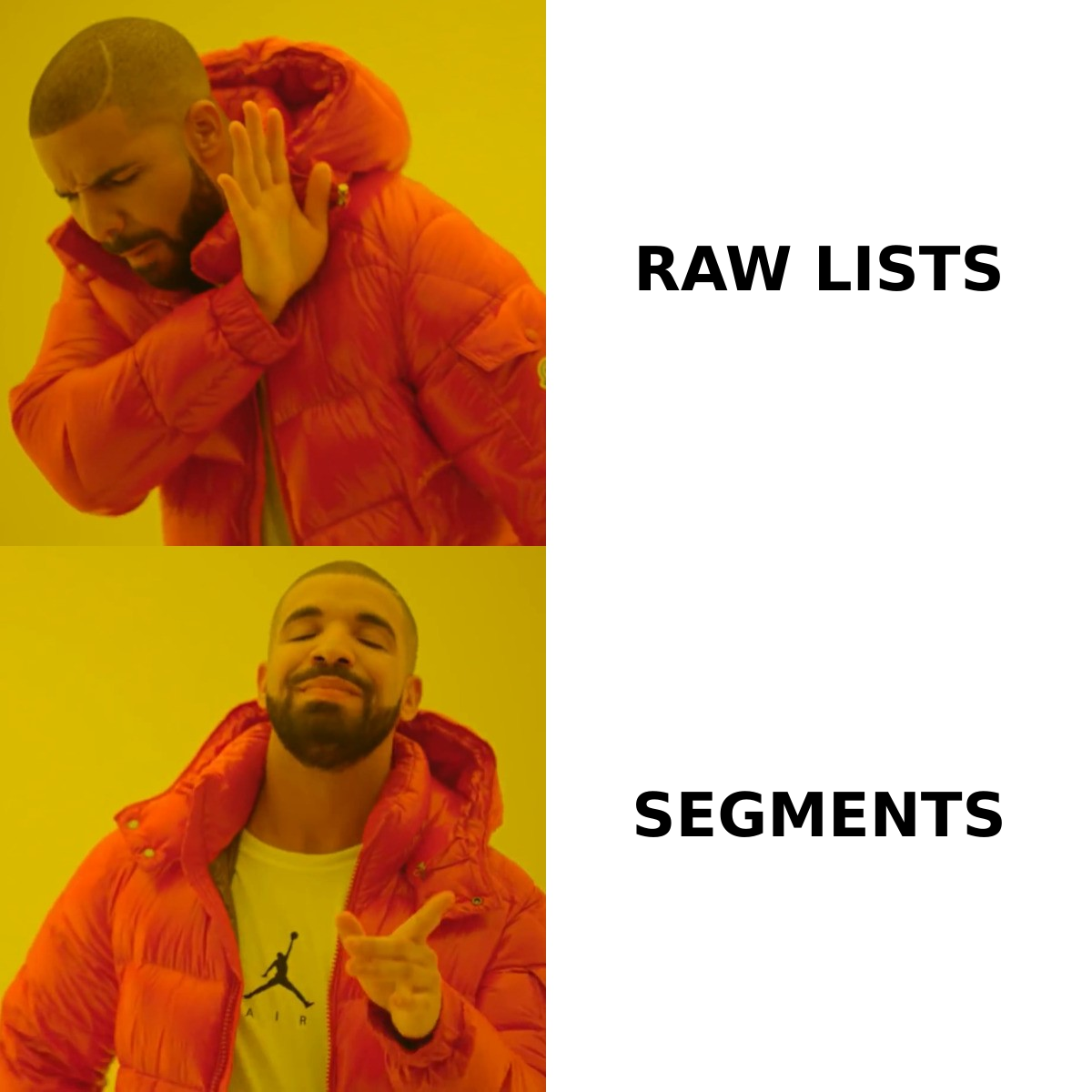
- Identity completion — turn a bare email into a full record: name, title, seniority, department.
- Firmographics — headcount, revenue band, industry, HQ location, funding.
- Technographics — what software the company runs (a buying signal for many B2B products).
- Contactability — a verified email and, where available, a direct phone number.
That last point matters more than people admit. Enrichment that appends an unverified email is worse than no enrichment, because it inflates your "complete" count while quietly poisoning deliverability. Run every appended address through an email verifier before it touches a sequence. If you're appending emails by company domain at scale, a domain search gives you the verified pattern and known contacts in one call.
What are the main lead segmentation models in 2026?#
There are four models worth knowing, and mature teams layer them rather than pick one.
1. Firmographic segmentation. The classic B2B cut: industry, company size, revenue, geography. Best for defining your ICP tiers and assigning territory. Cheap to build once you've enriched firmographic fields.
2. Behavioral segmentation. Groups leads by what they did — pages visited, demos requested, emails opened, pricing-page dwell time. This is where intent lives. It decays fast, so it must be refreshed continuously.
3. Persona / role segmentation. Splits a single account into its buying committee: economic buyer, champion, technical evaluator, end user. Requires enriched job titles and seniority to work. Without enrichment you can't tell a "Manager" from a "VP," and your messaging misses.
4. Lifecycle / stage segmentation. Where the lead sits in the funnel — subscriber, MQL, SQL, opportunity. Defines whether a lead gets a nurture email or a phone call. Pairs directly with your scoring model and your definition of a marketing qualified lead.
The 2026 best practice is a composite segment: firmographic tier × persona × behavioral intent. "VP-level champions at 200–1,000-employee SaaS companies who hit the pricing page twice this week" is a segment you can write a genuinely relevant email to. "People who filled out a form" is not.
How do you build a segmentation and enrichment pipeline?#
Treat it as a loop, not a one-time cleanup. Data goes stale at roughly 25–30% per year as people change jobs, so a pipeline that runs once is obsolete within months.
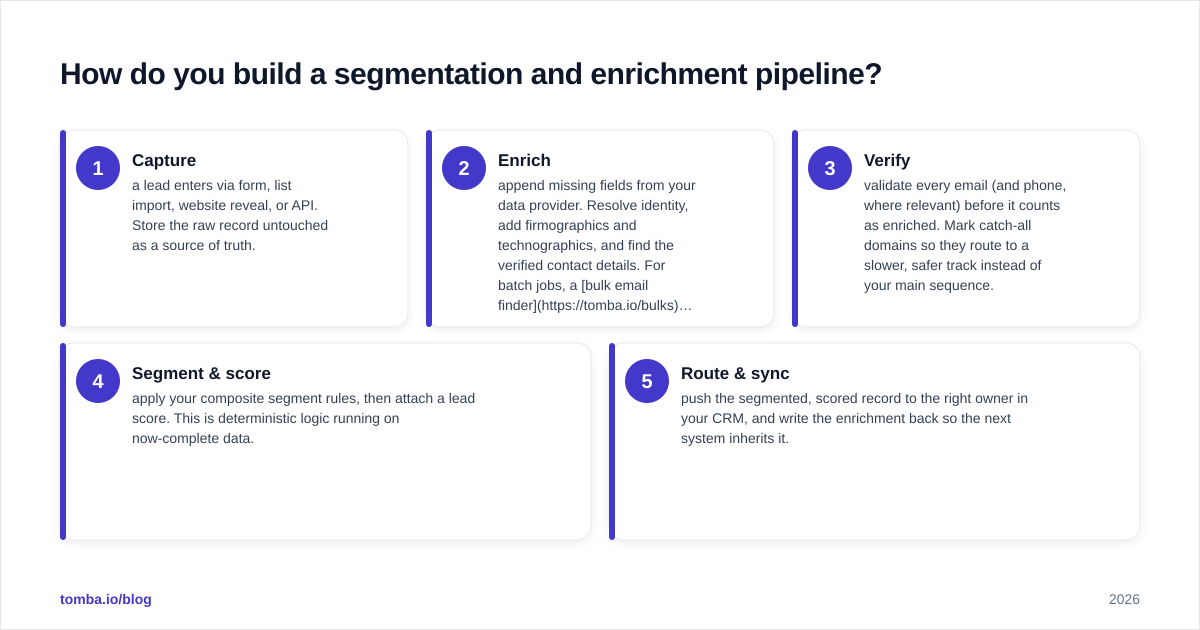
A working loop has five stages:
- Capture — a lead enters via form, list import, website reveal, or API. Store the raw record untouched as a source of truth.
- Enrich — append missing fields from your data provider. Resolve identity, add firmographics and technographics, and find the verified contact details. For batch jobs, a bulk email finder handles thousands of records in one pass.
- Verify — validate every email (and phone, where relevant) before it counts as enriched. Mark catch-all domains so they route to a slower, safer track instead of your main sequence.
- Segment & score — apply your composite segment rules, then attach a lead score. This is deterministic logic running on now-complete data.
- Route & sync — push the segmented, scored record to the right owner in your CRM, and write the enrichment back so the next system inherits it.
Then the loop repeats: re-enrich on a schedule (job-change detection, quarterly firmographic refresh) so segments stay true. Tie this into your broader data enrichment strategy rather than treating it as a one-off list-cleaning chore.
The most common mistake here is doing enrichment and verification as separate manual exports. Every CSV round-trip is a chance to drop records, duplicate rows, or ship unverified emails. Wire stage 2 and stage 3 together through an API or a native CRM integration so a lead is never "enriched but unverified."
Which tools handle segmentation and enrichment?#
The market splits into all-in-one platforms and focused data layers you compose yourself. Both work; they fit different budgets and team sizes.
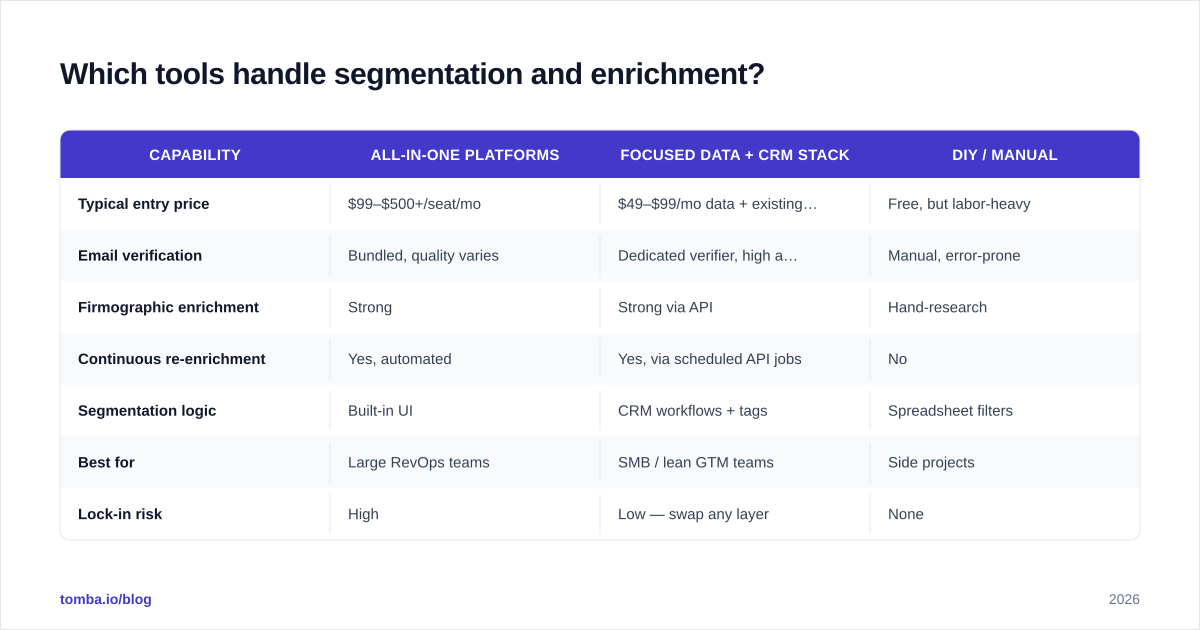
| Capability | All-in-one platforms | Focused data + CRM stack | DIY / manual |
|---|---|---|---|
| Typical entry price | $99–$500+/seat/mo | $49–$99/mo data + existing CRM | Free, but labor-heavy |
| Email verification | Bundled, quality varies | Dedicated verifier, high accuracy | Manual, error-prone |
| Firmographic enrichment | Strong | Strong via API | Hand-research |
| Continuous re-enrichment | Yes, automated | Yes, via scheduled API jobs | No |
| Segmentation logic | Built-in UI | CRM workflows + tags | Spreadsheet filters |
| Best for | Large RevOps teams | SMB / lean GTM teams | Side projects |
| Lock-in risk | High | Low — swap any layer | None |
The focused-stack approach has won share since 2024 because the data layer is now cheap and API-first. You pair a precise enrichment-and-verification source with the CRM you already own, and you keep segmentation logic where your reps already work. Independent review sites like G2 are useful for sanity-checking accuracy claims before you commit budget — vendor-reported match rates are almost always higher than what you'll see on your own list.
For the enrichment-and-verification layer specifically, the things that actually move the needle are match rate on your target geographies, verification accuracy (especially catch-all handling), and whether you can run it via API so the whole loop is automated. Tomba's pricing starts with a free tier (25 searches/mo) and a Starter plan at $49/mo, which is enough to validate the pipeline before scaling to Growth ($99/mo) or Pro ($249/mo).
How do you measure if your segmentation and enrichment actually works?#
You measure the downstream metrics, not the data itself. "We enriched 10,000 records" is an activity number; nobody got paid for it. Tie the work to outcomes:
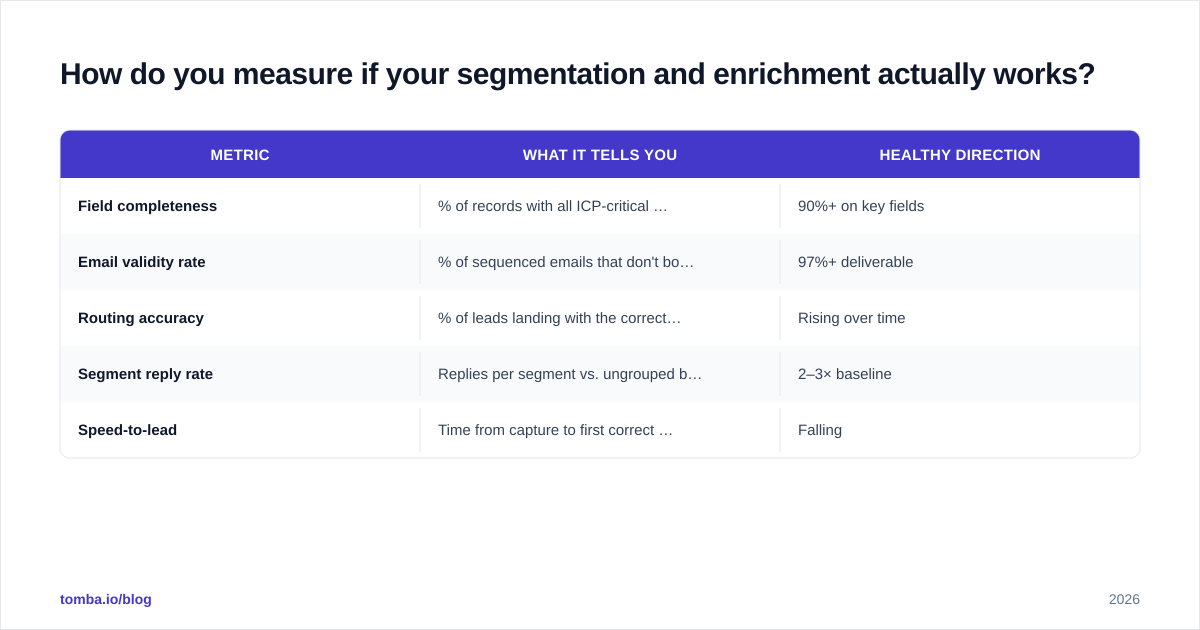
| Metric | What it tells you | Healthy direction |
|---|---|---|
| Field completeness | % of records with all ICP-critical fields | 90%+ on key fields |
| Email validity rate | % of sequenced emails that don't bounce | 97%+ deliverable |
| Routing accuracy | % of leads landing with the correct owner first time | Rising over time |
| Segment reply rate | Replies per segment vs. ungrouped baseline | 2–3× baseline |
| Speed-to-lead | Time from capture to first correct touch | Falling |
If enrichment is working, your bounce rate drops and your sender reputation holds — which protects every other campaign you run. If segmentation is working, your best segments pull dramatically higher reply rates than a generic blast, and you can prove it. When a segment underperforms, the question is almost always "is the data behind this segment complete and fresh?" — which sends you back to stage 2.
One caution: don't over-segment. Twelve micro-segments that each get a slightly different email is more maintenance than most teams can sustain, and the marginal lift past three or four well-defined composite segments is small. Start with your top ICP tier, prove the lift, then expand.
What does a real segmentation and enrichment workflow look like?#
Concretely, here's a lean SaaS team running the loop end to end:
- A visitor downloads a guide, leaving name, work email, and company.
- On form submit, an API call enriches the record: title (VP of Engineering), seniority (executive), headcount (340), industry (fintech), tech stack (AWS, Snowflake), and a verified direct email.
- The email is verified in the same call; the domain is flagged not-catch-all, so it's safe to sequence.
- Composite segment rules fire: enterprise tier × technical-buyer persona × high-intent (guide + pricing visit). Score = 87.
- The lead routes to the senior AE for fintech, who gets a Slack ping with the enriched context attached — no manual research.
- Thirty days later, a scheduled re-enrichment job checks for job changes and refreshes firmographics, keeping the segment honest.
Notice there's no CSV, no manual lookup, and no "I'll research this account before I call." The data work happened in milliseconds at capture, and the rep started from a complete picture. That's the whole point of treating segmentation and enrichment as one connected system instead of two separate chores.
Get the data layer right first#
Segmentation strategy is easy to draw on a whiteboard and impossible to execute on thin data. Before you design another segment, make sure every lead that enters your funnel gets enriched and verified automatically — that's the foundation everything else stands on.
Start with the Tomba Email Finder to turn names and domains into verified, segmentation-ready contact records, then wire verification and enrichment into your capture flow via the API. The free tier is enough to run the loop on a real list and watch your bounce rate fall and your reply rates climb. Get the data layer right, and your segments finally start telling the truth.
// get started
Find, verify and enrich your first contacts today
Start on the free plan with 25 searches a month, then scale when your team is ready.
Free plan · No credit card required · GDPR & CCPA
// about the author