Outbound Sales Strategy in 2026: The Complete Playbook
A practical, no-fluff guide to building an outbound sales strategy in 2026 — channels, sequences, data, and the metrics that actually move pipeline.
TL;DR
- An outbound sales strategy is a repeatable system for starting conversations with buyers who haven't raised their hand yet — built on tight targeting, clean contact data, and multichannel sequences.
- The 2026 version of outbound is less volume and more relevance: smaller lists, better data, sharper messaging, and signals that tell you who to contact now.
- The five pillars are ICP definition, list building, data accuracy, sequence design, and measurement. Skip any one and the whole engine stalls.
- Bad data is the silent killer. Bounce rates above 3–5% throttle deliverability and waste rep hours before a single reply lands.
- Below: a full framework, a channel comparison table, real benchmarks, and the exact metrics to track week over week.
What is an outbound sales strategy?#
An outbound sales strategy is your deliberate plan for reaching prospects who haven't found you yet. Think of it like fishing with a spear instead of a net: inbound waits for fish to swim into the boat, while outbound picks a specific fish and goes after it. You choose the accounts, you choose the people, and you start the conversation on your terms.
That control is the entire point. Inbound is wonderful when it works, but it's unpredictable — you can't schedule a content marketing flywheel to spin up Q3 pipeline on demand. Outbound, done right, is a dial you can turn. Add reps, add accounts, tighten messaging, and pipeline responds.
The catch is that "done right" has changed. The spray-and-pray era — buy a list, blast 10,000 emails, hope for 0.5% — is dead. Inboxes are smarter, buyers are fatigued, and email providers punish senders who treat volume as a strategy. In 2026, the winning motion is fewer, better touches aimed at the right people with messaging that proves you did your homework.
How is outbound different from inbound?#
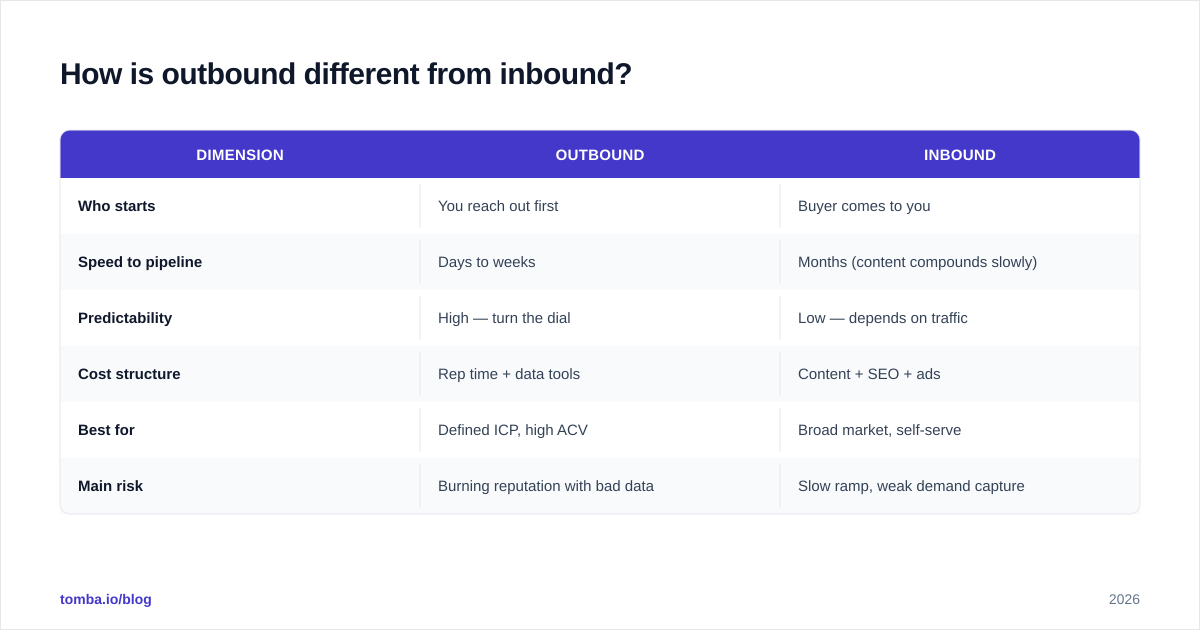
The two motions aren't rivals — they're complements that cover different parts of the funnel. The difference comes down to who initiates and how fast you can scale it.
| Dimension | Outbound | Inbound |
|---|---|---|
| Who starts | You reach out first | Buyer comes to you |
| Speed to pipeline | Days to weeks | Months (content compounds slowly) |
| Predictability | High — turn the dial | Low — depends on traffic |
| Cost structure | Rep time + data tools | Content + SEO + ads |
| Best for | Defined ICP, high ACV | Broad market, self-serve |
| Main risk | Burning reputation with bad data | Slow ramp, weak demand capture |
Most high-performing B2B teams run both. Inbound captures the demand that already exists; outbound creates demand among accounts that fit but aren't looking yet. The mistake is treating outbound as a cheaper version of advertising. It isn't — it's a precision instrument, and precision starts with knowing exactly who you're aiming at.
Who should you target? (Define your ICP first)#
Conclusion first: if your Ideal Customer Profile is fuzzy, nothing downstream works. Targeting is the lever with the highest payoff, because every wasted touch on a bad-fit account compounds — worse reply rates, worse deliverability, demoralized reps.
A usable ICP is specific enough to disqualify. Not "B2B SaaS companies" but "Series A–B vertical SaaS companies, 50–250 employees, in North America, with a VP of Sales but no RevOps hire yet." That last clause is a trigger — a reason this account needs you now.
Build your ICP around three layers:
- Firmographics — industry, size, revenue, geography, tech stack.
- Buying signals — recent funding, new exec hires, job postings, product launches, expansion into new markets. These tell you when, not just who.
- Pain fit — the specific, expensive problem your product removes. If you can't name it in one sentence, the prospect won't either.
Score accounts against those layers and tier them. Tier 1 gets fully personalized, multichannel sequences and maybe a hand-written note. Tier 3 gets a lighter, more templated touch. Spending equal effort on every account is how teams run out of hours before they run out of list.
How do you build a clean prospect list?#
Once the ICP is set, you need names, titles, and — critically — verified contact details. This is where most outbound engines quietly leak performance. A beautifully segmented list is worthless if 30% of the emails bounce.
The build process has three steps:
- Source the accounts. Pull companies matching your firmographics from a B2B database, LinkedIn Sales Navigator, or intent-data providers. Layer in the buying signals so your list is ranked by readiness, not just fit.
- Find the right people. For each account, identify the actual decision-makers and champions — not just whoever's title matched a keyword. Use a domain search to map everyone at a company, then narrow to the roles that matter.
- Get verified contact info. Pull professional email addresses and phone numbers, then verify them before they enter a sequence. An email finder plus a verification pass keeps your bounce rate where it belongs.
Resist the urge to maximize list size. A focused list of 200 verified, well-fit contacts will out-produce 2,000 scraped guesses every time — and it won't torch your sender reputation in the process.
Why does data accuracy decide everything?#
Bad data doesn't just waste time — it actively damages your ability to reach anyone. Here's the mechanism: every hard bounce signals to mailbox providers that you're either careless or a spammer. Let bounces climb past 3–5% and your messages start landing in spam folders for good addresses too. One dirty list can poison a domain you spent months warming.
B2B contact data also decays fast. People change jobs, companies rebrand, domains shift. Industry estimates put B2B data decay at roughly 30% per year — meaning a list you bought last spring is already a third wrong. That's why verification isn't a one-time chore; it's a recurring hygiene practice.
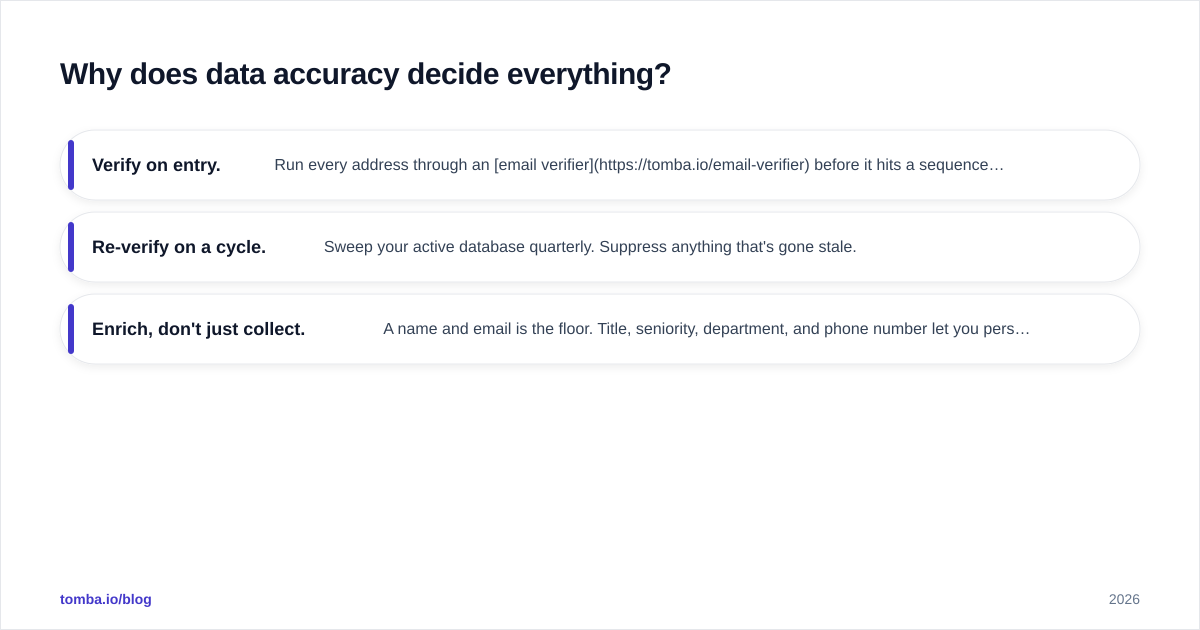
Three habits keep your data clean:
- Verify on entry. Run every address through an email verifier before it hits a sequence. Catch invalids, traps, and catch-all domains up front.
- Re-verify on a cycle. Sweep your active database quarterly. Suppress anything that's gone stale.
- Enrich, don't just collect. A name and email is the floor. Title, seniority, department, and phone number let you personalize and switch channels when email stalls.
If you want to go deeper on the deliverability side, the fundamentals of email deliverability and protecting your sender reputation are worth internalizing before you scale send volume.
What channels should an outbound sequence use?#
The strongest outbound sequences are multichannel by default. Buyers ignore the channel they're tired of and respond on the one that catches them at the right moment. Relying on email alone in 2026 leaves a large share of replies on the table.
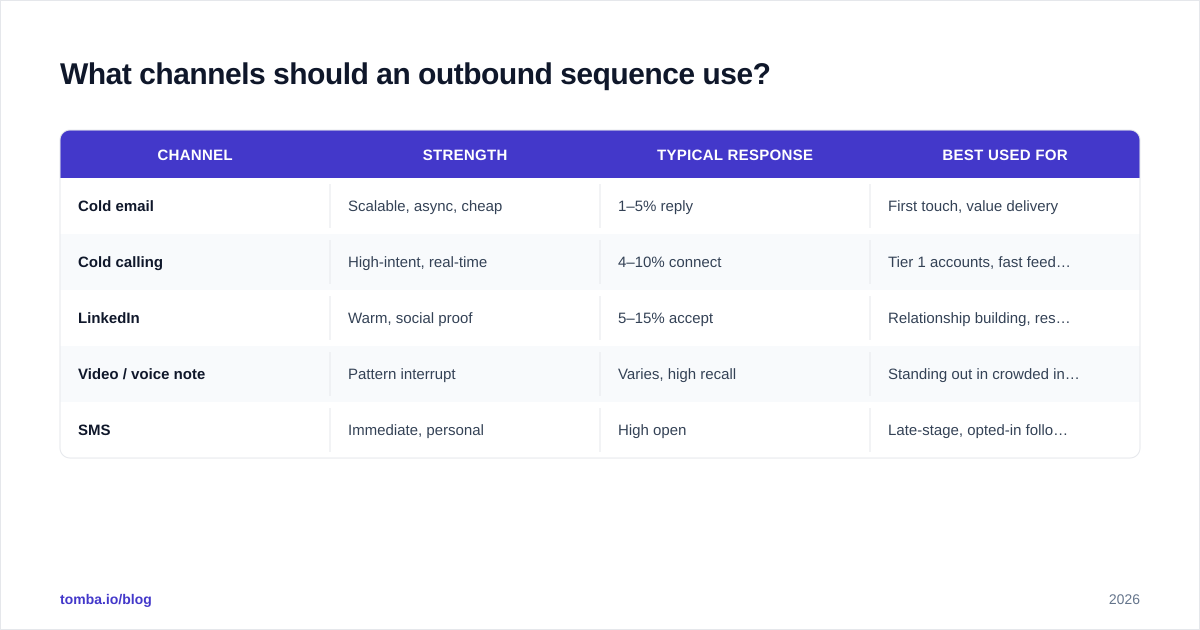
Here's how the core channels stack up:
| Channel | Strength | Typical response | Best used for |
|---|---|---|---|
| Cold email | Scalable, async, cheap | 1–5% reply | First touch, value delivery |
| Cold calling | High-intent, real-time | 4–10% connect | Tier 1 accounts, fast feedback |
| Warm, social proof | 5–15% accept | Relationship building, research | |
| Video / voice note | Pattern interrupt | Varies, high recall | Standing out in crowded inboxes |
| SMS | Immediate, personal | High open | Late-stage, opted-in follow-up |
A practical cadence blends them over 2–3 weeks. For example: email day 1, LinkedIn view + connect day 2, call day 4, value-add email day 7, LinkedIn message day 9, breakup email day 14. The exact mix matters less than the principle — multiple channels, spaced out, each adding something instead of just "checking in."
For phone-heavy motions, having accurate mobile numbers is non-negotiable. A phone finder that returns verified direct dials keeps connect rates from cratering on dead extensions.
How do you write outreach that actually gets replies?#
Relevance beats polish. A grammatically perfect email about nothing the buyer cares about loses to a slightly rough message that names their exact problem. Structure every cold touch around the prospect, not your product.
A reliable framework for the body:
- Opener (1 line): A specific, earned observation — their funding round, a job posting, a competitor move. Prove you're not mass-blasting.
- Problem (1–2 lines): The pain this persona feels, named in their language.
- Value (1–2 lines): What changes when the problem goes away, ideally with a concrete proof point or peer result.
- Ask (1 line): A low-friction, single call to action. "Worth a 15-minute look next week?" beats "Let me know your availability and I'll send a calendar invite for a comprehensive demo."
Keep it under 120 words. Write at a sixth-grade reading level. One ask per message. And kill the throat-clearing — "I hope this email finds you well" is the fastest way to signal a template. If you need a head start, a library of proven cold email templates gives you structures to adapt rather than copy.
Subject lines deserve their own attention since they gate everything else. Short, lowercase, and curiosity-driven tends to win — test relentlessly rather than trusting your gut.
What metrics prove your outbound is working?#
You can't improve what you don't measure, and most teams measure the wrong thing — total emails sent. Volume is an input, not a result. Track the conversion at each step so you can find the leak.
The metrics that matter, in order:
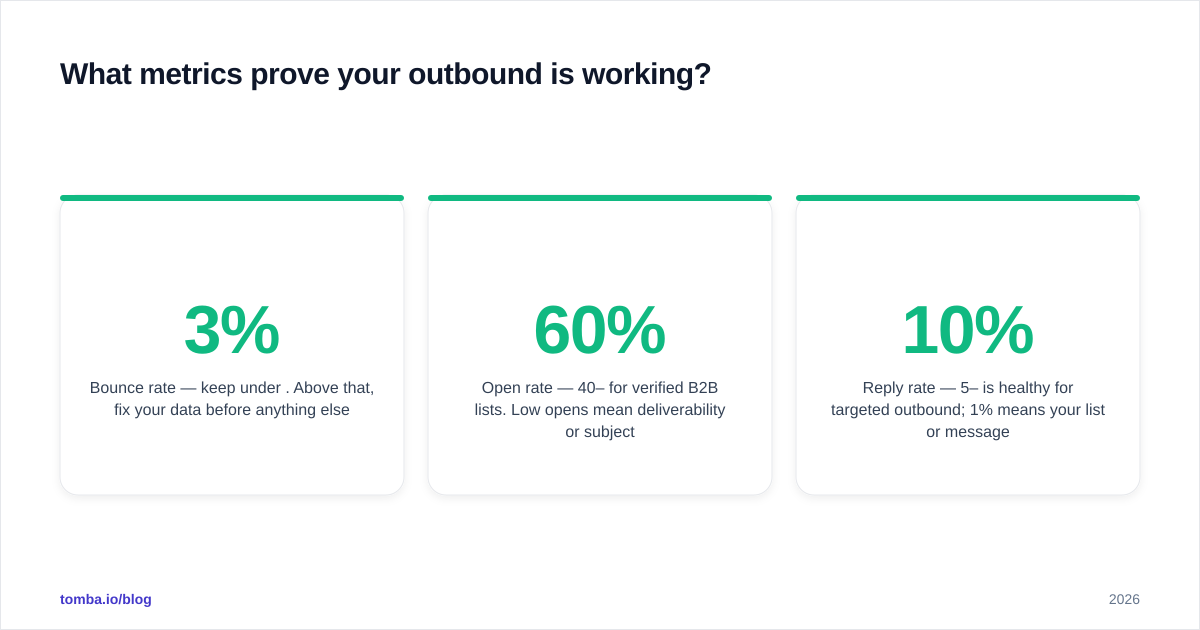
- Bounce rate — keep under 3%. Above that, fix your data before anything else.
- Open rate — 40–60% for verified B2B lists. Low opens mean deliverability or subject-line problems.
- Reply rate — 5–10% is healthy for targeted outbound; 1% means your list or message is off.
- Positive reply rate — replies that want to talk, not just "unsubscribe."
- Meetings booked — the real currency of outbound.
- Meeting-to-opportunity rate — proves you're booking fit prospects, not just anyone polite.
Watch these weekly and diagnose top-down. Low opens? Data or subject lines. Good opens, low replies? Message or targeting. Good replies, few meetings? Your call to action or qualification. Each metric points to a specific fix, which is exactly why turning "outbound isn't working" into a number is half the battle. Track your response rate as the leading indicator and let it drive your iteration loop.
What's the simplest way to start?#
Don't boil the ocean. Pick one tightly defined segment of your ICP — say, 100 accounts that just raised a round. Build a verified list. Write one multichannel sequence. Run it for three weeks, measure every step, and fix the biggest leak. Then scale what works and clone it to the next segment.
For broader context on where outbound fits in your funnel, HubSpot's research on sales and the buyer-behavior data on Gartner's sales insights are solid, vendor-neutral starting points. And if you want to benchmark tools, peer reviews on G2 cut through marketing copy quickly.
The teams that win at outbound in 2026 aren't the ones sending the most — they're the ones sending the most relevant messages to the most accurate contacts. Every part of the framework above either sharpens relevance or protects accuracy. Get those two right and the dial actually turns.
Build your outbound engine on data you can trust#
Outbound lives or dies on contact accuracy, so start there. Tomba's Email Finder lets you pull verified professional emails by name, company, or domain — and pair them with built-in verification so your bounce rate stays low and your sender reputation stays intact. Begin on the free tier (25 searches a month) to pressure-test your first list, then scale up as your sequences prove out; full Tomba pricing runs from $49/mo Starter to custom Enterprise. Clean data in, predictable pipeline out — that's the whole game.
// get started
Find, verify and enrich your first contacts today
Start on the free plan with 25 searches a month, then scale when your team is ready.
Free plan · No credit card required · GDPR & CCPA
// about the author