Outbound Sales Channels in 2026: The Complete Strategy Guide
Email, phone, LinkedIn, or all three? Here is how to pick, sequence, and measure the outbound sales channels that actually book meetings in 2026.
TL;DR
- An outbound sales channel is any path you use to reach a prospect who has not raised their hand yet — email, phone, LinkedIn, SMS, direct mail, and video are the main ones in 2026.
- No single channel wins. The teams hitting quota run multi-channel sequences where each touch reinforces the others, typically 8–14 touches across 3+ channels.
- Email is still the workhorse for scale and deliverability tracking; phone wins for reply speed; LinkedIn wins for warm credibility. Use all three in a coordinated order.
- Channel choice should follow your ICP, deal size, and data quality — not the channel that feels most comfortable.
- Your channel mix is only as good as your contact data. Bad emails and stale phone numbers quietly kill every channel at once.
What is an outbound sales channel?#
An outbound sales channel is the medium you use to start a conversation with a prospect who has not asked to hear from you. Inbound waits for the buyer to come to you; outbound goes and finds them. The channel is simply the how: a cold email, a cold call, a LinkedIn message, a text, a personalized video, or a piece of physical mail landing on a desk.
Think of channels like the lanes on a highway. The destination — a booked meeting — is the same in every lane. But each lane has a different speed limit, traffic level, and cost of entry. A good driver does not pick one lane and stay there for the whole trip. They move based on conditions. That is exactly how modern outbound works.
In 2026, the conversation has moved past "which channel is best?" to "what is the right sequence of channels for this specific buyer?" Buyers ignore single-channel outreach almost reflexively now. A lone cold email gets archived. A lone cold call goes to voicemail. But an email, followed by a relevant LinkedIn touch, followed by a call that references both — that earns attention.
What are the main outbound sales channels in 2026?#
There are six channels that matter for most B2B teams. Each has a clear strength and a clear failure mode.
Cold email. Still the backbone of outbound because it scales and it is measurable. You can send hundreds of personalized emails a week and track opens, replies, and bounces down to the contact. The failure mode is deliverability — one bad list or an unwarmed domain and your messages never reach the inbox.
Cold calling. The fastest path to a real conversation. A connected call gives you tone, objection handling, and an instant yes or no. The failure mode is volume math: connect rates hover around 5–10%, so you need a lot of dials and accurate numbers.
LinkedIn / social selling. The credibility channel. A profile view, a thoughtful comment, and a connection request build familiarity before you ever pitch. The failure mode is platform limits and the temptation to spray generic connection notes that read as automated.
SMS / text. High open rates (often cited above 90%) and near-instant reads, best used after some prior permission or contact. The failure mode is compliance — texting cold contacts without consent invites legal risk in many regions.
Personalized video. A short Loom-style clip cuts through a crowded inbox because almost nobody else is doing it well. The failure mode is time per touch; it does not scale to thousands.
Direct mail. A physical package or handwritten note for high-value accounts. Expensive, slow, memorable. The failure mode is cost and the logistics of getting accurate mailing data.
Which outbound sales channel performs best?#
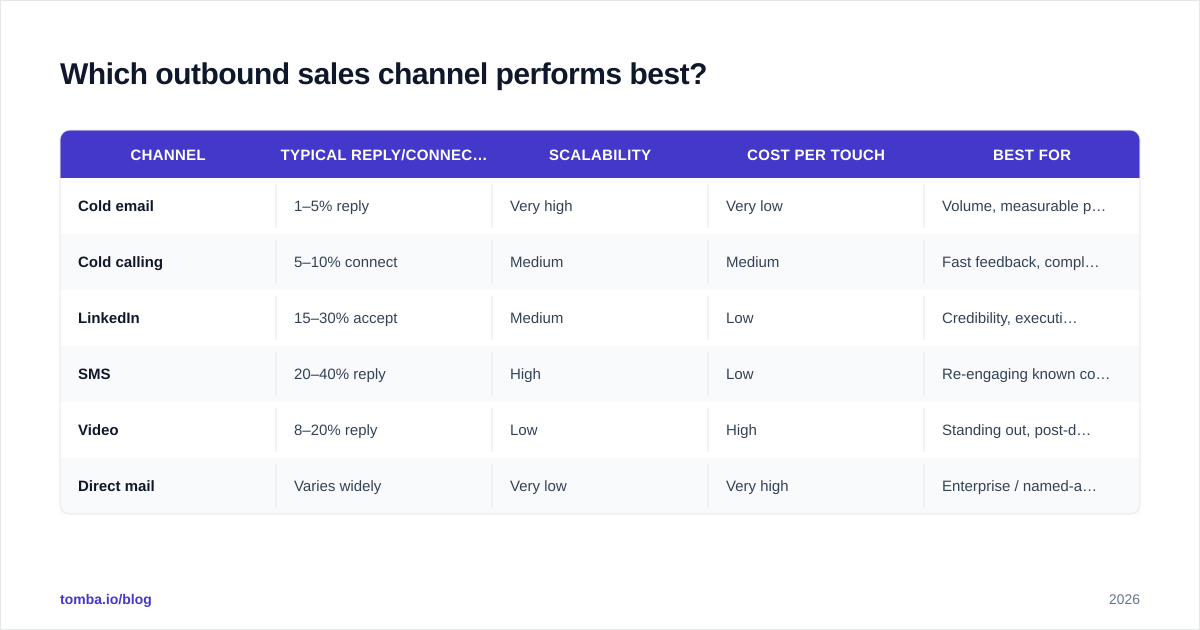
Short answer: the one your buyer actually responds to — and you only learn that by testing the mix. But here is an honest head-to-head on the dimensions that matter.
| Channel | Typical reply/connect rate | Scalability | Cost per touch | Best for |
|---|---|---|---|---|
| Cold email | 1–5% reply | Very high | Very low | Volume, measurable pipeline, mid-market |
| Cold calling | 5–10% connect | Medium | Medium | Fast feedback, complex/high-ACV deals |
| 15–30% accept | Medium | Low | Credibility, executive buyers, warm-up | |
| SMS | 20–40% reply | High | Low | Re-engaging known contacts, reminders |
| Video | 8–20% reply | Low | High | Standing out, post-demo follow-up |
| Direct mail | Varies widely | Very low | Very high | Enterprise / named-account ABM |
A few things jump out. LinkedIn and SMS show the highest engagement rates, but both have ceilings — LinkedIn limits how many requests you can send, and SMS only works once you have some prior relationship or consent. Email has the lowest per-message reply rate but the highest ceiling on volume, which is why it remains the channel you build everything else around. Cold calling sits in the middle on every axis, which is exactly why it pairs so well as the "closer" touch in a sequence.
According to HubSpot's sales research, the strongest predictor of a booked meeting is not the channel — it is the number of relevant touches before you give up. That points to the real lesson below.
Should you use one channel or multiple?#
Use multiple — and it is not close. Gartner's B2B buying research shows buyers move through a tangled, non-linear journey and expect to encounter sellers across several touchpoints. A single channel only reaches the slice of buyers who happen to prefer that channel on that day.
Here is the mechanism that makes multi-channel work: each touch lowers the cost of the next one. When a prospect has seen your name in their inbox and on a LinkedIn profile view, your cold call is no longer cold — it is "oh, you're the person who emailed me." Familiarity compounds. Researchers call this the mere-exposure effect, and outbound sequences exploit it on purpose.
The mistake teams make is treating "multi-channel" as "the same message blasted everywhere." That is just noise on five platforms. Real multi-channel means coordinated touches where each one references or builds on the last. Your LinkedIn note mentions the email. Your call mentions the LinkedIn connection. The thread is visible to the buyer, and it signals persistence plus competence.
This is also where teams get distracted. Every quarter a shiny new channel promises to replace the rest. Resist it. Add channels to your proven core; do not abandon what works to chase the new thing.
How do you build a multi-channel outbound sequence?#
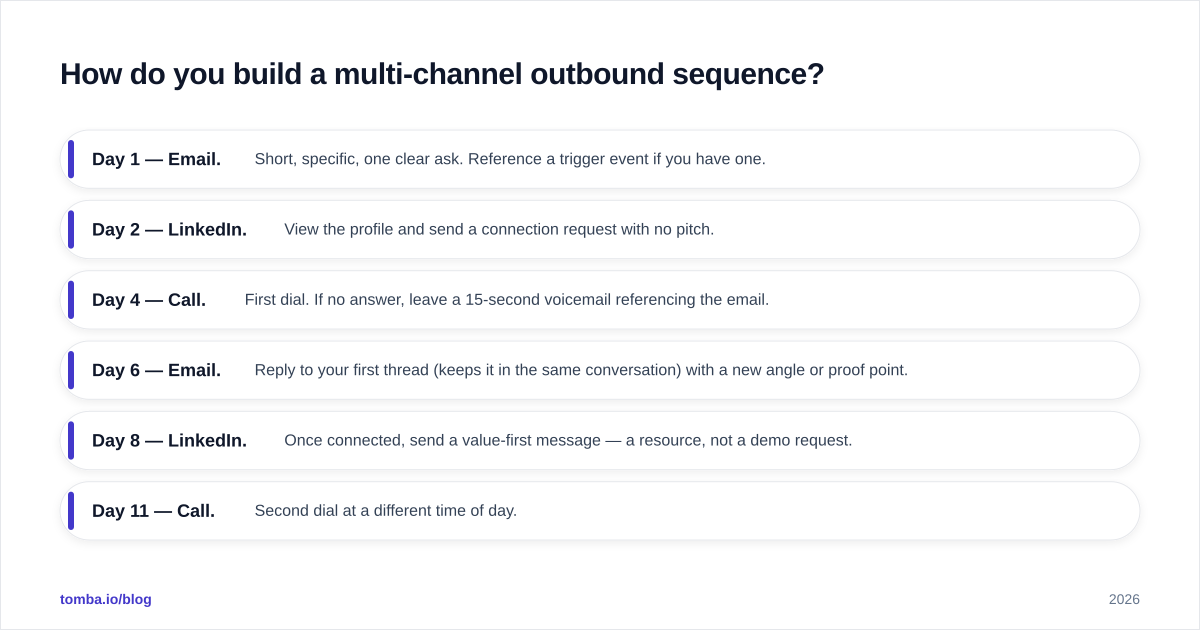
Start with a simple, repeatable cadence and only add complexity once you have data. Here is a proven 14-day, 3-channel skeleton you can adapt:
- Day 1 — Email. Short, specific, one clear ask. Reference a trigger event if you have one.
- Day 2 — LinkedIn. View the profile and send a connection request with no pitch.
- Day 4 — Call. First dial. If no answer, leave a 15-second voicemail referencing the email.
- Day 6 — Email. Reply to your first thread (keeps it in the same conversation) with a new angle or proof point.
- Day 8 — LinkedIn. Once connected, send a value-first message — a resource, not a demo request.
- Day 11 — Call. Second dial at a different time of day.
- Day 14 — Email. A short, polite breakup email. These get surprisingly high reply rates.
Two principles hold this together. First, vary the angle, not just the channel — repeating "just following up" five times is annoying regardless of medium. Second, measure per step, not just per sequence, so you can see exactly where prospects drop off and fix that one touch.
If you want to go deeper on the social side of this cadence, our guide to LinkedIn outreach breaks down message structure and timing, and the broader concept of social selling explains how to warm accounts before the sequence even starts.
How do you choose the right channels for your market?#
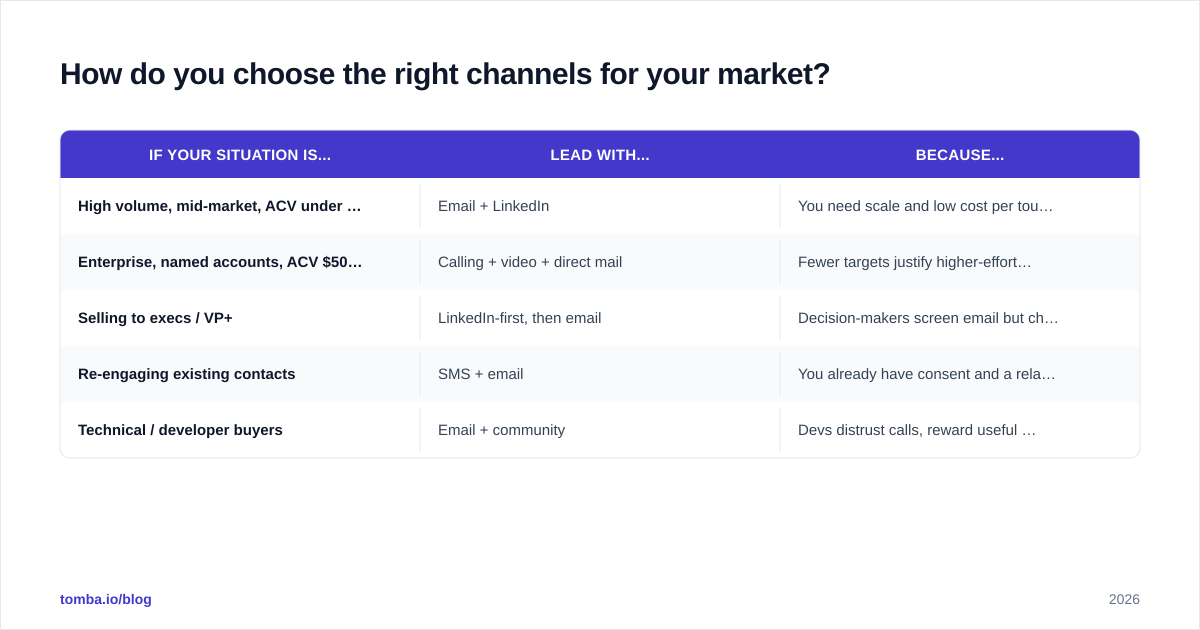
Match the channel to three variables: who you sell to, how big the deal is, and how good your data is.
| If your situation is... | Lead with... | Because... |
|---|---|---|
| High volume, mid-market, ACV under $10k | Email + LinkedIn | You need scale and low cost per touch |
| Enterprise, named accounts, ACV $50k+ | Calling + video + direct mail | Fewer targets justify higher-effort touches |
| Selling to execs / VP+ | LinkedIn-first, then email | Decision-makers screen email but check LinkedIn |
| Re-engaging existing contacts | SMS + email | You already have consent and a relationship |
| Technical / developer buyers | Email + community | Devs distrust calls, reward useful written outreach |
Notice that deal size is the strongest lever. When you have 5,000 prospects and a $5k product, you cannot hand-record videos — email and LinkedIn carry the load. When you have 50 named accounts and a $200k product, a personalized box in the mail is cheap relative to the deal, and it works.
The third variable, data quality, is the one teams underestimate. A perfect channel strategy executed against a list of bounced emails and disconnected phone numbers produces nothing. Your channel mix sits on top of your contact data, and if that foundation is shaky, every lane on the highway is closed.
How does data quality affect channel performance?#
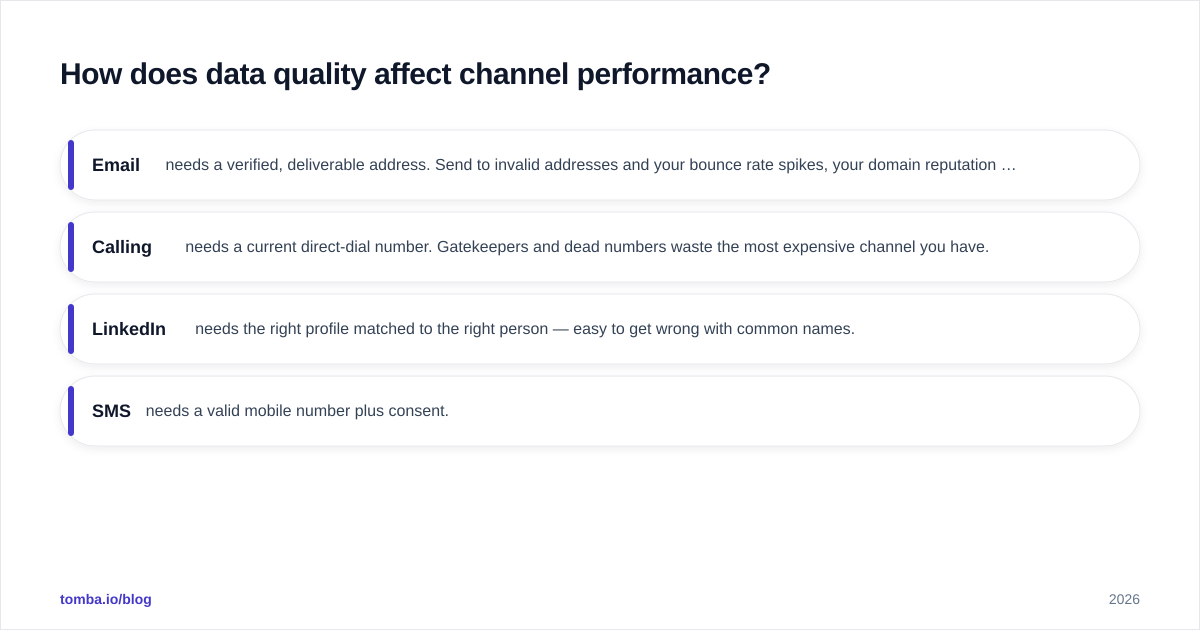
It affects everything, because each channel needs a different type of accurate data, and a gap in any one breaks that channel silently.
- Email needs a verified, deliverable address. Send to invalid addresses and your bounce rate spikes, your domain reputation drops, and even your good emails start landing in spam.
- Calling needs a current direct-dial number. Gatekeepers and dead numbers waste the most expensive channel you have.
- LinkedIn needs the right profile matched to the right person — easy to get wrong with common names.
- SMS needs a valid mobile number plus consent.
This is where a contact data layer earns its keep. Before a sequence ever fires, you want to find the right professional address with an email finder, confirm it is safe to send with an email verifier, and pull a direct-dial with a phone finder so your call touches actually connect. Running outreach without that step is like mailing letters to addresses you guessed.
There is a deliverability angle too. Every bounced email teaches inbox providers that your domain sends to bad lists. Clean data protects your sender reputation, which protects the deliverability of every future campaign. The channels are connected: sloppy data on one degrades the others.
You can sanity-check vendors on independent review sites like G2 before committing budget — look for accuracy and bounce-rate numbers, not just feature lists.
How do you measure outbound channel performance?#
Track each channel separately, then track the sequence as a whole. The two views answer different questions.
Per-channel metrics tell you which lane is working:
- Email: delivery rate, reply rate, positive reply rate, bounce rate.
- Calling: dials, connect rate, conversation-to-meeting rate.
- LinkedIn: acceptance rate, reply rate on messages.
- SMS: delivery, reply, opt-out rate.
Sequence-level metrics tell you whether the orchestration is working: meetings booked per 100 prospects entered, and the touch number at which most positive replies occur. That second number is gold — if most "yes" replies come on touch 6, cutting your sequence at touch 4 is leaving pipeline on the table.
One trap to avoid: do not optimize a single channel in isolation. If you judge cold calling only by its standalone connect rate, you will kill it — yet that call might be the touch that converts a prospect your emails warmed up. Measure the channel's contribution to the sequence, not just its solo numbers. Tie everything back to response rate and, ultimately, meetings booked.
Common outbound channel mistakes to avoid#
- Single-channel dependence. Relying only on email (or only on calls) caps your reach at one buyer preference. Diversify.
- Uncoordinated touches. Five channels sending five unrelated messages is noise. Make each touch reference the last.
- Chasing every new channel. A shiny tool is not a strategy. Add to your proven core; do not replace it.
- Skipping data verification. The fastest way to waste a great sequence is to run it on unverified contacts.
- Giving up too early. Most replies come after touch 5. Sequences that stop at touch 3 never see the pipeline they almost earned.
- Identical messaging across channels. Repetition without a new angle reads as spam regardless of medium.
Putting your channel strategy together#
The winning outbound motion in 2026 is not a single perfect channel — it is a coordinated mix matched to your buyer, sequenced over two weeks, measured per step, and built on accurate contact data. Start with email and LinkedIn as your scalable core, layer calling in as your conversion touch, and reserve video or direct mail for the accounts that justify the effort.
Everything in that motion depends on reaching the right person at the right address and number. Before you launch your next sequence, build your list on data you can trust: use the Tomba Email Finder to find verified professional emails by domain, name, or company, pair it with the verifier to protect deliverability, and check the Tomba pricing page — the free tier gives you 25 searches a month to test it against your own list before you commit. Get the data layer right, and every channel you run starts performing like it should.
Ready to find emails that actually work?
Join 150,000+ professionals who stopped guessing and started sending. Free credits on signup — no credit card required.
Get the Tomba newsletter
Practical outbound tactics and product updates — once every two weeks.
About the author