How to Measure Outsourced Outbound Sales: A 2026 Guide
Outsourcing your outbound doesn't mean outsourcing accountability. Here's the metrics framework, SLAs, and data-ownership rules that keep an agency honest in 2026.
You signed an agency to run your outsourced outbound sales. Six weeks in, they send a slide deck full of "activity": 14,000 emails sent, 3,200 dials, 41 "conversations started." Your CRM, meanwhile, shows two meetings booked and zero opportunities. Who's right?
Both numbers are real. Only one of them pays your salary. The gap between "activity reported by a vendor" and "revenue measured in your system" is where most outsourced programs quietly die. This guide is about closing that gap.
TL;DR#
- Measure outcomes you own, not activity the vendor reports. Sent volume and "conversations" are inputs; SQLs, pipeline, and closed-won are the only scoreboard that matters.
- Define the metric stack before you sign — set the SLA, the attribution window, and the data-ownership clause in the contract, not after the first bad month.
- Own your data layer. If the agency's tools hold your prospect list, verification status, and reply history, you can't measure them independently — and you can't leave.
- In-house vs. outsourced is a measurement question, not just a cost question. The right answer depends on how cleanly you can instrument the work.
- Audit the funnel monthly against a shared definition of "qualified," or you'll spend quarter three arguing about what a meeting is.
What does measuring outsourced outbound sales actually mean?#
There are two things people mean by it, and conflating them causes most of the pain.
The first is outsourcing the outbound motion — hiring an agency or an SDR-as-a-service team to run prospecting, sequencing, and booking on your behalf. The second is outsourcing the measurement of that motion — letting the same vendor define the KPIs, run the dashboard, and grade their own homework.
Doing the first is a legitimate strategic choice. Doing the second is how you lose control of your pipeline. The whole discipline here is keeping those two decisions separate: the vendor can run the work, but you own the scoreboard.
The principle is simple. Every metric that decides whether you renew, expand, or fire the vendor should be computed from data that lives in your CRM, from a definition you wrote. Anything the agency reports from its own tooling is a leading indicator at best and marketing at worst.
Why is activity reporting the wrong scoreboard?#
Because activity is the one thing an agency can always produce, regardless of whether it works.
A team paid to "do outbound" will always be able to show you that it did outbound. Emails went out. Dials happened. LinkedIn requests were sent. None of that is evidence the program is working — it's evidence the program is running. The two are not the same, and vendors who lead with volume are usually hiding a conversion problem downstream.
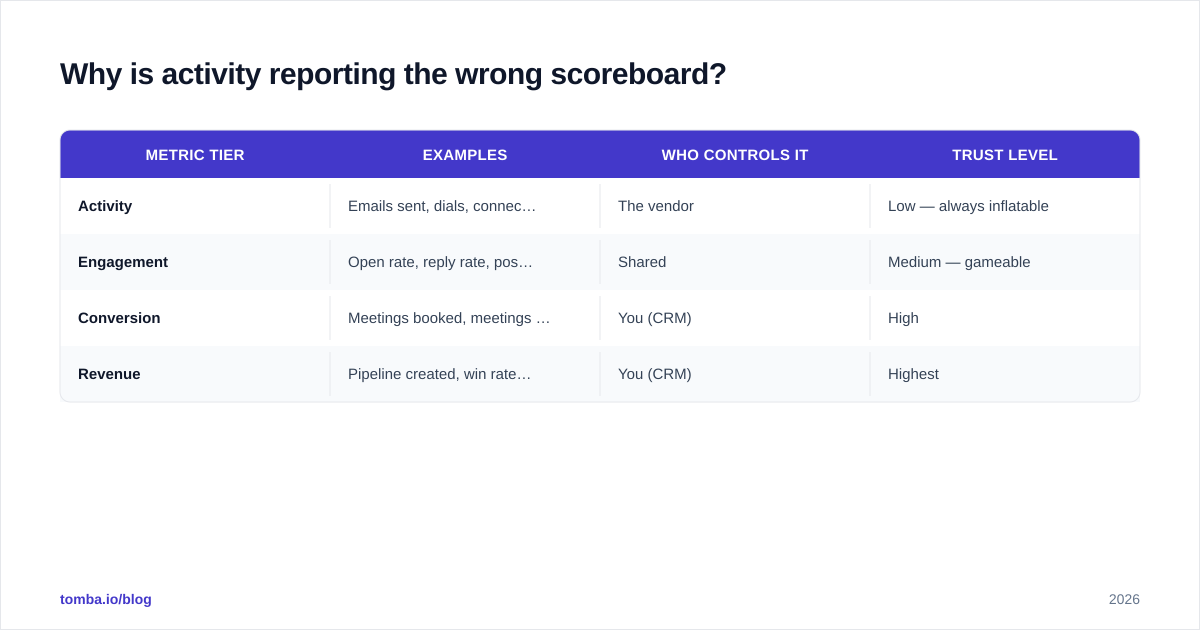
Here's the hierarchy you should grade against, from least to most trustworthy:
| Metric tier | Examples | Who controls it | Trust level |
|---|---|---|---|
| Activity | Emails sent, dials, connection requests | The vendor | Low — always inflatable |
| Engagement | Open rate, reply rate, positive replies | Shared | Medium — gameable |
| Conversion | Meetings booked, meetings held, SQLs | You (CRM) | High |
| Revenue | Pipeline created, win rate, closed-won | You (CRM) | Highest |
The rule of thumb: the further down this table a metric sits, the more it belongs in your contract as an SLA. An agency that resists being measured on held meetings and accepted opportunities — not just booked ones — is telling you something. Held-but-unqualified meetings are where outsourced numbers and real outcomes diverge most. So split "booked," "held," and "accepted" into three separate counts from day one. Track your response rate as a leading signal, but never let it stand in for pipeline.
How do you build the metric stack before signing?#
Decide three things in the contract, before the first email goes out. Reverse-engineering them after a disappointing month means negotiating from weakness.
1. The qualifying definition. Write down, in one sentence both sides sign, what makes a meeting a Sales Qualified Lead. Title, company size, expressed need, authority — pick the gates and freeze them. Most disputes between buyers and agencies are not about effort; they're about an undefined word.
2. The attribution window. If a prospect the agency emailed in March closes in July through your AE, does the agency get credit? Define the window (30, 60, 90 days) and the touch model up front. Vague attribution lets a vendor claim every deal that smells like outbound.
3. The data-ownership clause. Every prospect record, verification status, email, and reply must be exportable to you on demand, in a raw format, at any time. This is the clause vendors negotiate hardest and the one you should never give up — it's covered in its own section below.
With those three locked, your monthly review stops being a debate and becomes an audit. You're no longer asking "did you work hard?" You're checking a shared definition against your own system of record. For the broader vocabulary here — MQL, SQL, pipeline stages — the B2B glossary is a useful shared reference so both teams use words the same way.
Should you outsource outbound or keep it in-house?#
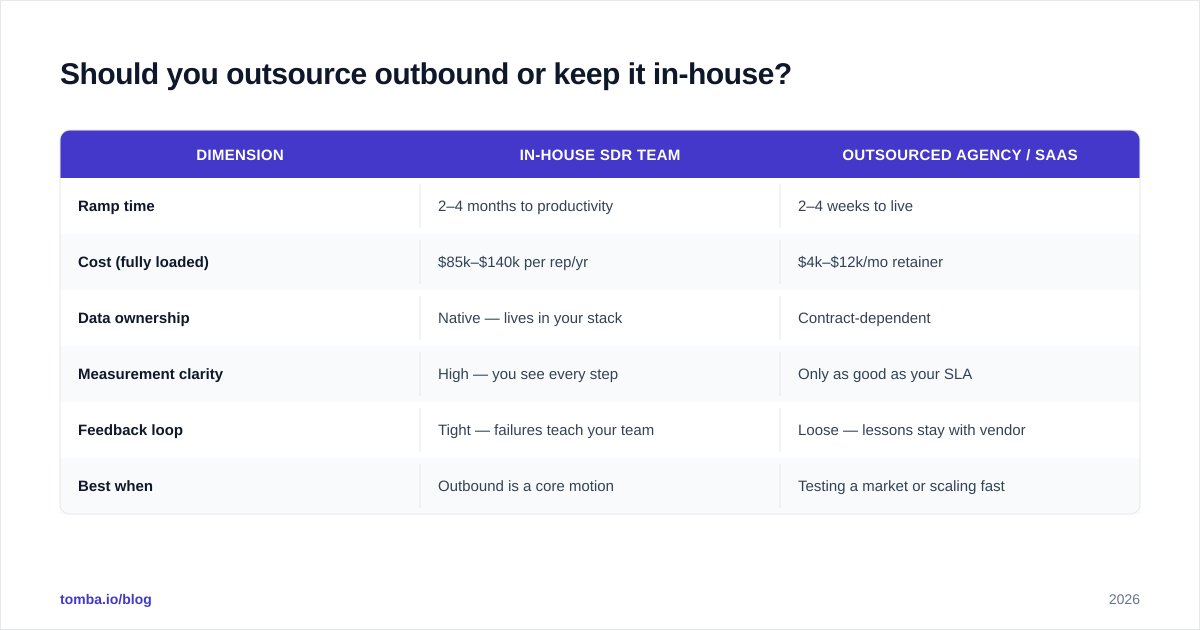
This is usually framed as a cost question. It's really a measurement question: how cleanly can you instrument the work, and who learns from the data?
Outsourcing buys speed and removes hiring risk. But it also puts a layer of glass between you and the feedback loop. When an in-house SDR sends 300 emails and books nothing, your team learns why — the list was wrong, the offer was weak, the timing was off. When an agency does the same, that learning often stays inside the agency. You get a summary; they keep the lesson.
| Dimension | In-house SDR team | Outsourced agency / SaaS |
|---|---|---|
| Ramp time | 2–4 months to productivity | 2–4 weeks to live |
| Cost (fully loaded) | $85k–$140k per rep/yr | $4k–$12k/mo retainer |
| Data ownership | Native — lives in your stack | Contract-dependent |
| Measurement clarity | High — you see every step | Only as good as your SLA |
| Feedback loop | Tight — failures teach your team | Loose — lessons stay with vendor |
| Best when | Outbound is a core motion | Testing a market or scaling fast |
Neither column wins outright. The honest read for 2026: outsource when you need to validate a segment or scale quickly and you've written tight SLAs; keep it in-house when outbound is a durable core motion and the compounding learning is worth the ramp. Many strong teams do both — an agency to test new markets, an in-house team to own the proven ones. Either way, the win rate on outbound-sourced deals is the metric that eventually settles the argument.
Which KPIs actually hold an agency accountable?#
Track a small set, weight them toward the bottom of the funnel, and review them on the same cadence every month. A useful shortlist:
- Meetings held / meetings booked (the show-rate). A high booking number with a low show rate means the agency is booking low-intent prospects. This ratio exposes it instantly.
- SQL acceptance rate. Of the meetings your AEs took, how many did your AEs accept as qualified? This is the single best honesty check, because your team grades it, not the vendor.
- Pipeline created (dollar value). Sum of opportunity value from agency-sourced meetings, inside the attribution window. This is what you're actually buying.
- Cost per SQL and cost per pipeline dollar. Retainer divided by accepted SQLs. Compare it against your in-house cost per SQL and against what tools like G2 suggest is normal for your segment.
- Time-to-first-meeting. How long from kickoff to the first held, accepted meeting. A slow start is sometimes setup; a slow month three is a problem.
Notice what's missing: emails sent, total dials, "touchpoints." Those belong in a diagnostic appendix, not on the scorecard. As HubSpot's research on sales metrics repeatedly shows, teams that lead with activity metrics over outcome metrics consistently overestimate the health of their pipeline.
How do you keep ownership of your data layer?#
This is the part most buyers underestimate, and it's the part that determines whether you can measure independently at all.
If the agency runs everything inside its own platform — its prospect database, its verification, its sequencer, its reply inbox — then every number you receive is a number the vendor chose to show you. You can't recompute it. You can't audit it. And when the contract ends, you walk away with a slide deck instead of an asset.
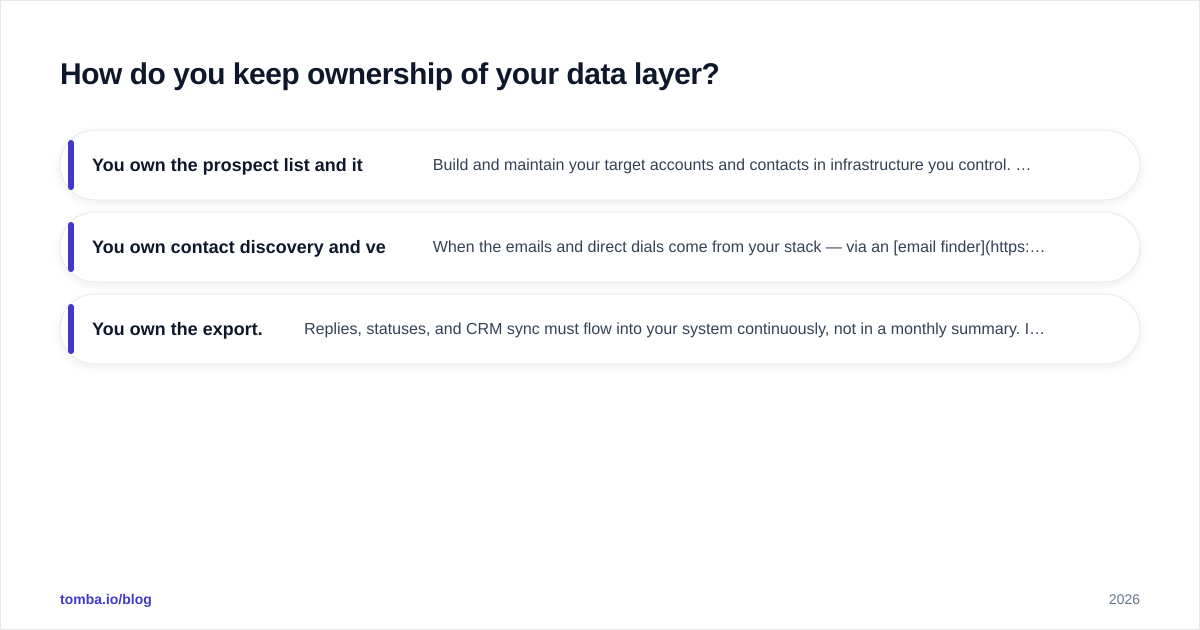
The fix is to insist that the data layer is yours, even when the labor is theirs. In practice that means:
- You own the prospect list and its enrichment. Build and maintain your target accounts and contacts in infrastructure you control. Running your own data enrichment and keeping a clean B2B database means the agency executes against your list, not a black-box list you can never see again.
- You own contact discovery and verification. When the emails and direct dials come from your stack — via an email finder and phone finder you run — you can independently check the quality of what the agency is contacting, instead of trusting their bounce-rate report.
- You own the export. Replies, statuses, and CRM sync must flow into your system continuously, not in a monthly summary. If you can't pull the raw data on a random Tuesday, you don't own it.
When the data layer is yours, switching agencies becomes a vendor decision instead of a migration crisis — and your measurement survives the switch because it never depended on the vendor's tooling in the first place. That independence is the whole point: you can fire the labor without losing the asset.
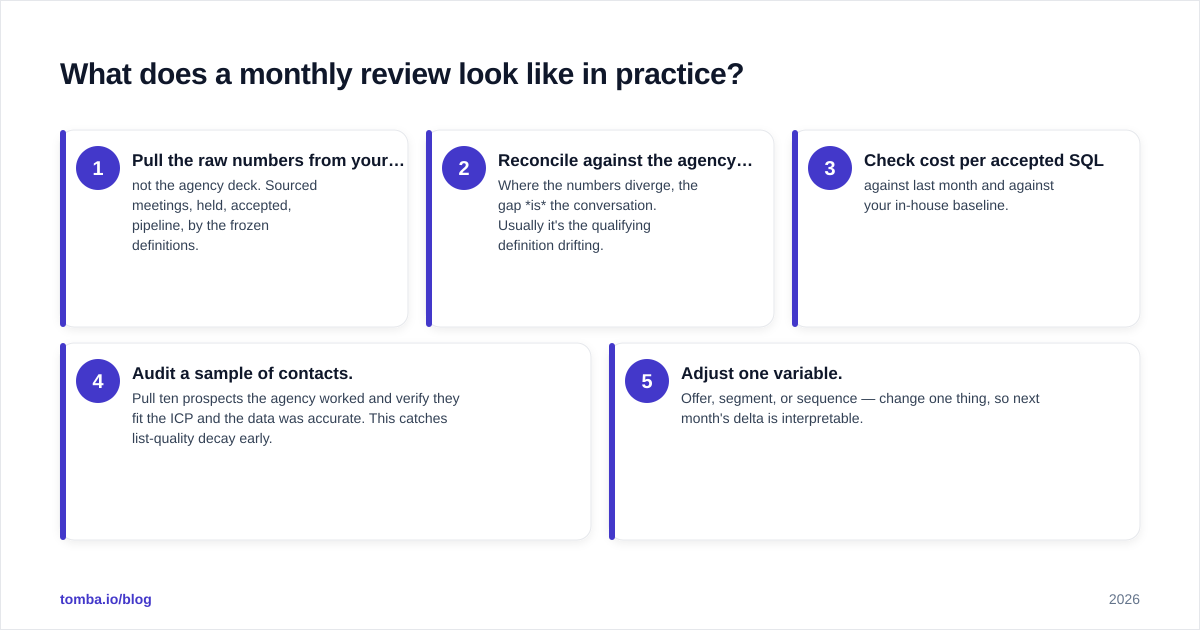
What does a monthly review look like in practice?#
Keep it boring and repeatable. The same five steps, same order, every month:
- Pull the raw numbers from your CRM — not the agency deck. Sourced meetings, held, accepted, pipeline, by the frozen definitions.
- Reconcile against the agency report. Where the numbers diverge, the gap is the conversation. Usually it's the qualifying definition drifting.
- Check cost per accepted SQL against last month and against your in-house baseline.
- Audit a sample of contacts. Pull ten prospects the agency worked and verify they fit the ICP and the data was accurate. This catches list-quality decay early.
- Adjust one variable. Offer, segment, or sequence — change one thing, so next month's delta is interpretable.
Run this loop and the renew/expand/fire decision makes itself by quarter's end. Skip it, and you'll be relitigating "what counts as a meeting" forever.
The bottom line#
Running outsourced outbound sales is fine. Outsourcing the scoreboard is not. Hold the labor at arm's length and the measurement close: write the qualifying definition and attribution window into the contract, grade the vendor on accepted SQLs and sourced pipeline rather than activity, and — above all — keep the prospect data, discovery, and verification in infrastructure you control. Do that, and an agency becomes a lever you can pull and release at will. Skip it, and you've handed a stranger the keys to your pipeline.
That independence starts with owning how you find and verify the people you reach. Build your target lists on data you control with the Tomba Email Finder — find and verify professional contacts by domain, name, or company, export them straight into your CRM, and hand any agency a clean list you can always audit. Start free with 25 searches a month, or see Tomba pricing when you're ready to scale. The agency can run the plays; you keep the data, and the scoreboard.
// get started
Find, verify and enrich your first contacts today
Start on the free plan with 25 searches a month, then scale when your team is ready.
Free plan · No credit card required · GDPR & CCPA
// about the author