ABM vs ABX in 2026: The RevOps Guide to Account-Based GTM
ABM got you the target list. ABX gets you the relationship. Here's how account-based marketing evolved into account-based experience—and how to run both in 2026.
Most teams that say they "do ABM" are really running a slightly more targeted email blast. They built a list of logos, loaded them into a sequence, and called it account-based. Then leads went cold, the board asked about pipeline, and someone in the Slack channel typed the question that started this whole debate: should we be doing ABX instead?
This guide answers that without the acronym theater. You'll see what actually changed between account-based marketing (ABM) and account-based experience (ABX), where each one fits, and how a modern revenue operations team wires both into a single go-to-market motion in 2026.
TL;DR#
- ABM is a targeting strategy. ABX is an operating model. ABM picks the accounts; ABX coordinates every touch—marketing, sales, CS, product—around those accounts' experience over time.
- ABX = ABM + intent data + orchestration + post-sale. It extends the account-based idea past the closed-won line into onboarding, expansion, and renewal.
- You don't choose one. Run ABM as the targeting layer inside an ABX framework. The tooling and the tier list are shared.
- Data quality decides both. A pristine target-account list with bad contact data fails identically whether you call it ABM or ABX. Enrichment and verified contacts are the unglamorous foundation.
- For most teams in 2026, the move is "ABX-lite": tier your accounts, align sales and marketing on a shared account plan, and add intent signals—without buying a six-figure orchestration platform on day one.
What is ABM, really?#
Account-based marketing is a go-to-market strategy where you treat a defined set of high-value accounts as the unit of work instead of individual leads. Rather than casting a wide net and counting marketing qualified leads, you pick (say) 200 companies that look like your best customers and concentrate marketing and sales effort on them.
The analogy: traditional demand generation is commercial fishing—drop a huge net, keep whatever you catch, throw back what you can't use. ABM is spearfishing. You know exactly which fish you want before you get in the water.
ABM became mainstream because the math is compelling for high-ACV B2B. According to Gartner's research on B2B buying, a typical buying group now involves six to ten stakeholders, each arriving with their own information. Spraying one message at one lead ignores the committee. ABM forces you to map the account.
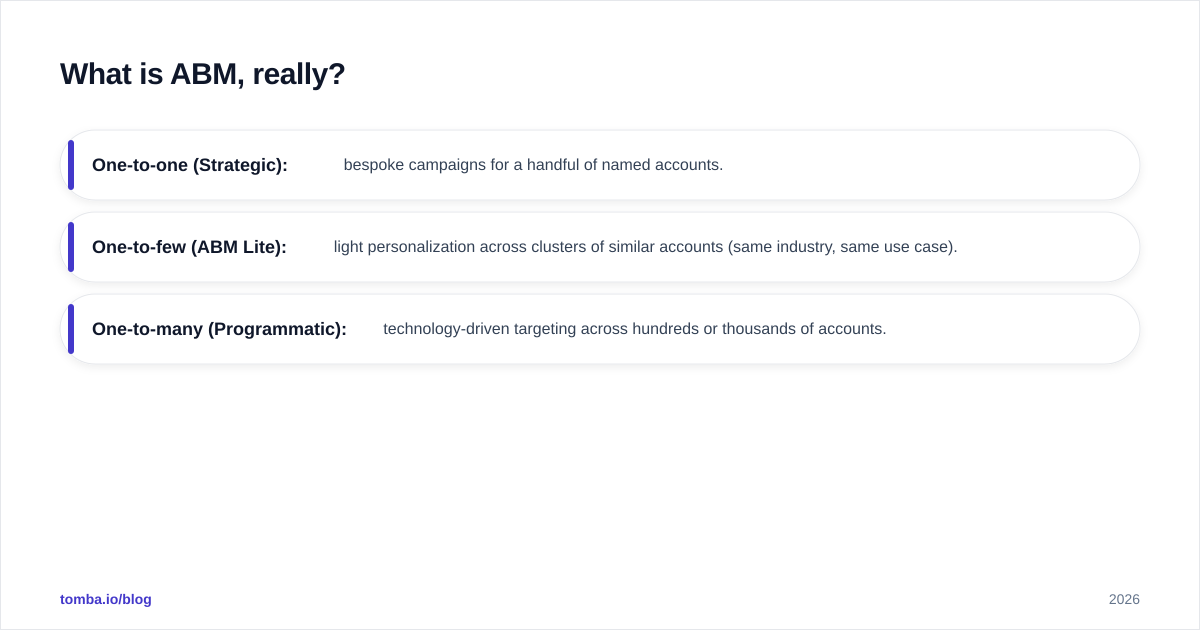
Classic ABM breaks into three flavors by intensity:
- One-to-one (Strategic): bespoke campaigns for a handful of named accounts.
- One-to-few (ABM Lite): light personalization across clusters of similar accounts (same industry, same use case).
- One-to-many (Programmatic): technology-driven targeting across hundreds or thousands of accounts.
What is ABX, and how is it different?#
Account-based experience (ABX) is the evolution of ABM that treats the entire account journey—before and after the sale—as one coordinated experience, triggered by buyer signals rather than campaign calendars.
If ABM answers "which accounts do we pursue?", ABX answers "what does this specific account experience across every team, at every stage, based on what they're actually doing right now?"
Three things make ABX different in practice:
- It's signal-led, not campaign-led. ABX waits for intent—a research spike, a pricing-page visit, a competitor mention—and orchestrates the next touch in response. ABM often runs on a fixed quarterly campaign cadence.
- It includes post-sale. ABM usually ends at closed-won. ABX explicitly designs onboarding, adoption, expansion, and renewal as part of the same account experience. Customer success is a first-class participant, not an afterthought.
- It's an operating model, not a marketing program. ABX assumes marketing, SDRs, AEs, and CS share one account plan, one definition of "engaged," and one source of truth. That's a revenue operations problem before it's a marketing problem.
Forrester, which has tracked the B2B revenue waterfall for years, frames the shift as moving from lead-centric to buying-group-centric and finally to a continuous, signal-driven motion. ABX is the operational name for that last stage.
ABM vs ABX: what's the actual difference?#
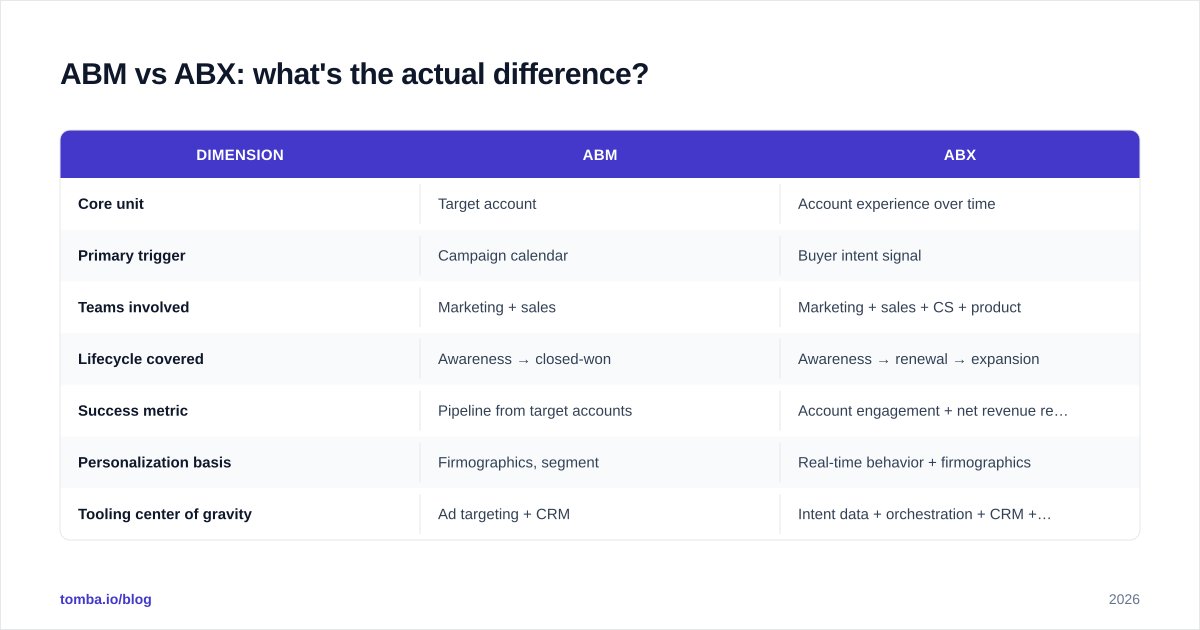
Here's the honest comparison. Most of the "ABX vs ABM" content online overstates the gap to sell a platform. The real difference is scope and trigger, not a wholesale replacement.
| Dimension | ABM | ABX |
|---|---|---|
| Core unit | Target account | Account experience over time |
| Primary trigger | Campaign calendar | Buyer intent signal |
| Teams involved | Marketing + sales | Marketing + sales + CS + product |
| Lifecycle covered | Awareness → closed-won | Awareness → renewal → expansion |
| Success metric | Pipeline from target accounts | Account engagement + net revenue retention |
| Personalization basis | Firmographics, segment | Real-time behavior + firmographics |
| Tooling center of gravity | Ad targeting + CRM | Intent data + orchestration + CRM + CS platform |
| Typical failure mode | "Targeted spam" with no follow-through | Over-engineering before data is clean |
The pattern to notice: every ABX column is a superset of the ABM column. You cannot run ABX without doing ABM first—you still have to choose the accounts. ABX just refuses to stop caring once the deal closes.
Is ABX better than ABM?#
Better is the wrong frame. ABX is broader, and broader is only better if you can operationalize it.
A 12-person startup with one marketer and three AEs does not need a signal-orchestration platform routing 14 plays across four teams. They need a clean target-account list, a shared definition of a good-fit account, and the discipline to actually personalize the first three touches. That's ABM, and it's the right call.
A 300-person scale-up with a real CS org, multi-product expansion revenue, and a RevOps function that owns the data—that company is leaving money on the table if it stops the account-based motion at closed-won. That's where ABX earns its complexity.
Use this rule of thumb:
- Choose ABM-first if your motion is mostly new logo, your ACV is moderate, or your team is small enough that orchestration is manual anyway.
- Choose ABX if expansion and retention are a major revenue line, you have the cross-functional headcount to coordinate, and you have intent data worth acting on.
What does an ABX motion look like end to end?#
Here's the lifecycle most RevOps teams converge on once they move past basic ABM. Each stage has an owner and a trigger—that ownership clarity is what separates ABX from "ABM with extra meetings."
- Define the ICP and tier the accounts. Tier 1 (1:1), Tier 2 (1:few), Tier 3 (programmatic). RevOps owns the scoring model.
- Build the account and contact map. Identify the buying group inside each target account—champion, economic buyer, blockers, end users. This is where data quality makes or breaks you.
- Listen for signals. Intent data, website visits, product usage, hiring trends. Marketing and RevOps own the signal layer.
- Orchestrate the play. A signal fires a coordinated response: an ad, an SDR touch, a tailored landing page. The play is pre-defined; the trigger is real-time.
- Sales engagement. AEs work the engaged buying group with full context on what marketing already did. No cold restart.
- Onboarding and adoption. CS inherits the account context and designs the first 90 days around the value the buyer was promised.
- Expansion and renewal. New signals (usage growth, new hires, new use cases) trigger expansion plays. The loop restarts inside the existing account.
Step 2 is where most programs quietly fail. You can have a flawless tier list and a beautiful orchestration platform, and it all collapses if the contact data is stale. The buying group you mapped six months ago has a new VP, two people left, and the email you have for the champion now bounces.
Why does data quality decide ABM and ABX outcomes?#
Because account-based anything is precision marketing, and precision marketing amplifies data errors instead of averaging them out.
In spray-and-pray demand gen, a 30% bad-data rate is annoying but survivable—you sent 10,000 emails, 3,000 missed, you still got volume. In a 1:1 ABX motion targeting 50 strategic accounts, a 30% bad-data rate means 15 of your most important accounts get a broken first impression or never get reached at all. There's no volume to hide behind.
That's why the unglamorous foundation of every serious account-based program is contact data hygiene:
- Find the right people. Once you've named the account, you need verified work emails for the buying group. A domain search returns the known email patterns and contacts at a target company so you're not guessing formats.
- Enrich the account record. Data enrichment fills in role, seniority, department, and company firmographics so your tiering and routing logic actually have fields to act on.
- Verify before you send. Bounces don't just waste a touch—they damage sender reputation, which degrades deliverability for the whole program.
This is the layer that doesn't show up in the slick ABX platform demo, and it's exactly the layer that determines whether the platform produces pipeline or dashboards.
What tools do you actually need for ABM vs ABX?#
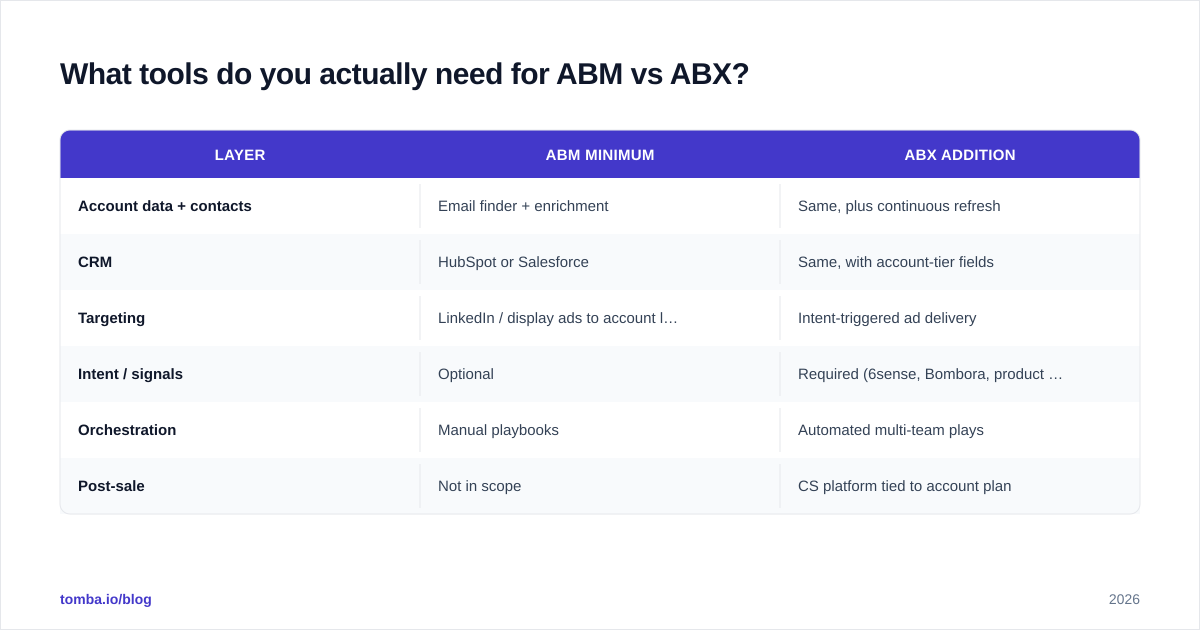
You need fewer net-new platforms than vendors imply, because ABX reuses most of the ABM stack. Here's the realistic stack by maturity.
| Layer | ABM minimum | ABX addition |
|---|---|---|
| Account data + contacts | Email finder + enrichment | Same, plus continuous refresh |
| CRM | HubSpot or Salesforce | Same, with account-tier fields |
| Targeting | LinkedIn / display ads to account lists | Intent-triggered ad delivery |
| Intent / signals | Optional | Required (6sense, Bombora, product usage) |
| Orchestration | Manual playbooks | Automated multi-team plays |
| Post-sale | Not in scope | CS platform tied to account plan |
Notice the first row is identical. Whether you're running lean ABM or full ABX, you start by knowing who's in the account and how to reach them. Tools like HubSpot's ABM features give you the workspace and tiering; you still have to feed them verified contacts. You can compare the broader category on G2's ABM platform listings once you know which layer you're actually buying for.
The mistake teams make is buying the orchestration layer (row five) before fixing the data layer (row one). It's like installing a high-end irrigation system over dead soil. Get the contacts and account records clean first; automate second.
How do you start ABX without boiling the ocean?#
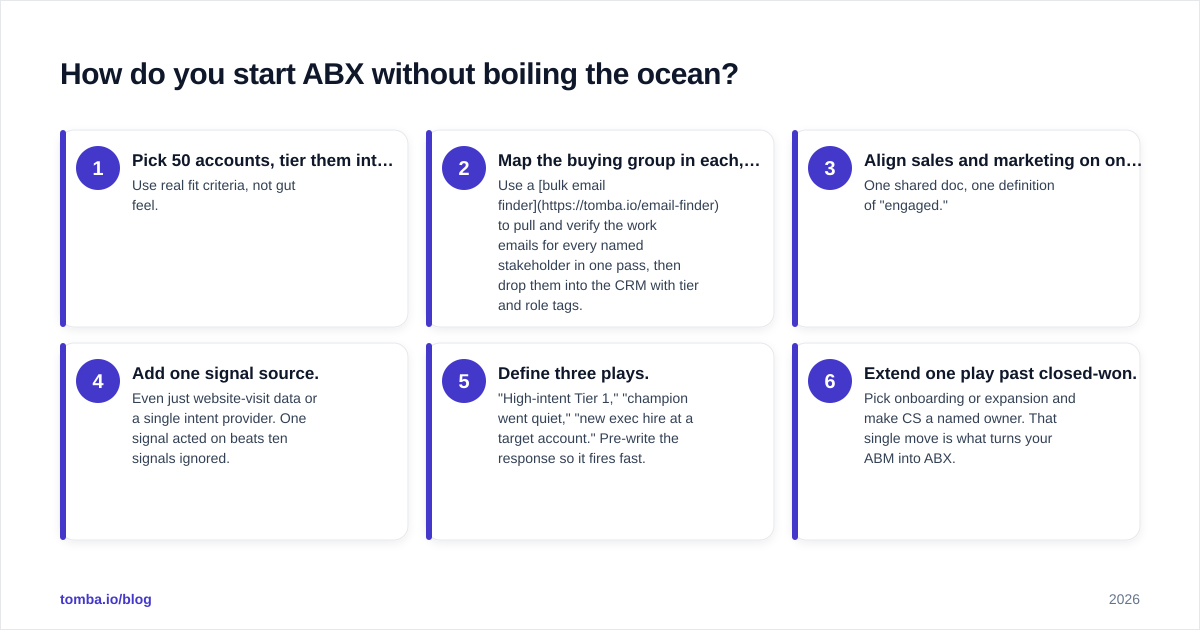
Run "ABX-lite." It's the 80/20 that gets most of the value without the platform sprawl, and it's where I'd point any team that's outgrowing basic ABM but isn't ready for a full orchestration build.
- Pick 50 accounts, tier them into three buckets. Use real fit criteria, not gut feel.
- Map the buying group in each, with verified contacts. Use a bulk email finder to pull and verify the work emails for every named stakeholder in one pass, then drop them into the CRM with tier and role tags.
- Align sales and marketing on one account plan per tier. One shared doc, one definition of "engaged."
- Add one signal source. Even just website-visit data or a single intent provider. One signal acted on beats ten signals ignored.
- Define three plays. "High-intent Tier 1," "champion went quiet," "new exec hire at a target account." Pre-write the response so it fires fast.
- Extend one play past closed-won. Pick onboarding or expansion and make CS a named owner. That single move is what turns your ABM into ABX.
Do that for one quarter, measure account engagement and pipeline, then decide whether the orchestration platform is worth it. Most teams find ABX-lite carries them much further than expected—because the constraint was never the software. It was the data and the alignment.
The bottom line#
ABM is how you choose the accounts. ABX is how every team treats those accounts across the entire lifecycle, triggered by what buyers actually do. You don't pick between them—you run ABM as the targeting core of an ABX operating model, and you scale the orchestration only as fast as your data and team coordination can support.
And both live or die on the same foundation: knowing exactly who's in each target account and being able to reach them with verified, deliverable contact data. That's the part no platform fixes for you.
Start there. Use the Tomba Email Finder to build and verify the buying-group contacts behind your target-account list—accurate work emails, enriched roles, and domain-level patterns—so your ABM targeting and your ABX orchestration are both running on data that actually lands. Map the accounts first; the rest of the motion only works when the contacts do.
Ready to find emails that actually work?
Join 150,000+ professionals who stopped guessing and started sending. Free credits on signup — no credit card required.
Get the Tomba newsletter
Practical outbound tactics and product updates — once every two weeks.
About the author