Demand Generation in 2026: The Complete B2B Strategy Guide
Demand generation in 2026 is no longer about flooding the funnel with cheap leads. Here's how modern RevOps teams build durable pipeline that actually converts.
Demand generation is the discipline of creating, capturing, and converting market interest into qualified pipeline that sales can actually close. In 2026, the teams winning at it have stopped treating it as a lead-volume game and started treating it as a revenue system. This guide walks you through the frameworks, channels, metrics, and tooling that separate teams generating real pipeline from teams generating busywork.
TL;DR#
- Demand generation ≠ lead generation. Demand gen creates and captures interest across the whole buyer journey; lead gen is just the capture step. Confusing the two is why most pipeline targets get missed.
- Split your spend by intent. Roughly 95% of your market isn't ready to buy today. Demand creation warms the future buyer; demand capture converts the in-market 5%. You need both.
- Measure pipeline and revenue, not MQLs. Self-reported attribution and closed-won pipeline beat last-click MQL counting in 2026.
- Clean data is the multiplier. The best campaign in the world fails if half your contact records bounce. Enrichment and verification are now table stakes.
- Tooling stack: content engine + paid channels + a CRM + a reliable contact-data layer (finder, verifier, enrichment).
What is demand generation, really?#
Think of demand generation like running a restaurant in a new neighborhood. Lead generation is the host at the door asking for reservations. But if nobody in the neighborhood knows the restaurant exists, there are no reservations to take. Demand generation is everything that makes people want to eat there in the first place — the aromas drifting down the street, the reviews, the friend who won't stop talking about the pasta — plus the host capturing the people who show up hungry.
Technically, demand generation is the full-funnel program that does two jobs:
- Demand creation — building awareness and intent in people who aren't searching for you yet.
- Demand capture — converting the people who already have intent (they're searching, comparing, or asking peers) into pipeline.
Most B2B teams over-invest in capture (Google Search ads, bottom-funnel content) because it's measurable, and under-invest in creation because it's slow. That's the central tension of the discipline, and getting the balance right is the whole game.
How is demand generation different from lead generation?#
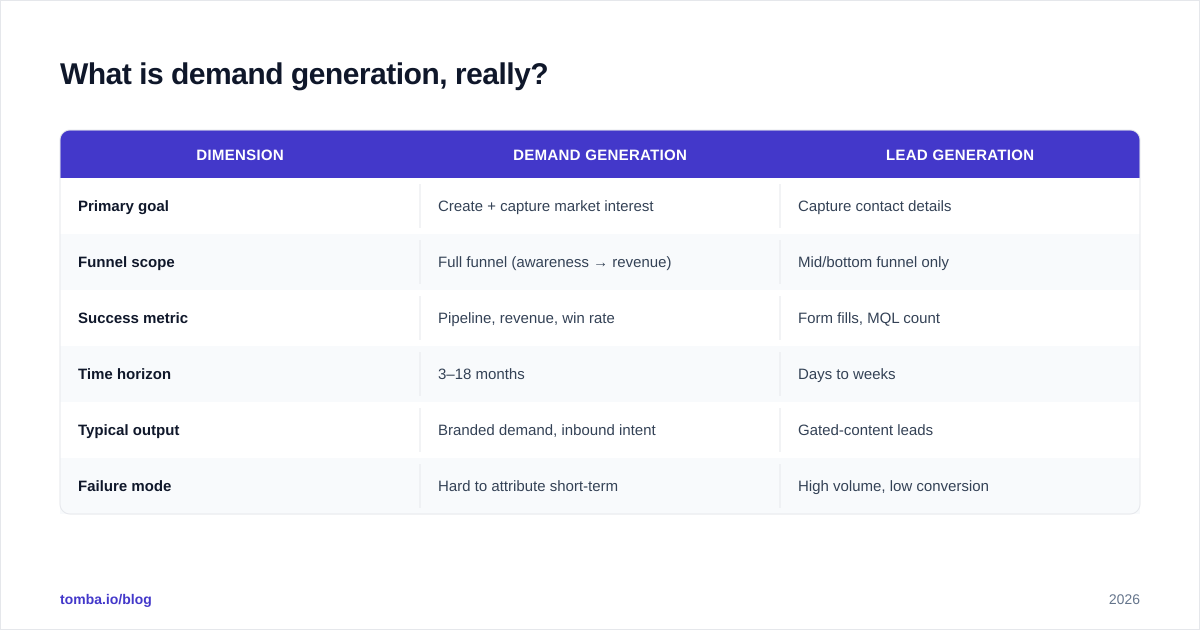
This is the question that trips up most teams and most budgets. They overlap, but they are not the same thing.
| Dimension | Demand Generation | Lead Generation |
|---|---|---|
| Primary goal | Create + capture market interest | Capture contact details |
| Funnel scope | Full funnel (awareness → revenue) | Mid/bottom funnel only |
| Success metric | Pipeline, revenue, win rate | Form fills, MQL count |
| Time horizon | 3–18 months | Days to weeks |
| Typical output | Branded demand, inbound intent | Gated-content leads |
| Failure mode | Hard to attribute short-term | High volume, low conversion |
Lead generation is a tactic inside demand generation. When a team reports "we hit our lead target but missed pipeline," they ran lead gen and called it demand gen. The fix isn't more forms — it's building the creation layer that makes those forms convert.
Why does demand generation matter more in 2026?#
Three shifts made demand generation the center of the revenue operations conversation this year:
Buyers self-educate before they ever talk to you. Industry research from Gartner has shown for years that B2B buyers spend the majority of their journey researching independently and only a sliver of it with sales reps. By 2026 that gap is wider — buyers arrive at the first sales call with a shortlist already formed. If you weren't part of the education phase, you're not on the list.
The 95/5 rule is now operational, not academic. The LinkedIn/Ehrenberg-Bass research popularized the idea that only about 5% of your market is in-market at any given time. Demand creation is how you stay memorable to the 95% so that when they enter the market, you're the brand they already trust.
Cheap leads got cheaper — and worthless. AI made it trivial to scrape, generate, and blast contact lists. The result: inboxes are saturated and reply rates on un-targeted outreach have cratered. Quality of demand, backed by quality of data, is the only durable edge.
What does the modern demand gen funnel look like?#
The classic linear funnel (awareness → consideration → decision) is a useful sketch but a poor map. Real buyers loop, stall, and re-enter. A more honest model splits activity into creation and capture running in parallel, with a data layer feeding both.
The non-obvious part: the data and routing layer in the middle is what most teams skip. You can generate all the demand you want, but if the captured contact lands in your CRM with a bounced email and no firmographic context, your SDRs can't act on it. That's where enrichment and verification earn their keep — more on that below.
What channels drive demand generation in 2026?#
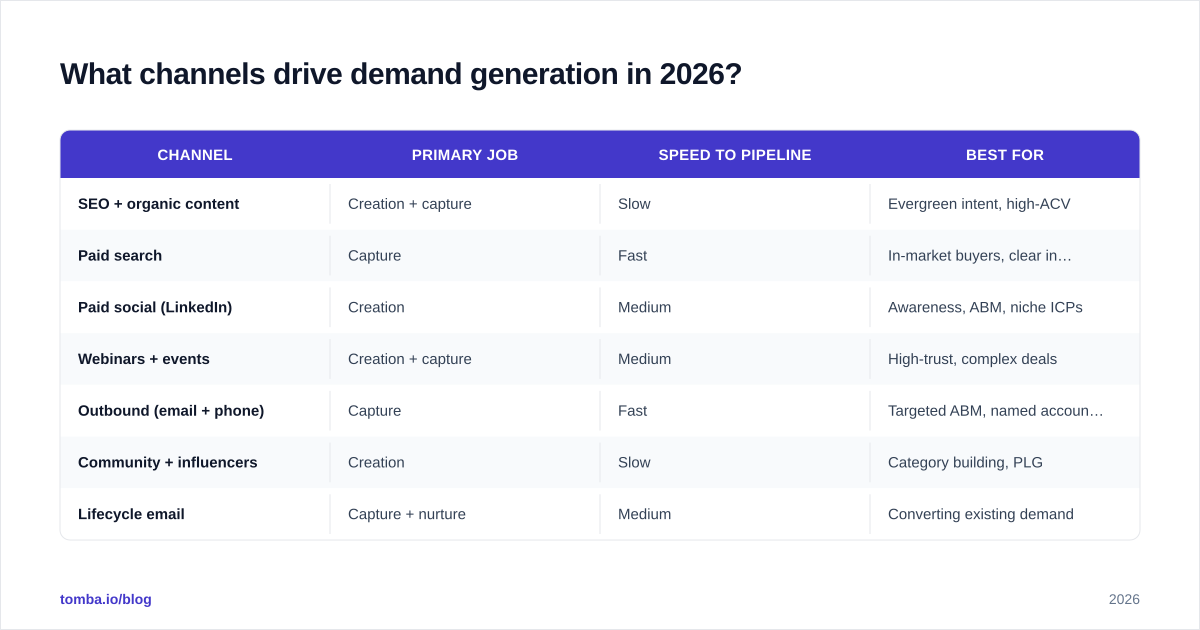
There's no single channel that works. Demand gen is a portfolio, and the mix depends on your motion (PLG, sales-led, hybrid), ACV, and sales cycle. Here's how the main channels split by job.
| Channel | Primary job | Speed to pipeline | Best for |
|---|---|---|---|
| SEO + organic content | Creation + capture | Slow | Evergreen intent, high-ACV |
| Paid search | Capture | Fast | In-market buyers, clear intent |
| Paid social (LinkedIn) | Creation | Medium | Awareness, ABM, niche ICPs |
| Webinars + events | Creation + capture | Medium | High-trust, complex deals |
| Outbound (email + phone) | Capture | Fast | Targeted ABM, named accounts |
| Community + influencers | Creation | Slow | Category building, PLG |
| Lifecycle email | Capture + nurture | Medium | Converting existing demand |
How should you split creation vs. capture budget?#
A defensible 2026 starting point: 60% capture, 40% creation if you're early and need pipeline now; shift toward 50/50 or even 40/60 as you mature and want to lower your cost of capture over time. Pure-capture teams plateau — they exhaust the in-market 5% and watch CAC climb every quarter. Creation is what makes capture cheaper later.
Where does outbound fit?#
Outbound is demand capture aimed at accounts you've decided are a fit, whether or not they've raised their hand. It's the highest-leverage channel when two things are true: your targeting is precise, and your contact data is accurate. Get either wrong and outbound becomes spam that damages your sender reputation.
This is the failure point I see most often. A team builds a beautiful account list, then feeds it guessed or stale email addresses. Half bounce. Deliverability tanks. The campaign gets blamed when the data was the problem. Before any outbound demand gen motion, you need verified, enriched contacts — using an email finder to source accurate addresses and an email verifier to scrub the list first.
How do you build a demand generation engine step by step?#
Here's the operational sequence. Treat it as a build order, not a checklist to do in parallel — each step makes the next one work.
1. Define your ICP and segments precisely. Not "mid-market SaaS" — that's a vibe, not a target. Specify industry, employee count, tech stack, role titles, and trigger events. Your marketing qualified lead definition should fall out of this directly.
2. Map the demand layer. For each segment, decide what creates demand (the problem they don't yet connect to your solution) and what captures it (the search terms and triggers that mean they're ready).
3. Build the content engine. You need both creation content (point-of-view, category education, thought leadership) and capture content (comparisons, pricing pages, product deep-dives, calculators). Most teams have only the latter.
4. Stand up the data and routing layer. This is the unglamorous core. Every captured contact needs to be verified, enriched with firmographics, deduped, and routed to the right owner within minutes. Enrich your inbound and outbound lists with data enrichment so reps inherit context instead of a bare email address.
5. Launch capture channels first. Get paid search, comparison content, and targeted outbound running to harvest existing demand. This funds the program and proves the motion.
6. Layer in creation channels. Once capture is humming, invest in the slow-burn creation channels (organic, social, community, events) that lower your blended CAC over the next few quarters.
7. Instrument everything for pipeline, not leads. Wire up self-reported attribution ("How did you hear about us?") alongside multi-touch, and report on sourced and influenced pipeline.
What metrics should you actually track?#
Stop reporting MQL counts to your leadership team. Here's the metric hierarchy that matters in 2026:
- Pipeline created (sourced + influenced) — the top-line demand gen number.
- Pipeline-to-spend ratio — how much pipeline per dollar of program spend.
- Win rate by source — reveals which channels create quality demand, not just volume.
- Cost per opportunity (not per lead) — keeps you honest about quality.
- Velocity — how fast demand moves from captured to closed.
- Data health rate — bounce rate, enrichment coverage, dedupe rate. Leading indicator for everything downstream.
You can read more on related definitions in the Tomba B2B glossary if you want shared language across your RevOps team. Platforms like HubSpot and review sites like G2 are also useful for benchmarking your channel mix against peers.
What are the most common demand generation mistakes?#
After watching dozens of programs, the failure patterns rhyme:
Mistaking activity for demand. Publishing posts, running ads, and sending emails is motion, not demand. If none of it changes the size or speed of your pipeline, it's theater. Tie every program to a pipeline hypothesis.
Gating everything. Putting every asset behind a form maximizes lead count and minimizes reach — the opposite of demand creation. Ungate your best creation content so it can do its job; gate only the bottom-funnel assets where the form fill signals real intent.
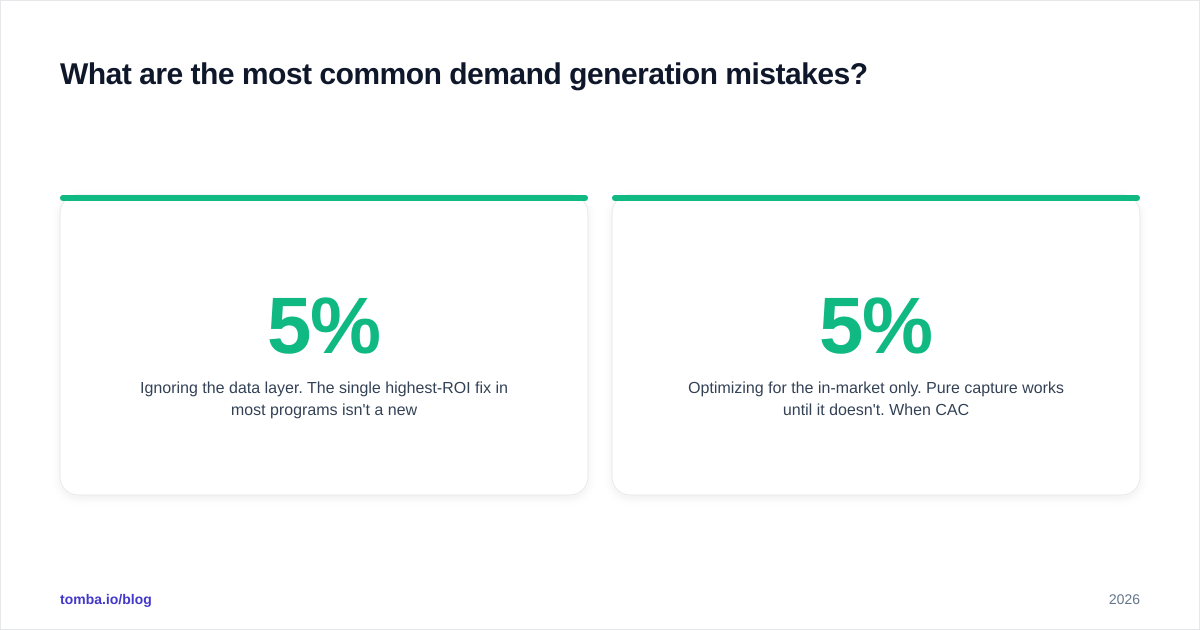
Ignoring the data layer. The single highest-ROI fix in most programs isn't a new channel — it's cleaning the contact data feeding the channels you already run. A 5% improvement in deliverability often beats a 50% increase in send volume.
Optimizing for the in-market 5% only. Pure capture works until it doesn't. When CAC starts climbing every quarter, it's because you've never built the creation layer that keeps you top-of-mind with the 95%.
Reporting last-click attribution as truth. Last-click systematically over-credits capture channels and under-credits creation. Pair it with self-reported attribution to see the full picture.
How do you know if your demand gen is working?#
Three signals, in order of reliability:
- Pipeline is growing faster than spend. The ratio improves over time as creation compounds.
- Win rates are stable or rising even as volume grows — proof you're scaling quality demand.
- More deals report "I already knew about you" in self-reported attribution — the fingerprint of working demand creation.
If volume is up but win rate is down, you're running lead gen and calling it demand gen. Rebalance toward creation and tighten your data.
What tools do you need for demand generation?#
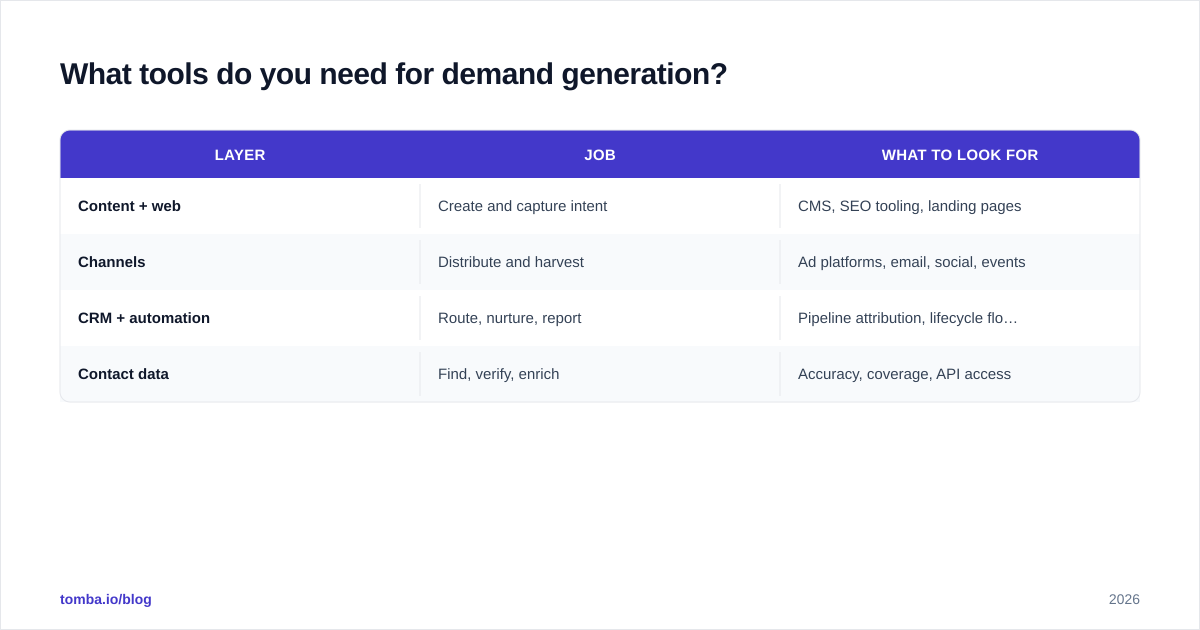
You don't need 40 tools. You need four layers working together:
| Layer | Job | What to look for |
|---|---|---|
| Content + web | Create and capture intent | CMS, SEO tooling, landing pages |
| Channels | Distribute and harvest | Ad platforms, email, social, events |
| CRM + automation | Route, nurture, report | Pipeline attribution, lifecycle flows |
| Contact data | Find, verify, enrich | Accuracy, coverage, API access |
The contact-data layer is the one teams under-resource and the one that quietly determines whether the other three layers produce revenue. Accurate emails mean your outbound lands; enriched records mean your routing and personalization work; verified lists mean your sender reputation survives. Tomba sits in that layer — its email finder, verifier, domain search, and enrichment tools feed clean, accurate contacts into the rest of your stack. On pricing, the Tomba plans start with a free tier (25 searches/mo), then Starter at $49/mo, Growth at $99/mo, and Pro at $249/mo — so you can validate the data quality before scaling spend.
Putting it together#
Demand generation in 2026 is a revenue system, not a campaign. Create demand to stay memorable to the 95% who aren't ready yet. Capture demand to convert the 5% who are. Measure both against pipeline and revenue, not vanity lead counts. And underpin all of it with a contact-data layer clean enough that the demand you generate actually reaches a human who can buy.
Get the sequence right — ICP, demand map, content engine, data layer, capture-then-creation channels, pipeline instrumentation — and you build the kind of compounding pipeline that doesn't evaporate the moment you pause ad spend.
Ready to make your demand gen data actually convert? Start with the contact layer that everything else depends on. Tomba's Email Finder sources accurate, verified professional email addresses by domain, name, or company — so the demand you work so hard to generate lands in real inboxes and turns into pipeline instead of bounces. Try it free with 25 searches a month, no credit card, and feed clean data into your funnel from day one.
// get started
Find, verify and enrich your first contacts today
Start on the free plan with 25 searches a month, then scale when your team is ready.
Free plan · No credit card required · GDPR & CCPA
// about the author