GTM Strategy in 2026: A Practical Go-To-Market Framework
Most go-to-market plans fail because they skip the boring parts: ICP, motion, and metrics. Here's a 2026 GTM strategy framework you can actually run.
TL;DR
- A GTM strategy is the operating plan that connects your product, your ideal customer, and the motion you use to reach them — not a launch checklist.
- Most 2026 GTM strategies fail on fundamentals: a fuzzy ICP, the wrong sales motion, and metrics nobody actually owns.
- Pick one primary motion (product-led, sales-led, channel-led, or community-led) and resource it fully before adding a second.
- Clean contact data is the unglamorous foundation — bad data quietly kills more pipeline than bad messaging.
- Measure leading indicators (pipeline coverage, activation, win rate) weekly, not just revenue at quarter-end.
What is a GTM strategy?#
A go-to-market (GTM) strategy is the plan for how you turn a product into revenue: who you sell to, what you say, how you reach them, and how money changes hands. Think of it like a flight plan. The product is the aircraft, but the GTM strategy is the route, the fuel calculation, and the air-traffic coordination that gets you to the destination without running out of runway.
Gartner defines go-to-market as the coordinated plan a company uses to deliver a value proposition to customers and achieve competitive advantage. The key word is coordinated. A GTM strategy is not a marketing campaign or a sales quota in isolation — it's the alignment layer that keeps product, marketing, sales, and customer success pointed at the same customer.
The framework above shows the five layers every GTM strategy needs. Skip a layer and the whole thing wobbles. Most teams spend 80% of their energy on the message and the channel — the visible parts — and almost none on the ICP and the data that feeds it. That ratio is backwards, and it's why so many launches stall.
Why do most GTM strategies fail in 2026?#
The honest answer: they fail before launch, on three fundamentals.
First, a fuzzy ICP. "Mid-market SaaS companies" is not an ideal customer profile — it's a category. A real ICP names the firmographics (size, industry, geo), the trigger events (hiring a VP of Sales, raising a Series B), and the specific person who feels the pain. When your ICP is vague, every downstream decision inherits that vagueness.
Second, the wrong motion. Teams copy the GTM playbook of whatever company is trending on LinkedIn. A $40/month productivity tool tries to run enterprise field sales; a six-figure platform tries to run pure self-serve. Motion has to match price point, deal complexity, and buying committee size.
Third, data rot. You can have a perfect ICP and the right motion, but if your contact list is 30% stale, your reps burn hours on bounced emails and dead numbers. Clean, enriched data is the plumbing — invisible until it leaks.
The pattern repeats across every failed GTM post-mortem: the strategy looked great on the slide and broke on contact with reality because a fundamental was skipped.
What are the core components of a GTM strategy?#
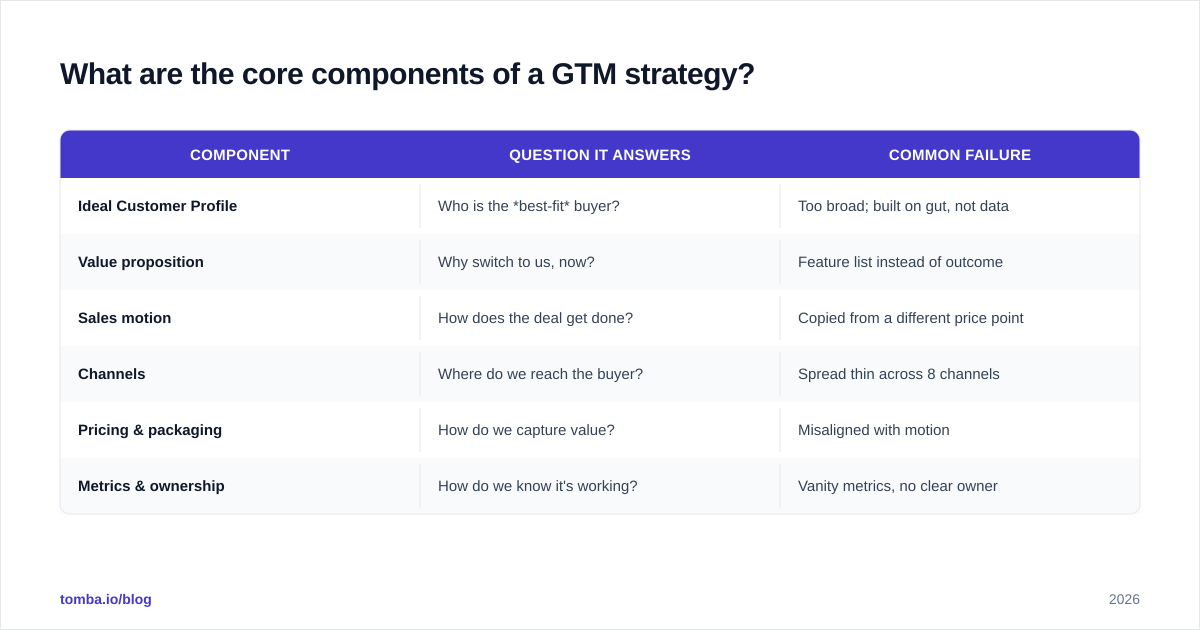
Every durable GTM strategy contains the same building blocks. Here's what each one actually means in practice.
| Component | Question it answers | Common failure |
|---|---|---|
| Ideal Customer Profile | Who is the best-fit buyer? | Too broad; built on gut, not data |
| Value proposition | Why switch to us, now? | Feature list instead of outcome |
| Sales motion | How does the deal get done? | Copied from a different price point |
| Channels | Where do we reach the buyer? | Spread thin across 8 channels |
| Pricing & packaging | How do we capture value? | Misaligned with motion |
| Metrics & ownership | How do we know it's working? | Vanity metrics, no clear owner |
The components reinforce each other. A self-serve motion demands transparent pricing and a low-friction channel; an enterprise motion demands a strong value proposition for a buying committee and a longer nurture. Mix them carelessly and you get friction — like an aircraft built for short hops trying to cross an ocean.
For the ICP and channel layers specifically, your B2B database and enrichment process do the heavy lifting. You can't target an account you can't identify, and you can't reach a buyer whose contact details are wrong.
Which GTM motion is right for you?#
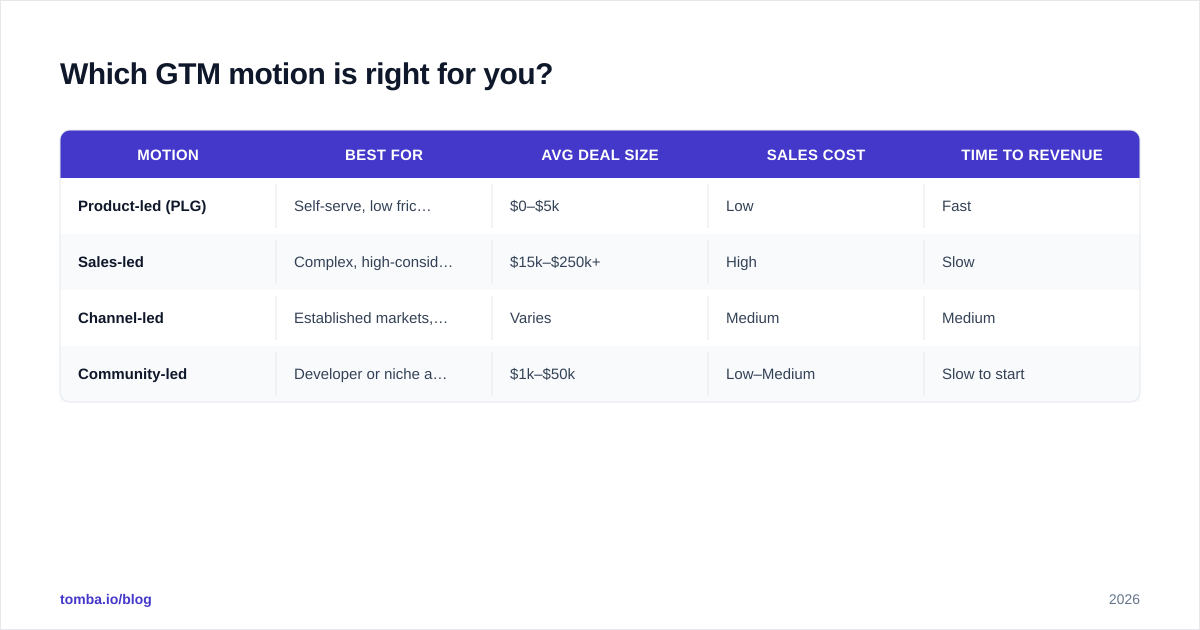
This is the highest-leverage decision in the whole strategy, so don't outsource it to a trend. The four primary motions trade off speed, cost, and deal size differently.
| Motion | Best for | Avg deal size | Sales cost | Time to revenue |
|---|---|---|---|---|
| Product-led (PLG) | Self-serve, low friction products | $0–$5k | Low | Fast |
| Sales-led | Complex, high-consideration deals | $15k–$250k+ | High | Slow |
| Channel-led | Established markets, partner reach | Varies | Medium | Medium |
| Community-led | Developer or niche audiences | $1k–$50k | Low–Medium | Slow to start |
A few rules of thumb. If a buyer can understand and adopt your product in one sitting, lean product-led. If the deal needs three stakeholders, a security review, and a procurement cycle, you need sales-led. If your buyers already trust a set of integrators or resellers, channel-led borrows that trust. And if your users genuinely talk to each other — developers, marketers, niche professionals — community-led compounds slowly but cheaply.
Pick one as primary. The biggest GTM mistake after a fuzzy ICP is running two motions at half-strength. Resource your primary motion until it's working, then layer a second. HubSpot's go-to-market resources and peer reviews on G2 are useful for pressure-testing which motion your category actually rewards.
How do you build a GTM strategy step by step?#
Here's the sequence that survives contact with a real quarter. Run it in order — later steps depend on earlier ones.
1. Define the ICP with evidence. Pull your last 20 closed-won deals. What do they share? Size, industry, trigger, the title of the champion. Write it down as filters you could actually search on, not adjectives.
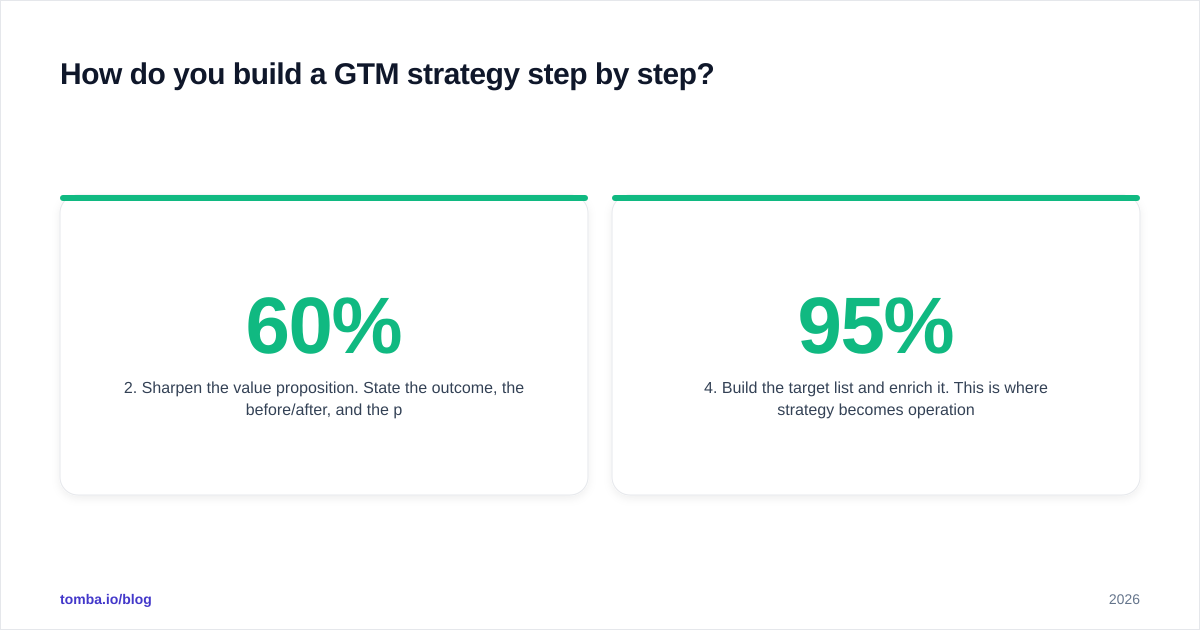
2. Sharpen the value proposition. State the outcome, the before/after, and the proof. "Cut sales research time by 60%" beats "AI-powered prospecting platform."
3. Choose the primary motion using the table above. Match it to deal size and buying-committee complexity.
4. Build the target list and enrich it. This is where strategy becomes operational. Use domain search to map the companies that fit your ICP, then run data enrichment to fill in roles, seniority, and verified contact details. A list with 95% deliverable addresses is worth more than a list three times its size at 60%.
5. Pick two channels, not eight. Resource them properly. Outbound email plus LinkedIn is a complete starting stack for most sales-led teams.
6. Instrument the metrics before you launch, so you're not retrofitting tracking mid-quarter.
7. Launch, then iterate weekly. Treat the first 60 days as a learning system, not a verdict.
Notice that two of the seven steps are about data and targeting. That's not an accident. The teams that win GTM are usually the ones whose reps spend their time talking to fit accounts instead of hunting for working contact details.
How do you measure GTM success?#
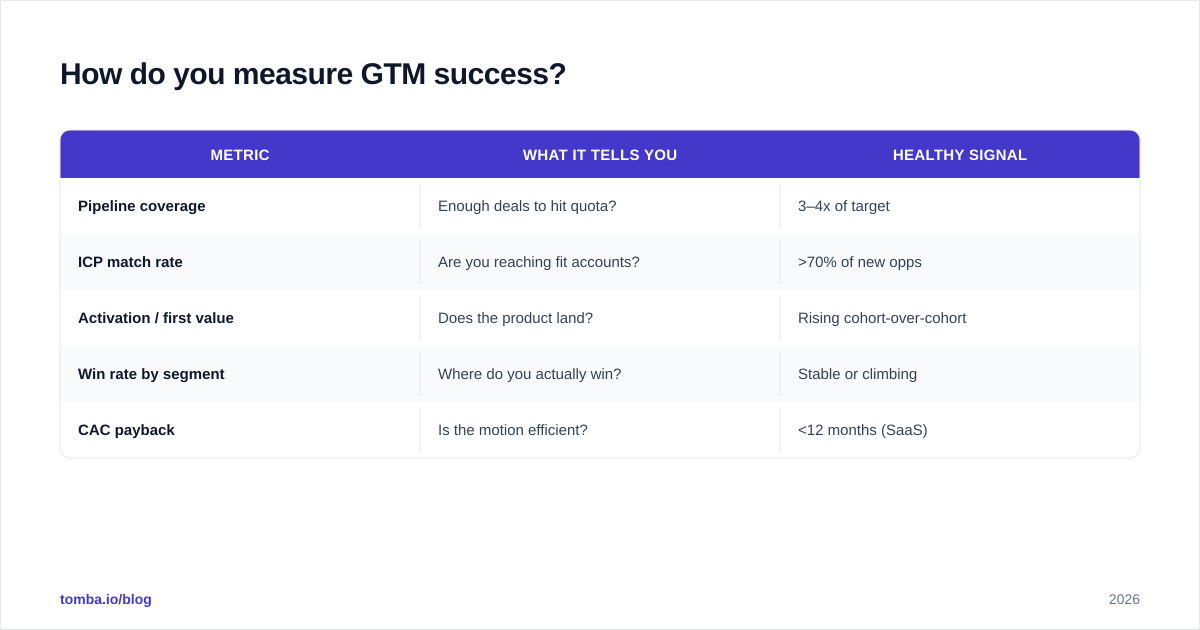
If you only look at revenue, you'll know your strategy failed three months after you could have fixed it. Revenue is a lagging indicator. Watch the leading ones weekly.
| Metric | What it tells you | Healthy signal |
|---|---|---|
| Pipeline coverage | Enough deals to hit quota? | 3–4x of target |
| ICP match rate | Are you reaching fit accounts? | >70% of new opps |
| Activation / first value | Does the product land? | Rising cohort-over-cohort |
| Win rate by segment | Where do you actually win? | Stable or climbing |
| CAC payback | Is the motion efficient? | <12 months (SaaS) |
The most overlooked metric is ICP match rate — the share of your pipeline that actually fits your profile. When it drops, reps are chasing whatever answers the phone, and your win rate quietly erodes a quarter later. Tie it back to your data: if match rate is falling, the problem is usually targeting and list quality, not closing skill. For a deeper breakdown of pipeline health metrics, Salesforce's revenue resources are a solid neutral reference.
Every metric needs a named owner. "Marketing and sales share pipeline" means no one owns it. Assign it to one person who reports on it weekly.
What are the most common GTM mistakes to avoid?#
A short list of the failures that show up again and again:
- Boiling the ocean. Targeting everyone means resonating with no one. Narrow the ICP until it feels uncomfortably specific, then narrow it once more.
- Launching on dirty data. Reps lose trust in a list the first time three emails bounce in a row. Verify before you launch, not after.
- Confusing activity with progress. 500 emails sent is not a result. 40 meetings booked with fit accounts is.
- Changing the strategy every two weeks. Give a motion at least one full sales cycle before you judge it.
- No feedback loop to product. GTM tells you what the market wants. If those signals never reach the roadmap, you're flying blind on the next release.
Avoiding these five won't guarantee success, but committing any of them reliably guarantees a stalled quarter.
How does data quality underpin your GTM strategy?#
Here's the through-line of this whole framework: a GTM strategy is only as good as the data it runs on. Your ICP is a hypothesis about which accounts to pursue. Your channels are the roads to those accounts. But if the contact records along those roads are wrong — outdated titles, bounced emails, dead numbers — even a brilliant strategy delivers reps to the wrong door.
This is why enrichment and verification aren't a back-office afterthought; they're part of the strategy itself. Before a single rep sends a single email, the target list should be built from real firmographic fit and validated contact details. That's the difference between a motion that compounds and one that burns out the team chasing ghosts.
If you want to see where your own data stands, Tomba publishes its data sources and pricing transparently — worth a look when you're comparing Tomba pricing against the cost of bad data.
Ready to build the data layer under your GTM strategy?#
A go-to-market strategy lives or dies on whether your reps reach real, fit-for-profile buyers. Start by turning your ICP into an actual contact list: use the Tomba Email Finder to find verified, professional email addresses by domain, name, or company, then enrich those records so every rep starts the quarter with a clean, deliverable list instead of a spreadsheet full of guesses. The free tier gives you 25 searches a month to test the fit — enough to validate your targeting before you scale the motion. Strategy sets the direction; clean data is what gets you there.
Ready to find emails that actually work?
Join 150,000+ professionals who stopped guessing and started sending. Free credits on signup — no credit card required.
Get the Tomba newsletter
Practical outbound tactics and product updates — once every two weeks.
About the author