ICP, Buyer Personas, and Segmentation: 2026 GTM Guide
Your ICP defines which companies to chase, personas define who to talk to, and segmentation decides the order. Here is how to build all three in 2026 without guesswork.
TL;DR
- Your ICP describes the companies worth selling to; your buyer personas describe the people inside those companies who decide, use, and pay. They are not the same thing, and conflating them is why most targeting falls apart.
- Segmentation is the connective tissue: it slices your ICP and personas into prioritized groups so reps spend time on accounts that actually close.
- A useful ICP is built from your won deals, not your aspirations. Pull firmographic, technographic, and behavioral signals from real customers before you write a single persona.
- Personas should capture goals, pains, triggers, and objections — not hobbies and stock-photo headshots. If a detail does not change your message, cut it.
- Once the model exists, the bottleneck becomes data. Finding and verifying the right contacts at in-ICP accounts is where tools like the Tomba Email Finder earn their keep.
What is the difference between an ICP and a buyer persona?#
The short answer: an Ideal Customer Profile (ICP) is account-level, a buyer persona is person-level. You aim the ICP at a market; you aim personas at the humans who say yes.
Think of it like fishing. The ICP is the lake you choose — the body of water where the right fish actually live. The persona is the specific lure you tie on for the species you want to catch. Pick the wrong lake and the best lure in the world catches nothing. Pick the right lake but the wrong lure, and you watch fish swim past all day.
In B2B revenue operations, this distinction has real budget consequences. Your ICP governs which accounts marketing advertises to, which lists SDRs prospect, and which deals AEs are allowed to spend time on. Your personas govern messaging, sequencing, and which stakeholders you loop in to avoid a single-threaded deal.
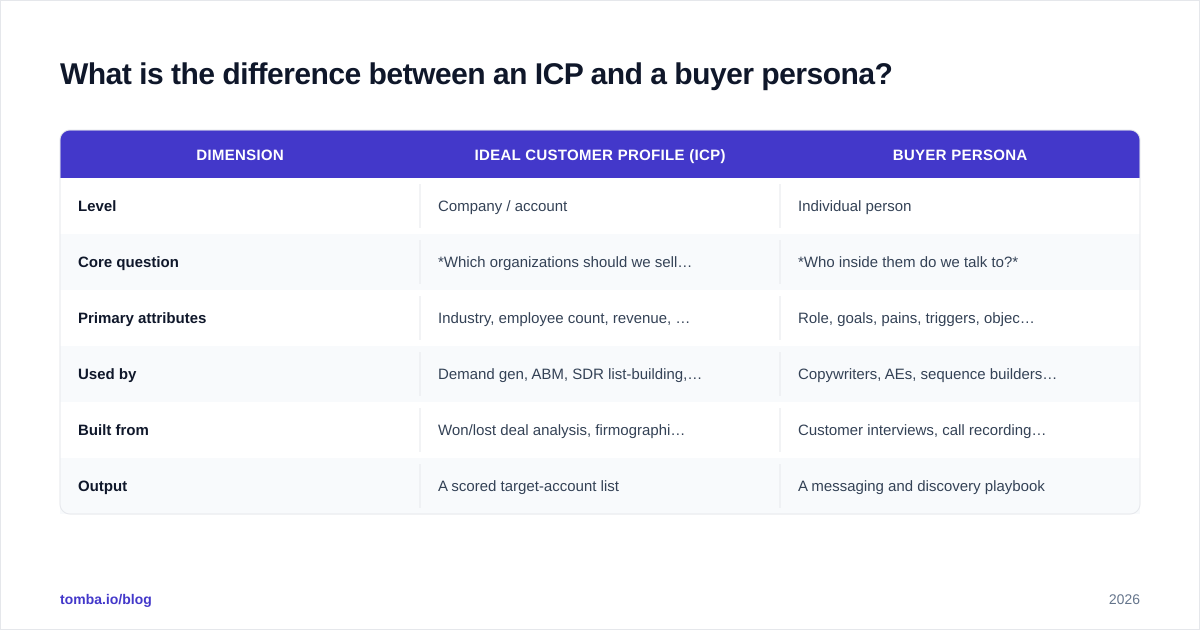
Here is the clean separation:
| Dimension | Ideal Customer Profile (ICP) | Buyer Persona |
|---|---|---|
| Level | Company / account | Individual person |
| Core question | Which organizations should we sell to? | Who inside them do we talk to? |
| Primary attributes | Industry, employee count, revenue, region, tech stack, growth stage | Role, goals, pains, triggers, objections, buying power |
| Used by | Demand gen, ABM, SDR list-building, territory design | Copywriters, AEs, sequence builders, product marketing |
| Built from | Won/lost deal analysis, firmographic data | Customer interviews, call recordings, CRM notes |
| Output | A scored target-account list | A messaging and discovery playbook |
A practical tell that you have mixed them up: if your "persona" document mentions company size or industry, that data belongs in the ICP. If your "ICP" mentions someone's career goals or daily frustrations, that belongs in a persona.
Why does getting your ICP and buyer personas right matter in 2026?#
Because the cost of being wrong has gone up. Inbox providers are stricter, buyers are more allergic to irrelevant outreach, and sending volume no longer compensates for bad targeting. According to Gartner research on B2B buying, the typical purchase now involves a buying group of six to ten stakeholders — which means a single persona is almost never enough to win a deal.
When your ICP and buyer personas are tight, three things happen:
- Win rates climb because reps stop forcing fits. A focused win rate is the cleanest downstream proof that your targeting is working.
- Deliverability improves because you email fewer wrong people, generate fewer spam complaints, and protect sender reputation.
- CAC drops because every dollar of ad spend and every hour of SDR time concentrates on accounts that can actually buy.
The inverse is just as real. A loose ICP produces bloated pipelines full of deals that stall in procurement, demo no-shows, and "we went a different direction" emails. Those deals do not just fail — they consume forecast attention and demoralize reps. Tight targeting is a quality-of-life upgrade for your whole revenue team, not only a metrics play.
How do you build an ICP from real data?#
Start with your wins, not your wishlist. The single most common ICP mistake is describing the customer you want instead of the customer you keep.
Step 1 — Pull your best 20–50 accounts. Define "best" with money, not vibes: highest lifetime value, fastest sales cycle, lowest churn, strongest expansion. Export them from your CRM.
Step 2 — Find the patterns. Tag each account across firmographic and technographic axes:
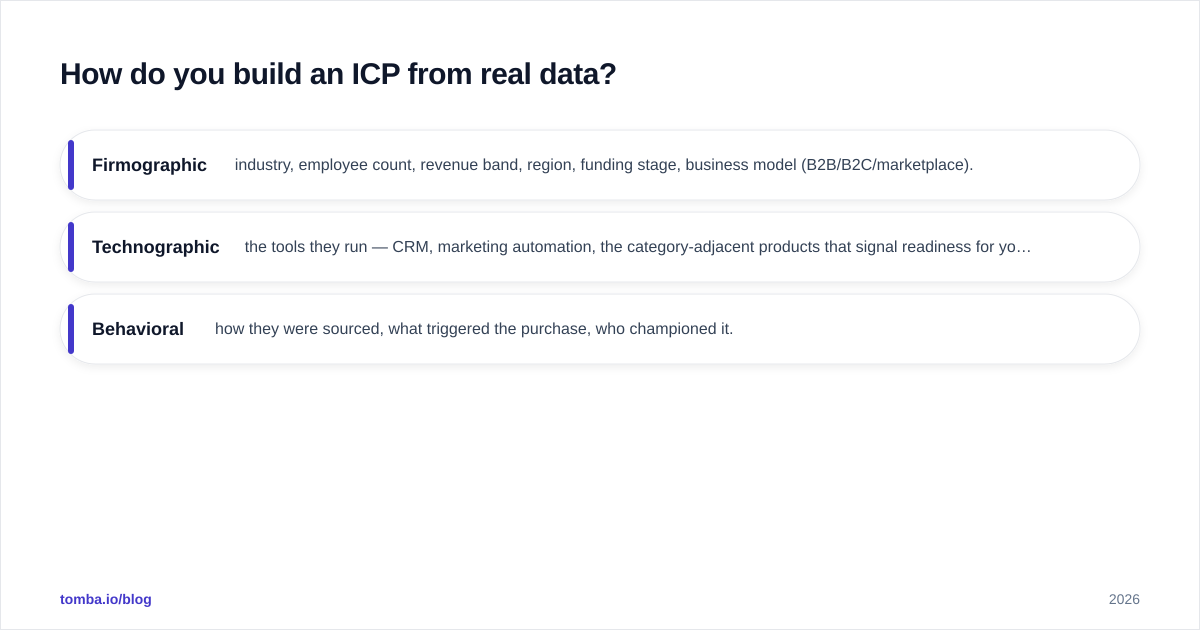
- Firmographic: industry, employee count, revenue band, region, funding stage, business model (B2B/B2C/marketplace).
- Technographic: the tools they run — CRM, marketing automation, the category-adjacent products that signal readiness for yours.
- Behavioral: how they were sourced, what triggered the purchase, who championed it.
Step 3 — Write the profile as ranges, not absolutes. "SaaS companies, 50–500 employees, $5M–$50M revenue, North America, running HubSpot or Salesforce, post-Series A" is usable. "Mid-market tech companies" is not.
Step 4 — Validate against losses. Look at deals you lost or churned. If they match your draft ICP, your profile is too loose and needs another constraint.
This is where a clean B2B database and data enrichment matter. You cannot pattern-match across hundreds of accounts if half your CRM fields are blank. Enrich first, analyze second. Filling gaps in firmographic and technographic data turns a vague hunch into a filterable, repeatable rule set.
A quick gut check for your finished ICP: could a new SDR, handed only the profile, build a clean prospecting list without asking you a single clarifying question? If not, it is still too abstract.
How do you build buyer personas that actually change your messaging?#
Interview real buyers, then ruthlessly cut anything that does not affect what you say or send.
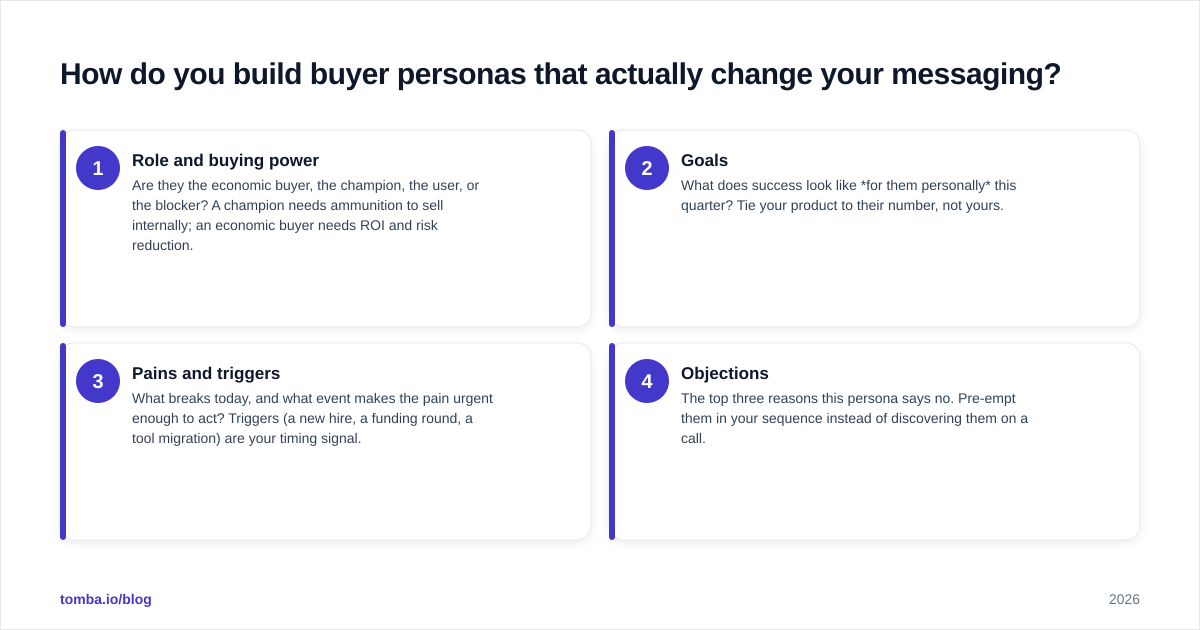
The persona-building trap is decoration: a name, a headshot, a paragraph about weekend hobbies. None of that changes a single line of a cold email. A persona earns its place only if it sharpens your message. Focus on four fields:
- Role and buying power — Are they the economic buyer, the champion, the user, or the blocker? A champion needs ammunition to sell internally; an economic buyer needs ROI and risk reduction.
- Goals — What does success look like for them personally this quarter? Tie your product to their number, not yours.
- Pains and triggers — What breaks today, and what event makes the pain urgent enough to act? Triggers (a new hire, a funding round, a tool migration) are your timing signal.
- Objections — The top three reasons this persona says no. Pre-empt them in your sequence instead of discovering them on a call.
Where does the raw material come from? Three sources, in order of value: recorded sales calls (listen for the buyer's own words), customer-success notes, and short interviews with recent closed-won champions. Mine the language verbatim. The phrases your buyers actually use are better copy than anything you will invent.
Resist the urge to build twelve personas. Most B2B motions run well on three to five: typically an economic buyer, a champion/user, and a technical or financial gatekeeper. Each maps to a different stage of the deal and a different message. For deeper persona templates and the broader vocabulary, the HubSpot buyer persona resources and peer reviews on G2 are solid, vendor-neutral references.
How does segmentation connect your ICP and personas?#
Segmentation is the prioritization layer — it answers which in-ICP accounts and personas you work first, and how. An ICP says "these 4,000 accounts qualify." Segmentation says "start with these 300, with this message, in this channel."
Without segmentation, an ICP is just a big list and reps default to working whatever is loudest. With it, you get tiers that map effort to expected return.
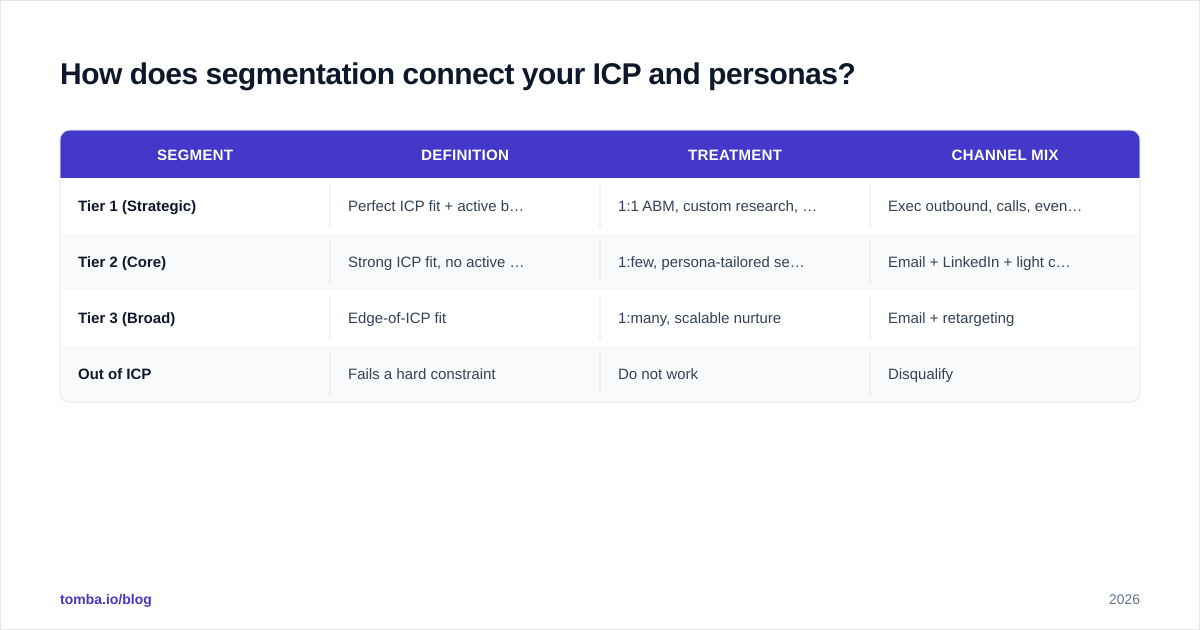
A common model uses three tiers:
| Segment | Definition | Treatment | Channel mix |
|---|---|---|---|
| Tier 1 (Strategic) | Perfect ICP fit + active buying signal | 1:1 ABM, custom research, multithreaded | Exec outbound, calls, events |
| Tier 2 (Core) | Strong ICP fit, no active trigger yet | 1:few, persona-tailored sequences | Email + LinkedIn + light calls |
| Tier 3 (Broad) | Edge-of-ICP fit | 1:many, scalable nurture | Email + retargeting |
| Out of ICP | Fails a hard constraint | Do not work | Disqualify |
Segmentation axes worth layering in:
- Firmographic — size or industry sub-segments that need different proof points.
- Behavioral / intent — accounts showing research signals get promoted a tier.
- Lifecycle — a marketing qualified lead that has engaged twice deserves different handling than a cold name.
- Persona density — accounts where you already have multiple known stakeholders are cheaper to multithread.
The payoff is routing. Once accounts are tiered and personas are defined, your CRM and sales automation can route each lead to the right play automatically instead of relying on a rep's memory.
What does the workflow look like end to end?#
Put the pieces in sequence and the model runs itself:
- Define the ICP from won-deal analysis (account level).
- Build 3–5 personas from customer interviews (person level).
- Segment in-ICP accounts into tiers by fit and intent.
- Source contacts — find the right personas at each in-ICP account.
- Verify the data so you protect deliverability.
- Route and message each segment with its persona-specific play.
- Measure and refine — feed win/loss data back into the ICP quarterly.
Steps 4 and 5 are where most teams stall. You have a beautiful targeting model and an empty contact column. This is the operational gap: knowing who to reach is worthless until you have a verified way to reach them.
That is the practical job of an email-finding workflow. Use domain search to pull the people who match your personas at a target account, then run an email verifier pass before anything enters a sequence. A clean, verified list is what turns a targeting framework on a slide into pipeline in your CRM.
A note on refresh cadence: treat your ICP and personas as living documents, not stone tablets. Markets shift, your product expands, and last year's perfect-fit segment may be commoditized today. Re-run the won-deal analysis at least quarterly, and revisit personas whenever your best reps start improvising new objection-handling on calls — that improvisation is your signal that the documented persona has drifted from reality.
Common mistakes to avoid#
- Building the ICP from aspiration. Your dream logos rarely match your easiest, stickiest revenue. Trust the data over the brand names.
- One persona to rule them all. A six-person buying group needs at least an economic buyer and a champion. Single-threaded deals die.
- Decorative personas. If a field does not change your message, delete it. Hobbies do not sell software.
- Static segments. Intent changes weekly. A Tier 3 account that just hired a VP in your category is now Tier 1.
- Skipping verification. A perfectly segmented list of unverified emails will torch your sender reputation faster than no list at all.
Frequently asked questions#
Do small teams need all three — ICP, personas, and segmentation? Yes, but lighter. A startup can run on a one-paragraph ICP, two personas, and two tiers. The discipline matters more than the document length.
How many personas is too many? If you have more than five and cannot recite the difference between two of them, merge them. Personas you cannot remember are personas you will not use.
Where does intent data fit? Intent is a segmentation input, not a replacement for the ICP. It tells you when an in-ICP account is in-market; it does not redefine who qualifies.
Bringing it together#
Your ICP picks the lake, your personas tie the right lure, and segmentation decides which spots to fish first. Get those three aligned and every downstream metric — reply rate, win rate, CAC — moves in your favor because every rep is finally spending time on accounts that can actually buy.
The framework is only half the work, though. Once you know exactly which companies and personas to pursue, you still need verified, current contact data to act on it. The Tomba Email Finder turns your targeting model into a working list — find professional email addresses by domain, name, or company at every account inside your ICP, then verify them before they hit a sequence. Start on the free tier (25 searches a month), and scale into Starter at $49/mo when your segmented pipeline is ready to run. Build the model once; let the data engine fill it forever.
// get started
Find, verify and enrich your first contacts today
Start on the free plan with 25 searches a month, then scale when your team is ready.
Free plan · No credit card required · GDPR & CCPA
// about the author