Product-Led Growth in 2026: The Complete RevOps Playbook
Product-led growth turns your product into the primary acquisition engine. Here is how RevOps teams build, measure, and scale a PLG motion in 2026 — without burning your sales team.
TL;DR
- Product-led growth (PLG) makes the product itself the main driver of acquisition, conversion, and expansion — users get value before they ever talk to sales.
- PLG is not "no sales." The best 2026 motions are hybrid: self-serve at the bottom, product-qualified leads (PQLs) routed to humans at the top.
- The metrics that matter shift from MQLs and demo bookings to activation rate, time-to-value, PQL conversion, and net revenue retention.
- RevOps owns the plumbing: product analytics, lead scoring, billing, and the data enrichment that turns an anonymous signup into a routable account.
- Tools like Slack, Figma, and Calendly proved PLG scales — but it only works when your data layer can tell a tire-kicker from a buyer.
What is product-led growth?#
Product-led growth is a go-to-market strategy where the product is the primary engine for acquiring, activating, and retaining customers. Instead of a salesperson demoing value, the user experiences it directly — usually through a free trial, freemium tier, or interactive sandbox — and the product nudges them toward a paid plan.
Think of it like a bakery that puts free samples on the counter. A traditional sales-led company keeps the pastries behind glass and assigns a clerk to talk you into buying. A product-led company hands you a bite at the door, and the croissant does the selling. Technically, PLG means your funnel is instrumented so the product collects signals (signups, feature usage, team invites) and acts on them, rather than gating everything behind a "Book a demo" button.
The model went mainstream because it matches how software actually gets bought now. Buyers research, trial, and form opinions long before they want to hear from a rep. According to OpenView's PLG research, product-led companies tend to grow faster and trade at higher multiples than their sales-led peers — largely because acquisition cost stays low while the product compounds.
PLG sits inside the broader discipline of revenue operations, because the motion lives or dies on how well marketing, product, and sales data are stitched together. Get that wrong and you have a beautiful free product feeding a black hole.
How does the PLG model actually work?#
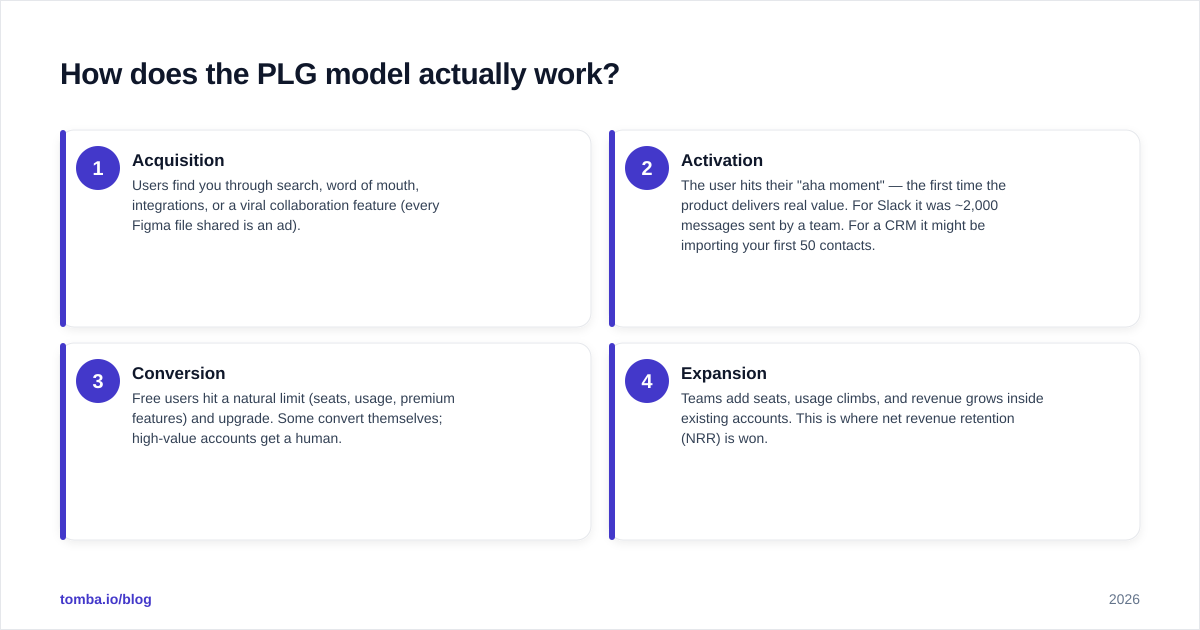
A working PLG motion runs as a loop, not a linear funnel. Four stages repeat and reinforce each other:
- Acquisition — Users find you through search, word of mouth, integrations, or a viral collaboration feature (every Figma file shared is an ad).
- Activation — The user hits their "aha moment" — the first time the product delivers real value. For Slack it was ~2,000 messages sent by a team. For a CRM it might be importing your first 50 contacts.
- Conversion — Free users hit a natural limit (seats, usage, premium features) and upgrade. Some convert themselves; high-value accounts get a human.
- Expansion — Teams add seats, usage climbs, and revenue grows inside existing accounts. This is where net revenue retention (NRR) is won.
The magic is that activation and expansion feed acquisition. Happy teams invite coworkers, share outputs, and recommend you. That self-reinforcing loop is why PLG companies can grow with a fraction of the sales headcount.
Where RevOps comes in: none of those stages run themselves. Someone has to define what "activated" means in your product analytics, decide which usage thresholds trigger a sales touch, and make sure billing, the CRM, and your data warehouse agree on what an "account" is. That is the unglamorous backbone of every PLG success story.
Is PLG better than sales-led growth?#
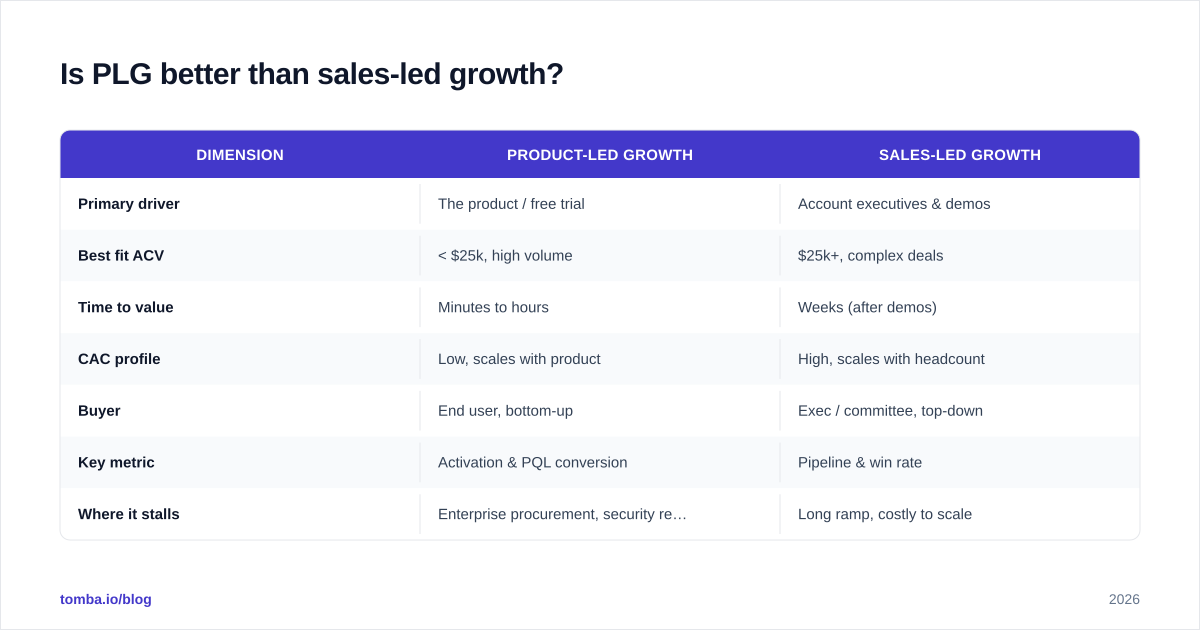
Neither wins universally — they fit different deal sizes and buyer behaviors. The honest answer is that most companies in 2026 run a blend.
| Dimension | Product-Led Growth | Sales-Led Growth |
|---|---|---|
| Primary driver | The product / free trial | Account executives & demos |
| Best fit ACV | < $25k, high volume | $25k+, complex deals |
| Time to value | Minutes to hours | Weeks (after demos) |
| CAC profile | Low, scales with product | High, scales with headcount |
| Buyer | End user, bottom-up | Exec / committee, top-down |
| Key metric | Activation & PQL conversion | Pipeline & win rate |
| Where it stalls | Enterprise procurement, security review | Long ramp, costly to scale |
| RevOps focus | Usage data, self-serve billing | Forecasting, CRM hygiene |
PLG shines when the product is easy to try, delivers value fast, and serves many small teams. Sales-led still rules large, regulated, multi-stakeholder deals where someone has to navigate procurement and a six-figure security questionnaire.
The trap is treating them as opposites. A pure self-serve motion leaves enterprise money on the table; a pure sales motion ignores the bottom-up adoption already happening in your free tier. Hybrid PLG — self-serve for small accounts, sales-assisted for the whales your usage data flags — is the dominant 2026 pattern. Companies like Notion, Atlassian, and HubSpot all run versions of it.
What metrics matter in a product-led motion?#
You stop optimizing for demo bookings and start optimizing for product signals. The vanity metric graveyard is full of "MQLs" that never touched the product. Here are the metrics that actually predict revenue in PLG:
- Activation rate — % of signups who reach the aha moment. If this is low, nothing downstream matters. Fix onboarding before you spend a dollar on ads.
- Time-to-value (TTV) — How long from signup to first real outcome. Shorter TTV lifts every other number.
- Product-qualified leads (PQLs) — Users whose in-product behavior signals buying intent (hit a usage cap, invited 5 teammates, used a premium feature 3x). PQLs convert far better than marketing qualified leads.
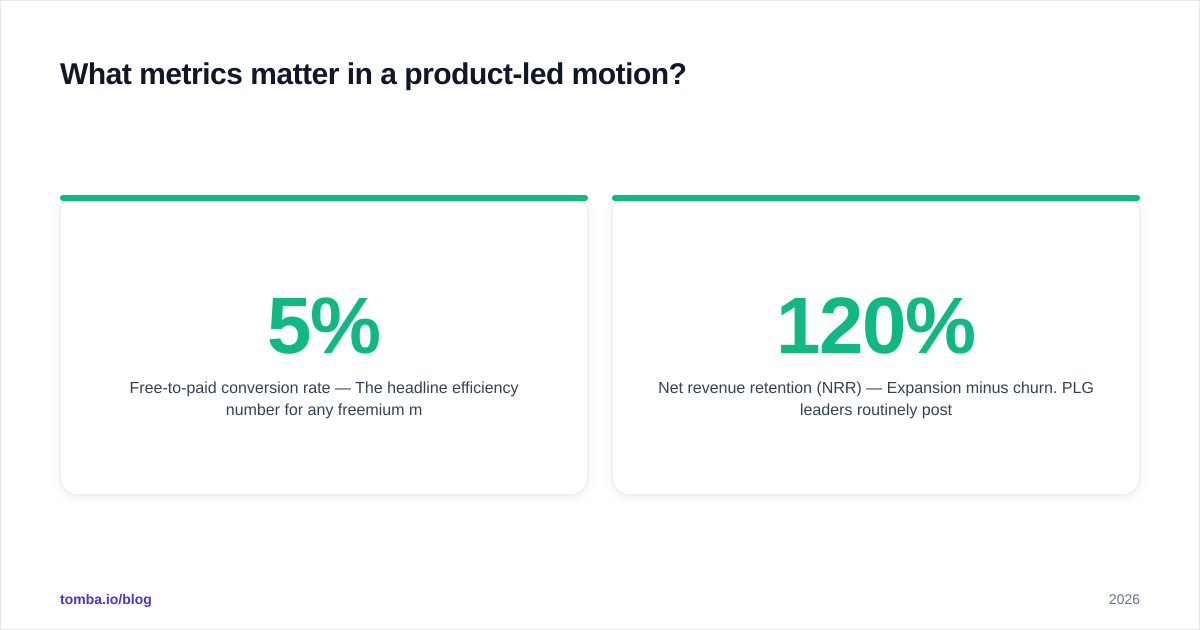
- Free-to-paid conversion rate — The headline efficiency number for any freemium model. Benchmarks vary, but 2–5% is common for freemium and higher for free trials.
- Net revenue retention (NRR) — Expansion minus churn. PLG leaders routinely post 120%+, meaning they grow even with zero new logos.
- Viral coefficient (k-factor) — How many new users each existing user brings. Collaboration features make this measurable.
The PQL is the linchpin. A PQL is only useful if you can act on it — which means routing it to the right rep with enough context to have a smart conversation. That requires knowing who the person is and what company they belong to, fast.
What does the 2026 PLG tech stack look like?#
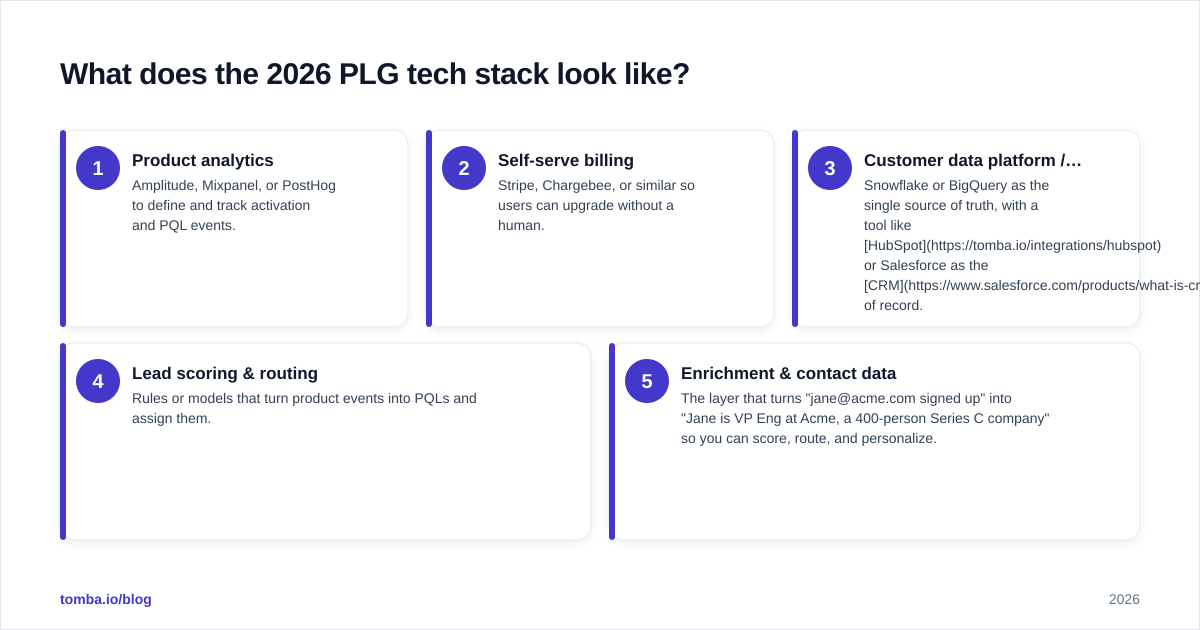
A modern PLG stack has five layers, and RevOps is responsible for making them talk to each other:
- Product analytics — Amplitude, Mixpanel, or PostHog to define and track activation and PQL events.
- Self-serve billing — Stripe, Chargebee, or similar so users can upgrade without a human.
- Customer data platform / warehouse — Snowflake or BigQuery as the single source of truth, with a tool like HubSpot or Salesforce as the CRM of record.
- Lead scoring & routing — Rules or models that turn product events into PQLs and assign them.
- Enrichment & contact data — The layer that turns "jane@acme.com signed up" into "Jane is VP Eng at Acme, a 400-person Series C company" so you can score, route, and personalize.
That last layer is where a lot of PLG motions quietly break. A user signs up with a personal Gmail, or signs up with a work email but you have no company context, and your scoring model has nothing to work with. This is where data enrichment earns its keep — appending firmographics, role, and verified contact details to every signup in real time. When you also need to reach a decision-maker the free user reports to, an email finder and a B2B database fill the gaps your signup form left open.

How do you route product-qualified leads to sales?#
PQL routing is the handoff that makes hybrid PLG work — and the place teams most often fumble. The principle: let the product qualify, let humans close the accounts worth a human's time.
A practical routing flow looks like this:
- Detect the signal. Your analytics fires a PQL event — a free account hits 80% of its usage cap, or three users from the same domain sign up in a week.
- Enrich the account. Append company size, industry, and revenue so you know if this is a 5-person shop or a 5,000-person enterprise. Cheap accounts stay self-serve; high-fit accounts get routed.
- Identify the buyer. The active user may not hold the budget. Use domain search to map the buying committee and a phone finder when a rep wants to reach out directly.
- Route with context. Drop the lead into the rep's queue with the usage story attached: what they did, when, and why they look ready.
The difference between a PQL and a cold lead is intent you can see. A rep who opens an account and reads "this team sent 1,200 messages and invited 8 coworkers last week" has a completely different conversation than one working a scraped list. The data work behind that context is exactly what RevOps should obsess over.
What are the common PLG mistakes?#
Most failed PLG attempts trace back to a handful of avoidable errors:
- Gating value too early. If users have to talk to sales before they feel anything, you do not have PLG — you have a sales-led motion with a free-trial sticker. Let the product prove itself first.
- No clear activation definition. "Signups are up" is meaningless if nobody activates. Define the aha moment precisely and instrument it.
- Ignoring the bottom-up buyer. Procurement may sign the check, but the end user chose you. Design for the practitioner, not just the VP.
- Dirty contact data. Garbage signup data poisons scoring and routing. Verify emails at capture so your PQL model is not chasing typos and burner addresses — an email verifier at the form is table stakes.
- Treating PLG and sales as enemies. The motions should feed each other. Self-serve revenue funds the sales team that lands the enterprise logos self-serve can't.
- No expansion plan. Acquisition gets the headlines, but NRR pays the bills. If you have no plan to grow accounts after conversion, your beautiful loop leaks.
A useful gut check: review your G2 reviews and trial feedback every quarter. The friction users complain about is your activation rate leaking in plain sight.
How do you start a PLG motion without breaking sales?#
Start small, instrument everything, and keep sales in the loop. You do not need to rebuild the company to test product-led growth.
A 90-day starting plan:
- Weeks 1–3: Define your aha moment and instrument activation in your product analytics. Agree on the metric with product and sales.
- Weeks 4–6: Ship one self-serve path — a free trial or a freemium tier with a clear upgrade trigger. Verify and enrich every signup so your data layer is clean from day one.
- Weeks 7–9: Define a single PQL rule and route those leads to a small sales pod. Track conversion against your normal inbound.
- Weeks 10–13: Measure free-to-paid conversion, PQL win rate, and TTV. Double down on what activates users; kill what doesn't.
The point is to prove the loop on a slice of your funnel before you bet the GTM org on it. Sales stays focused on the accounts your usage data flags as worth their time, and nobody feels their pipeline yanked away.
The bottom line#
Product-led growth wins when the product can sell itself and your data layer is good enough to know who's buying. The strategy is not about firing your sales team — it's about pointing them at the accounts your product has already warmed up, and letting self-serve handle the rest. Activation, PQLs, and NRR replace demo bookings as the numbers that matter, and RevOps owns the enrichment and routing that make the whole loop run.
That data layer is where most PLG motions stall — anonymous signups, missing company context, and no way to reach the actual buyer. Tomba's Email Finder gives your PLG motion the contact intelligence it needs: turn a free signup into a routable, enriched account, map the buying committee behind every active team, and reach decision-makers with verified data instead of guesses. Start free with 25 searches a month, and check Tomba pricing when your product-led pipeline outgrows the free tier.
Ready to find emails that actually work?
Join 150,000+ professionals who stopped guessing and started sending. Free credits on signup — no credit card required.
Get the Tomba newsletter
Practical outbound tactics and product updates — once every two weeks.
About the author