Sales Hub Sales Management Enablement Program Guide 2026
A sales hub turns scattered enablement into one operating system. Here's how to build a sales enablement program that ramps reps faster in 2026.
TL;DR
- A sales enablement program is the system that arms reps with the content, training, coaching, and data they need to close — a "sales hub" is the central place where all of it lives.
- Scattered enablement (PDFs in Slack, decks in Drive, tribal knowledge in senior reps' heads) is the default failure mode. A hub fixes it by making one source of truth.
- The four pillars are content, training/onboarding, coaching, and operational data. Skip any one and ramp time balloons.
- Measure the program by ramp time, quota attainment, content usage, and win rate — not by how many assets you produced.
- Clean contact data is the fuel. The best playbook fails if reps work bad emails and dead numbers, so enablement and data hygiene are the same project.
What is a sales enablement program?#
A sales enablement program is the repeatable system that gives your sales team everything it needs to sell — the right content at the right moment, structured onboarding, ongoing coaching, and the data and tools that make outreach land. Think of it like a professional kitchen. A great chef (your rep) still can't cook service if the pantry is disorganized, the recipes live in three different binders, and nobody trained the line. Enablement is the kitchen system: stocked, labeled, and drilled, so every cook produces the same quality on a busy night.
A "sales hub" is the pantry and the recipe book combined into one place. Instead of a rep hunting through Slack threads for the latest pricing deck, asking a teammate which objection-handling doc is current, and copy-pasting an email template someone wrote in 2023, they open one hub and find the approved, versioned, measured version of each.
The distinction matters because most teams confuse making assets with running a program. Producing 40 case studies is activity. A program is the operating model that decides which case study a rep surfaces on a stage-three call, tracks whether it moved the deal, and retires the ones that don't.
Why do most sales enablement efforts fail?#
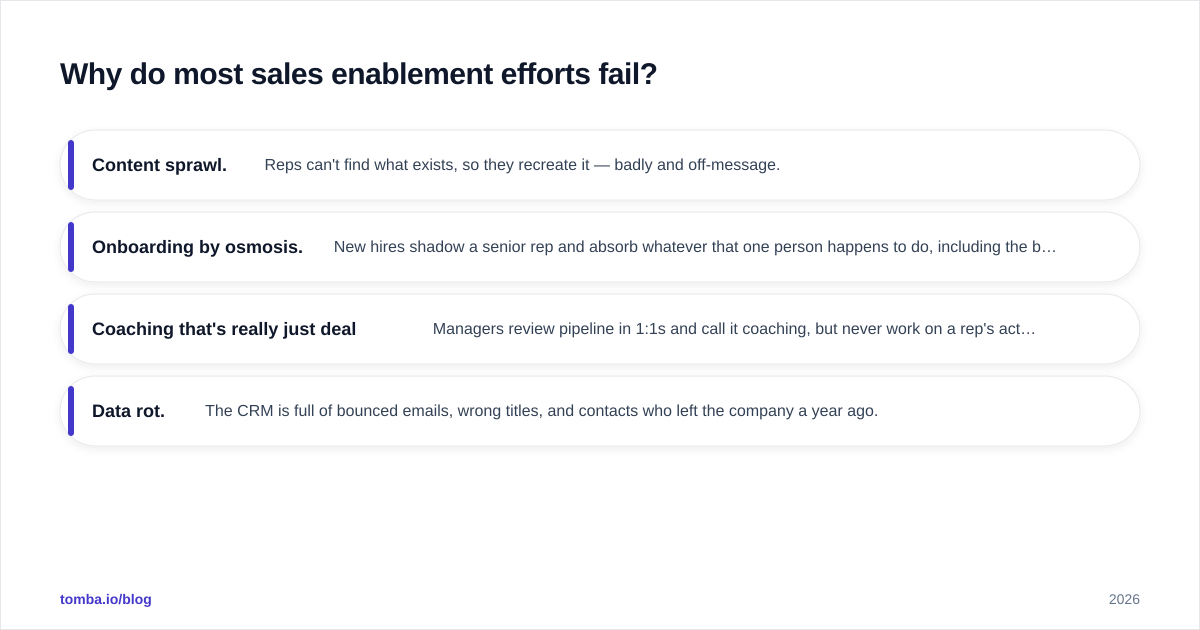
Most enablement fails because it's a pile of artifacts, not a system. The symptoms are easy to spot:
- Content sprawl. Reps can't find what exists, so they recreate it — badly and off-message.
- Onboarding by osmosis. New hires shadow a senior rep and absorb whatever that one person happens to do, including the bad habits.
- Coaching that's really just deal inspection. Managers review pipeline in 1:1s and call it coaching, but never work on a rep's actual skills.
- Data rot. The CRM is full of bounced emails, wrong titles, and contacts who left the company a year ago.
Each of these compounds. A rep with great training and a dead contact list still sends emails into the void. A rep with clean data but no objection framework freezes on the first "we already use a competitor." The hub model wins because it forces these four pillars to live together and reference each other.
The other quiet killer is that enablement gets treated as a one-time launch instead of a living program. You can't "finish" enablement any more than a gym can "finish" your fitness. Markets shift, competitors reprice, products ship, and the playbook has to move with them.
What are the core pillars of a sales hub?#
A functional sales hub rests on four pillars. Drop one and the whole thing tilts.
1. Content. Battlecards, case studies, one-pagers, email templates, call scripts, pricing guides, and demo flows — versioned, tagged by sales stage and persona, and searchable. Critically, usage is tracked so you know what reps actually pull and what closes.
2. Training and onboarding. A structured ramp path: week-one product knowledge, week-two messaging and objection handling, week-three live-call certification. New hires follow the same path instead of inheriting whatever their mentor remembers to mention.
3. Coaching. Ongoing, skill-specific development. Call recordings reviewed against a scorecard, role-play on hard objections, and targeted feedback loops. This is where reps go from "trained" to "good."
4. Operational data and tooling. The CRM, the sequencer, the dialer, and — underrated — the prospect data itself. If reps spend an hour a day cleaning lists or chasing wrong contacts, no amount of great content saves them.
These pillars feed each other. Coaching reveals which content is missing. Content usage data shows which training stuck. Clean data makes the whole motion measurable. To see how these connect into pipeline outcomes, it helps to map them against your broader sales process so enablement isn't a silo bolted onto the side of the org.
How do you build a sales enablement program step by step?#
Here's a practical build order. You don't need all of it on day one, but you do need the sequence right.
Phase 1 — Audit and centralize. List every asset that exists, who owns it, when it was last updated, and whether it's still accurate. Most teams find 30-50% is stale. Kill the dead weight and move what survives into one hub.
Phase 2 — Map to the buyer journey. Tag each piece of content to a sales stage and persona. A discovery-stage CFO needs a different asset than a stage-four technical evaluator. If you can't map an asset to a moment, it probably shouldn't exist.
Phase 3 — Standardize onboarding. Write the ramp path down. Define what "ramped" means with a certification, not a vibe. A rep is ready when they can pass a mock discovery call and a live objection drill — not when 30 days have passed.
Phase 4 — Instrument and iterate. Track content usage, ramp time, and win rate by cohort. Review monthly. Retire what nobody uses, double down on what closes.
A common mistake is to skip straight to Phase 3 because hiring is urgent. Onboarding built on un-audited content just trains reps faster in the wrong direction.
Sales hub vs. scattered tools: which wins?#
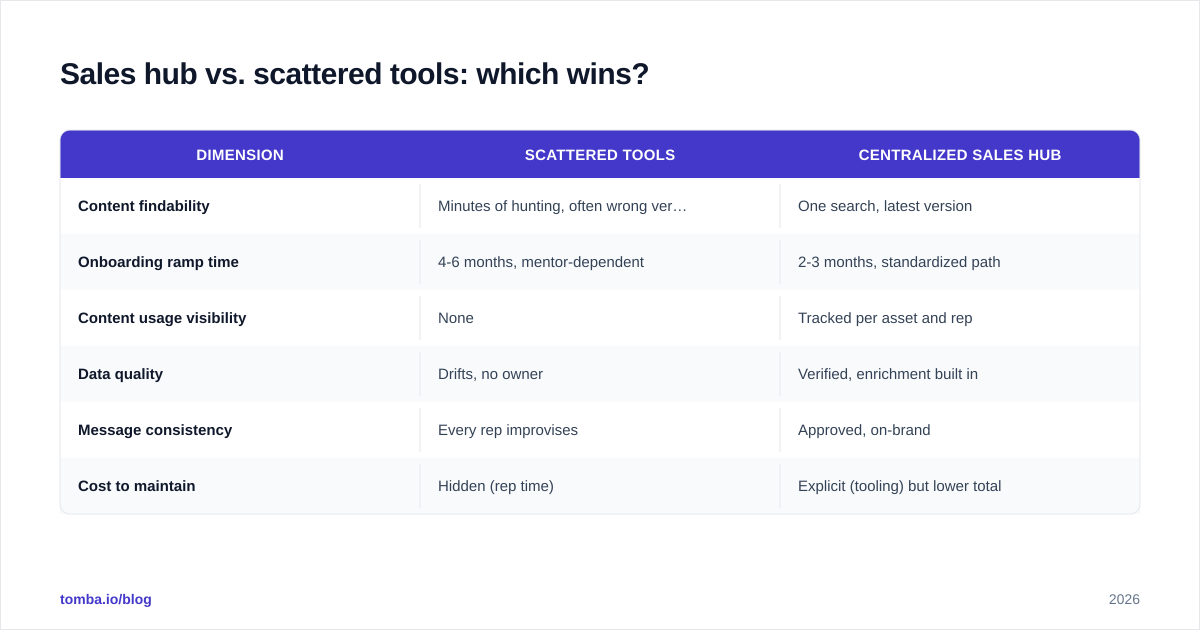
The honest answer: a hub wins for any team past ~5 reps, but "hub" doesn't have to mean one expensive monolithic platform. It means a deliberate, connected stack with a single source of truth. Here's how the two models compare.
| Dimension | Scattered tools | Centralized sales hub |
|---|---|---|
| Content findability | Minutes of hunting, often wrong version | One search, latest version |
| Onboarding ramp time | 4-6 months, mentor-dependent | 2-3 months, standardized path |
| Content usage visibility | None | Tracked per asset and rep |
| Data quality | Drifts, no owner | Verified, enrichment built in |
| Message consistency | Every rep improvises | Approved, on-brand |
| Cost to maintain | Hidden (rep time) | Explicit (tooling) but lower total |
The cost line is where teams get fooled. Scattered tools look cheaper because the cost is hidden inside every rep's wasted hour. A hub makes the cost explicit as a line item, which feels worse but is almost always lower in total. According to research summarized by HubSpot, reps spend roughly a third of their time actually selling — enablement's job is to claw back the other two-thirds, and you can't claw back what you can't see.
That said, beware the opposite failure: buying a giant platform and assuming the program builds itself. Tools are necessary, not sufficient. The program is the operating model; the hub is where it lives.
How does data quality fit into sales enablement?#
Data quality is the fuel, and it's the pillar enablement teams most often forget. You can build flawless battlecards and a beautiful onboarding path, but if a rep's prospect list is full of bounced addresses and people who changed jobs, the program produces motion without results.
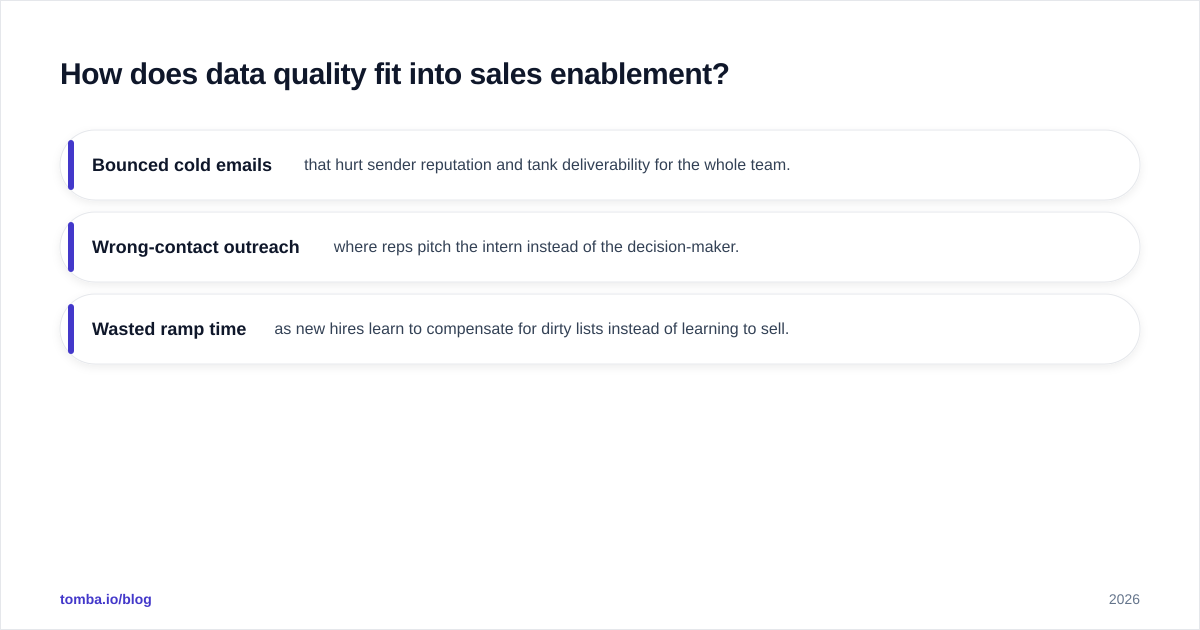
Concretely, bad data shows up as:
- Bounced cold emails that hurt sender reputation and tank deliverability for the whole team.
- Wrong-contact outreach where reps pitch the intern instead of the decision-maker.
- Wasted ramp time as new hires learn to compensate for dirty lists instead of learning to sell.
This is why the data layer belongs inside the enablement program, not in a separate ops backlog. When a rep needs to reach a new account, the hub should make it trivial to pull a verified contact — not kick off a 20-minute manual hunt. An email finder plugged into the workflow means reps spend their energy on the conversation, not the lookup. Pair it with an email verifier so the addresses in your sequences are clean before they ever send, and your deliverability — and your reputation — stays intact.
For team-wide list building, a bulk email finder lets ops prepare verified, segmented lists that drop straight into the sequencer, so enablement and prospecting stop fighting over data hygiene. The point isn't to bolt on more tools — it's that "clean contact data" is a deliverable of the enablement program, with an owner and a standard, just like content and coaching.
What metrics prove a sales enablement program works?#
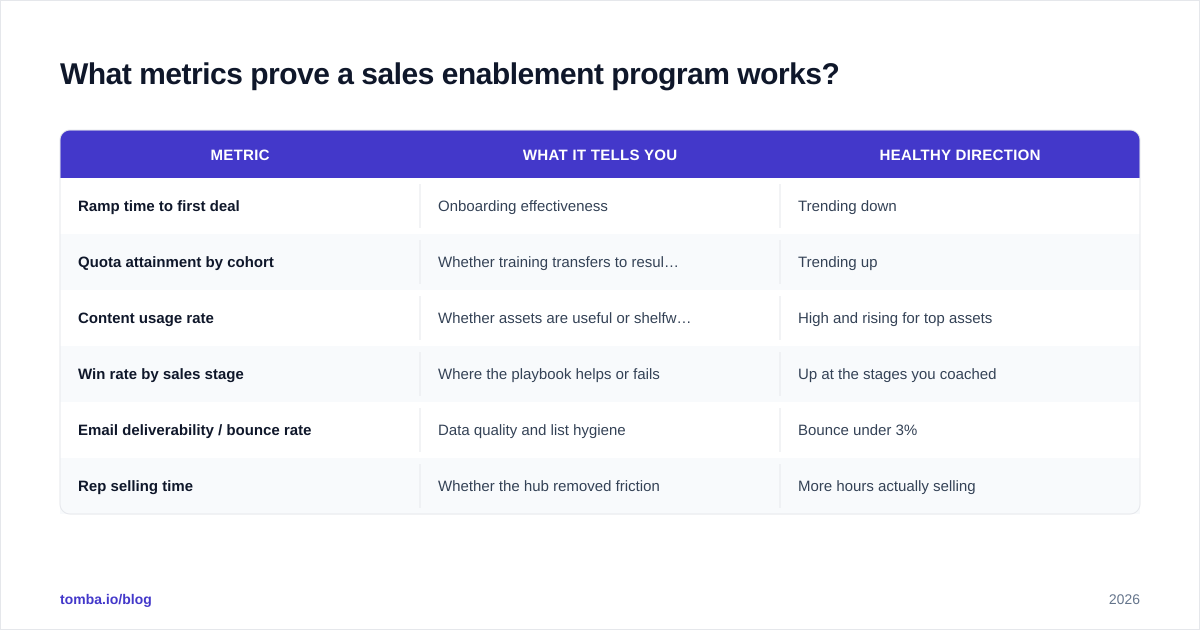
Measure outcomes, not output. The number of assets you shipped is vanity. These are the metrics that tell you the program is doing its job:
| Metric | What it tells you | Healthy direction |
|---|---|---|
| Ramp time to first deal | Onboarding effectiveness | Trending down |
| Quota attainment by cohort | Whether training transfers to results | Trending up |
| Content usage rate | Whether assets are useful or shelfware | High and rising for top assets |
| Win rate by sales stage | Where the playbook helps or fails | Up at the stages you coached |
| Email deliverability / bounce rate | Data quality and list hygiene | Bounce under 3% |
| Rep selling time | Whether the hub removed friction | More hours actually selling |
Watch ramp time and cohort attainment together. If ramp time drops but attainment doesn't, you trained reps to be fast at the wrong things. If attainment climbs but content usage is flat, your wins might be coming from a few star reps, not the program — and that's a fragility you want to catch early. The response rate on your outbound is another early signal: it moves before revenue does, so it's a useful leading indicator that messaging and data are both working.
Tie every metric back to a pillar. A bad bounce rate is a data problem. Flat content usage is a content or coaching problem. Slow ramp is an onboarding problem. The diagnostic clarity is the whole reason to run a program instead of a pile of assets.
How often should you refresh the program?#
Run a light review monthly and a deep refresh quarterly. Monthly, you retire dead content and check the metric dashboard. Quarterly, you re-audit against product changes, competitor moves, and new objections reps are hearing in the field. Annually, you revisit the onboarding path end to end.
The trigger-based rule is simpler: any time the product ships a meaningful release, a competitor reprices, or win rate drops at a specific stage, the relevant part of the hub gets updated within the week. Enablement that lags reality by a quarter is enablement reps stop trusting — and the moment they stop trusting the hub, they go back to improvising, and you're back to scattered tools with extra steps.
Putting it together#
A sales enablement program is an operating system, not a content library. Build it on four connected pillars — content, training, coaching, and data — and house them in a single hub so reps stop hunting and start selling. Audit ruthlessly, map everything to the buyer journey, standardize onboarding around certification instead of calendar days, and measure ramp time and cohort attainment rather than asset count. And don't treat data as someone else's problem: clean, verified contacts are the fuel that makes every other pillar pay off.
If you're standing up the data layer of your hub, start where reps lose the most time — finding and verifying who to contact. Tomba's Email Finder plugs verified, accurate contact data straight into your enablement workflow, so your reps work real people instead of dead addresses. The free tier gives you 25 searches a month to test it, and paid plans start at $49/mo on the Starter tier — see full Tomba pricing to match a plan to your team size. Build the program once, keep the data clean, and let your reps spend their hours where they belong: in the conversation.
// get started
Find, verify and enrich your first contacts today
Start on the free plan with 25 searches a month, then scale when your team is ready.
Free plan · No credit card required · GDPR & CCPA
// about the author