Sales Hub Hiring and Enablement: Sales Management Guide 2026
A practical 2026 playbook for building a sales hub that connects hiring, onboarding, and enablement into one revenue engine—scorecards, ramp plans, and the tools that hold it together.
Hiring great reps and enabling them well are usually treated as two separate projects run by two separate people. That split is why most sales teams ramp slowly and churn fast. The fix is a sales hub: a single operating system where management, enablement, and hiring share the same data, the same scorecards, and the same definition of "good." This guide shows you how to build it in 2026.
If you only remember one thing: sales management enablement hiring is not three workflows, it's one loop. The way you hire defines what you enable, and the way you enable proves whether you hired right.
TL;DR#
- A sales hub unifies hiring, onboarding, and enablement so a rep's first day flows from the same scorecard that screened them.
- Most teams fail because they hire on gut feel, then "enable" with a slide deck and a Slack channel—no shared definition of competence.
- Build a hiring scorecard tied to the exact behaviors your ramp plan teaches, then measure both against quota attainment.
- A real 30-60-90 ramp plan has checkpoints, owners, and a kill criterion—not just "shadow some calls."
- Tooling matters less than the loop, but the right CRM and data layer (clean contact data included) removes the friction that kills ramp speed.
What Is a Sales Hub for Management, Enablement, and Hiring?#
A sales hub is the shared layer where your hiring criteria, onboarding curriculum, coaching cadence, and performance data all reference the same source of truth. Think of it like a restaurant kitchen line: the hiring manager, the trainer, and the head chef all work from one recipe card. When a new cook joins, they're not guessing what "done" looks like—the standard is written down and the same person who hired them taught it.
In sales terms, that means the competencies you screen for in interviews are the exact competencies your enablement program builds and your managers coach against. No translation loss.
The technical version: your applicant tracking system, your learning content, your call-recording tool, and your CRM feed one dashboard. A manager can look at a rep and see the interview scorecard, the ramp milestones hit, the coaching notes, and the pipeline generated—on one screen. Most companies have all four systems and zero integration between them. That gap is the whole problem.
Why Does Sales Management Enablement Hiring Fail So Often?#
Because each piece is optimized in isolation. Recruiting is measured on time-to-fill. Enablement is measured on course completion. Management is measured on quarterly number. None of them is measured on ramp-adjusted productivity, which is the only metric that connects all three.
The symptoms are familiar:
- You hire a "great closer" from a competitor who can't generate their own pipeline in your motion.
- Onboarding is a one-week firehose of product training and then "go sell."
- Six months in, you can't tell whether a struggling rep was a bad hire or a bad onboarding.
The root cause is the absence of a shared rubric. When hiring and enablement use different language, you can't trace a performance gap back to its origin. According to Gartner research on sales effectiveness, the highest-performing teams treat onboarding as an extension of the hiring process, not a separate event.
)
How Do You Build a Hiring Scorecard That Predicts Quota Attainment?#
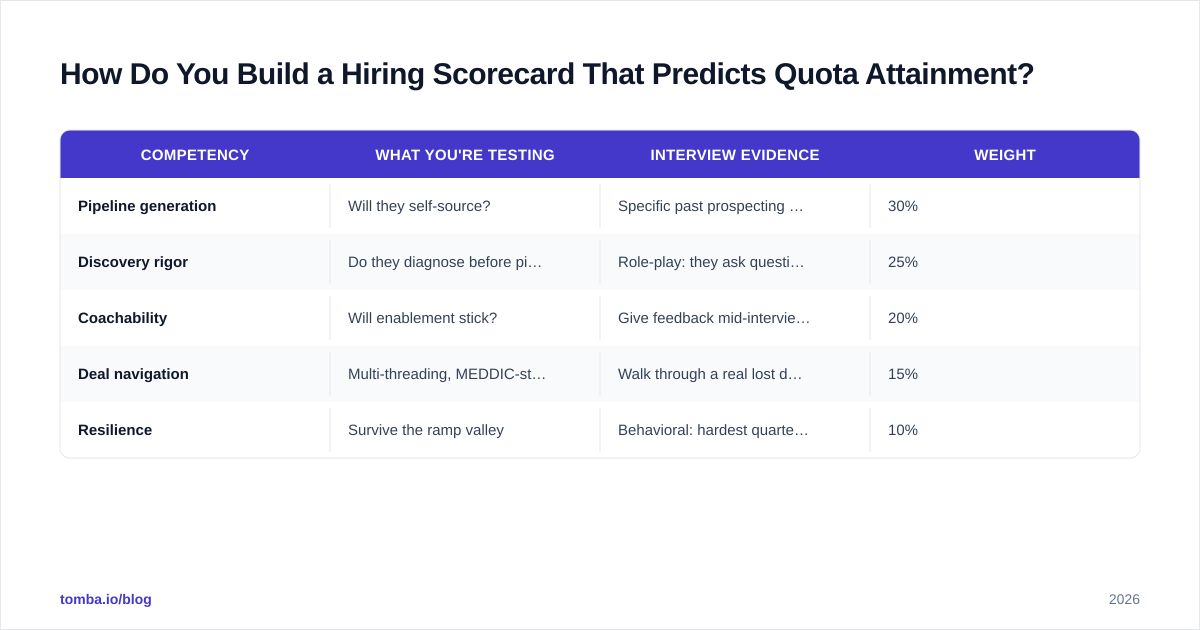
Start from the job, not the résumé. List the four or five behaviors that actually drive results in your motion, then score every candidate against them with evidence, not vibes.
A workable scorecard for a mid-market AE:
| Competency | What you're testing | Interview evidence | Weight |
|---|---|---|---|
| Pipeline generation | Will they self-source? | Specific past prospecting numbers + a live mock outreach | 30% |
| Discovery rigor | Do they diagnose before pitching? | Role-play: they ask questions, you score depth | 25% |
| Coachability | Will enablement stick? | Give feedback mid-interview, watch them adjust | 20% |
| Deal navigation | Multi-threading, MEDDIC-style | Walk through a real lost deal post-mortem | 15% |
| Resilience | Survive the ramp valley | Behavioral: hardest quarter, what they did | 10% |
The weights matter. If pipeline generation is 30% of the score, your enablement program had better spend at least 30% of ramp time on prospecting—and your win rate data had better confirm self-sourced pipeline closes. When the scorecard and the curriculum diverge, you've broken the loop.
Two rules keep scorecards honest. First, every competency needs an observable behavior—"good communicator" is not a competency, "summarizes a discovery call in two sentences the prospect agrees with" is. Second, score independently before debriefing, so the loudest interviewer doesn't anchor the panel.
What Does a 30-60-90 Enablement Ramp Look Like?#
A real ramp plan has checkpoints, named owners, and a kill criterion. Here's the skeleton.
Days 0–30: Foundation. Product, ICP, messaging, and tooling. The checkpoint is a certified pitch and a clean CRM hygiene test. Owner: enablement. Kill criterion: can't articulate the value prop unaided by day 30.
Days 31–60: Application. Shadow, then reverse-shadow, then run discovery calls with a manager scoring against the same rubric used in hiring. The checkpoint is three self-run discovery calls scored "passing." Owner: front-line manager. This is where most ramps quietly collapse because no one owns the handoff from enablement to management.
Days 61–90: Independence. Own a territory, build pipeline, advance deals. The checkpoint is a self-sourced pipeline target and at least one deal past discovery. Owner: manager, with enablement on call.
Notice the data dependency running underneath all of this. A rep can't hit a day-61 pipeline target if they spend week nine hand-building prospect lists and guessing at contact details. The fastest-ramping teams remove that friction by handing new reps a clean data layer on day one—accurate accounts, verified contacts, and enriched records—so the rep practices selling, not data entry. Pairing your CRM with data enrichment and a reliable email finder turns the prospecting portion of ramp from a research slog into reps actually working live conversations.
Which Sales Hub Tools Should You Compare in 2026?#
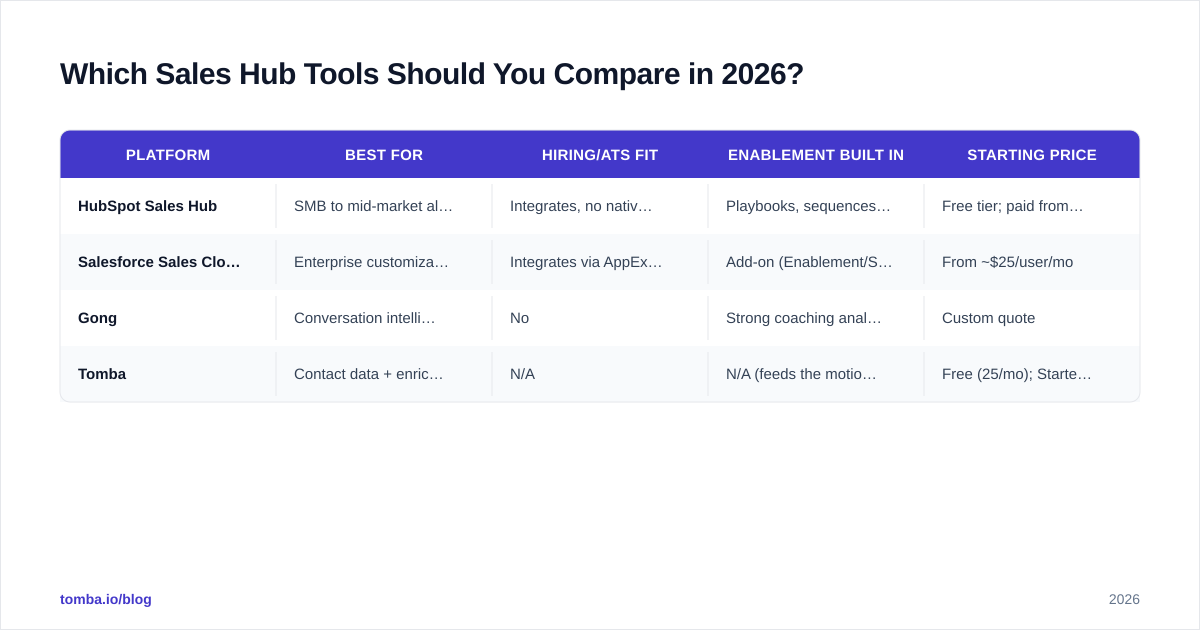
There's no single "sales hub" product that does hiring, enablement, and management equally well. You assemble it. Here's how the common anchor platforms compare for this use case.
| Platform | Best for | Hiring/ATS fit | Enablement built in | Starting price |
|---|---|---|---|---|
| HubSpot Sales Hub | SMB to mid-market all-in-one | Integrates, no native ATS | Playbooks, sequences, coaching | Free tier; paid from ~$20/seat/mo |
| Salesforce Sales Cloud | Enterprise customization | Integrates via AppExchange | Add-on (Enablement/Sales Programs) | From ~$25/user/mo |
| Gong | Conversation intelligence + coaching | No | Strong coaching analytics | Custom quote |
| Tomba | Contact data + enrichment layer | N/A | N/A (feeds the motion) | Free (25/mo); Starter $49/mo |
A few honest notes. HubSpot Sales Hub is the easiest to stand up if you want sequences, playbooks, and coaching in one place. Salesforce wins when you need deep customization and already live in that ecosystem. Gong is the best at turning real calls into coaching material, which is gold for the day-31–60 phase. None of them solves your data problem—that's a separate layer. You can compare user reviews across categories on G2 before committing budget.
Tomba sits in that data layer rather than the workflow layer. It won't run your ramp plan, but it keeps the records your ramp plan depends on clean. If your reps are burning ramp weeks on bad data, no enablement platform will save the number—you can review Tomba pricing to see where a data layer fits the budget.
)
How Do You Measure Whether Enablement and Hiring Are Working?#
Track the loop, not the parts. Four metrics tie hiring and enablement to revenue:
- Time to first deal. From start date to first closed-won. This exposes onboarding drag better than "ramp time to full quota," which is too lagging to act on.
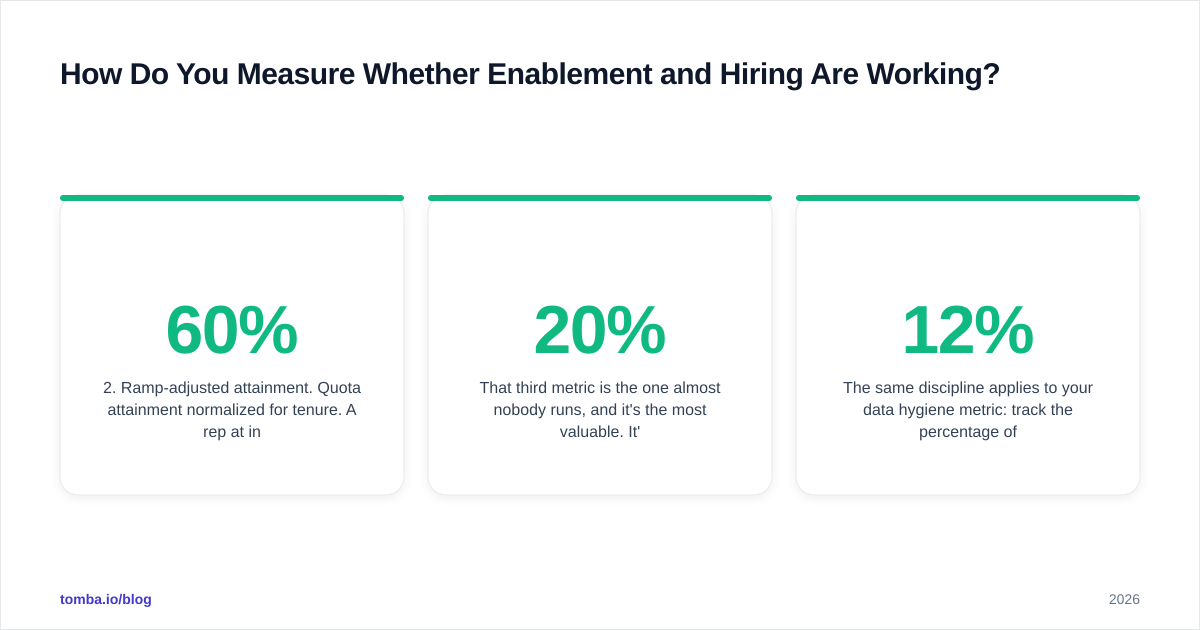
- Ramp-adjusted attainment. Quota attainment normalized for tenure. A rep at 60% in month four isn't behind a rep at 90% in month twelve.
- Scorecard-to-performance correlation. Do high interview scores actually predict attainment? If not, your scorecard is measuring the wrong things—go fix the rubric, not the reps.
- Onboarding cohort survival. What percent of each hiring cohort is still hitting target at month nine? A cliff at month six usually means a hiring problem; a slow bleed usually means an enablement problem.
That third metric is the one almost nobody runs, and it's the most valuable. It's the feedback wire that closes the loop. If your "coachability" score has zero correlation with attainment, stop weighting it 20% and find what actually predicts success on your team. Treat your hiring scorecard as a living model you retrain every two or three cohorts.
The same discipline applies to your data hygiene metric: track the percentage of new-rep prospect records that bounce or stall. If a new cohort is hitting 12% bounce rates, your enablement program is teaching reps to work a dirty list. Wiring a bulk verify step into the onboarding workflow keeps that number honest and protects sender reputation while reps learn.
What's the Simplest Way to Start If You Have No Hub Today?#
Don't buy software first. Write one document: a shared competency rubric used by hiring and enablement and coaching. That single artifact is 80% of the value. Then wire your existing tools to reference it—tag your call recordings by competency, label your onboarding modules by competency, score interviews by competency. The "hub" emerges from the shared language before you ever buy a platform.
Once the rubric is live and you've run two cohorts through it, you'll know exactly which tool gaps hurt most—usually data quality and coaching visibility—and you can buy precisely instead of buying a suite and hoping.
Frequently Asked Questions#
Is sales enablement the same as sales training? No. Training is an event; enablement is an ongoing system that includes content, coaching, tooling, and process. Training is one input to enablement.
Who should own the sales hub—RevOps, enablement, or management? Enablement typically owns the curriculum and tooling, management owns coaching and performance, and RevOps owns the data plumbing. The hub works when all three reference one rubric. One named accountable owner prevents the day-31 handoff collapse.
How long should a sales ramp take in 2026? It depends on deal complexity and ACV, but for mid-market SaaS, 90 days to independent pipeline generation and roughly two sales cycles to full quota is a reasonable target. Measure time-to-first-deal as your early signal.
Do I need a dedicated ATS to run good sales hiring? Not at first. A disciplined scorecard in a spreadsheet beats a sloppy process in expensive software. Add an ATS when hiring volume makes manual tracking the bottleneck.
Build the Loop, Then Buy the Tools#
The teams that win at sales management enablement hiring in 2026 aren't the ones with the most software—they're the ones whose hiring scorecard, ramp plan, and coaching rubric all speak the same language. Write that rubric, run two cohorts, measure the loop, then buy precisely.
When you get to the data layer that ramp speed depends on, start with the Tomba Email Finder. Hand new reps verified, enriched contact data on day one so they spend ramp time selling instead of researching—and your enablement program gets measured on conversations, not data cleanup. The free tier covers 25 searches a month to test the fit before you commit.
// get started
Find, verify and enrich your first contacts today
Start on the free plan with 25 searches a month, then scale when your team is ready.
Free plan · No credit card required · GDPR & CCPA
// about the author