Sales Hub Org Roles: A 2026 Sales Management Enablement Guide
Who owns quota, who owns coaching, who owns the data? A field guide to sales management org roles inside the modern sales hub — titles, RACI, and team design that actually scales.
TL;DR
- A "sales hub" is the operating center of your revenue team — the people, the system of record, and the enablement layer that connects them. Roles only make sense when you define all three together.
- The five core role clusters are leadership (CRO/VP Sales), front-line management (sales managers), individual contributors (SDRs/BDRs and AEs), enablement, and revenue operations.
- Most org dysfunction is a RACI problem, not a headcount problem: two people think they own coaching, nobody owns data hygiene.
- Use a RACI matrix to assign every recurring sales activity to exactly one accountable owner before you hire your next rep.
- Clean contact data is the shared dependency under every role — bad inputs make even a perfect org chart miss quota.
What is a "sales hub" and why do roles matter?#
A sales hub is the operating center where your revenue team's people, tooling, and enablement converge — think of it as the airport control tower for deals. The planes (deals) are flown by reps, but the tower decides who lands when, who gets coached, and which data the whole system trusts.
Most teams obsess over the org chart — boxes and reporting lines — and ignore the org operating model: who is accountable for each recurring activity. The chart tells you who reports to whom. It does not tell you who owns lead routing, who signs off on discounts, or who keeps the CRM clean. That gap is where quota leaks.
This guide maps the sales management org roles you'll find inside a modern hub, then gives you a RACI framework to assign accountability so the boxes actually function. Whether you run a 5-person startup pod or a 200-seat enterprise floor, the role clusters are the same — only the headcount per cluster changes.
What are the core sales management org roles?#
There are five role clusters. Every healthy sales hub fills all five — even if one person wears three hats early on.
1. Sales leadership. The CRO or VP of Sales owns the number, the strategy, and the comp plan. They translate company targets into territory and quota design, and they're accountable to the board. In smaller orgs this is a founder or a single VP; at scale it splits into a CRO over multiple VPs by segment (SMB, mid-market, enterprise).
2. Front-line management. Sales managers (sometimes "team leads") own a pod of reps. Their job is coaching, forecasting, and deal inspection — not closing deals themselves. The classic failure mode is the "player-coach" who keeps selling and never coaches. A healthy span of control is 6–8 reps per manager; beyond that, coaching quality collapses.
3. Individual contributors. This splits into prospecting roles (SDRs/BDRs who book meetings) and closing roles (AEs who run the cycle to signature). Larger orgs add account managers and customer success for expansion. Specialization here — separating "hunters" from "closers" — is the single biggest lever on pipeline volume, per the model HubSpot popularized in The Sales Acceleration Formula.
4. Sales enablement. Enablement owns onboarding, ongoing training, content, and the tooling reps touch daily. They turn the leader's strategy into ramped, productive reps. According to Gartner's sales research, enablement functions that report into a dedicated leader (versus a side-of-desk manager) ramp reps measurably faster.
5. Revenue operations. RevOps owns the system of record, reporting, forecasting infrastructure, lead routing, and data quality. If you don't know what revenue operations is yet, it's the team that makes sure the CRM tells the truth. They are the unglamorous backbone — and the first hire most teams make too late.
How do these roles map across company size?#
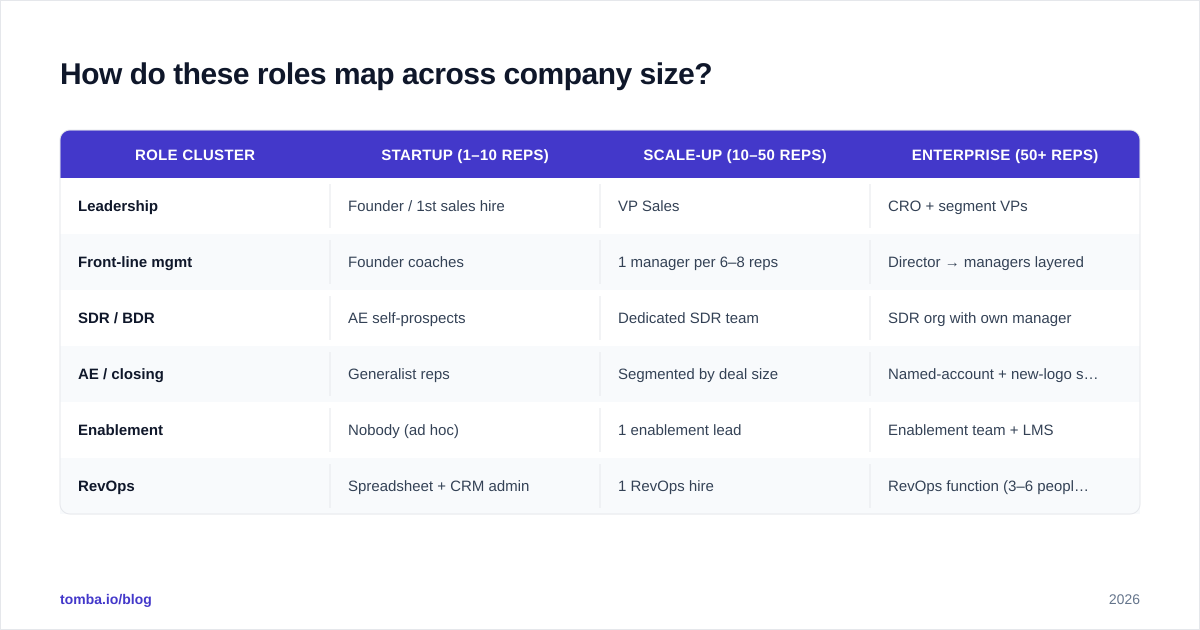
The roles don't change; the packing does. Here's how the five clusters consolidate or split as you grow.
| Role cluster | Startup (1–10 reps) | Scale-up (10–50 reps) | Enterprise (50+ reps) |
|---|---|---|---|
| Leadership | Founder / 1st sales hire | VP Sales | CRO + segment VPs |
| Front-line mgmt | Founder coaches | 1 manager per 6–8 reps | Director → managers layered |
| SDR / BDR | AE self-prospects | Dedicated SDR team | SDR org with own manager |
| AE / closing | Generalist reps | Segmented by deal size | Named-account + new-logo split |
| Enablement | Nobody (ad hoc) | 1 enablement lead | Enablement team + LMS |
| RevOps | Spreadsheet + CRM admin | 1 RevOps hire | RevOps function (3–6 people) |
The pattern: leadership and ICs come first, enablement and RevOps come last — and that ordering is exactly why most scale-ups stall around 15 reps. They've hired sellers faster than they've hired the people who make sellers productive.
Who owns what? The sales hub RACI framework#
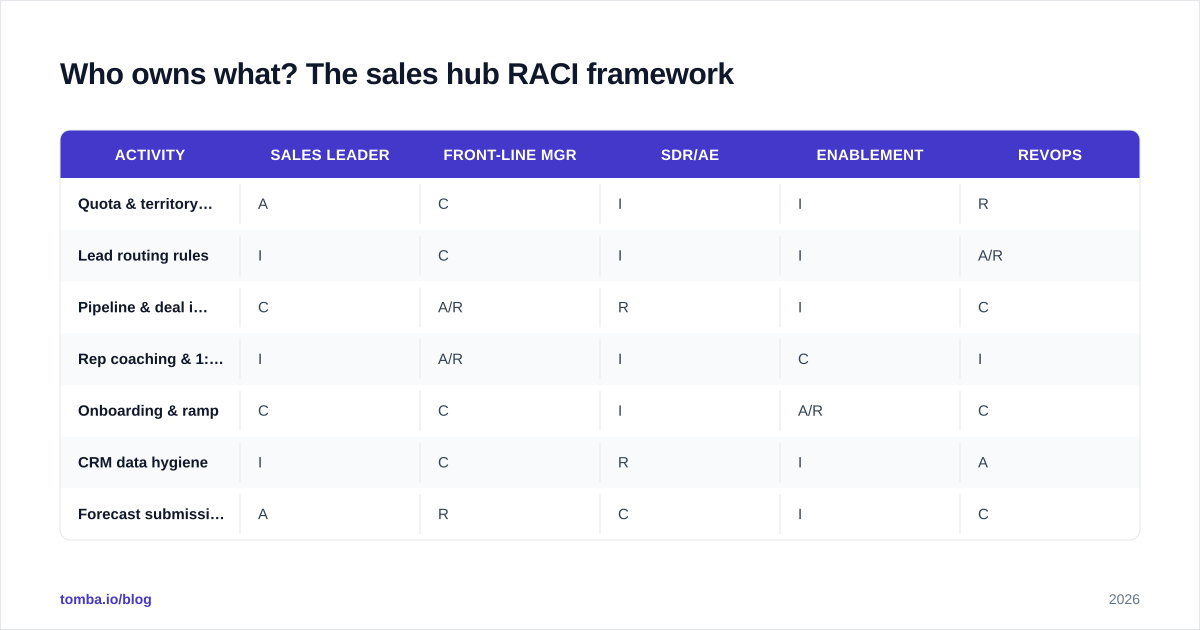
Conclusion first: assign every recurring sales activity to exactly one Accountable owner before you debate headcount. RACI — Responsible, Accountable, Consulted, Informed — is the cleanest way to do it.
- Responsible — does the work.
- Accountable — owns the outcome (only one person, always).
- Consulted — gives input before the work happens.
- Informed — told after it's done.
Here's a starter RACI for the activities that cause the most cross-team friction.
| Activity | Sales Leader | Front-line Mgr | SDR/AE | Enablement | RevOps |
|---|---|---|---|---|---|
| Quota & territory design | A | C | I | I | R |
| Lead routing rules | I | C | I | I | A/R |
| Pipeline & deal inspection | C | A/R | R | I | C |
| Rep coaching & 1:1s | I | A/R | I | C | I |
| Onboarding & ramp | C | C | I | A/R | C |
| CRM data hygiene | I | C | R | I | A |
| Forecast submission | A | R | C | I | C |
| Contact data enrichment | I | I | R | C | A |
Two rules make this work. First, every row has exactly one A. If two boxes say "A," you've found a future argument. Second, the A is not always the most senior person — RevOps is accountable for data hygiene even though the CRO outranks them. Accountability follows expertise, not title.
This is also where CRM discipline lives or dies. The RACI is only real if it's enforced in the system of record — routing rules, required fields, and forecast categories all encode who owns what.
What does sales enablement actually own?#
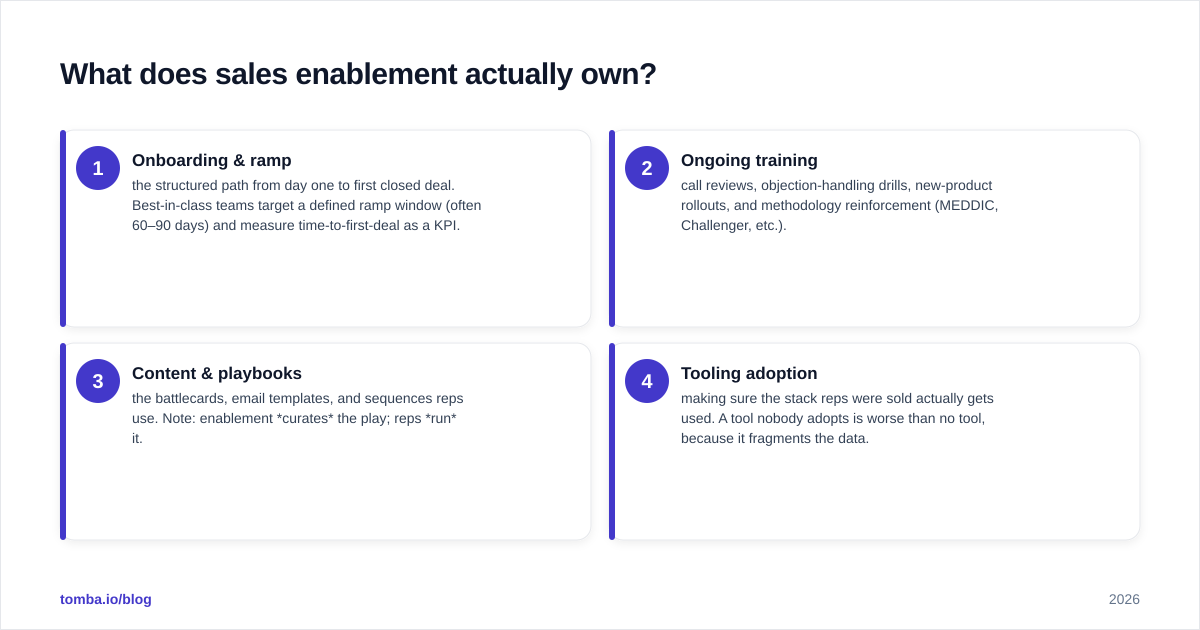
Enablement owns the gap between "hired" and "productive." Concretely, that's four things:
- Onboarding & ramp — the structured path from day one to first closed deal. Best-in-class teams target a defined ramp window (often 60–90 days) and measure time-to-first-deal as a KPI.
- Ongoing training — call reviews, objection-handling drills, new-product rollouts, and methodology reinforcement (MEDDIC, Challenger, etc.).
- Content & playbooks — the battlecards, email templates, and sequences reps use. Note: enablement curates the play; reps run it.
- Tooling adoption — making sure the stack reps were sold actually gets used. A tool nobody adopts is worse than no tool, because it fragments the data.
The trap is treating enablement as a content library. It's a behavior-change function. The deliverable isn't a deck — it's a rep who closes faster. When you're building out the prospecting motion, lean on proven assets like cold email templates rather than asking every new rep to reinvent the wheel.
Where does RevOps fit, and why is data the shared dependency?#
RevOps is the role cluster that every other role silently depends on. Leadership can't forecast on dirty data. Managers can't inspect a pipeline full of stale deals. Reps can't sequence contacts that bounce. Enablement can't measure ramp without clean activity data.
That makes contact data quality the single shared dependency under the entire org chart. You can design a flawless RACI, hire elite reps, and still miss quota if the inputs are wrong — wrong emails, missing phone numbers, duplicate accounts, and decayed titles. B2B data decays fast; Gartner and most data vendors peg contact-data decay at roughly 20–30% per year as people change jobs.
RevOps owns the remedy: a defined source of truth, enrichment on entry, and verification before outreach. In practice that means:
- Enrichment at lead creation — every new record gets firmographic and contact fields filled automatically, not manually. A data enrichment workflow keeps records complete the moment they enter the CRM.
- Verification before send — bounce-checking emails before sequences run protects sender reputation and keeps the SDR team out of the spam folder.
- Deduplication and ownership rules — one account, one owner, no "who's been working this?" disputes.
When RevOps owns data and enablement owns adoption, reps spend their time selling instead of cleaning spreadsheets. That's the entire point of the hub.
How do you avoid the most common org-design mistakes?#
Five failure patterns show up again and again. Each maps back to a missing or doubled-up role.
Player-coach managers. A manager carrying their own quota will always prioritize their deals over coaching their team. Fix: make management a distinct role with a coaching-based comp plan, not a quota.
No SDR/AE split too long. Asking closers to also prospect caps pipeline volume. Specializing is the highest-ROI org change most scale-ups can make.
Enablement as an afterthought. When onboarding is "shadow a rep for a week," ramp time balloons. Name an owner even before you can afford a full team.
RevOps hired last. Teams that wait until 30 reps to hire RevOps spend a year untangling data debt. Hire the first RevOps person by rep 10.
No single accountable owner per activity. The RACI exists on a slide but isn't enforced in the CRM. Fix: encode it in routing rules, required fields, and forecast categories.
For a deeper benchmark on how leading teams structure these functions, G2's sales software category data and Salesforce's State of Sales research are both worth a read — they track how role specialization correlates with attainment across thousands of orgs.
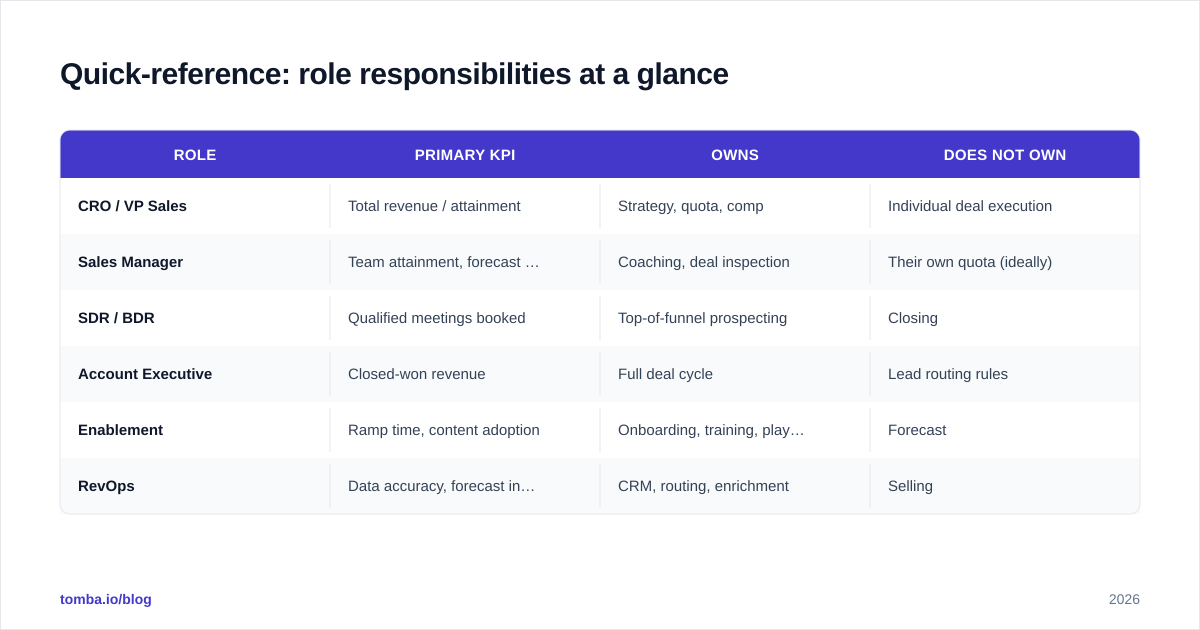
Quick-reference: role responsibilities at a glance#
| Role | Primary KPI | Owns | Does NOT own |
|---|---|---|---|
| CRO / VP Sales | Total revenue / attainment | Strategy, quota, comp | Individual deal execution |
| Sales Manager | Team attainment, forecast accuracy | Coaching, deal inspection | Their own quota (ideally) |
| SDR / BDR | Qualified meetings booked | Top-of-funnel prospecting | Closing |
| Account Executive | Closed-won revenue | Full deal cycle | Lead routing rules |
| Enablement | Ramp time, content adoption | Onboarding, training, playbooks | Forecast |
| RevOps | Data accuracy, forecast infra | CRM, routing, enrichment | Selling |
Print this, tape it to the wall, and the next time someone asks "wait, who owns that?" you'll have an answer instead of a meeting.
Build the org on a clean data foundation#
A great org chart is wasted on bad data. Before you finalize roles and RACI, make sure the contact records your whole team depends on are accurate and complete — because every role downstream inherits those inputs.
That's where Tomba's Email Finder fits into the hub. Your SDRs find verified professional emails by name or company, your RevOps team enriches and verifies records before they hit a sequence, and your managers forecast on a pipeline built from real, reachable contacts. The free tier gives you 25 searches a month to test it against your existing list; paid plans start at $49/mo, and you can see the full Tomba pricing breakdown before you commit. Define your roles, draw your RACI — then feed the whole machine data it can trust.
Ready to find emails that actually work?
Join 150,000+ professionals who stopped guessing and started sending. Free credits on signup — no credit card required.
Get the Tomba newsletter
Practical outbound tactics and product updates — once every two weeks.
About the author